DNA, Inheritance & Gene Expression — Chapter Practice, Grade 10
Use DNA and inheritance models while testing their limits with expression and variation evidence.
Problem 1
- thymine (T)
- cytosine (C)
- guanine (G)
- another adenine (A)
Answer and explanation
thymine (T)
A-T and C-G are the complementary base pairs; adenine always bonds with thymine.
Problem 2
- A double helix — a twisted ladder
- A single straight line
- A flat triangle
- A solid sphere
Answer and explanation
A double helix — a twisted ladder
Two strands wind around each other to form the double-helix, or twisted-ladder, shape.
Problem 3
Answer and explanation
40 thymine bases
Adenine pairs only with thymine, so 40 A bases require 40 T partners.
Problem 4
Answer and explanation
Each new DNA molecule is made of one original (conserved) strand and one newly built strand, so half of every copy is 'old.' That is what 'semiconservative' means.
Problem 5
- Each strand acts as a template that determines exactly which bases must be added to build its partner
- The bases pair together completely at random
- Both strands are identical, so one can be thrown away
- DNA does not need to be copied before a cell divides
Answer and explanation
Each strand acts as a template that determines exactly which bases must be added to build its partner
Because A only pairs with T and C only with G, one strand's sequence dictates its partner's, so each old strand is a perfect template for building a new one.
Problem 6
Answer and explanation
T-G-C-A in corresponding paired positions; actual strands have opposite orientation.
A pairs with T and C with G.
Apply the rule to each position in the supplied order.
Response criteria
- Use the stated conditions.
- Show the evidence or calculation.
- Explain the conclusion and any stated limitation.
Problem 7
Hints
Pairing rules provide a template mechanism; sequence order still matters.
Answer and explanation
AACG, pairing T with A and G with C.
Problem 8
Hints
State what the supplied observations or conditions establish, and separate that from any assumption.
Answer and explanation
A sequence change can persist and be copied into later DNA molecules.
Problem 9
Answer and explanation
No. Each has one old and one new strand under the semiconservative model.
Semiconservative replication produces two duplexes, each with an original template strand and a newly synthesized partner in the basic model. Strand separation exposes templates, and pairing constrains new sequence. DNA polymerase builds in the 5′→3′ direction, with additional enzymes and mechanisms supporting copying and ligation. Replication is not splitting each base in half or preserving an entirely old double helix beside an entirely new one. One old strand per product is the central inheritance pattern; actual forks involve more detailed leading/lagging behavior.
No. Each has one old and one new strand under the semiconservative model.
Response criteria
- Read the structures, axes, directions and units correctly.
- Connect the evidence with the biological mechanism.
- Respect stated model assumptions and distinguish an observation from a further inference.
Problem 10
Answer and explanation
The directly paired complement is 3′-TTGCAA-5′. Each resulting duplex has one old template strand and one newly synthesized partner in the ideal model.
The directly paired complement is 3′-TTGCAA-5′. Each resulting duplex has one old template strand and one newly synthesized partner in the ideal model.
Response criteria
- Use the stated measurements or conditions, with correct units.
- Connect the result to the biological mechanism or evidence relationship.
- Identify the assumption, model limit or further evidence requested.
Problem 11
- a lipid
- messenger RNA (mRNA)
- a finished protein
- a new chromosome
Answer and explanation
messenger RNA (mRNA)
Transcription produces an mRNA copy of the gene; the protein is built later, during translation.
Problem 12
- cell membrane
- vacuole
- ribosome
- nucleus
Answer and explanation
ribosome
Ribosomes read the mRNA codons and link amino acids together into a protein.
Problem 13
Answer and explanation
45 bases
3 bases per codon x 15 amino acids = 45 bases.
Problem 14
Answer and explanation
Transcription is copying a gene's DNA into mRNA inside the nucleus; translation is reading that mRNA's codons at a ribosome to build a protein from amino acids. Transcription makes the message, and translation reads it.
Problem 15
- nonsense — it creates an early stop signal
- a frameshift that shifts every later codon
- always fatal to the cell
- silent — the protein is unchanged
Answer and explanation
silent — the protein is unchanged
When a changed codon still codes for the same amino acid, the protein is unchanged, so the mutation is 'silent' — possible because several codons can specify the same amino acid.
Problem 16
Answer and explanation
Methionine followed by alanine in this simplified translation example.
Read the mRNA codons as supplied, not their complements.
Match AUG to methionine and GCU to alanine.
Response criteria
- Use the stated conditions.
- Show the evidence or calculation.
- Explain the conclusion and any stated limitation.
Problem 17
Hints
Specify template versus coding strand before converting a sequence.
Answer and explanation
It can be synonymous, leaving that amino acid unchanged; other regulatory effects are still possible.
Problem 18
Hints
State what the supplied observations or conditions establish, and separate that from any assumption.
Answer and explanation
Translation reads mRNA; the template must first be converted to complementary RNA with correct orientation.
Problem 19
Answer and explanation
The supplied code maps GCA/GCU to alanine and GUA to valine; different codons can share or differ in meaning.
A substitution changes a base; an insertion or deletion changes sequence length. A reading frame groups consecutive bases into codons, so a non-three-base insertion within a translated region can alter downstream grouping. Code redundancy allows a substitution to retain the same amino acid, as GCA and GCU both specify alanine in the supplied entries. Other changes alter an amino acid or termination. Effects depend on location, regulation and protein context; not every mutation is visible or every substitution harmless.
The supplied code maps GCA/GCU to alanine and GUA to valine; different codons can share or differ in meaning.
Response criteria
- Read the structures, axes, directions and units correctly.
- Connect the evidence with the biological mechanism.
- Respect stated model assumptions and distinguish an observation from a further inference.
Problem 20
Answer and explanation
GCU retains alanine; GUA specifies valine. Regulatory context, protein folding/activity and other biological conditions determine downstream effects, so a measured trait needs additional evidence.
GCU retains alanine; GUA specifies valine. Regulatory context, protein folding/activity and other biological conditions determine downstream effects, so a measured trait needs additional evidence.
Response criteria
- Use the stated measurements or conditions, with correct units.
- Connect the result to the biological mechanism or evidence relationship.
- Identify the assumption, model limit or further evidence requested.
Problem 21
- no alleles for that trait
- two identical alleles (for example BB or bb)
- two different alleles (Bb)
- only one allele in total
Answer and explanation
two identical alleles (for example BB or bb)
Homozygous means the two alleles match (BB or bb); heterozygous (Bb) means they differ.
Problem 22
- A blend of brown and white
- It cannot be determined
- Brown
- White
Answer and explanation
Brown
One dominant B is enough to produce the brown phenotype, so Bb is brown.
Problem 23
Answer and explanation
25 %
Bb x Bb gives BB, Bb, Bb, bb — 1 of the 4 boxes (25%) is bb, the recessive phenotype.
Problem 24
Answer and explanation
Cross with bb under the model. Any bb offspring implies the tested parent supplied b. All dominant offspring in a small sample do not prove BB because Bb can produce such a sample by chance.
Problem 25
Answer and explanation
16 (1 out of this many)
Each tt has probability 1/4; multiplying independent events, 1/4 x 1/4 = 1/16, so 1 out of 16.
Problem 26
Answer and explanation
¼ AA, ½ Aa and ¼ aa; each offspring is a new probability event.
Each parent contributes A or a with probability one half.
The four equally likely combinations are AA, Aa, aA and aa.
Response criteria
- Use the stated conditions.
- Show the evidence or calculation.
- Explain the conclusion and any stated limitation.
Problem 27
Hints
Probabilities describe many outcomes, not a guaranteed pattern in every small family.
Answer and explanation
1/4=25%, combining a from each parent.
Problem 28
Hints
State what the supplied observations or conditions establish, and separate that from any assumption.
Answer and explanation
No. Both produce the dominant phenotype; more genotype or family evidence is required.
Problem 29
Answer and explanation
No. Each modeled independent outcome retains its probability; earlier outcomes do not force a balancing result.
A probability describes a model of possible outcomes, not a promised number in every small sample. For a recessive-category probability of 1/4 and 80 independent modeled offspring, the expected count is 20. Actual samples vary through chance, and unexpected counts require evaluation of sample size, model conditions and measurement rather than immediate rejection or certainty. Independent births in the model do not acquire a memory that forces the next child to balance earlier outcomes.
No. Each modeled independent outcome retains its probability; earlier outcomes do not force a balancing result.
Response criteria
- Read the structures, axes, directions and units correctly.
- Connect the evidence with the biological mechanism.
- Respect stated model assumptions and distinguish an observation from a further inference.
Problem 30
Answer and explanation
Expected aa count is 60×1/2=30. The probability of three Aa outcomes is (1/2)³=1/8. Neither expectation forces a specific finite family outcome.
Expected aa count is 60×1/2=30. The probability of three Aa outcomes is (1/2)³=1/8. Neither expectation forces a specific finite family outcome.
Response criteria
- Use the stated measurements or conditions, with correct units.
- Connect the result to the biological mechanism or evidence relationship.
- Identify the assumption, model limit or further evidence requested.
Problem 31
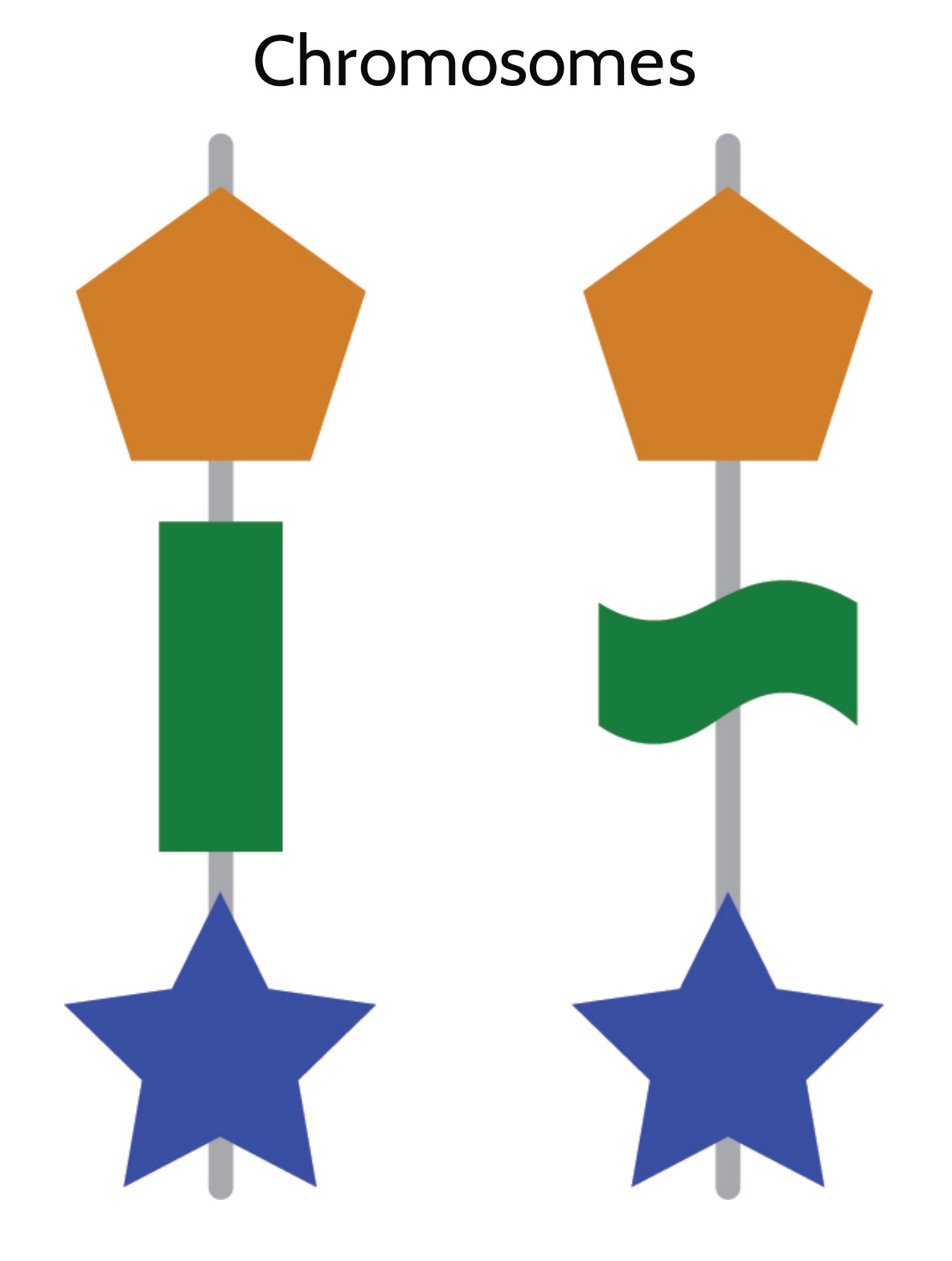
Answer and explanation
The orange and blue categories match while the green categories differ. They represent selected allele versions in a supplied model. A shape difference is not a nucleotide sequence, a measured chromosome deformity or proof of a dominance/trait relationship; those require the stated mapping and relevant functional/context evidence.
Compare corresponding marked positions on both homolog symbols.
Keep allele-category symbols separate from physical chromosome shape.
Request sequence, phenotype-model and functional/environment evidence before broader conclusions.
Response criteria
- Correctly compare matching orange/blue and differing green categories.
- Identify the drawing as an allele-category model.
- State the limits for sequence, dominance or causal trait claims.
Problem 32
Answer and explanation
50 %
Two of four equally likely combinations are RW.
Problem 33
- expressed in the heterozygote under the stated model
- always more common
- always healthier
- more genes than recessive
Answer and explanation
expressed in the heterozygote under the stated model
Dominance describes the genotype–phenotype relationship.
Problem 34
Answer and explanation
Several genes contribute to pigment and observed color; a two-allele model omits important biology.
Problem 35
Answer and explanation
1:2:1 phenotype ratio under the stated incomplete-dominance model.
Each parent supplies R or W.
The combinations RR, RW, WR and WW give ¼ red, ½ pink and ¼ white.
Response criteria
- Use the stated conditions.
- Show the evidence or calculation.
- Explain the conclusion and any stated limitation.
Problem 36
Hints
Do not extend one trait's pattern to all traits.
Answer and explanation
Codominance, rather than an intermediate blended phenotype.
Problem 37
Hints
State what the supplied observations or conditions establish, and separate that from any assumption.
Answer and explanation
Many genes and environmental factors such as nutrition influence a complex trait.
Problem 38
Answer and explanation
The relevant allele-copy arrangement differs; the locus and chromosome-system assumptions determine the genotype possibilities.
A sex-linked locus lies on a sex chromosome. In a selected X-linked model with no corresponding allele on Y, a single X-linked copy can have a different expression pattern from a two-copy genotype. The square follows the stated gamete contributions and trait relationship. It does not imply all traits are X-linked, every organism uses the same chromosome system, or sex/gender characteristics reduce to one allele. Linkage and copy count must be stated rather than borrowed from an autosomal complete-dominance example.
The relevant allele-copy arrangement differs; the locus and chromosome-system assumptions determine the genotype possibilities.
Response criteria
- Read the structures, axes, directions and units correctly.
- Connect the evidence with the biological mechanism.
- Respect stated model assumptions and distinguish an observation from a further inference.
Problem 39
Answer and explanation
Genotypes are 1/4 RR, 1/2 Rr, 1/4 rr, giving three phenotype categories in the same ratio under this model. The alleles remain distinct and segregate; the intermediate appearance does not erase them.
Genotypes are 1/4 RR, 1/2 Rr, 1/4 rr, giving three phenotype categories in the same ratio under this model. The alleles remain distinct and segregate; the intermediate appearance does not erase them.
Response criteria
- Use the stated measurements or conditions, with correct units.
- Connect the result to the biological mechanism or evidence relationship.
- Identify the assumption, model limit or further evidence requested.
Problem 40
- Altered gene regulation
- A new species name
- A changed graph color
- Every cell losing water
Answer and explanation
Altered gene regulation
Expression controls can change RNA or protein levels.
Problem 41
Answer and explanation
A mutation may occur only in body cells and not enter the reproductive lineage.
Problem 42
Answer and explanation
Other genetic or environmental differences could explain its performance.
Problem 43
Answer and explanation
No; it is regulation of expression in the supplied scenario.
The described change is in gene use.
A mutation would require a sequence change, which the prompt excludes.
Response criteria
- Use the stated conditions.
- Show the evidence or calculation.
- Explain the conclusion and any stated limitation.
Problem 44
Hints
Expression amount and DNA sequence are different measurements.
Answer and explanation
No. It might affect regulation or RNA processing, though it can also be neutral; evaluate the specific evidence.
Problem 45
Hints
State what the supplied observations or conditions establish, and separate that from any assumption.
Answer and explanation
They help distinguish the intervention's effect from background variation and procedure effects.
Problem 46
Answer and explanation
No. Expression, function, unintended effects and relevant system outcomes need independent evaluation.
Biotechnology uses biological processes or components for a defined purpose. Sequencing, selective breeding and molecular editing are different approaches with different mechanisms. A designed sequence must be delivered, expressed and evaluated in the relevant organism/context. Off-target effects are unintended changes or interactions beyond the desired target, and broader ecological or ethical questions require additional evidence and values. A classroom model should compare purpose, method, measured function and limitations; it is not a home genetic-modification protocol.
No. Expression, function, unintended effects and relevant system outcomes need independent evaluation.
Response criteria
- Read the structures, axes, directions and units correctly.
- Connect the evidence with the biological mechanism.
- Respect stated model assumptions and distinguish an observation from a further inference.
Problem 47
Answer and explanation
It may reduce transcription or another regulatory process without changing the polypeptide sequence. Use matched genetic backgrounds/controls, protein amount/activity measurements and an appropriate trait test to examine causality and alternatives.
It may reduce transcription or another regulatory process without changing the polypeptide sequence. Use matched genetic backgrounds/controls, protein amount/activity measurements and an appropriate trait test to examine causality and alternatives.
Response criteria
- Use the stated measurements or conditions, with correct units.
- Connect the result to the biological mechanism or evidence relationship.
- Identify the assumption, model limit or further evidence requested.