States of Matter & Gases — Chapter Practice, Grade 11
Relate particle motion, attractions, gas models, and phase-change energy.
Problem 1
- number of particles
- Kelvin temperature
- pressure of the gas
- volume of the container
Answer and explanation
Kelvin temperature
A core assumption of KMT is that average kinetic energy is directly proportional to the absolute (Kelvin) temperature.
Problem 2
- solid
- liquid
- gas
- they are identical in all states
Answer and explanation
gas
In a gas, kinetic energy dominates: particles spread far apart and move quickly with almost no attraction between them.
Problem 3
Answer and explanation
300 K
K = °C + 273 = 27 + 273 = 300 K.
Problem 4
- The substance is cooling down
- The particles have stopped moving completely
- An error was made recording the data
- A phase change is occurring; added energy breaks particle attractions instead of raising the temperature
Answer and explanation
A phase change is occurring; added energy breaks particle attractions instead of raising the temperature
During a phase change the temperature holds steady because the incoming energy goes into breaking attractions (potential energy), not speeding particles up (kinetic energy).
Problem 5
Answer and explanation
The added energy is used to overcome the attractive forces holding the particles in the solid arrangement — it raises their potential energy, not their kinetic energy. Since temperature measures average kinetic energy, it stays constant until all of the solid has melted.
Problem 6
- freezing, condensation, and deposition
- melting, boiling, and sublimation
- melting, freezing, and boiling
- sublimation, deposition, and condensation
Answer and explanation
freezing, condensation, and deposition
Freezing, condensation, and deposition all move to a more ordered, tightly held state and release energy; melting, vaporization, and sublimation absorb it.
Problem 7
Hints
Specify fixed volume and amount before applying the relation.
Answer and explanation
It is an absolute scale compatible with the kinetic-energy relation, unlike Celsius's arbitrary zero.
Problem 8
Hints
State what the supplied observations or conditions establish, and separate that from any assumption.
Answer and explanation
No. Energy can drive the phase change while temperature stays nearly constant.
Problem 9
Answer and explanation
No. Mean translational kinetic energy doubles, while a characteristic speed increases by √2, approximately 1.41.
For an ideal gas, mean translational kinetic energy per particle is proportional to absolute temperature in kelvin: 3kBT/2. The corresponding molar quantity uses R rather than kB. At a given temperature particles have a distribution of speeds; none of these statements requires every molecule to move at one speed. Doubling T doubles the mean translational energy, while a characteristic speed for the same particle mass scales as the square root of T. Celsius ratios do not express this relation.
No. Mean translational kinetic energy doubles, while a characteristic speed increases by √2, approximately 1.41.
Response criteria
- Interpret labels, structures, axes, units and directions correctly.
- Explain the chemistry relationship or mechanism.
- Respect stated assumptions and distinguish observation from inference.
Problem 10
Answer and explanation
The energy ratio is 2 and the characteristic speed ratio √2≈1.41. Kelvin is an absolute scale proportional to this mean energy; Celsius has an offset and its numeric ratios do not express the same physical relation.
The energy ratio is 2 and the characteristic speed ratio √2≈1.41. Kelvin is an absolute scale proportional to this mean energy; Celsius has an offset and its numeric ratios do not express the same physical relation.
Response criteria
- Use the stated measurements or conditions, with correct units.
- Connect the result to the chemical mechanism or evidence relationship.
- Identify the assumption, model limit or further evidence requested.
Problem 11
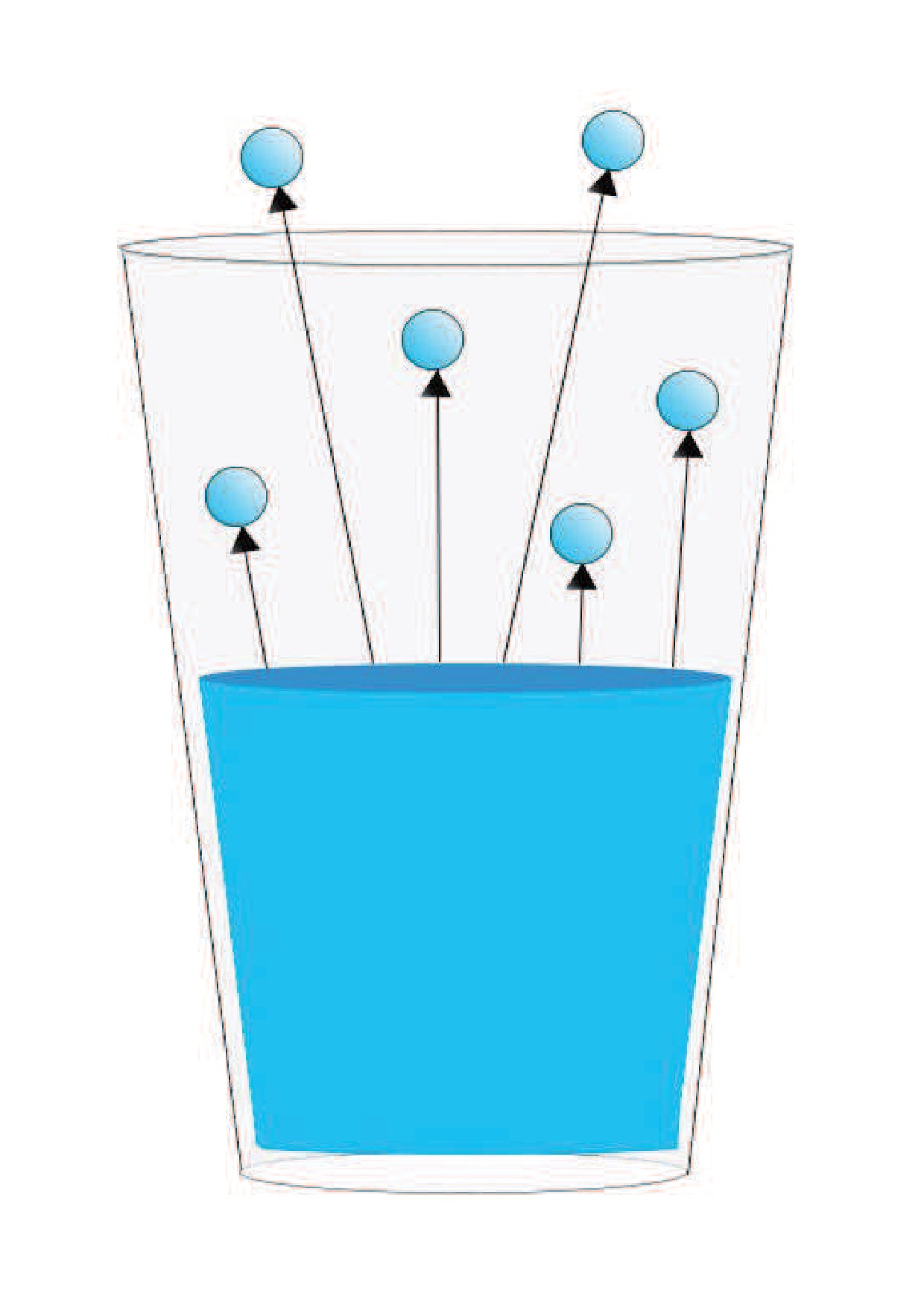
Answer and explanation
The arrows show selected molecules leaving the surface. They are not broken O–H bonds, a literal complete inventory or a claim that all molecules share one speed. Add vapor and returning condensation with equal opposing rates at the stated closed-vessel equilibrium; a constant liquid amount need not mean motion has stopped.
Identify the source’s visible labels, scales and unfinished or omitted information.
Use the local complete explanations to connect the observation with an explicit mechanism.
State assumptions and a limit before extending the model.
Response criteria
- Interpret the source symbols and boundary correctly.
- Explain the relevant mechanism using quantities/species consistently.
- State a meaningful omission, assumption or evidence limitation.
Problem 12
- completely unrelated
- inversely proportional
- directly proportional
- always equal
Answer and explanation
inversely proportional
Boyle's Law: as volume decreases, pressure increases in inverse proportion, so P₁V₁ = P₂V₂.
Problem 13
Answer and explanation
2 L
Boyle's Law: V₂ = P₁V₁/P₂ = (1.0 × 6.0)/3.0 = 2.0 L.
Problem 14
Answer and explanation
6 L
Charles's Law: V₂ = V₁ × (T₂/T₁) = 4.0 × (300/200) = 6.0 L.
Problem 15
Answer and explanation
4 atm
Gay-Lussac's Law (constant volume): P₂ = P₁ × (T₂/T₁) = 2.0 × (600/300) = 4.0 atm.
Problem 16
Answer and explanation
The gas laws describe direct proportionality with the true amount of particle motion, and only the Kelvin scale starts at absolute zero (genuine zero energy). Celsius has an arbitrary zero and negative values, so ratios like V/T come out wrong unless temperatures are first converted with K = °C + 273.
Problem 17
Answer and explanation
2.25 L
Combined gas law: V₂ = V₁ × (P₁/P₂) × (T₂/T₁) = 3.0 × (1.0/2.0) × (450/300) = 3.0 × 0.5 × 1.5 = 2.25 L.
Problem 18
Hints
The qualitative direction is an independent check.
Answer and explanation
V₂=2.0×450/300=3.0 L.
Problem 19
Hints
State what the supplied observations or conditions establish, and separate that from any assumption.
Answer and explanation
Absolute temperatures are about 293 K and 313 K; Celsius ratios do not measure proportional thermal energy.
Problem 20
Answer and explanation
250 kPa absolute, the sum of the gauge reading and atmospheric reference.
Absolute pressure is measured relative to vacuum, while gauge pressure is measured relative to the surrounding atmosphere. An ordinary gauge reading of zero therefore does not mean zero molecular collisions or vacuum. In the selected example, a 150 kPa gauge reading with 100 kPa atmosphere corresponds to 250 kPa absolute. Gas-law equations use the absolute pressure; temperature also uses an absolute scale. State both reference conditions rather than treating the printed number on an instrument as automatically suitable.
250 kPa absolute, the sum of the gauge reading and atmospheric reference.
Response criteria
- Interpret labels, structures, axes, units and directions correctly.
- Explain the chemistry relationship or mechanism.
- Respect stated assumptions and distinguish observation from inference.
Problem 21
Answer and explanation
V₂=3.00(100/150)(350/300)=2.33 L. Assume the same gas amount and ideal behavior; leakage, reaction or condensation would require another account.
V₂=3.00(100/150)(350/300)=2.33 L. Assume the same gas amount and ideal behavior; leakage, reaction or condensation would require another account.
Response criteria
- Use the stated measurements or conditions, with correct units.
- Connect the result to the chemical mechanism or evidence relationship.
- Identify the assumption, model limit or further evidence requested.
Problem 22
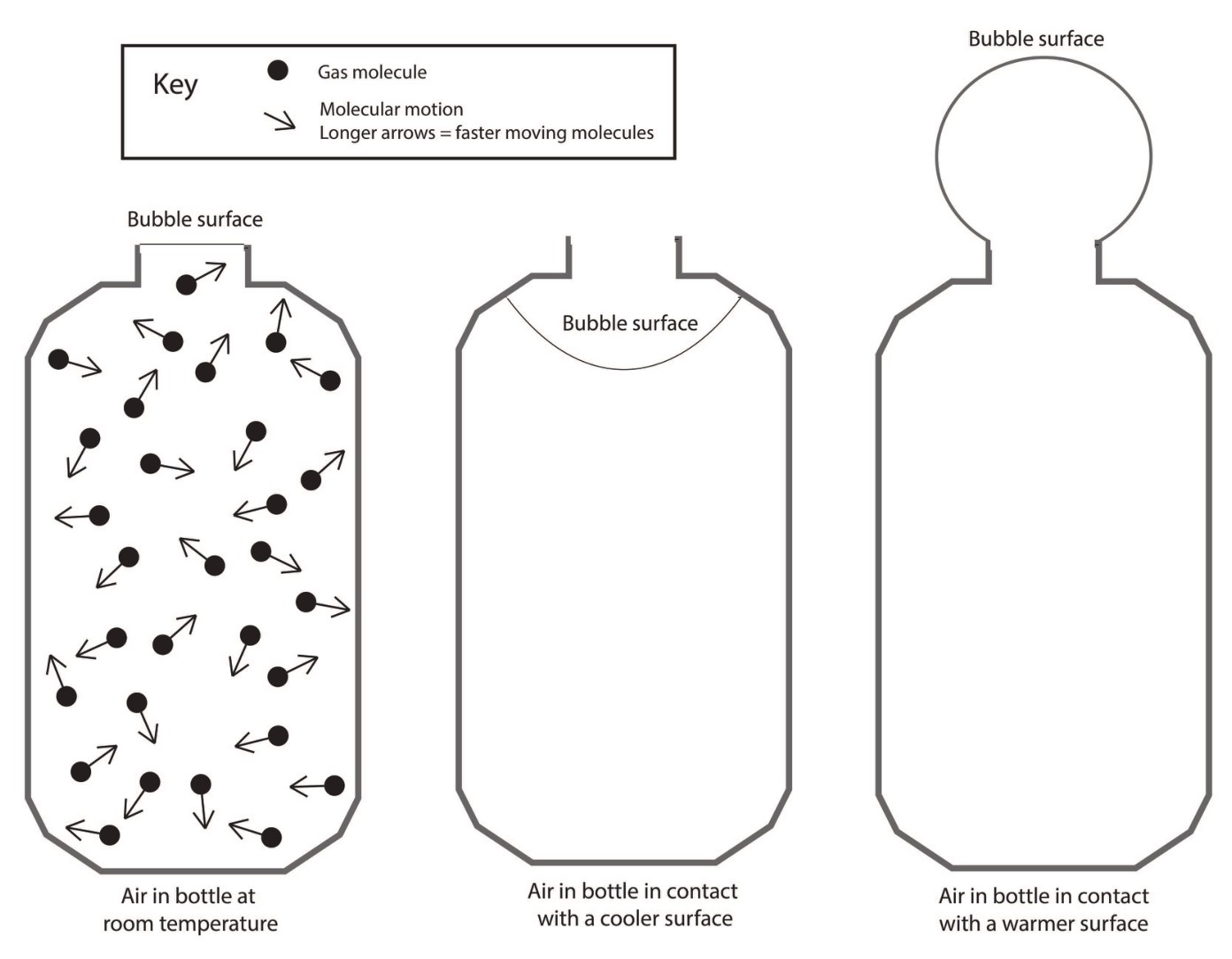
Answer and explanation
Mean translational energy increases with kelvin temperature, characteristic speed for the same species increases with √T, and volume increases proportionally to T under the fixed-pressure ideal model. Keep molecule identity and total count fixed. A rigid sealed vessel fixes volume, so pressure rises instead; blank template regions do not mean zero particles.
Identify the source’s visible labels, scales and unfinished or omitted information.
Use the local complete explanations to connect the observation with an explicit mechanism.
State assumptions and a limit before extending the model.
Response criteria
- Interpret the source symbols and boundary correctly.
- Explain the relevant mechanism using quantities/species consistently.
- State a meaningful omission, assumption or evidence limitation.
Problem 23
- the mass in grams
- the number of collisions
- the number of moles of gas
- the number of neutrons
Answer and explanation
the number of moles of gas
n is the amount of gas measured in moles.
Problem 24
- 8.314 J/(mol·K)
- 22.4 L/mol
- 6.02 × 10²³
- 0.0821 L·atm/(mol·K)
Answer and explanation
0.0821 L·atm/(mol·K)
R = 0.0821 L·atm/(mol·K) is the value that matches atm, liters, and kelvin.
Problem 25
Answer and explanation
67.2 L
Volume = moles × 22.4 L/mol = 3.0 × 22.4 = 67.2 L.
Problem 26
Answer and explanation
0.5 mol
Moles = volume ÷ 22.4 L/mol = 11.2 ÷ 22.4 = 0.50 mol.
Problem 27
Answer and explanation
4.93 atm
P = nRT/V = (2.0 × 0.0821 × 300) / 10.0 = 49.26 / 10.0 ≈ 4.93 atm.
Problem 28
Answer and explanation
By Avogadro's Law, equal volumes at the same temperature and pressure hold equal numbers of particles, regardless of their mass. The ideal gas law depends only on the number of moles (n), not the type or weight of the gas, so one mole of any ideal gas fills 22.4 L at STP.
Problem 29
Hints
Match the units of pressure and R.
Answer and explanation
P=nRT/V=1.0×8.31×300/10=249.3 kPa, about 250 kPa.
Problem 30
Hints
State what the supplied observations or conditions establish, and separate that from any assumption.
Answer and explanation
Finite particle volume and intermolecular attractions become more important under those conditions.
Problem 31
Answer and explanation
It decreases inversely with absolute temperature because the amount per volume decreases under the model.
Substituting n=m/Mₘ into the ideal gas law gives ρ=PMₘ/(RT). Gas density therefore depends on pressure and temperature as well as chemical identity. Rearranging to Mₘ=ρRT/P can estimate a molar mass when the sample is sufficiently ideal and its composition is appropriate. A mixture’s result can represent an average rather than one pure species. State the gas conditions and uncertainty before interpreting a density as unique substance identification.
It decreases inversely with absolute temperature because the amount per volume decreases under the model.
Response criteria
- Interpret labels, structures, axes, units and directions correctly.
- Explain the chemistry relationship or mechanism.
- Respect stated assumptions and distinguish observation from inference.
Problem 32
Answer and explanation
Mₘ=ρRT/P=1.20×0.0821×300/1.00≈29.6 g/mol. The estimate assumes ideal behavior and suitable composition; several substances or mixtures can have a similar average molar mass.
Mₘ=ρRT/P=1.20×0.0821×300/1.00≈29.6 g/mol. The estimate assumes ideal behavior and suitable composition; several substances or mixtures can have a similar average molar mass.
Response criteria
- Use the stated measurements or conditions, with correct units.
- Connect the result to the chemical mechanism or evidence relationship.
- Identify the assumption, model limit or further evidence requested.
Problem 33
- London dispersion forces
- dipole-dipole forces
- hydrogen bonding
- ionic bonding
Answer and explanation
London dispersion forces
London dispersion forces arise from temporary dipoles and act in every molecule, even nonpolar ones.
Problem 34
- another hydrogen
- nitrogen, oxygen, or fluorine
- carbon
- any metal
Answer and explanation
nitrogen, oxygen, or fluorine
Hydrogen bonding requires H bonded to a highly electronegative N, O, or F atom.
Problem 35
- Cl₂
- CH₄
- H₂O
- CO₂
Answer and explanation
H₂O
Water has H bonded to O, so it can hydrogen-bond; the others lack H attached to N, O, or F.
Problem 36
- weaker dispersion forces
- no intermolecular forces at all
- hydrogen bonding
- stronger dispersion forces and a higher boiling point
Answer and explanation
stronger dispersion forces and a higher boiling point
A larger, more polarizable electron cloud produces stronger London dispersion forces, which raises the boiling point.
Problem 37
Answer and explanation
Water molecules hydrogen-bond to one another (H attached to O is attracted to the O of neighbors), a strong intermolecular force, so a great deal of energy is needed to separate them into a gas. Methane is nonpolar with only weak London dispersion forces, so its molecules pull apart at a very low temperature.
Problem 38
- Ne < Kr < Xe
- Xe < Kr < Ne
- Kr < Ne < Xe
- they all boil at the same temperature
Answer and explanation
Ne < Kr < Xe
Dispersion forces increase with size and number of electrons (Ne < Kr < Xe), so boiling point rises in the same order.
Problem 39
Hints
Molecular size and shape can change the result; do not use one factor as a universal ranking.
Answer and explanation
Temporary and induced charge fluctuations produce London dispersion forces.
Problem 40
Hints
State what the supplied observations or conditions establish, and separate that from any assumption.
Answer and explanation
No. Size and polarizability strengthen dispersion; compare the complete set of interactions.
Problem 41
Answer and explanation
Methane’s hydrogens are bonded to carbon, not the strongly polar N–H, O–H or F–H donor pattern used in this introductory comparison.
In common introductory examples, hydrogen bonding involves a hydrogen covalently attached to N, O or F interacting with a suitable neighboring electron-rich region. Water can supply O–H donors and oxygen acceptor sites. A molecule containing any hydrogen atom is not automatically a hydrogen-bond donor, and some molecules accept without donating. Hydrogen bonding is an intermolecular interaction here, distinct from the O–H covalent bond inside water; geometry and chemical context affect its strength.
Methane’s hydrogens are bonded to carbon, not the strongly polar N–H, O–H or F–H donor pattern used in this introductory comparison.
Response criteria
- Interpret labels, structures, axes, units and directions correctly.
- Explain the chemistry relationship or mechanism.
- Respect stated assumptions and distinguish observation from inference.
Problem 42
Answer and explanation
Nonpolar molecules still experience dispersion attractions between molecules. Ordinary vaporization of a stable molecular substance mainly changes intermolecular arrangement/interactions, while breaking its internal covalent bonds is a chemical change requiring a different account.
Nonpolar molecules still experience dispersion attractions between molecules. Ordinary vaporization of a stable molecular substance mainly changes intermolecular arrangement/interactions, while breaking its internal covalent bonds is a chemical change requiring a different account.
Response criteria
- Use the stated measurements or conditions, with correct units.
- Connect the result to the chemical mechanism or evidence relationship.
- Identify the assumption, model limit or further evidence requested.
Problem 43
Hints
Write the relationship first; substitute with consistent units.
Answer and explanation
1670 J
mL=5×334.
Problem 44
Answer and explanation
It includes sensible heating but omits latent heat needed to change phase.
Response criteria
- State a scientifically accurate conclusion.
- Show the calculation or mechanism that supports it.
- Include units, conditions, or limits where relevant.
Problem 45
Hints
List the given quantities, select a relationship, and check units before substituting.
Answer and explanation
1002 J
3×334=1002; sample heat would be negative.
Problem 46
Answer and explanation
No. Ordinary boiling primarily overcomes intermolecular attractions; the molecules remain H₂O.
Response criteria
- State a scientifically accurate conclusion.
- Show the calculation or mechanism that supports it.
- Include units, conditions, or limits where relevant.
Problem 47
Hints
Do not apply mcΔT alone to a phase-change plateau.
Answer and explanation
Q=20×2×15=600 J.
Problem 48
Hints
State what the supplied observations or conditions establish, and separate that from any assumption.
Answer and explanation
Phase-change energy mL plus any separate warming before or after, with each segment counted once.
Problem 49
Answer and explanation
Approximately −3340 J for the reverse transition under the corresponding conditions.
A specific latent energy L gives energy per mass for a particular phase change under specified conditions. Near ordinary-pressure melting, water’s fusion value is about 334 J/g. Melting ten grams of ice at its transition therefore needs about 3,340 J even while temperature is nearly constant. Vaporization has a different value, and reverse transitions have the opposite system heat sign. The energy concerns the full phase arrangement, not ordinary cleavage of every O–H covalent bond in the molecules.
Approximately −3340 J for the reverse transition under the corresponding conditions.
Response criteria
- Interpret labels, structures, axes, units and directions correctly.
- Explain the chemistry relationship or mechanism.
- Respect stated assumptions and distinguish observation from inference.
Problem 50
Answer and explanation
Melting: 20.0×334=6680 J. Warming: 20.0×4.18×10.0=836 J. Total=7516 J≈7.52 kJ. The sample receives positive heat under the stated boundary.
Melting: 20.0×334=6680 J. Warming: 20.0×4.18×10.0=836 J. Total=7516 J≈7.52 kJ. The sample receives positive heat under the stated boundary.
Response criteria
- Use the stated measurements or conditions, with correct units.
- Connect the result to the chemical mechanism or evidence relationship.
- Identify the assumption, model limit or further evidence requested.