Waves, Sound & Light — Chapter Practice, Grade 8
Connect vibrating sources, wave properties, sound, light and information with a complete source–medium–receiver model. This is a required chapter and is included in the course final.
Problem 1
Answer and explanation
No. The motion can be too fast or small to detect with the chosen method. A suitable measurement or record is needed.
No. The motion can be too fast or small to detect with the chosen method. A suitable measurement or record is needed.
Response criteria
- Use the supplied conditions and relevant evidence.
- Explain the scientific mechanism or calculation.
- State a meaningful limitation or testable next step.
Problem 2
Answer and explanation
Amplitude is 3 mm. The cycle count per time, and hence frequency of 200 Hz, is unchanged in this comparison.
Amplitude is 3 mm. The cycle count per time, and hence frequency of 200 Hz, is unchanged in this comparison.
Response criteria
- Use the supplied conditions and relevant evidence.
- Explain the scientific mechanism or calculation.
- State a meaningful limitation or testable next step.
Problem 3
Answer and explanation
Frequency needs the number of complete cycles divided by a defined time. An unscaled drawing alone does not establish hertz.
Frequency needs the number of complete cycles divided by a defined time. An unscaled drawing alone does not establish hertz.
Response criteria
- Use the supplied conditions and relevant evidence.
- Explain the scientific mechanism or calculation.
- State a meaningful limitation or testable next step.
Problem 4
Answer and explanation
The intermediate medium and interactions, and how the receiver responds. The picture should also identify limits such as scale and omitted biological detail.
The intermediate medium and interactions, and how the receiver responds. The picture should also identify limits such as scale and omitted biological detail.
Response criteria
- Use the supplied conditions and relevant evidence.
- Explain the scientific mechanism or calculation.
- State a meaningful limitation or testable next step.
Problem 5
Answer and explanation
A and B are 200 Hz, while C is 300 Hz. B has three times A’s amplitude; C has A’s amplitude but higher frequency. Frequency and amplitude are distinct. Predicting received sound also needs distance, medium, losses and receiver response. The source records alone do not establish an exact perceived loudness.
A and B are 200 Hz, while C is 300 Hz. B has three times A’s amplitude; C has A’s amplitude but higher frequency. Frequency and amplitude are distinct. Predicting received sound also needs distance, medium, losses and receiver response. The source records alone do not establish an exact perceived loudness.
Response criteria
- Use the supplied conditions and relevant evidence.
- Explain the scientific mechanism or calculation.
- State a meaningful limitation or testable next step.
Problem 6
Answer and explanation
Pitch is associated with the shared frequency, while loudness may differ with amplitude under comparable source, medium, distance and receiver conditions. Neither quantity is a universal perception guarantee.
Pitch is associated with the shared frequency, while loudness may differ with amplitude under comparable source, medium, distance and receiver conditions. Neither quantity is a universal perception guarantee.
Response criteria
- Use the supplied conditions and relevant evidence.
- Explain the scientific mechanism or calculation.
- State a meaningful limitation or testable next step.
Problem 7
Answer and explanation
Amplitude and frequency can vary independently. Compare graph height and cycles per stated time separately.
Amplitude and frequency can vary independently. Compare graph height and cycles per stated time separately.
Response criteria
- Use the supplied conditions and relevant evidence.
- Explain the scientific mechanism or calculation.
- State a meaningful limitation or testable next step.
Problem 8
Answer and explanation
A simplified chain is ruler → nearby air → farther air → receiver. A paper membrane can be a model receiver, but detectable motion depends on many factors. Failure to see it move at quiet volume is not evidence that energy transfer never occurs. The intermediate medium and interactions, and how the receiver responds. The picture should also identify limits such as scale and omitted biological detail.
A simplified chain is ruler → nearby air → farther air → receiver. A paper membrane can be a model receiver, but detectable motion depends on many factors. Failure to see it move at quiet volume is not evidence that energy transfer never occurs. The intermediate medium and interactions, and how the receiver responds. The picture should also identify limits such as scale and omitted biological detail.
Response criteria
- Use the supplied conditions and relevant evidence.
- Explain the scientific mechanism or calculation.
- State a meaningful limitation or testable next step.
Problem 9
Hints
Distinguish the observed quantities, the proposed mechanism and its conditions.
Answer and explanation
Both have frequency 200 Hz; amplitude doubles. Frequency-related pitch is comparable in the simple model, while received loudness also depends on distance, medium and receiver. The amplitude comparison alone does not fix a person’s perception.
Both have frequency 200 Hz; amplitude doubles. Frequency-related pitch is comparable in the simple model, while received loudness also depends on distance, medium and receiver. The amplitude comparison alone does not fix a person’s perception.
Problem 10
Hints
Distinguish the observed quantities, the proposed mechanism and its conditions.
Answer and explanation
Pitch is associated with the shared frequency, while loudness may differ with amplitude under comparable source, medium, distance and receiver conditions. Neither quantity is a universal perception guarantee.
Pitch is associated with the shared frequency, while loudness may differ with amplitude under comparable source, medium, distance and receiver conditions. Neither quantity is a universal perception guarantee.
Problem 11
Answer and explanation
Neither has a higher frequency in this matched window. Displacement amplitude differs; a numerical vertical position scale and units are needed to measure it.
A cycle is one complete repeat, such as one peak to the next matching peak. A taller trace does not automatically have more cycles. Compare amplitude and frequency one at a time rather than using the word louder for both.
Neither has a higher frequency in this matched window. Displacement amplitude differs; a numerical vertical position scale and units are needed to measure it.
Response criteria
- Use the named labels, directions or supplied quantities accurately.
- Connect the visual evidence to the scientific mechanism or calculation.
- State the relevant model conditions or limitation.
Problem 12
Answer and explanation
Period 0.2 s; frequency 5 Hz; amplitude 3 mm; peak-to-trough span 6 mm. The source moves locally rather than traveling across the sound path.
Use matching-peak separation for period and its reciprocal for frequency.
Measure amplitude from the middle position to a peak.
Period 0.2 s; frequency 5 Hz; amplitude 3 mm; peak-to-trough span 6 mm. The source moves locally rather than traveling across the sound path.
Response criteria
- Use the named labels, directions or supplied quantities accurately.
- Connect the visual evidence to the scientific mechanism or calculation.
- State the relevant model conditions or limitation.
Problem 13
Answer and explanation
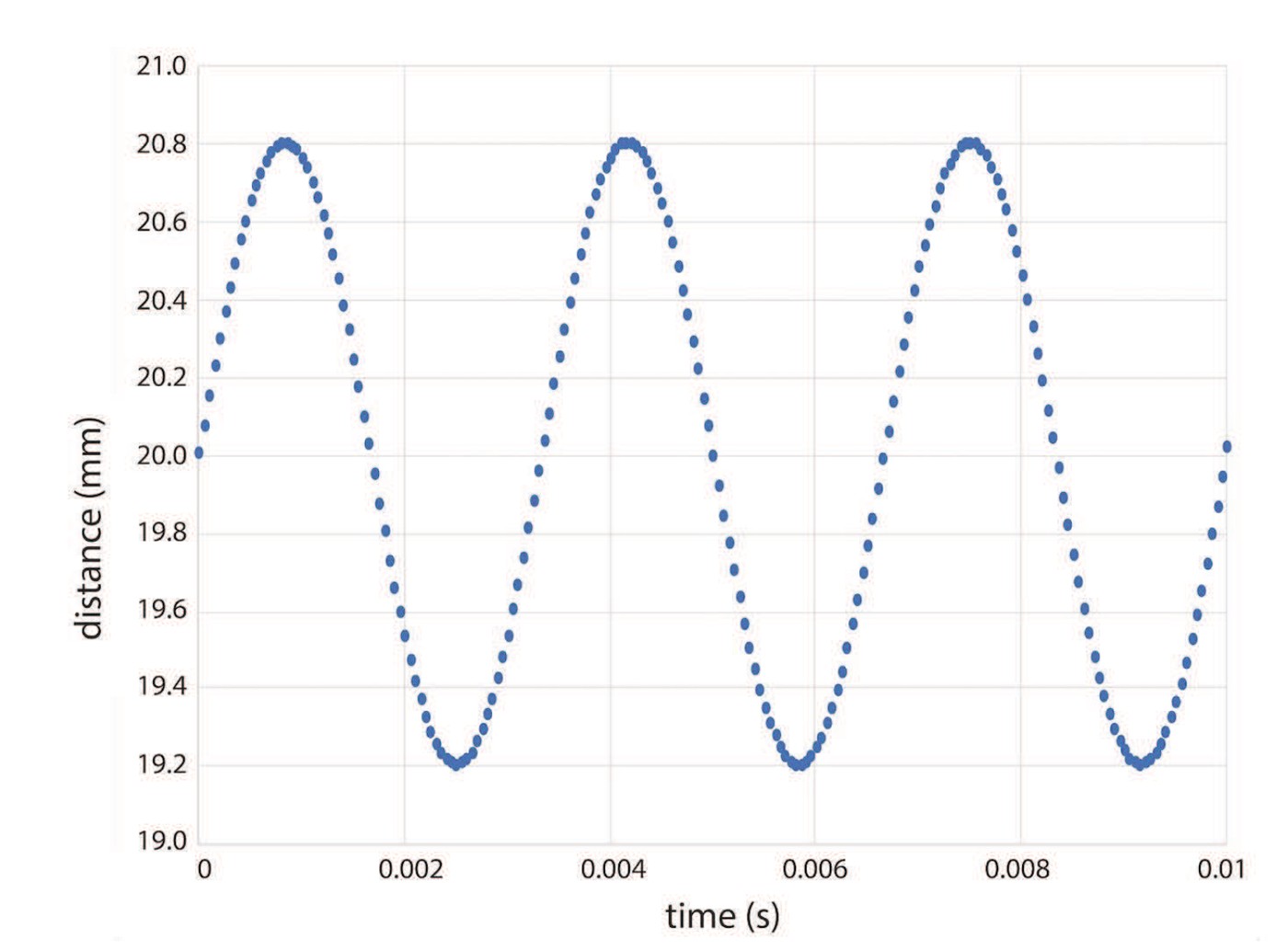
One cycle takes about 0.0033 s, giving frequency about 300 Hz using cycles per second = 1/period. The midline is near 20 mm and extrema are about 19.2 and 20.8 mm, so displacement amplitude is about 0.8 mm. Amplitude measures departure from the midline, not distance from the coordinate origin. Allow reasonable approximate readings from this source graph.
Compare consecutive peaks: about 0.0033 s per cycle.
Compute 1/period, approximately 300 cycles per second, or Hz.
Amplitude is about 20.8−20 = 0.8 mm (half the peak-to-peak displacement).
Response criteria
- Read time on the horizontal axis; do not call it wavelength.
- Estimate frequency from repeats per second.
- Measure amplitude from the midline and distinguish coordinate origin from equilibrium.
Problem 14
Answer and explanation
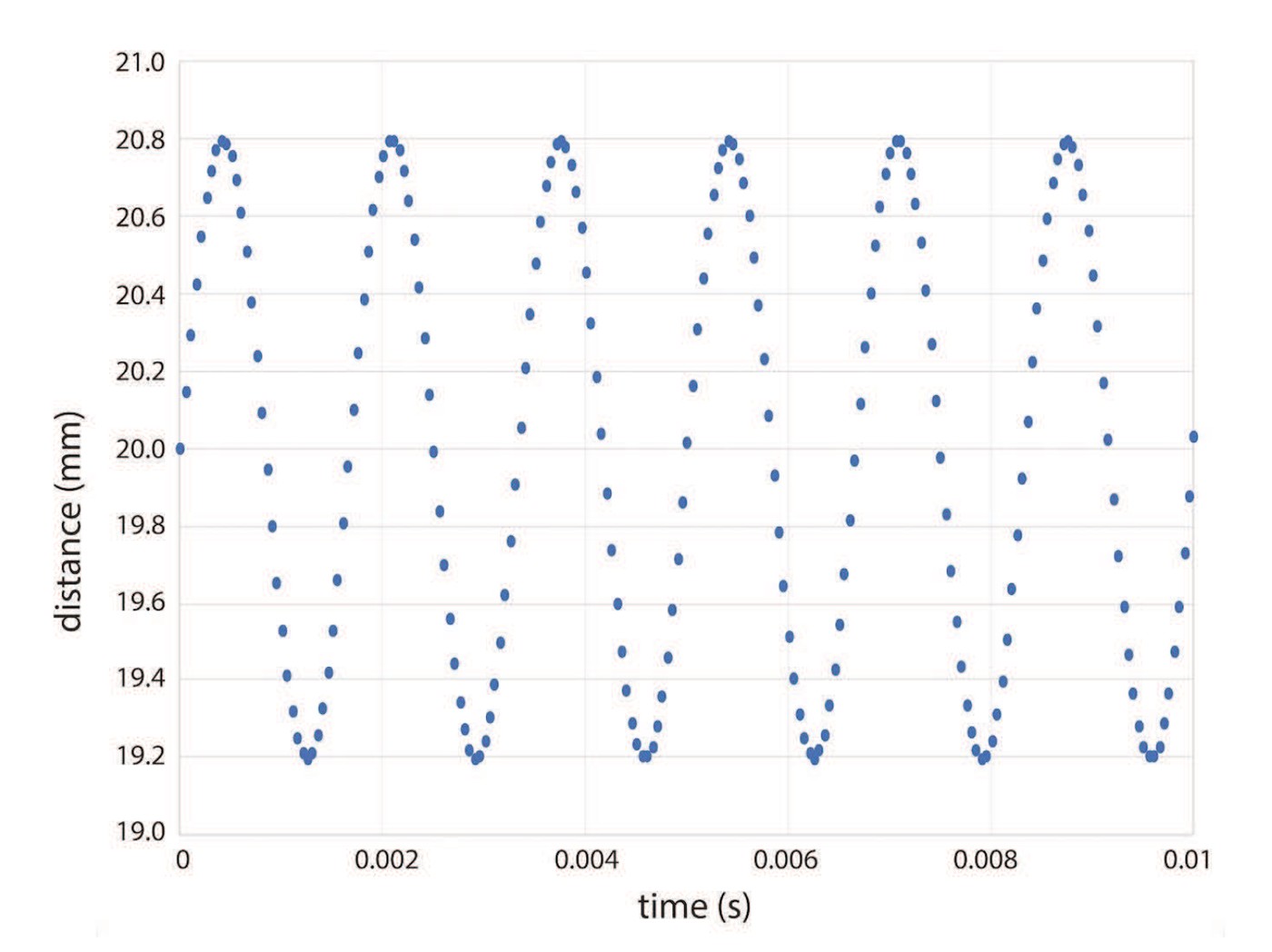
One cycle takes about 0.0017 s, giving frequency about 600 Hz using cycles per second = 1/period. The midline is near 20 mm and extrema are about 19.2 and 20.8 mm, so displacement amplitude is about 0.8 mm. Amplitude measures departure from the midline, not distance from the coordinate origin. Allow reasonable approximate readings from this source graph. B has about twice A’s frequency and half its period, while displacement amplitude stays approximately 0.8 mm. Faster repetition does not automatically mean a larger vibration.
Compare consecutive peaks: about 0.0017 s per cycle.
Compute 1/period, approximately 600 cycles per second, or Hz.
Amplitude is about 20.8−20 = 0.8 mm (half the peak-to-peak displacement).
Response criteria
- Read time on the horizontal axis; do not call it wavelength.
- Estimate frequency from repeats per second.
- Measure amplitude from the midline and distinguish coordinate origin from equilibrium.
Problem 15
Answer and explanation
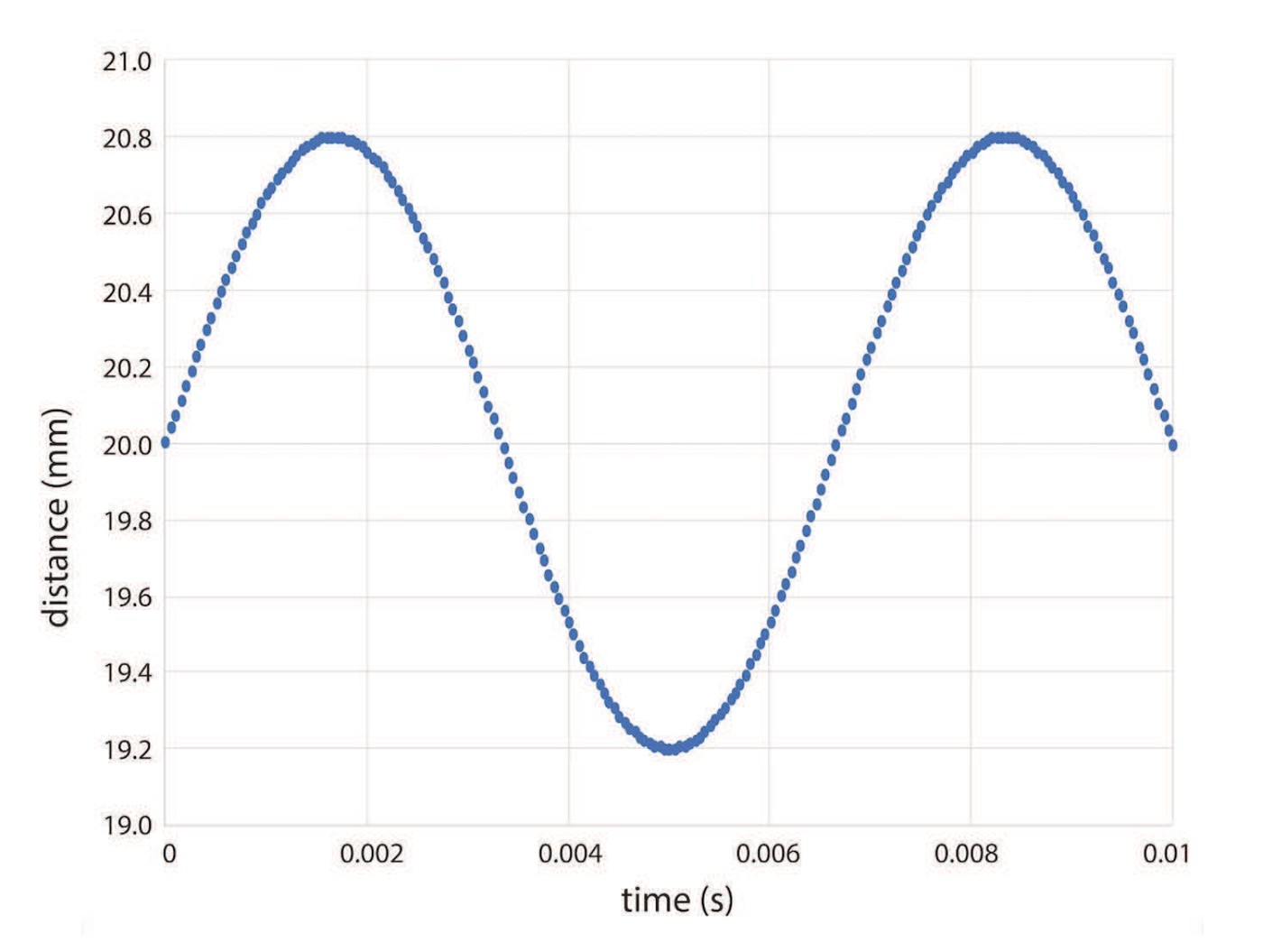
One cycle takes about 0.0067 s, giving frequency about 150 Hz using cycles per second = 1/period. The midline is near 20 mm and extrema are about 19.2 and 20.8 mm, so displacement amplitude is about 0.8 mm. Amplitude measures departure from the midline, not distance from the coordinate origin. Allow reasonable approximate readings from this source graph. About 1.5 cycles in 0.010 s gives 150 Hz. Counting only one ignores the half-cycle and would incorrectly give 100 Hz; use the measured period or account for the partial cycle.
Compare consecutive peaks: about 0.0067 s per cycle.
Compute 1/period, approximately 150 cycles per second, or Hz.
Amplitude is about 20.8−20 = 0.8 mm (half the peak-to-peak displacement).
Response criteria
- Read time on the horizontal axis; do not call it wavelength.
- Estimate frequency from repeats per second.
- Measure amplitude from the midline and distinguish coordinate origin from equilibrium.
Problem 16
Answer and explanation
18 m/s
v = f × λ = 3 × 6 = 18 m/s.
Problem 17
Answer and explanation
2 Hz
f = 1 ÷ T = 1 ÷ 0.5 = 2 Hz.
Problem 18
Answer and explanation
3 m
λ = v ÷ f = 12 ÷ 4 = 3 m.
Problem 19
- wavelength
- amplitude
- period
- frequency only
Answer and explanation
amplitude
A bigger amplitude means more energy is being carried by the wave.
Problem 20
- amplitude
- period
- wavelength
- frequency
Answer and explanation
wavelength
Wavelength is the distance between two matching points, such as crest to crest.
Problem 21
Answer and explanation
4 m
λ = v ÷ f = 200 ÷ 50 = 4 m.
Problem 22
Answer and explanation
4 Hz and 0.25 s per cycle.
Frequency=v/λ=12/3=4 Hz.
Period=1/f=1/4=0.25 s.
Response criteria
- Use the stated conditions.
- Show the evidence or calculation.
- Explain the conclusion and any stated limitation.
Problem 23
Hints
Hz means cycles per second, not meters per second.
Answer and explanation
v=5×0.6=3 m/s.
Problem 24
Hints
State what the supplied observations or conditions establish, and separate that from any assumption.
Answer and explanation
No. Waves transfer energy; local matter mainly oscillates in a simple wave model, though real water can also have currents.
Problem 25
Answer and explanation
That would confuse the traveling pattern with the local motion of the material. The marked rope location oscillates locally rather than being carried across with the crest.
Follow one material marker rather than only a crest. A transverse rope wave has local motion perpendicular to travel. Sound uses a different local-motion direction, so do not assume every mechanical wave looks like a vertical rope curve.
That would confuse the traveling pattern with the local motion of the material. The marked rope location oscillates locally rather than being carried across with the crest.
Response criteria
- Use the named labels, directions or supplied quantities accurately.
- Connect the visual evidence to the scientific mechanism or calculation.
- State the relevant model conditions or limitation.
Problem 26
Answer and explanation
Speed 0.8×5 = 4 m/s. The represented energy increases by a factor of four under the stated matched squared-amplitude comparison.
Combine a spatial repeat and a temporal repeat.
Keep all named comparison conditions fixed before using the amplitude pattern.
Speed 0.8×5 = 4 m/s. The represented energy increases by a factor of four under the stated matched squared-amplitude comparison.
Response criteria
- Use the named labels, directions or supplied quantities accurately.
- Connect the visual evidence to the scientific mechanism or calculation.
- State the relevant model conditions or limitation.
Problem 27
Answer and explanation
1360 m
distance = speed × time = 340 × 4 = 1,360 m.
Problem 28
- transverse
- longitudinal
- electromagnetic
- standing only
Answer and explanation
longitudinal
Sound particles vibrate in the same direction the wave travels, making it a longitudinal wave.
Problem 29
- higher
- lower
- louder only
- quieter only
Answer and explanation
higher
Higher frequency corresponds to higher pitch.
Problem 30
- water
- steel
- a vacuum (empty space)
- air
Answer and explanation
a vacuum (empty space)
Sound needs a medium of particles to travel through, so it cannot travel through a vacuum.
Problem 31
Answer and explanation
The speaker cone vibrates back and forth, pushing air molecules together to create compressions and pulling them apart to create rarefactions. This repeating pattern travels outward through the air as a sound wave.
Problem 32
Answer and explanation
400 Hz
f = v ÷ λ = 340 ÷ 0.85 = 400 Hz.
Problem 33
Answer and explanation
68 m to the wall in this model.
Total path=340×0.4=136 m.
The path goes to the wall and back, so wall distance=136/2=68 m.
Response criteria
- Use the stated conditions.
- Show the evidence or calculation.
- Explain the conclusion and any stated limitation.
Problem 34
Hints
Remember the return path; the echo delay is not one-way time.
Answer and explanation
The 400 Hz sound, because its frequency is higher.
Problem 35
Hints
State what the supplied observations or conditions establish, and separate that from any assumption.
Answer and explanation
Sound needs particles of a medium to transmit mechanical disturbances; a vacuum lacks that medium.
Problem 36
Answer and explanation
The pressure disturbance and energy travel through the air. Individual particles move locally rather than carrying themselves from speaker to listener.
Draw a line of particles with alternating close and less-close spacing. Show travel and local motion along the same axis in the longitudinal model. Do not show one particle traveling all the way from a speaker to a listener.
The pressure disturbance and energy travel through the air. Individual particles move locally rather than carrying themselves from speaker to listener.
Response criteria
- Use the named labels, directions or supplied quantities accurately.
- Connect the visual evidence to the scientific mechanism or calculation.
- State the relevant model conditions or limitation.
Problem 37
Answer and explanation
Round-trip length is 340×0.3 = 102 m, so reflector distance is 51 m. The measured time includes travel out and back.
Draw both travel legs.
Divide total path by two only under the stated same-path out-and-back comparison.
Round-trip length is 340×0.3 = 102 m, so reflector distance is 51 m. The measured time includes travel out and back.
Response criteria
- Use the named labels, directions or supplied quantities accurately.
- Connect the visual evidence to the scientific mechanism or calculation.
- State the relevant model conditions or limitation.
Problem 38
Answer and explanation
One cycle takes about 0.0033 s, giving frequency about 300 Hz using cycles per second = 1/period. The midline is near 20 mm and extrema are about 19.2 and 20.8 mm, so displacement amplitude is about 0.8 mm. Amplitude measures departure from the midline, not distance from the coordinate origin. Allow reasonable approximate readings from this source graph.
Compare consecutive peaks: about 0.0033 s per cycle.
Compute 1/period, approximately 300 cycles per second, or Hz.
Amplitude is about 20.8−20 = 0.8 mm (half the peak-to-peak displacement).
Response criteria
- Read time on the horizontal axis; do not call it wavelength.
- Estimate frequency from repeats per second.
- Measure amplitude from the midline and distinguish coordinate origin from equilibrium.
Problem 39
Answer and explanation
One cycle takes about 0.0017 s, giving frequency about 600 Hz using cycles per second = 1/period. The midline is near 20 mm and extrema are about 19.2 and 20.8 mm, so displacement amplitude is about 0.8 mm. Amplitude measures departure from the midline, not distance from the coordinate origin. Allow reasonable approximate readings from this source graph. B has about twice A’s frequency and half its period, while displacement amplitude stays approximately 0.8 mm. Faster repetition does not automatically mean a larger vibration.
Compare consecutive peaks: about 0.0017 s per cycle.
Compute 1/period, approximately 600 cycles per second, or Hz.
Amplitude is about 20.8−20 = 0.8 mm (half the peak-to-peak displacement).
Response criteria
- Read time on the horizontal axis; do not call it wavelength.
- Estimate frequency from repeats per second.
- Measure amplitude from the midline and distinguish coordinate origin from equilibrium.
Problem 40
Answer and explanation
One cycle takes about 0.0067 s, giving frequency about 150 Hz using cycles per second = 1/period. The midline is near 20 mm and extrema are about 19.2 and 20.8 mm, so displacement amplitude is about 0.8 mm. Amplitude measures departure from the midline, not distance from the coordinate origin. Allow reasonable approximate readings from this source graph. About 1.5 cycles in 0.010 s gives 150 Hz. Counting only one ignores the half-cycle and would incorrectly give 100 Hz; use the measured period or account for the partial cycle.
Compare consecutive peaks: about 0.0067 s per cycle.
Compute 1/period, approximately 150 cycles per second, or Hz.
Amplitude is about 20.8−20 = 0.8 mm (half the peak-to-peak displacement).
Response criteria
- Read time on the horizontal axis; do not call it wavelength.
- Estimate frequency from repeats per second.
- Measure amplitude from the midline and distinguish coordinate origin from equilibrium.
Problem 41
Answer and explanation
300 m
λ = v ÷ f = 300,000,000 ÷ 1,000,000 = 300 m.
Problem 42
- gamma rays
- visible light
- radio waves
- X-rays
Answer and explanation
radio waves
Radio waves sit at the long-wavelength end of the electromagnetic spectrum.
Problem 43
- radio waves
- microwaves
- visible light
- gamma rays
Answer and explanation
gamma rays
Gamma rays have higher photon energy because their frequencies are higher. Total delivered energy also depends on how much radiation arrives and for how long.
Problem 44
- reflected
- absorbed
- transmitted
- turned into sound
Answer and explanation
transmitted
Clear glass mostly transmits light, letting it pass through.
Problem 45
Answer and explanation
The apple's surface absorbs most colors of light but reflects red wavelengths back to our eyes, so we perceive the apple as red.
Problem 46
- is absorbed at the surface
- is only reflected
- refracts (bends) when passing from water to air
- stops moving inside the water
Answer and explanation
refracts (bends) when passing from water to air
Light bends (refracts) as it passes between materials like water and air, making the pencil appear bent.
Problem 47
Answer and explanation
The reflected light depends on both the material and the illumination.
White light contains red wavelengths that the material can reflect toward the eye.
Blue illumination provides little red light to reflect and much may be absorbed.
Response criteria
- Use the stated conditions.
- Show the evidence or calculation.
- Explain the conclusion and any stated limitation.
Problem 48
Hints
Compare speed in the same medium; do not confuse frequency with speed.
Answer and explanation
Frequency and wavelength differ; frequency remains unchanged when light passes between stationary media, while speed and wavelength can change.
Problem 49
Hints
State what the supplied observations or conditions establish, and separate that from any assumption.
Answer and explanation
Light is electromagnetic and needs no material medium; sound is a mechanical disturbance requiring matter.
Problem 50
Answer and explanation
The higher-frequency case has more per photon (2 versus 1). The lower-frequency case has more total (8 versus 6), because it has more supplied photons.
A photon is a quantum of electromagnetic radiation. Per-photon energy, arrival amount and exposure duration are distinct. Do not replace a total-energy comparison with a frequency-only slogan when the photon counts or duration also change.
The higher-frequency case has more per photon (2 versus 1). The lower-frequency case has more total (8 versus 6), because it has more supplied photons.
Response criteria
- Use the named labels, directions or supplied quantities accurately.
- Connect the visual evidence to the scientific mechanism or calculation.
- State the relevant model conditions or limitation.
Problem 51
Answer and explanation
Absorbed amount is 120−30−70 = 20 units. Appearance depends on the incident wavelengths and the surface’s reflection toward the observer; a different lamp can change it.
Keep reflected, transmitted and absorbed pathways distinct.
Name both source and surface in a color explanation.
Absorbed amount is 120−30−70 = 20 units. Appearance depends on the incident wavelengths and the surface’s reflection toward the observer; a different lamp can change it.
Response criteria
- Use the named labels, directions or supplied quantities accurately.
- Connect the visual evidence to the scientific mechanism or calculation.
- State the relevant model conditions or limitation.
Problem 52
Answer and explanation
The time-varying input and resulting changing force are also needed to produce the membrane’s varying motion and air disturbance.
The time-varying input and resulting changing force are also needed to produce the membrane’s varying motion and air disturbance.
Response criteria
- Use the supplied conditions and relevant evidence.
- Explain the scientific mechanism or calculation.
- State a meaningful limitation or testable next step.
Problem 53
Answer and explanation
The encoding rules, timing and how to distinguish message boundaries and symbols; the physical carrier alone does not define the meaning.
The encoding rules, timing and how to distinguish message boundaries and symbols; the physical carrier alone does not define the meaning.
Response criteria
- Use the supplied conditions and relevant evidence.
- Explain the scientific mechanism or calculation.
- State a meaningful limitation or testable next step.
Problem 54
Answer and explanation
No. Noise can cause incorrect symbol decisions, especially near a threshold. Reliability depends on the system and code, not merely the digital label.
No. Noise can cause incorrect symbol decisions, especially near a threshold. Reliability depends on the system and code, not merely the digital label.
Response criteria
- Use the supplied conditions and relevant evidence.
- Explain the scientific mechanism or calculation.
- State a meaningful limitation or testable next step.
Problem 55
Answer and explanation
Sound requires material interactions in a medium. Magnetic interactions can occur across a vacuum; the two effects do not share the same air requirement.
Sound requires material interactions in a medium. Magnetic interactions can occur across a vacuum; the two effects do not share the same air requirement.
Response criteria
- Use the supplied conditions and relevant evidence.
- Explain the scientific mechanism or calculation.
- State a meaningful limitation or testable next step.
Problem 56
Answer and explanation
The decoded sequence is 0101. The 0.48 value is closest to the threshold, so small noise could change its symbol. Add the coil–magnet interaction, attached membrane vibration, successive air interactions and receiver. The drawing should not imply that charge or air particles travel the entire information path unchanged.
The decoded sequence is 0101. The 0.48 value is closest to the threshold, so small noise could change its symbol. Add the coil–magnet interaction, attached membrane vibration, successive air interactions and receiver. The drawing should not imply that charge or air particles travel the entire information path unchanged.
Response criteria
- Use the supplied conditions and relevant evidence.
- Explain the scientific mechanism or calculation.
- State a meaningful limitation or testable next step.
Problem 57
Answer and explanation
No. Magnetic fields can mediate an interaction through a vacuum, while ordinary sound requires a material medium. Different mechanisms predict the different observations.
No. Magnetic fields can mediate an interaction through a vacuum, while ordinary sound requires a material medium. Different mechanisms predict the different observations.
Response criteria
- Use the supplied conditions and relevant evidence.
- Explain the scientific mechanism or calculation.
- State a meaningful limitation or testable next step.
Problem 58
Answer and explanation
Noise can cause a reading to cross the decision threshold; a code and receiver design influence error detection and reliability.
Noise can cause a reading to cross the decision threshold; a code and receiver design influence error detection and reliability.
Response criteria
- Use the supplied conditions and relevant evidence.
- Explain the scientific mechanism or calculation.
- State a meaningful limitation or testable next step.
Problem 59
Answer and explanation
In a supplied vacuum comparison, magnets can still interact while no ordinary airborne sound crosses an empty gap. The magnetic force and sound transmission need different models. Use evidence about the actual gap rather than claim that all effects require air. Sound requires material interactions in a medium. Magnetic interactions can occur across a vacuum; the two effects do not share the same air requirement.
In a supplied vacuum comparison, magnets can still interact while no ordinary airborne sound crosses an empty gap. The magnetic force and sound transmission need different models. Use evidence about the actual gap rather than claim that all effects require air. Sound requires material interactions in a medium. Magnetic interactions can occur across a vacuum; the two effects do not share the same air requirement.
Response criteria
- Use the supplied conditions and relevant evidence.
- Explain the scientific mechanism or calculation.
- State a meaningful limitation or testable next step.
Problem 60
Hints
Distinguish the observed quantities, the proposed mechanism and its conditions.
Answer and explanation
Symbols are 0 and 1. Ordinary sound requires material interactions and cannot use a vacuum gap as an air medium. Magnetic interaction can act across a vacuum. The threshold rule can still make errors if noise alters the values.
Symbols are 0 and 1. Ordinary sound requires material interactions and cannot use a vacuum gap as an air medium. Magnetic interaction can act across a vacuum. The threshold rule can still make errors if noise alters the values.
Problem 61
Hints
Distinguish the observed quantities, the proposed mechanism and its conditions.
Answer and explanation
No. Magnetic fields can mediate an interaction through a vacuum, while ordinary sound requires a material medium. Different mechanisms predict the different observations.
No. Magnetic fields can mediate an interaction through a vacuum, while ordinary sound requires a material medium. Different mechanisms predict the different observations.
Problem 62
Answer and explanation
No. It can detect a pattern but needs the agreed code/context to interpret ready. Physical detection and message interpretation are different steps.
A signal is an observable changing pattern used to convey information. A code links a pattern to meaning. Explain both the physical mechanism carrying it and the rule used to interpret it.
No. It can detect a pattern but needs the agreed code/context to interpret ready. Physical detection and message interpretation are different steps.
Response criteria
- Use the named labels, directions or supplied quantities accurately.
- Connect the visual evidence to the scientific mechanism or calculation.
- State the relevant model conditions or limitation.
Problem 63
Answer and explanation
Changes between sample times and finer level differences are lost. Faster sampling improves temporal coverage but does not add more allowed amplitude levels; the encoding and reconstruction also matter.
Separate sampling times from quantized levels.
State which omitted detail each proposed change addresses.
Changes between sample times and finer level differences are lost. Faster sampling improves temporal coverage but does not add more allowed amplitude levels; the encoding and reconstruction also matter.
Response criteria
- Use the named labels, directions or supplied quantities accurately.
- Connect the visual evidence to the scientific mechanism or calculation.
- State the relevant model conditions or limitation.