Relative humidity — Science definition
A ratio comparing actual vapor conditions with the saturation reference at the current conditions, normally expressed as a percent.
Where it is taught
- Reading Weather Patterns — Atmosphere & Weather, Earth & Space Science, Grade 9
Questions using relative humidity
Problem 1
Answer and explanation
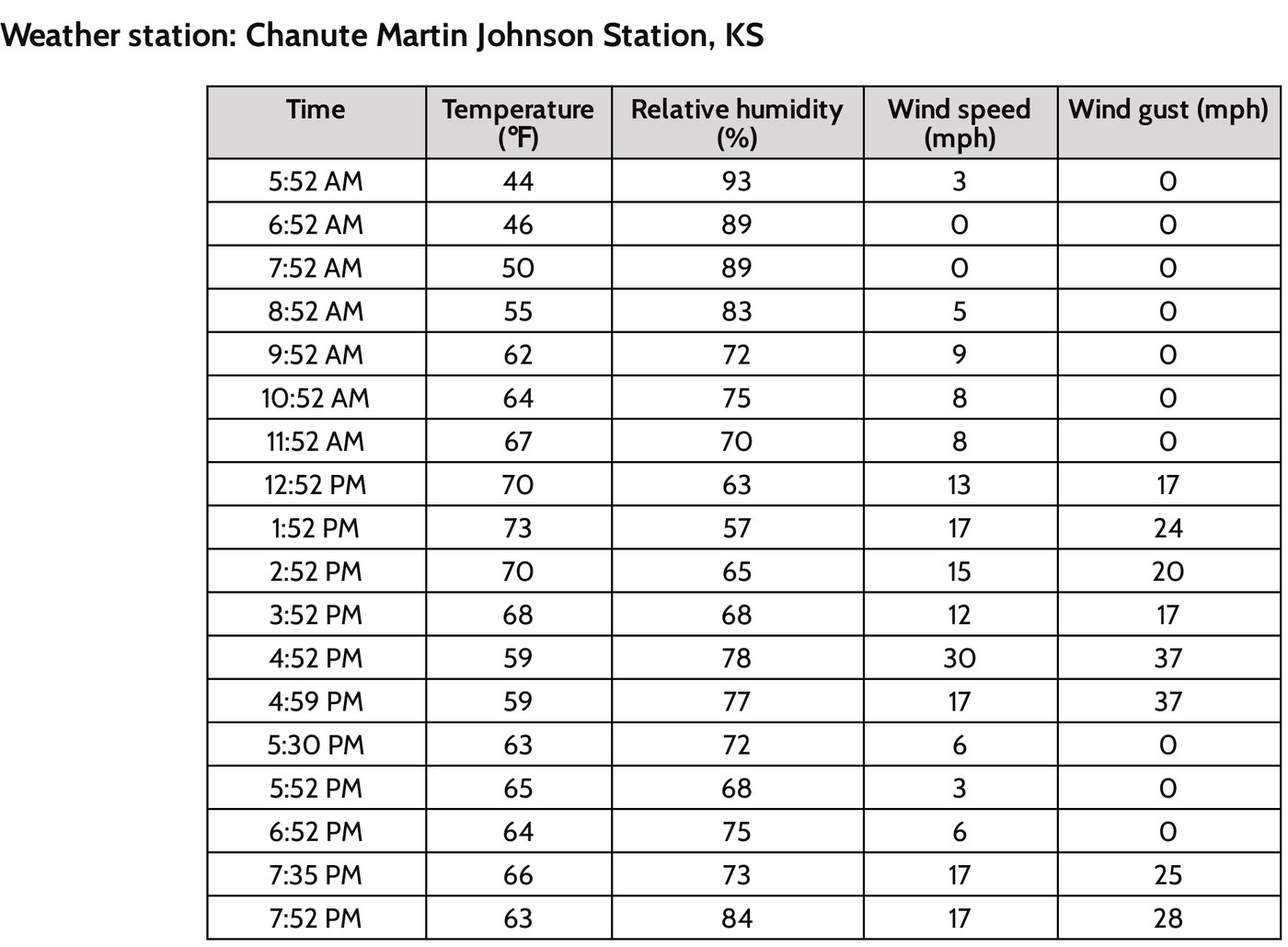
Temperature changes from 68 to 59 °F: −9 °F, equivalent to −5 °C. Relative humidity changes from 68% to 78%: +10 percentage points, not a 10% relative increase. Wind speed changes from 12 to 30 mph: +18 mph. The observations support a changing atmospheric situation at the named station; mapped front/pressure, wind direction, moisture and event-location evidence would help test causes. A humidity increase alone does not prove more water vapor, because saturation conditions change with temperature.
Read matching times and the correct source columns before subtracting.
Subtract later minus earlier: 59−68 = −9 °F; multiply the difference by 5/9 to obtain −5 °C. Do not subtract 32 when converting a temperature difference.
Compute 78−68 = 10 percentage points and 30−12 = 18 mph; gusts are a separate column.
State the station scale and time interval, then request independent mapped/process evidence rather than claim a unique cause.
Response criteria
- All changes use later minus earlier and retain correct units.
- Temperature-difference conversion and percentage-point distinction are correct.
- The inference is limited to the stated record and identifies evidence needed for a causal explanation.
Problem 2
- contains no water
- is saturated at its current temperature
- is at 100 °C
- cannot hold any water
Answer and explanation
is saturated at its current temperature
It holds as much vapour as it can at that temperature, so further cooling causes condensation.
Problem 3
Answer and explanation
100 %
When temperature equals dew point the air is saturated, so relative humidity is 100 percent.