Calculus I · Maxima, Minima, and the Shape of a Function
Where extrema hide: critical points
You cannot search every point of a curve. The first job is to narrow the hunt, and Chapter 6 already did the hard part. Recall Fermat’s lemma: at an interior peak or valley where the derivative exists, the derivative is zero — the curve is momentarily flat at the top of a hill or the bottom of a dip. Promoted to a search strategy, this is:
Fermat’s Theorem. If has a local maximum or minimum at an interior point , then either or does not exist.
A point where or fails to exist is called a critical point. Fermat’s theorem says: every interior extremum is a critical point. So the complete list of places an extremum can hide is short — the critical points, plus (on a closed domain) the endpoints. Everything else is ruled out before you start. That is the entire reason “set the derivative to zero” is the first move in every optimization problem: it’s not a ritual, it’s Fermat’s theorem narrowing an infinite search to a finite list.
A warning the theorem makes precise: is necessary but not sufficient. The function has , yet is neither a max nor a min — the curve flattens for an instant and keeps climbing. So a critical point is a candidate, not a verdict. The next two tests deliver the verdict.
The first-derivative test: watch the slope change sign
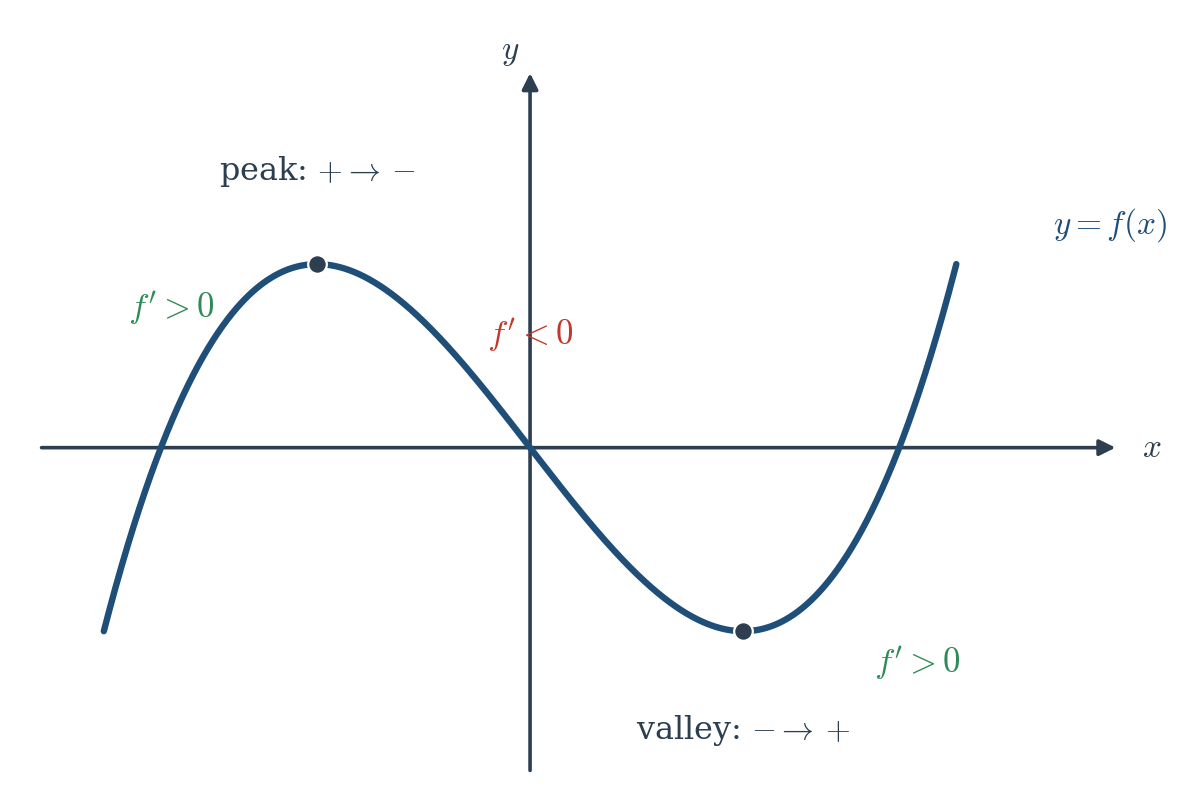
At a critical point, ask what the slope is doing on either side — and Chapter 6’s Consequence 2 (the sign of controls rising and falling) tells you what that means for the shape:
- If goes from positive to negative as passes through — rising, then falling — then is a local maximum. You climbed to a peak and came down.
- If goes from negative to positive — falling, then rising — then is a local minimum. You descended to a valley floor and climbed out.
- If does not change sign, is neither (like at : positive slope on both sides, just briefly zero).
That’s the whole test, and it rests entirely on monotonicity — which rests on the MVT. (Figure 8.2: a curve annotated with and signs for on each interval, with peaks where and valleys where .)