Calculus I · Patterns That Go Somewhere
Sequences: lists that follow a rule
A sequence is an ordered, never-ending list of numbers, each one produced by a rule. We write the first term , the second , the -th term , and the whole list as
The subscript is just the term’s position in line; is “the number sitting in the -th seat.” In Book 1 you found patterns like and said “those are the squares.” In sequence language that is simply the rule . Same idea, sharper notation — and the notation matters, because soon we will ask questions about all the terms at once, and you cannot do that without a name for the general one.
The two great families
Almost every sequence you meet at first belongs to one of two families, distinguished by how you get from one term to the next.
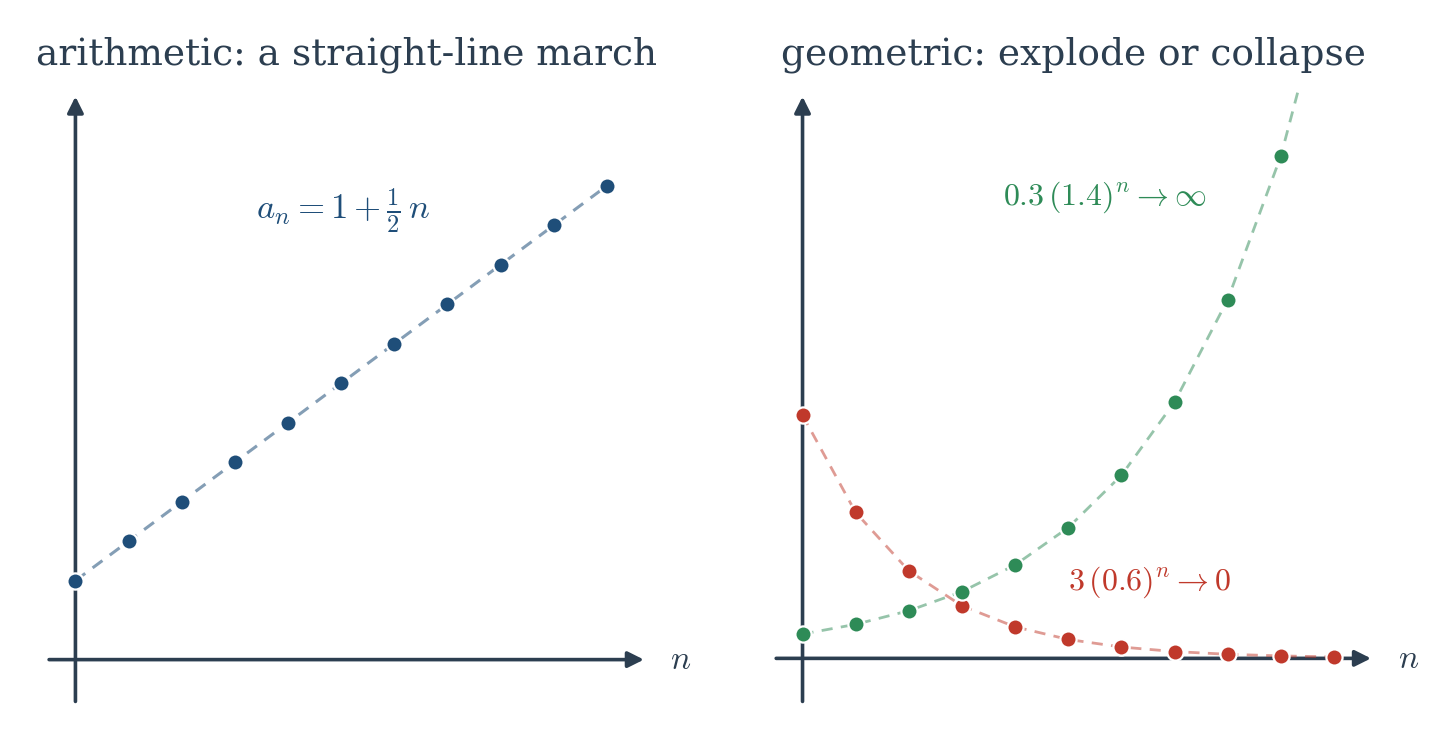
An arithmetic sequence gets from each term to the next by adding a fixed number , the common difference:
Example: has and , so . The tenth term is . Arithmetic sequences are the steady ones — they march in a straight line.
A geometric sequence gets from each term to the next by multiplying by a fixed number , the common ratio:
Example: has and , so . Geometric sequences are the ones that explode or collapse — and which one they do depends entirely on , a fact that will matter enormously later (you will see it run the whole show in Chapter 8). Keep your eye on geometric sequences. They are the most important family in this book.
The new question: what does it approach?
Here is where we leave familiar ground. Look at these four sequences not as lists to extend, but as journeys — and ask where each one is headed.
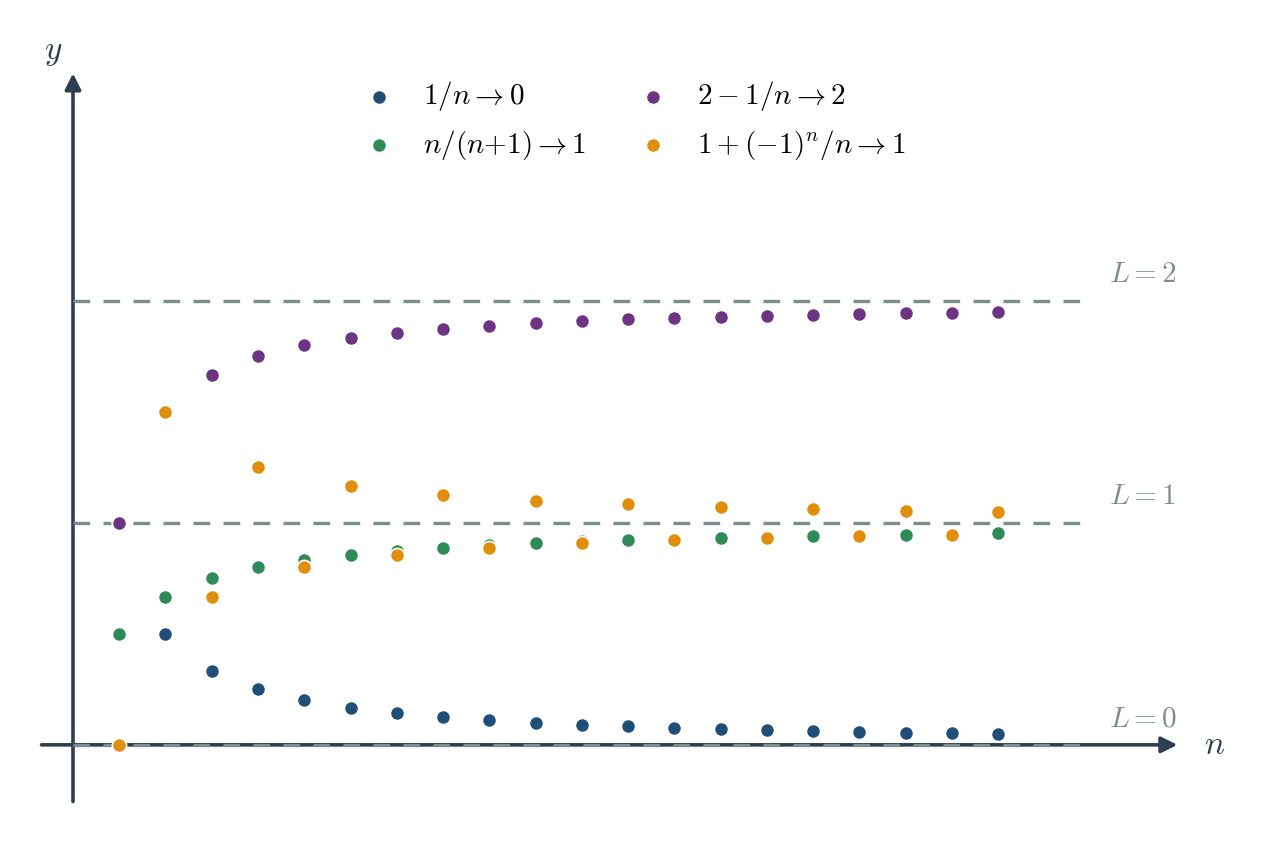
Read down the columns. The first two are sinking toward . The third is climbing toward but will never reach (since is always a hair below ). The fourth is climbing too, but toward some odd number near that is not , not , not anything with a name you know yet.
When a sequence’s terms get and stay arbitrarily close to a single number , we say the sequence converges to , that is its limit, and we write
So , and . The crucial word is stay: it is not enough to brush past once; the terms must close in and remain close, tighter and tighter, forever.
That fourth sequence is special enough to flag now and chase down later. Its limit is a genuine new constant of mathematics, and we will name it in Chapter 5 — where the whole chapter is built around it. For now treat “ approaches some number near ” as a promise, not a proven fact. We will keep returning to it, and we will finally nail it down for good in Chapter 10. Watching a debt like this get tracked and repaid across a book is part of what I want you to learn.
Toolkit: Finding the limit of a sequence
The laws. If and , then sums, products, and quotients behave as you’d hope: , , (provided ), .
The workhorse fact. , and so does for any fixed power . Almost every limit below gets reduced to this.
Geometric sequences. For : if then ; if then ; if then blows up; if it just flips and never settles.
The “divide by the biggest term” trick for ratios of polynomials: divide top and bottom by the highest power of present, then send each .
Worked example. Find . The biggest power is , so divide top and bottom by :
Now use the workhorse fact: as , and . By the limit laws the whole thing approaches . So the limit is . The trick converts a scary-looking ratio into “everything with a in it dies, read off what’s left.”