Calculus I · The Function That Is Its Own Slope
Every exponential is already proportional to itself
Start with a plain exponential function, , where is some fixed positive number — maybe , maybe . You met these in Book 1. Let us just take its derivative from scratch, the way we have taken every derivative so far: write down the difference quotient and see what happens.
Now use the one exponent rule that does all the work here: . Factor the out:
Look hard at what just happened, because it is the heart of the chapter. The came out front and did not change as shrank. The only part that depends on is the fraction . So when we take the limit as :
That underbraced limit is just a number. It does not depend on at all. Let us give it a name and call it , for the moment, because it is the mystery number attached to the base :
Read that boxed line out loud, because it is astonishing and most people never notice it. Every exponential function is already proportional to its own slope. The derivative of is just scaled by some fixed number . We have almost answered our question for free. The only thing standing between us and a function that equals its own derivative is that pesky constant out front. If only we could find a base that made exactly equal to .
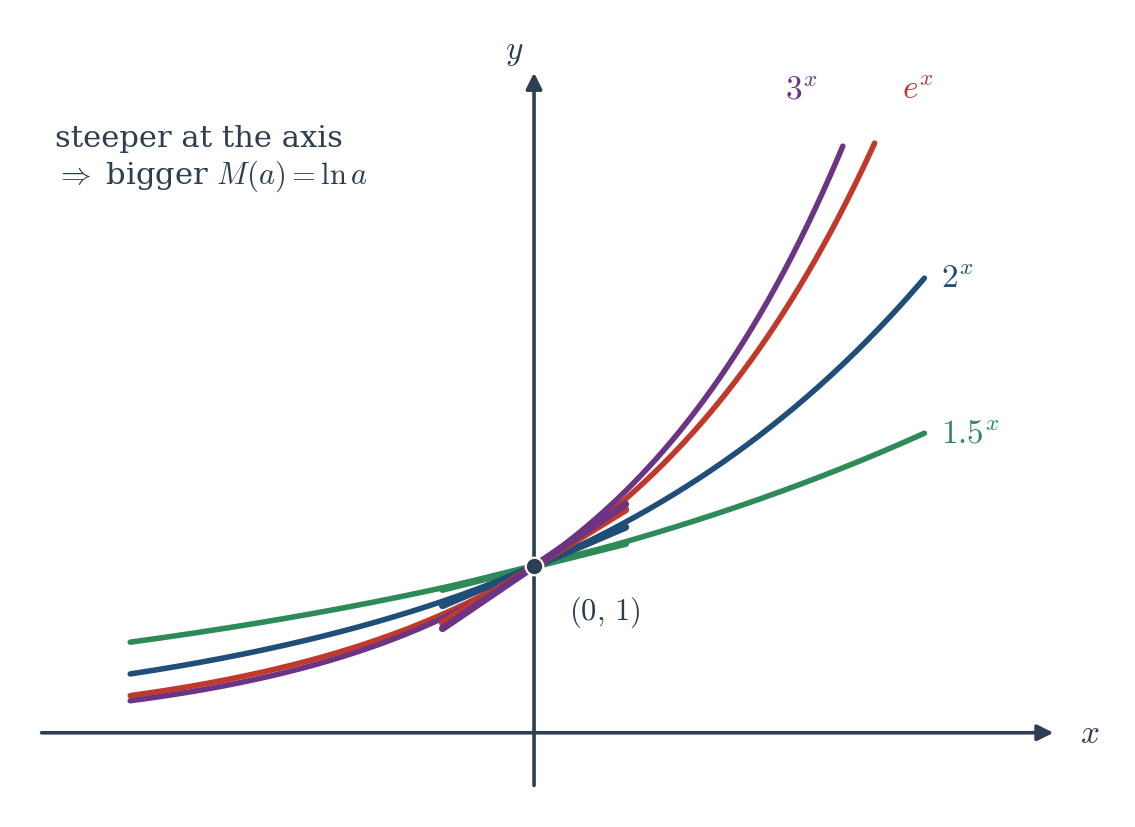
One more thing to notice before we hunt for that base. What is , geometrically? Plug into the boxed rule. Since , the slope of at is exactly . So:
is simply the slope of the curve as it crosses the -axis.
That gives us something we can actually look at. (Figure 5.1: the curves , , and a couple of others, each with its tangent line drawn where it crosses the -axis. The steeper the curve leaves the axis, the bigger .)