Calculus I
The Fundamental Theorem of Calculus
Or: why finding an area is the same as undoing a derivative — the summit of the book
Companion notebook. Play with this chapter’s ideas — sliders, animations, and drills — in
notebooks/ch11_fundamental_theorem.ipynb.
This is the chapter everything has been climbing toward. In Chapter 10 you built two things and left them estranged: the definite integral, a signed area defined as a punishing limit of rectangle-sums, and the antiderivative, found in seconds by running the Chapter 4 rules backward. They share a symbol and seem to share nothing else. This chapter proves they are the same — that the area under a curve can be computed by undoing a derivative — and that single fact is the most consequential theorem in all of calculus, perhaps in all of the mathematics that science uses.
By the end you will be able to evaluate a definite integral in one line instead of a page; you’ll learn integration by parts, the product rule run backward; you’ll see how every “total” — an area between curves, a volume, the length of a curve — is the same slicing-and-summing idea, so you never have to memorize a formula you can rederive; and, as the book’s final act, you will define the logarithm as an integral and watch every loan we took on about and — taken on faith chapters ago — get paid in full.
The whole chapter rests on one picture: let the right edge of an area move, and watch how fast the area grows.
The bridge, discovered: a moving area
Take a continuous function and define the area-so-far function
the signed area under from the fixed left edge out to a movable right edge . (You met this in Chapter 10’s last problem, where quietly turned out to have derivative .) Now ask the central question: how fast does this area grow as you slide to the right? — that is, what is ?
Push the right edge out by a tiny amount . The area gains a thin vertical strip of width and height about , so the extra area is approximately :
Let and the approximation becomes exact. The left side is the definition of . So : the rate at which area accumulates is exactly the height of the curve. (Figure 11.1: the region under from to , with the thin strip of width and height added on at the right edge — the strip whose area is .)
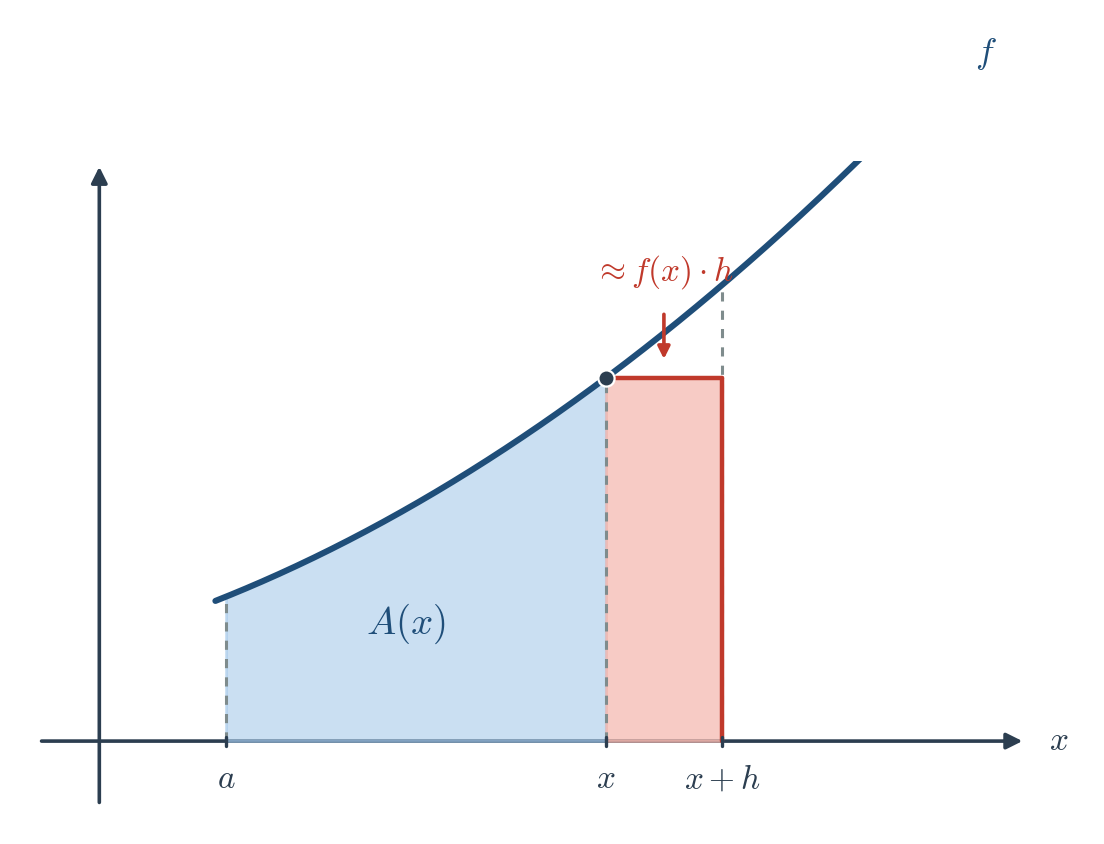
That is the entire secret. Differentiating the area gives back the curve. Read it the other way and it says the area function is an antiderivative of — which is the bridge between the two faces.
◆ Layer 2 — The strip argument, made rigorous
“The strip has height about ” needs tightening. On the little interval , the continuous function has a minimum value and a maximum (Extreme Value Theorem, Chapter 2). The strip’s area is squeezed between the areas of the short and tall rectangles: Divide by : . As the interval shrinks to the point , and by continuity both and converge to . The middle is squeezed (Chapter 2’s Squeeze Theorem) to . Hence , exactly.
This is half of the theorem.
Fundamental Theorem of Calculus, Part 1. If is continuous and , then is differentiable and Every continuous function is the derivative of its own accumulated area.