Calculus I · The Mean Value Theorem
First, the easy case: Rolle’s theorem
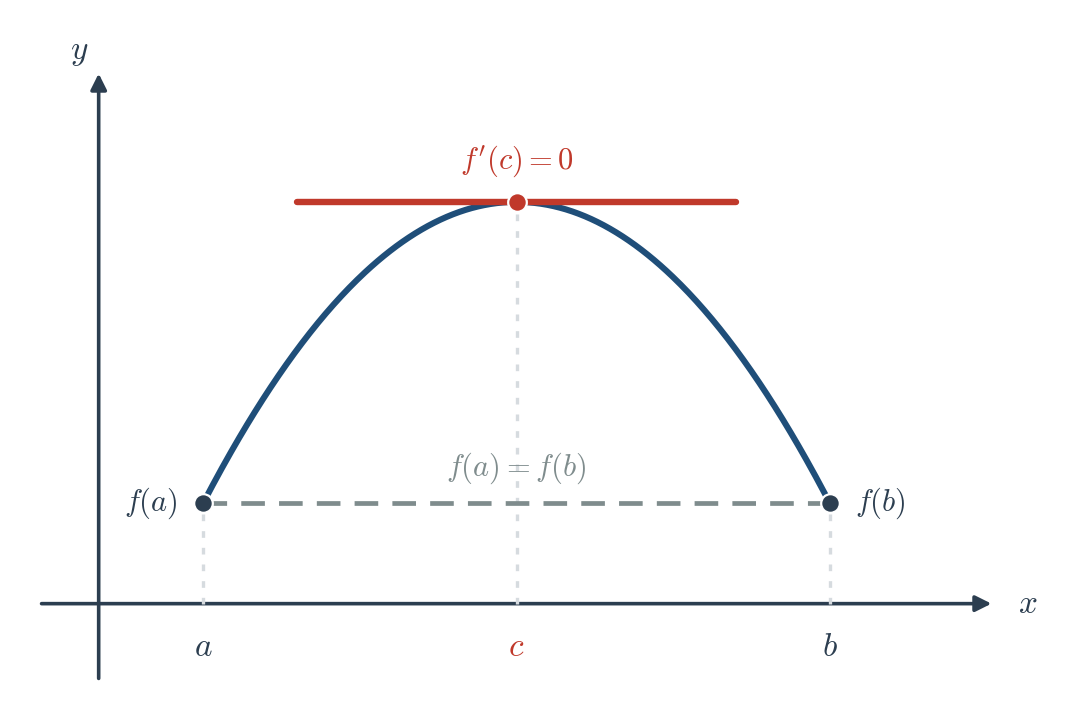
Start with a picture so simple it feels like it can’t be saying much. Suppose a smooth curve starts and ends at the same height — . Draw any such curve in the air with your finger. To come back down to where you started, you had to stop climbing at some point and turn around: there is a peak, or a valley, somewhere strictly between the ends. And at that turning point, the curve is momentarily flat — its slope is zero.
That is the entire content of Rolle’s theorem.
Rolle’s Theorem. If is continuous on , differentiable on , and , then there is at least one point in where .
The proof rests on one small, sharp fact about what the derivative must do at a peak — a fact worth isolating, because we will reuse it when we hunt for maxima in Chapter 8.
◆ Fermat’s lemma: at an interior peak, the slope is zero
Claim. If has a local maximum at an interior point (and exists), then . (Same for a local minimum.)
Why. Look at the difference quotient near the peak. Because is a maximum, the numerator is for every small — you can’t go higher than the top. Now watch the sign of the whole quotient from each side: - From the right (): numerator , denominator , so the quotient is . Taking gives . - From the left (): numerator , denominator , so the quotient is . Taking gives .
The derivative exists, so both one-sided limits equal . The only number that is both and is . So .
With that in hand, Rolle falls out cleanly:
◆ Proof of Rolle’s theorem
By the Extreme Value Theorem, attains a maximum and a minimum somewhere on . Two cases. - If both the max and the min happen at the endpoints, then since , the highest and lowest values of are equal — so is constant, and at every interior . - Otherwise, at least one of them occurs at an interior point . By Fermat’s lemma, there.
Either way, some interior has .
(Figure 6.1: a curve with , its interior peak marked, and a flat tangent line drawn at that peak.)