How Cars Work · The Big Battery
Why the battery is huge
A car uses a lot of energy to drive.
To go 250 miles, an electric car typically needs to store somewhere between 50 and 100 kilowatt-hours of energy. That number doesn’t mean much without comparison, so:
50 kilowatt-hours is roughly the amount of electricity an average American home uses in two days. It is the energy in about a gallon and a half of gasoline. It is enough work to lift a small car twenty miles into the air.
All of that has to fit inside the battery, in lithium-ion chemistry. There is no way around the laws of physics here. Chemistry stores a certain amount of energy per kilogram of material, and lithium-ion happens to store about 250 watt-hours per kilogram. To hold 50 kilowatt-hours, you need at least 200 kilograms — about 440 pounds — of battery cells. Real EV battery packs typically weigh 800 to 1,200 pounds total once you include the housing, cooling system, wiring, and management computer.
That is why electric cars are heavy. The battery is heavy. There is no shortcut.
A gasoline tank, for comparison, is light — gasoline holds about 12,000 watt-hours of energy per kilogram, almost fifty times more than a lithium-ion battery. That is why a single gallon of gasoline goes such a long way, and why electric cars couldn’t compete with gas cars on range until batteries got really, really good.
Cells, modules, and the pack
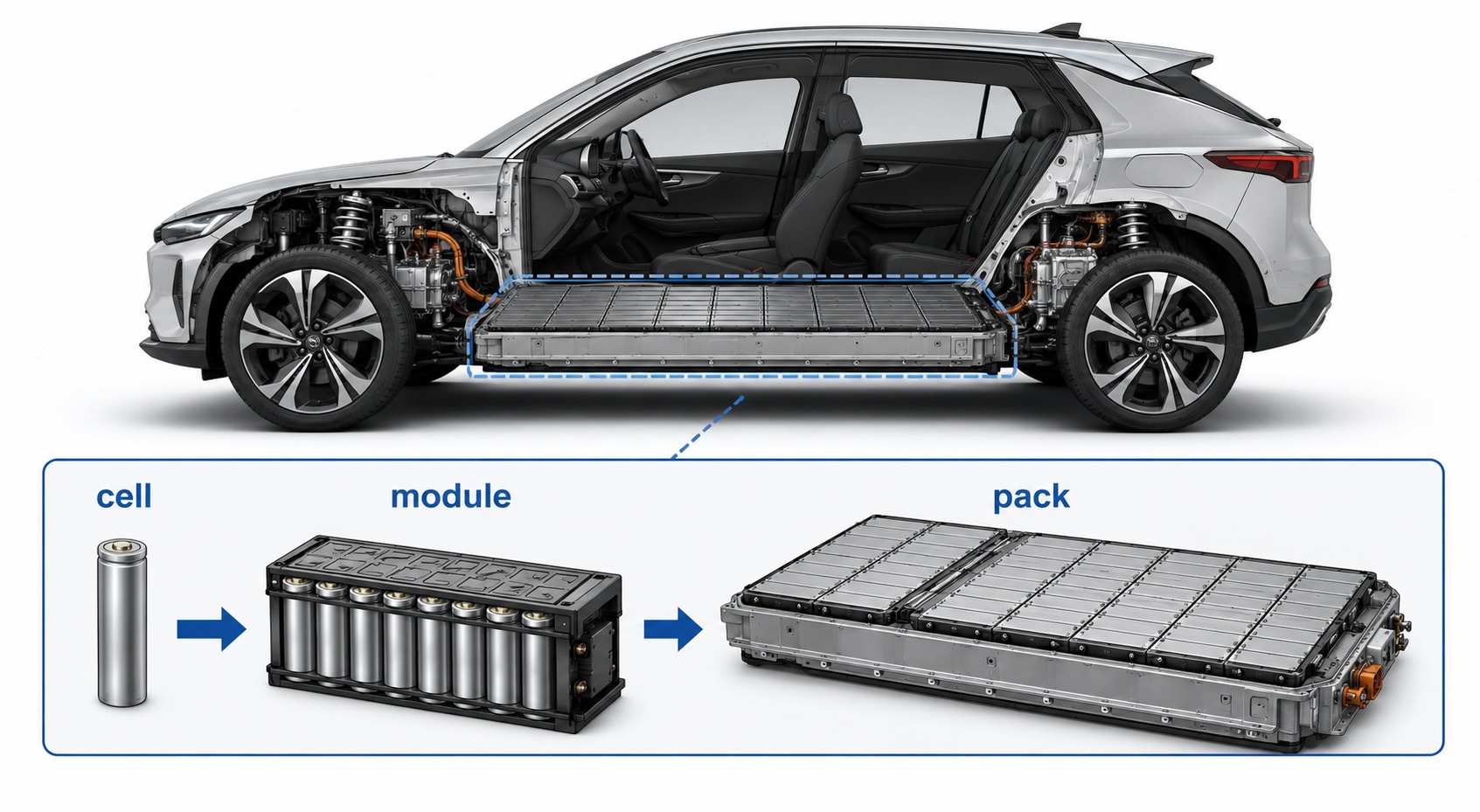
The actual battery in an EV is not one big block. It is made of thousands of little batteries, called cells, packed together like sardines.
A single lithium-ion cell looks more or less like an AA battery, except in different shapes. Some cars use cylindrical cells (like AA’s, but bigger and fatter — about the size of a roll of nickels). Some use rectangular pouch cells (like a thick deck of cards). Some use prismatic cells (like a small juice box). They all do the same thing: they hold about three or four volts of electrical pressure across their two terminals, and somewhere between two and ten amp-hours of capacity. (Roughly: enough energy to power a small light bulb for a few hours.)
To get from a cell to a car battery, engineers do two things. Stack cells end to end, and their voltages add together. Three cells of three volts each, in a stack, give nine volts. This is called wiring them in series. EV battery packs typically have many cells stacked in series to get a total voltage between 300 and 800 volts. Yes — eight hundred volts. That is much higher than the outlets in your house (which are 120 volts), and high enough to be very dangerous if anyone tried to mess with it. EV battery packs are sealed and shielded for exactly this reason.
Side by side, cells share the load and add their capacities. Two cells of three amp-hours each, side by side, give six amp-hours. This is called wiring them in parallel. EVs use parallel wiring to get total capacity high enough to drive hundreds of miles between charges.
Combine series and parallel, and you get a battery with both high voltage and high capacity. A typical EV battery is around 400 volts, with somewhere between 4,000 and 8,000 individual cells, all wired in a careful series-parallel arrangement under the floor of the car. The whole assembly — cells plus the metal housing plus the cooling system plus the wiring plus the management computer that watches every cell — is called the battery pack, or just the pack.