How Cars Work · The Mix
Fast air, low pressure
Here is the trick the carburetor uses, and it is one of the prettiest pieces of physics in any car.
When air moves fast, its pressure drops.
That sentence sounds like nonsense the first time you read it. It is true anyway. Air molecules in slow-moving air have time to push against everything around them — including outward, sideways, on the walls of whatever they’re flowing through. Air molecules in fast-moving air are too busy moving forward to do much pushing sideways. Less sideways push means lower pressure.
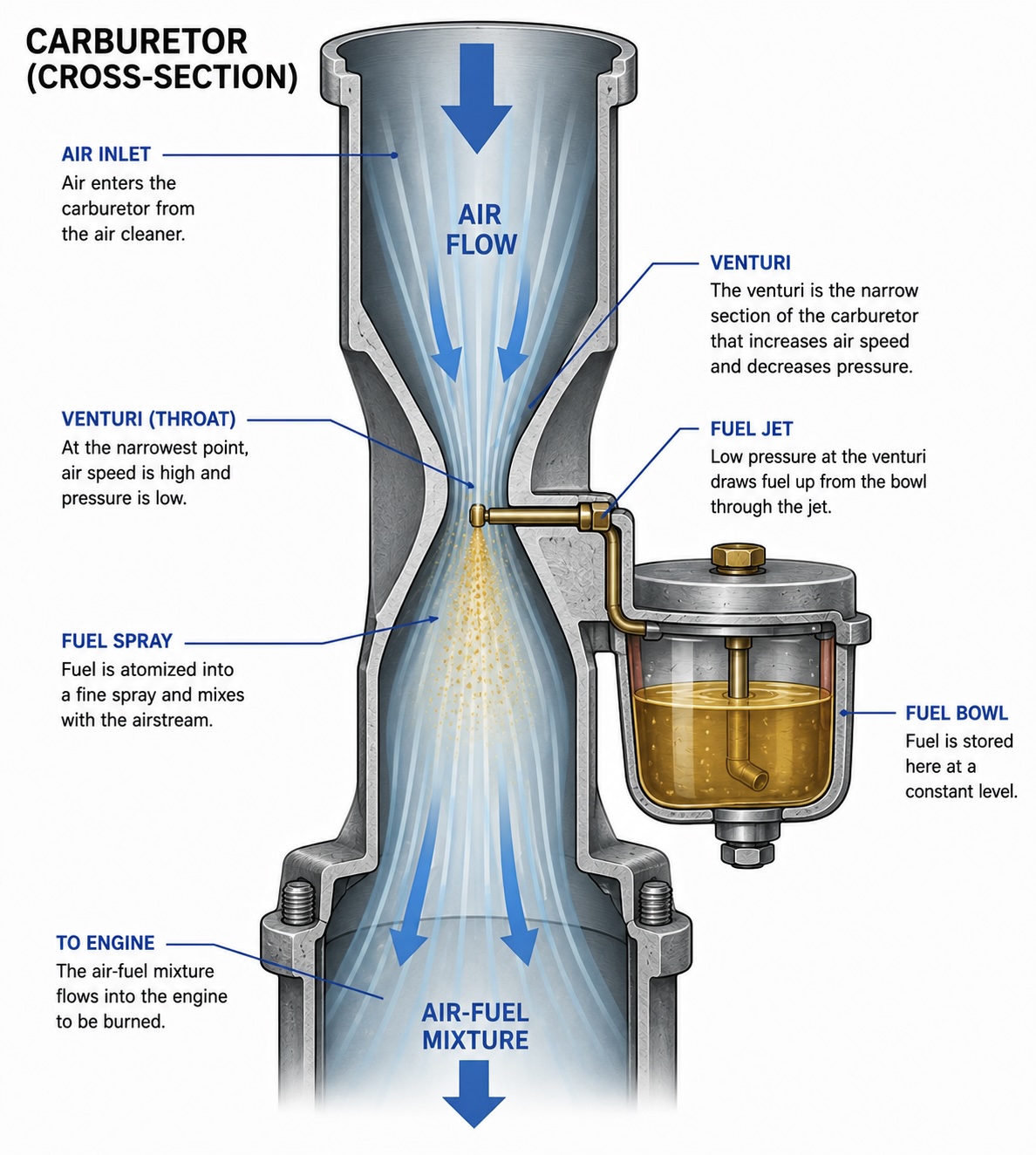
The carburetor takes advantage of this. It is a tube with a narrowed section in the middle, like an hourglass laid on its side. Air gets sucked through the tube by the engine. (Remember the SUCK stroke from last chapter? That is what is doing the sucking.) When air rushes through the narrow part, it has to speed up to fit through the smaller space.
Right at the narrowest point, the engineers have drilled a tiny hole. The hole connects, by a small passage, to a little reservoir of gasoline fed by the fuel pump.
Here is what happens. The air rushing through the narrow throat is moving fast, so its pressure is low. The gasoline in the reservoir is at normal air pressure, which is higher than low pressure. Higher pressure pushes toward lower pressure, so the gasoline gets shoved up through the tiny hole and squirts into the fast-moving airstream. But it doesn’t just dribble out. The fast air rips it into a fine mist on the way past.
By the time the air leaves the carburetor, it is full of perfectly suspended droplets of gasoline, ready to burn. That is the entire trick. Fast air, low pressure, fuel sucked up, atomized, mixed.
Try It: The Straw Atomizer
You will need:
A glass of water
Two regular drinking straws
Stick one straw straight down into the glass of water, with the top of it sticking up about an inch above the water surface.
Take the second straw and hold it horizontally, with one end right next to the top of the first straw — almost touching, but at a right angle, making a T-shape.
Now blow hard through the horizontal straw, across the top of the vertical one. Don’t blow into it — blow across it.
Water rises up the vertical straw and sprays out the top as a mist. Sometimes it shoots out hard enough to soak whatever is in front of you. (Maybe do this over a sink.)
You just made a carburetor. The fast air from your breath, blowing across the top of the vertical straw, lowered the pressure right above it. The water below was at normal air pressure. Higher pressure pushed the water up. The fast air ripped it into a mist on its way past.
That is exactly what is happening inside a carburetor on a running engine, except the air is being sucked through by the engine instead of blown by your lungs, and the liquid is gasoline instead of water. Same physics. Same result.