How Cars Work · The Motor
How a motor actually spins
Here is the trick. You make the spinning magnet not a permanent magnet, but an electromagnet — a coil of wire that becomes a magnet only when current flows through it. Then you do this:
1. Send current through the coil. The coil becomes a magnet, with one end north and the other end south.
2. The coil swings around toward alignment with the fixed magnet, the way the free magnet did in the last section.
3. Just before the coil settles into alignment, you reverse the current.
4. The coil’s north and south ends instantly swap places. Now the coil is pointed the wrong way, and the fixed magnet pushes and pulls it through another half-rotation.
5. Just before it settles again, you reverse the current again. And so on.
The coil keeps swinging around, never quite reaching its happy place because the moment it gets close, you flip the rules on it.
That is a motor. A coil of wire, on a pivot, near a magnet, with the current cleverly flipping every half rotation.
The thing that does the flipping in an old-fashioned motor is called a commutator. It is a clever pair of metal contacts on the coil’s spinning shaft. As the shaft turns, those contacts mechanically reverse the direction of current at exactly the right moment. No software, no controller — just shaped metal doing the right thing as the shaft rotates past.
Modern EV motors don’t use commutators. Instead, a small computer called the motor controller reads the position of the spinning part many times per second and feeds current through the coils in exactly the right pattern at the right moment. This is more efficient, has fewer moving parts that can wear out, and lets the controller play other tricks too — like running the motor faster or slower with great precision, or turning it from a motor into a generator (more on that next chapter).
Stator and rotor
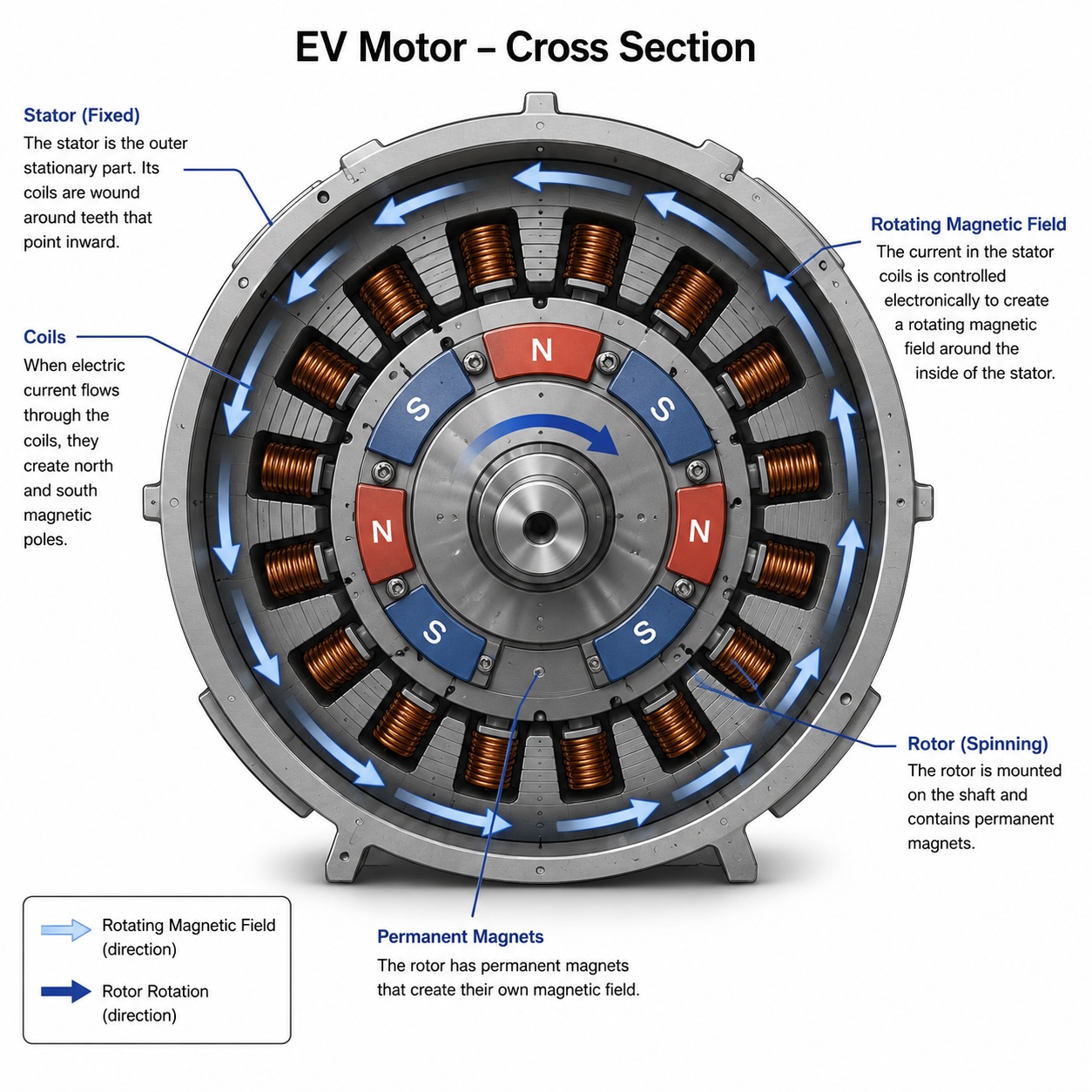
Inside an EV motor are two main pieces. The stator is the part that doesn’t move. It is a hollow cylinder lined on the inside with multiple coils of wire (usually three sets, called the three phases). The motor controller sends current through these coils in a careful, rotating pattern.
The rotor is the part that spins. It sits inside the hollow cylinder of the stator, on a shaft. In the most common type of EV motor, the rotor has its own permanent magnets bolted onto it.
When the controller sends current through the stator coils in the right pattern, the magnetic field inside the stator rotates — the field is moving around the inside of the cylinder without anything physically moving. The permanent magnets on the rotor try to follow that rotating field, the way a compass needle would follow a moving magnet. The rotor spins. The rotating field stays just ahead of it. The rotor chases it forever, or at least until the controller cuts the current.
The shaft of the rotor connects to the wheels through one fixed gear ratio. Spin the rotor, and the wheels turn.