How Cars Work · The Spark
How a coil makes more
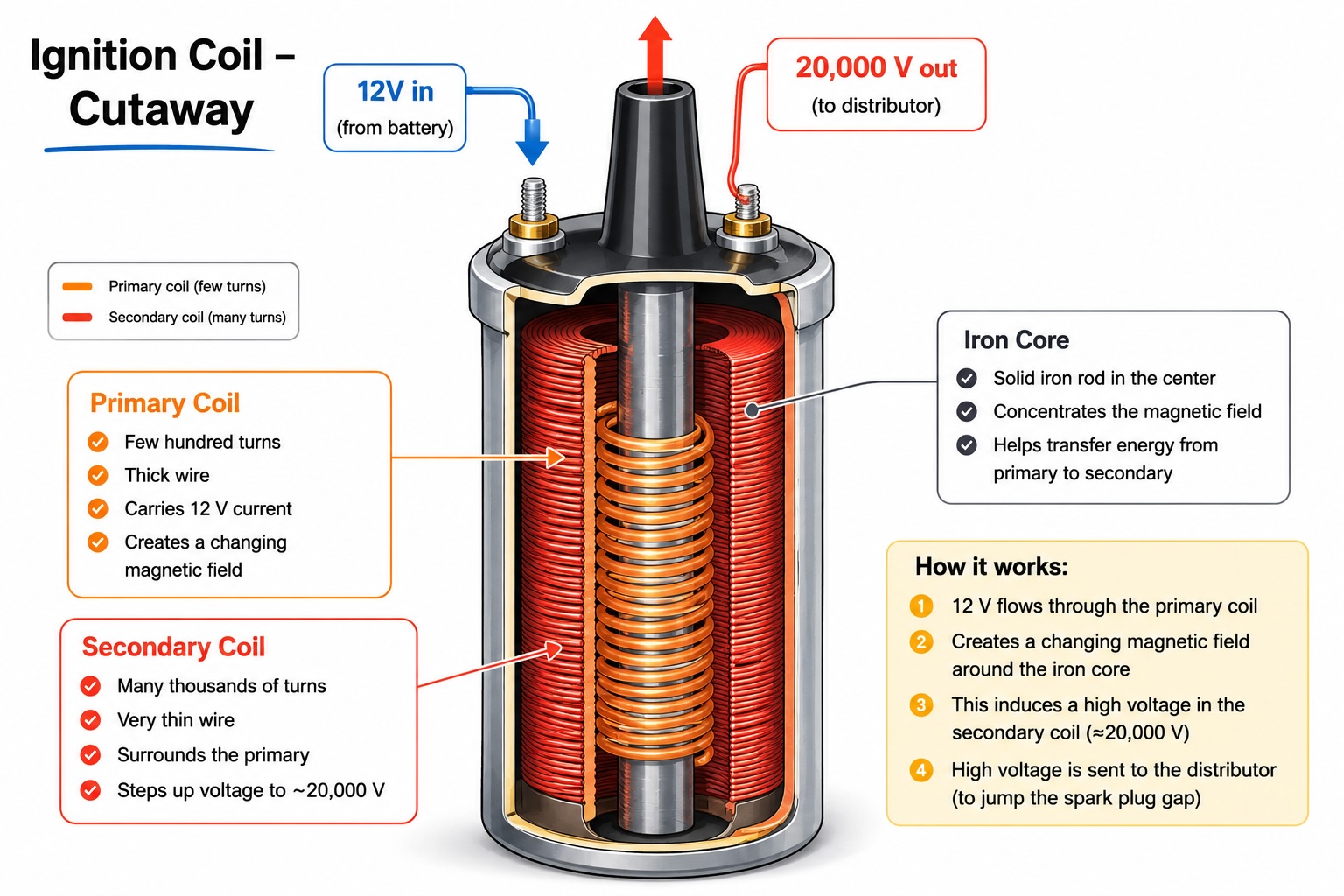
The work is done by a device called the ignition coil. From the outside, it looks like a small black can about the size of a soda can. Inside, it is two long pieces of wire, each wound into a tight coil, both wrapped around the same iron rod.
The two coils have very different lengths. One — called the primary coil — has maybe two hundred wraps of fairly thick wire. The other — the secondary coil — has tens of thousands of wraps of much thinner wire, wound around the outside of the primary.
Here is how it works. When current from the battery flows through the primary coil, the iron rod becomes a magnet. (Coils of wire with current flowing through them act like magnets. Wrap a wire around a nail, hook the ends of the wire to a battery, and the nail will pick up paper clips. Same idea.) The magnetic field threads through the inner coil and also through the much bigger outer coil.
Now the clever part. As long as the current is flowing steadily, nothing interesting happens with the second coil. But if you suddenly turn the current off — if you cut it abruptly — the magnetic field collapses. And here is the rule of physics that makes everything work:
A collapsing magnetic field through a coil of wire creates a voltage in that coil. The faster the field collapses, and the more turns of wire the coil has, the bigger the voltage.
The secondary coil has tens of thousands of turns of wire. When the magnetic field built up by the primary suddenly collapses, the secondary’s many turns each get a tiny voltage, and they all add up to one giant voltage at the ends of the wire.
The math works out about the way you would expect. If the secondary has a hundred times as many turns as the primary, the voltage at the secondary’s ends will be about a hundred times the voltage that was driving the primary. Twelve volts in, twelve hundred volts out. Or twelve volts in and twelve thousand volts out, if the ratio is bigger.
In a real ignition coil, the ratio is about a thousand to one. Twelve volts of battery current goes in. When it gets cut off, twenty thousand volts springs out the other end.