How the World Got Wired · A Memex and a Satellite
The Beach Ball
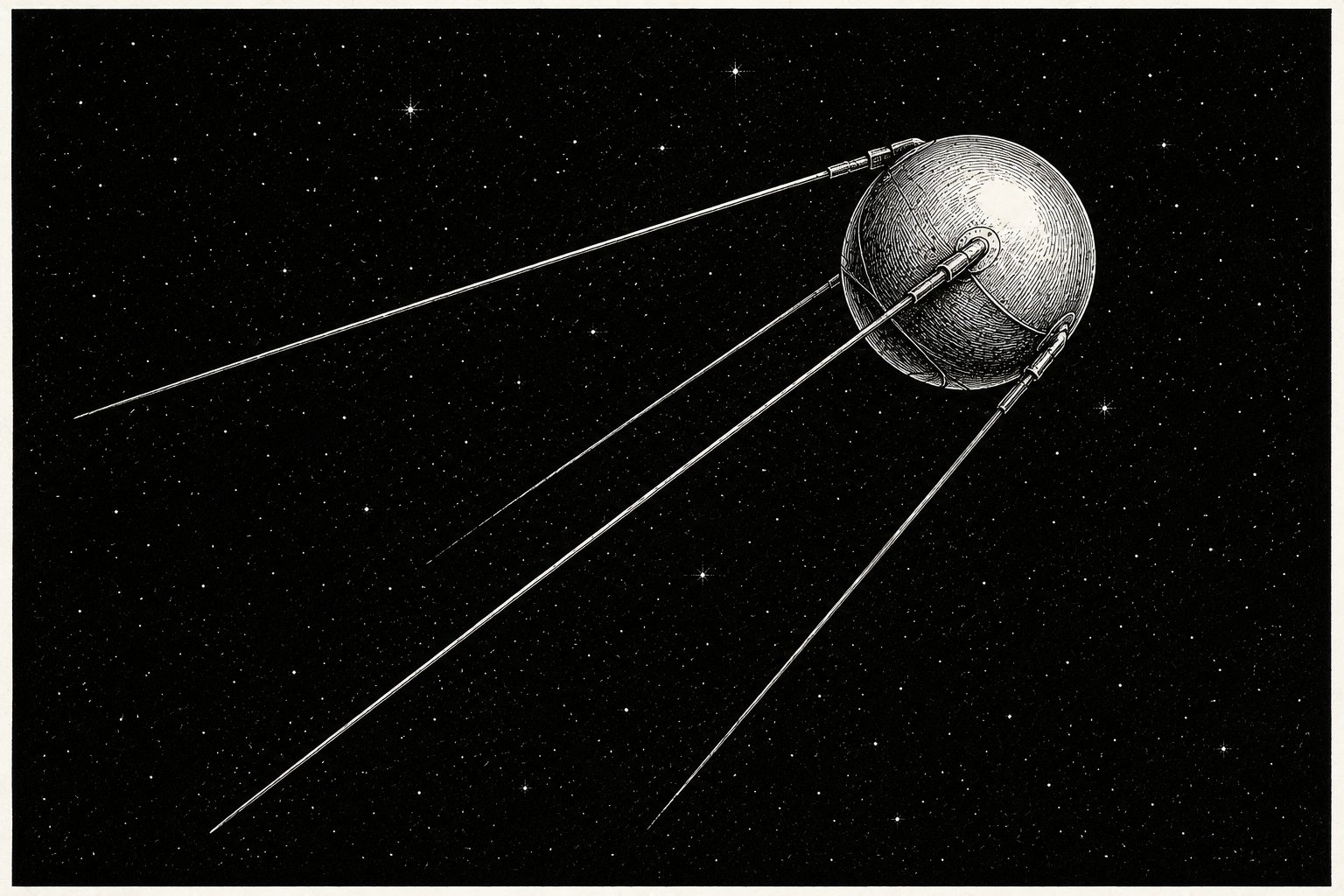
On the night of October 4, 1957, a small metal sphere — polished to a mirror finish, about the size of a beach ball, weighing about 184 pounds — separated from the top of a rocket high above the Earth. It had four whip-like radio antennas trailing behind it. It was now in orbit, which meant it was going to circle the planet, over and over, until something pulled it down. On a clear evening, in the right kind of twilight, you could actually look up and see it — a tiny moving star, much faster than any real star should move.
It was called Sputnik. The word means fellow traveler in Russian.
The Soviet Union had launched it.
Inside Sputnik was a simple radio transmitter, designed to send out a beep on a frequency that almost any shortwave radio could pick up. Beep. Beep. Beep. Every fraction of a second, for three weeks, until the batteries ran out.
Sputnik’s signal was on a frequency that almost any shortwave radio could pick up. All over the world — kids with little radios, men in basements, scientists in observatories — people turned their dials, found the right frequency, and listened to the Russian beach ball announcing itself as it passed over their countries every 96 minutes.
In America, this was a catastrophe.
Not because Sputnik itself was dangerous. Sputnik was just a beeping ball. It couldn’t do anything except beep. But the rocket that had put Sputnik into orbit was the same kind of rocket that could carry a nuclear bomb. The Soviet Union had just demonstrated, in front of the whole planet, that they could launch a heavy object into space and send it precisely to where they wanted.
If they could do that to a beach ball, they could do it to a city.
Worse — much worse, in the minds of many Americans — the Soviets had done it first. The United States had been working on its own satellite. It wasn’t ready. The Russians had beaten them. And the Russians were the people America was most afraid of, because the world after the Second World War had divided itself into two camps that did not trust each other at all, and the Russians ran the other one.
The American newspapers went wild. Politicians gave panicked speeches. Schools were criticized for not teaching enough math and science. Parents wondered whether the country was raising the wrong kind of children. President Eisenhower, who was usually a calm man, tried to reassure everyone, and mostly failed.
Less than four months later, in February 1958, the United States government created a new agency.
All 24 chapters of How the World Got Wired · Library · All courses