How the World Got Wired · Packets
The Pieces
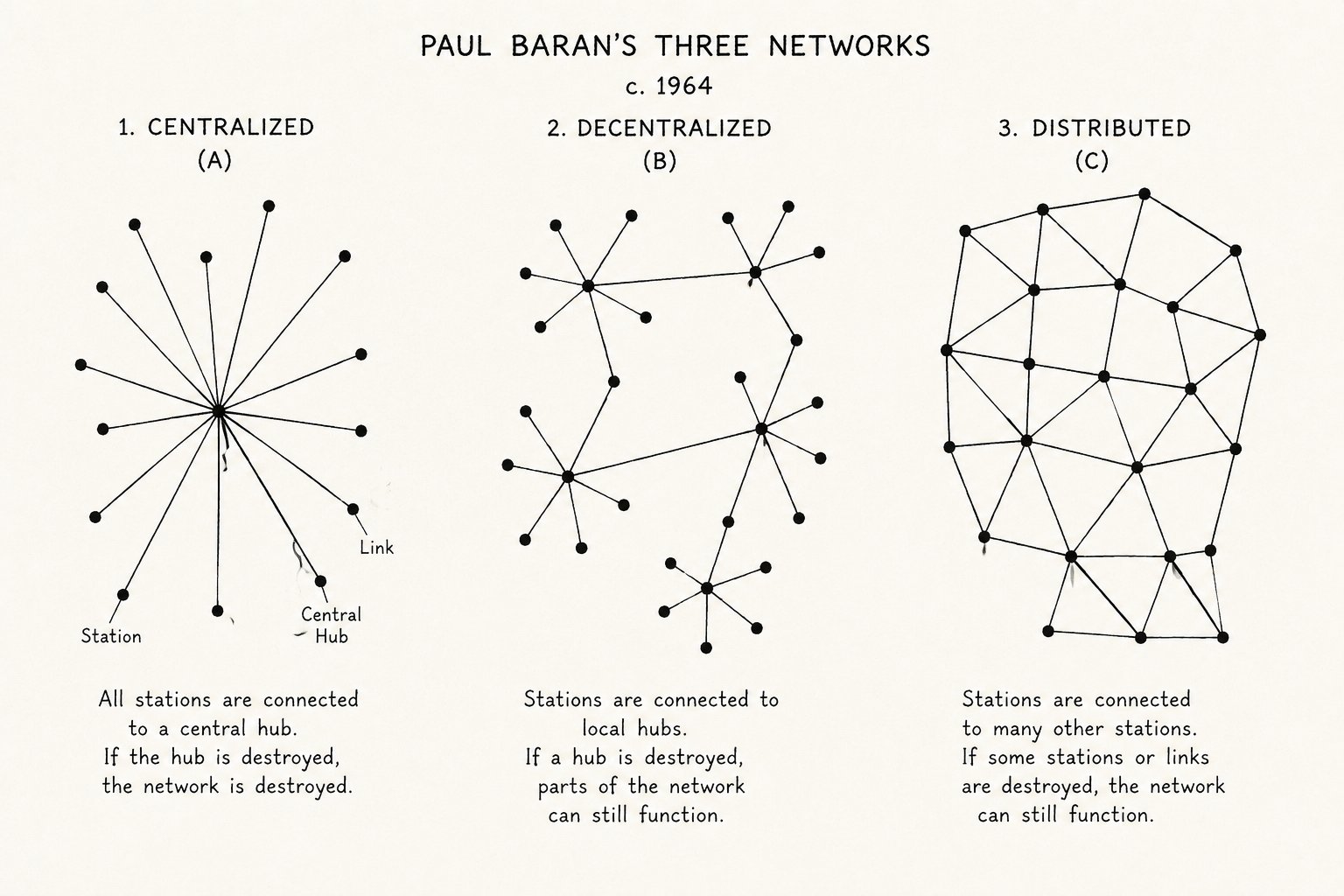
The problem with sending messages through a distributed network was that messages — especially long ones — were not really designed to find their own way. A voice call was a continuous stream. You couldn’t just split it across many paths.
Baran thought about this for a long time, and eventually he had a strange idea.
What if you didn’t send the message as one stream? What if you chopped it into small pieces — short, fixed-size chunks — and sent each piece separately through the network, by whatever path was fastest at that moment? Each piece would have its own little label saying I’m piece number 3 of 47, going to this address. At the other end, the pieces would arrive — maybe out of order, having taken different routes — and the receiving computer would put them back together.
If the network was damaged, the pieces would just go around the damage. If one piece got lost, you could ask for it to be re-sent without having to re-send the whole message. If one path was busy, the pieces would take a different path. The network would be alive and adaptive in a way that the old phone system, with its fixed circuits, could never be.
Baran called these little pieces message blocks. The name didn’t stick. In a few years, an Englishman would come up with a better word, and we’ll get to him in a minute. But the idea — the thing the word names — was Paul Baran’s, in 1960, in an office in Santa Monica, while he was trying to figure out how to keep America talking after a nuclear war.
He spent the next four years filling out the idea. He wrote an enormous report — eleven volumes long — called On Distributed Communications. He sent it to the Air Force. He sent it to engineers all over the country. He went to talk to the people who would actually have to build the thing.
The people who would actually have to build the thing were AT&T, the giant company that ran the American phone system. And AT&T said no.
All 24 chapters of How the World Got Wired · Library · All courses