How the World Got Wired · Search
The Stanford Patent
I want to pause here, because something interesting was happening with the legal ownership of the idea.
Larry Page and Sergey Brin had developed PageRank as part of their dissertation research, at Stanford University, on Stanford’s computers, paid for partly by the National Science Foundation. By the standard rules of American universities, the university owns inventions that its researchers create while doing university work. PageRank, technically, belonged to Stanford.
In 1998, Stanford filed a patent on the PageRank algorithm. The patent listed Larry Page as the inventor, but the owner of the patent was Stanford.
What happened next is unusual in the story of this book. Usually, when public-funded research becomes private wealth, the universities that paid for it get nothing. Cisco’s routers came from Stanford and Stanford got little in return for years. Mosaic came from the University of Illinois and Illinois got a small settlement after a lawsuit. But this time, the lawyers at Stanford were paying attention. They licensed the PageRank patent to Page and Brin’s new company — and as payment, they took 1.8 million shares of the company in return.
For most of the next two decades, those shares grew in value. When Stanford eventually sold the last of them, the university had collected about $336 million from a single patent that two of its graduate students had filed.
A third of a billion dollars, for a public university, from one piece of student research.
This is still rare. Most American universities, even today, do not capture much of the financial value of the things their researchers invent. Stanford did, in this case, partly because they had been burned by missing out on earlier opportunities, partly because they had grown smarter about technology licensing, and partly because Page and Brin themselves wanted the university to get a fair share.
It is one of the small, hopeful patterns in this book. Not all gifts to the public are taken without thanks.
The Garage
By the summer of 1998, Page and Brin had been trying to figure out what to do with their search engine. They didn’t really want to start a company. They wanted to finish their PhDs. So they tried to sell the search engine to one of the big internet companies of that time, and then go back to school.
They went to Excite, one of the major search portals of the day. Excite said no. They went to Yahoo!. Yahoo! said no. They went to AltaVista. AltaVista said no. Nobody, in early 1998, thought a better search engine was particularly valuable. The big companies had decided that the future of the internet was not search but portals — websites like Yahoo! that would be the starting point for everyone’s web browsing, mixing news and email and weather and shopping into a single place. Search was just one small feature of a portal. Why would they pay a million dollars for a slightly better version of one small feature?
Page and Brin were going to drop the whole project and go back to their studies.
In August of 1998, they were introduced to a man named Andy Bechtolsheim. Bechtolsheim was one of the co-founders of Sun Microsystems, an older Silicon Valley company. He was rich. He was an early-stage investor in promising new companies. The introduction was made by a Stanford professor.
The three of them met early one morning on the porch of another professor’s house in Palo Alto. Page and Brin demonstrated their search engine on a laptop. The demonstration lasted maybe fifteen minutes. Bechtolsheim watched. He nodded. He said: this is the most interesting thing I’ve seen in a long time. Why don’t I write you a check.
He pulled out his checkbook. He wrote a check for $100,000, made out to Google Inc. He handed it to Larry Page.
There was, at the time, no company called Google Inc. The name didn’t exist yet. Page and Brin had been calling their search engine BackRub, and then, after thinking about a very large number called a googol (which is a 1 followed by 100 zeros), had tried to name it Googol and accidentally misspelled it on a domain registration. The misspelled version stuck.
Now they had a check for $100,000 made out to a company that didn’t exist. The check sat in a desk drawer for two weeks while they figured out how to incorporate. On September 4, 1998, Google Inc. became a legal entity. The check was deposited.
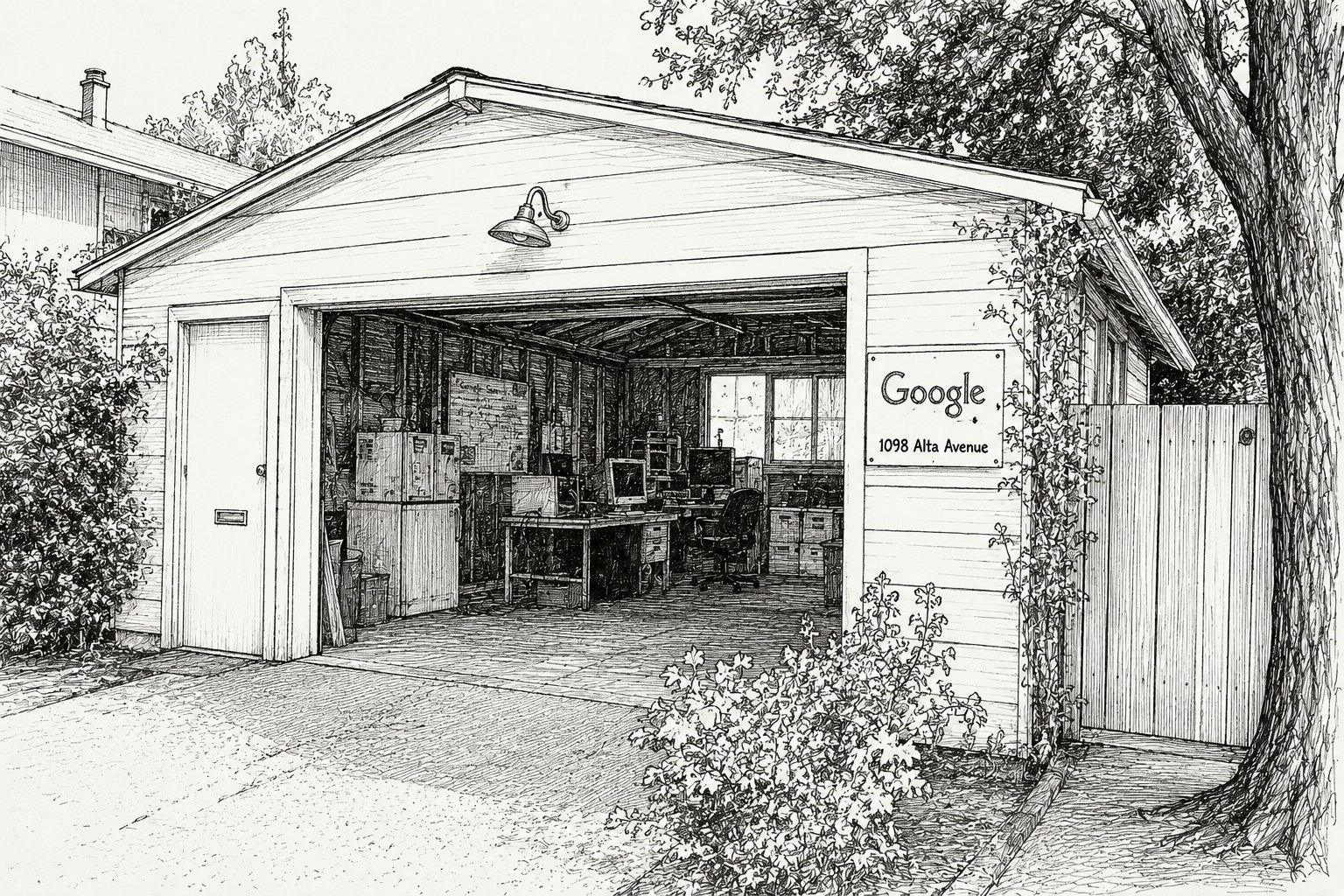
A few weeks later, they moved out of their dorm rooms and into a garage. The garage belonged to a young woman named Susan Wojcicki, who rented part of her house in Menlo Park to her sister’s friends. Wojcicki later joined Google herself. Years after that, she became the CEO of YouTube. The garage, where the entire company fit for about a year, is now owned by Google and preserved as a kind of museum.
All 24 chapters of How the World Got Wired · Library · All courses