How the World Got Wired · Ships and Sharks
How a Cable Gets Laid
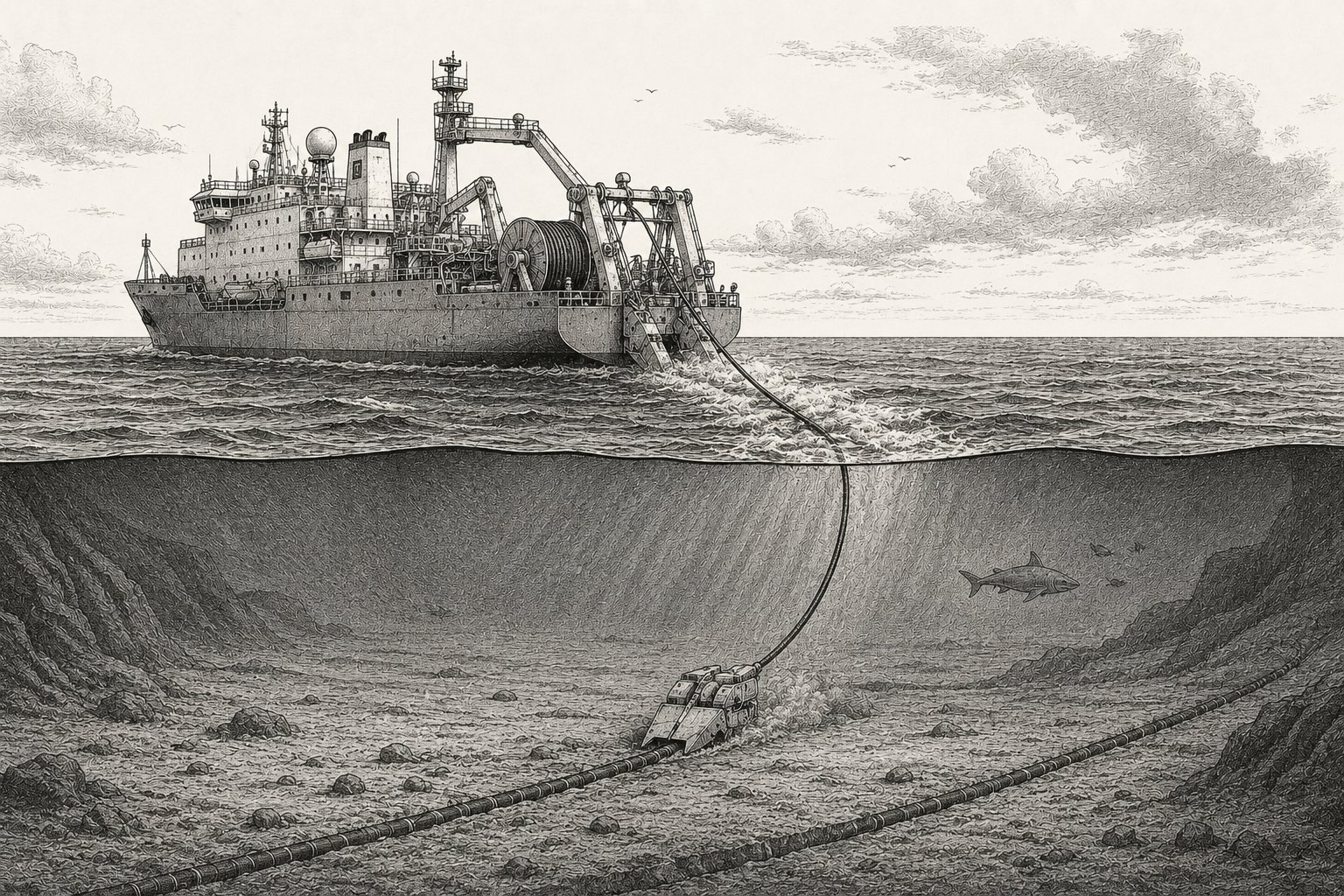
The actual job of putting a cable on the seafloor has not changed nearly as much as you might think.
It is still done by ships. Specialized ships, called cable ships, with reels of cable stacked in their holds. The reels are gigantic — some of them weighing thousands of tons. A single ship might carry enough cable to cross half of an ocean. They have names like CS Dependable and Ile de Bréhat and KDDI Cable Infinity.
When the ship reaches the place where the cable should start, it lowers one end into the water, attaches it to the shore, and then sails very slowly — usually no more than a few kilometers per hour — paying out the cable behind it, like a fisherman letting out a line. A trip across the Pacific can take a cable ship weeks. Sometimes months.
In deep water, the cable just settles onto the seafloor, lying where it lands. In shallow water, where fishing boats and anchors can damage it, the cable is buried. For this, the ship drags an enormous machine called a plow across the seafloor behind it. The plow looks like a piece of farm equipment that has been scaled up by a Jules Verne novel — twenty tons of steel, the size of a small house, with a giant blade that opens a furrow in the seabed, drops the cable in, and lets the ocean floor close back over it.
The cables themselves are surprisingly small. At the very center is a bundle of glass fibers — sometimes only eight strands, sometimes a few dozen, each one thinner than a hair. Around the fibers is a copper tube that carries electricity to power the amplifiers along the way. Around that is more insulation, then a steel sheath for strength, then a tough plastic coating. The whole bundle, in deep water, is about as thick as a marker pen. In shallow water, where it needs more protection, it gets thicker — sometimes as thick as your wrist, with extra steel armor.
Only three companies in the world do most of the cable laying. One is American (SubCom, which began life inside the old AT&T). One is French (Alcatel Submarine Networks). One is Japanese (NEC). Between them, these three companies have laid most of the cables your internet runs on. They are not famous companies. Most people have never heard of them. They are doing some of the most important work on Earth, mostly out of sight.
All 24 chapters of How the World Got Wired · Library · All courses