How the World Got Wired · The Other Internet
The Wall
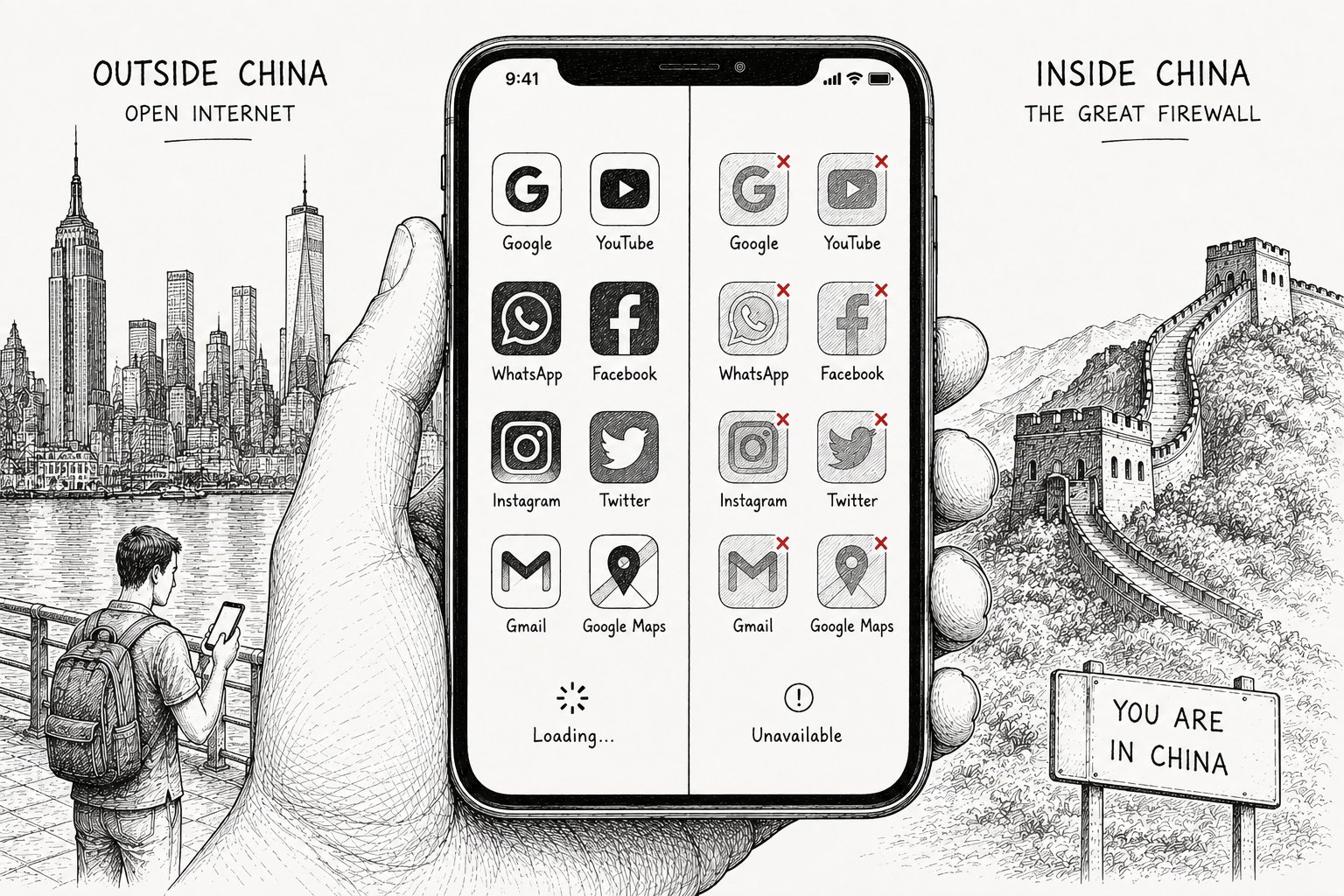
But I have not yet explained the part of the story that started this chapter. I have not yet told you, properly, about why your phone stops working when you land in China.
The Great Firewall — the formal name of the project that runs it is Golden Shield — is one of the most sophisticated information-control systems ever built. It is operated by the Chinese government. It does, basically, three things.
It blocks certain websites and apps from being reachable from inside China. You cannot use Google, Facebook, YouTube, Instagram, Twitter (now called X), WhatsApp, Wikipedia, the major American news sites, and many other foreign services from a normal Chinese internet connection. The blocks happen at the level of the routers — those devices you read about in Chapter 8 — that sit between Chinese networks and the rest of the world. When a packet leaves a Chinese computer trying to reach a forbidden destination, the routers refuse to forward it.
It filters what passes through. Even on sites that are not fully blocked, sensitive content — about certain political events in Chinese history, about current government criticism, about minority groups — is automatically removed or hidden. The filtering is done both by computers (looking for forbidden keywords) and by armies of human moderators.
It tracks. The government can, in many cases, see what people are doing online. This is one of the largest digital surveillance operations in the world.
People in China can sometimes get around the Great Firewall by using a kind of software called a VPN (Virtual Private Network), which makes their connection look like it is coming from somewhere else. VPNs are technically illegal in China, but for years they were widely used, especially by foreign businesspeople and academics who needed to use Google for work. In recent years, the government has been steadily making VPNs harder to use.
I want to tell you something honest about this. From inside the American framework of the open internet, the Great Firewall sounds straightforwardly bad — a system of censorship and surveillance that prevents ordinary people from learning what their government does not want them to learn. From that perspective, it is straightforwardly bad. Free access to information is one of the great gifts of the internet that Cerf and Kahn imagined.
But I want you to also see something more uncomfortable. The Great Firewall is not unpopular inside China. Many Chinese citizens — not all, but many — actually prefer their version of the internet. They do not miss Google. They do not feel that they are missing out by not having Facebook. They have grown up using a different set of products, and from inside their experience, the American internet feels chaotic and untrustworthy. They believe — or many of them believe — that some government oversight of the internet is reasonable, the way some government oversight of food safety or air travel is reasonable. They have made a different bargain than Americans have. Whether the bargain is wise is, in part, a question about values that the world is genuinely in disagreement about. It is not a thing that one side has already won.
All 24 chapters of How the World Got Wired · Library · All courses