How the World Got Wired · The Web, Given Away
What He Built
Now, if you remember Chapter 1, you might be feeling something familiar. A machine that lets you click from one document to another, following links across all the world’s knowledge, connecting any idea to any other idea. That is exactly the machine that Vannevar Bush had imagined in 1945, in his essay about the memex. Bush had described it. Berners-Lee was about to build it.
Bush had imagined the memex as a single desk, with microfilm inside, holding one person’s library. Berners-Lee imagined something much bigger. He imagined every document in the world, on every computer in the world, all linked together, all reachable from anywhere. He didn’t think of it as a desk. He thought of it as a web.
He needed to invent four things to make it work, and over the next two years — partly on his own, partly with a Belgian colleague named Robert Cailliau, who helped him push the idea inside CERN — he invented all four.
The first was a way for documents to be written so they could contain links. He called this language HTML, which stands for HyperText Markup Language. HTML is the language almost every web page in the world is still written in today. You don’t need to understand it to read a web page — your browser does the work — but it is, underneath, very simple. A web page in HTML is just text, with small instructions sprinkled inside it that say this part is a heading, or this part is a paragraph, or this part is a link to another page.
The second was a way for one computer to ask another computer for a document. He called this HTTP, which stands for HyperText Transfer Protocol. When your phone wants to read a web page, it sends a tiny HTTP message to the computer that holds the page — basically, please give me this document — and the other computer sends the document back. (You have seen HTTP without knowing it: every web address you have ever seen starts with the letters http or https. That’s what they mean.)
The third was a way to write down the address of any document, anywhere in the world, in a single line of text. He called this a URL, for Uniform Resource Locator. A URL is what you type into the top of your browser. It tells your computer exactly which document, on which computer, to ask for. The first URL Berners-Lee ever used was info.cern.ch. It still works.
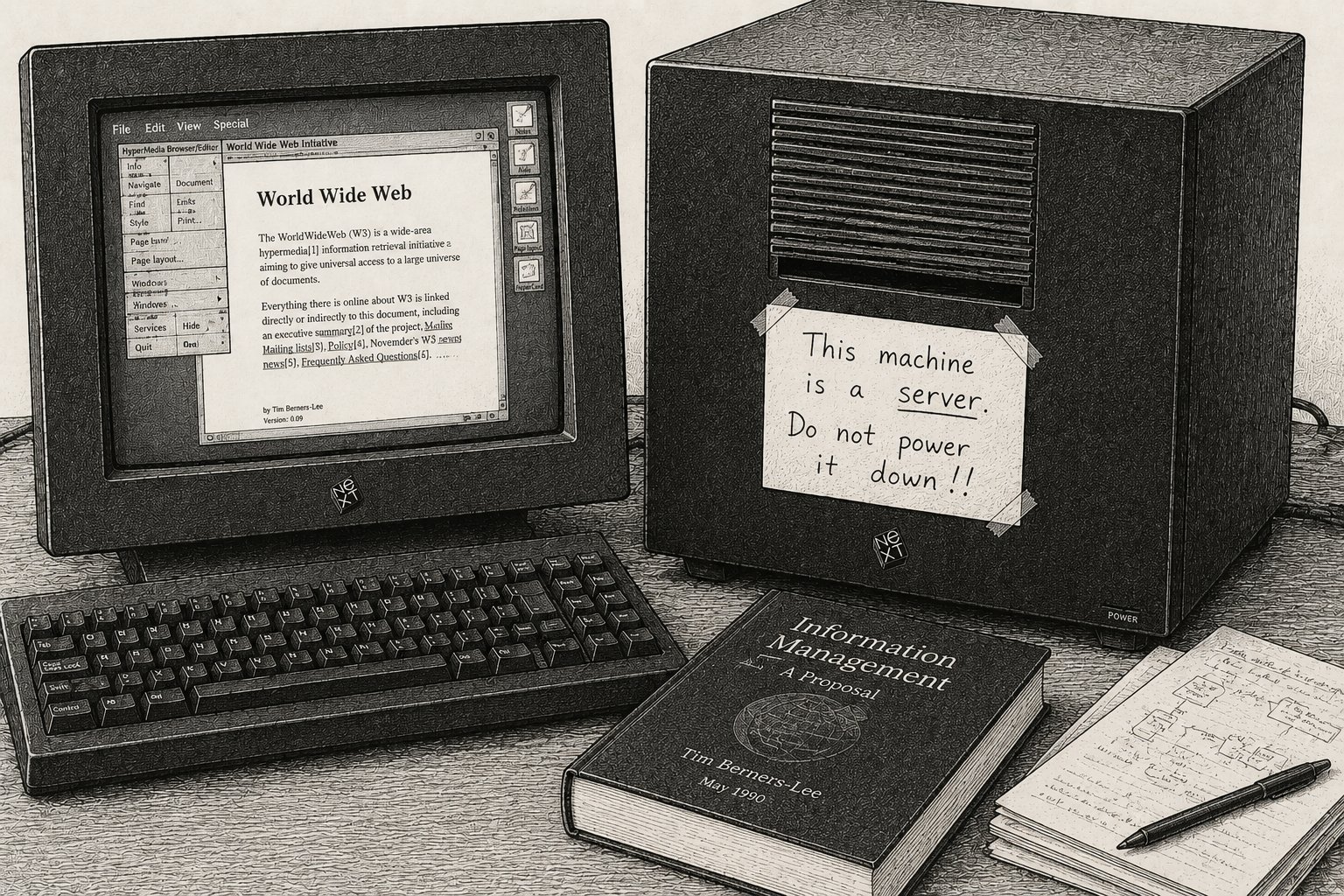
The fourth was the program that let you read web pages — a browser. The very first browser was written by Berners-Lee himself, on a black-and-white computer made by a company called NeXT, which had been started by a man named Steve Jobs after he was fired from Apple. (We’ll meet Steve Jobs again later.) Berners-Lee called his browser WorldWideWeb, which is also what he had decided to call the whole system.
He needed one more thing — a server, which is the program that lives on a computer and hands out documents when other computers ask for them with HTTP. He wrote that too.
By late 1990, all four pieces were working. On December 20, 1990, Tim Berners-Lee turned on the world’s first web server, on his NeXT computer at CERN. He stuck a sticker on the front of the computer that said: This machine is a server. Do not power it down!! The computer is still in a museum at CERN today, with the sticker still on it.
The world’s first website was a few pages explaining what the World Wide Web was and how to use it. It sat at info.cern.ch. For a long time, it was the only website that existed in the world.
All 24 chapters of How the World Got Wired · Library · All courses