How the World Got Wired
Chapter 22 — Two AI Internets
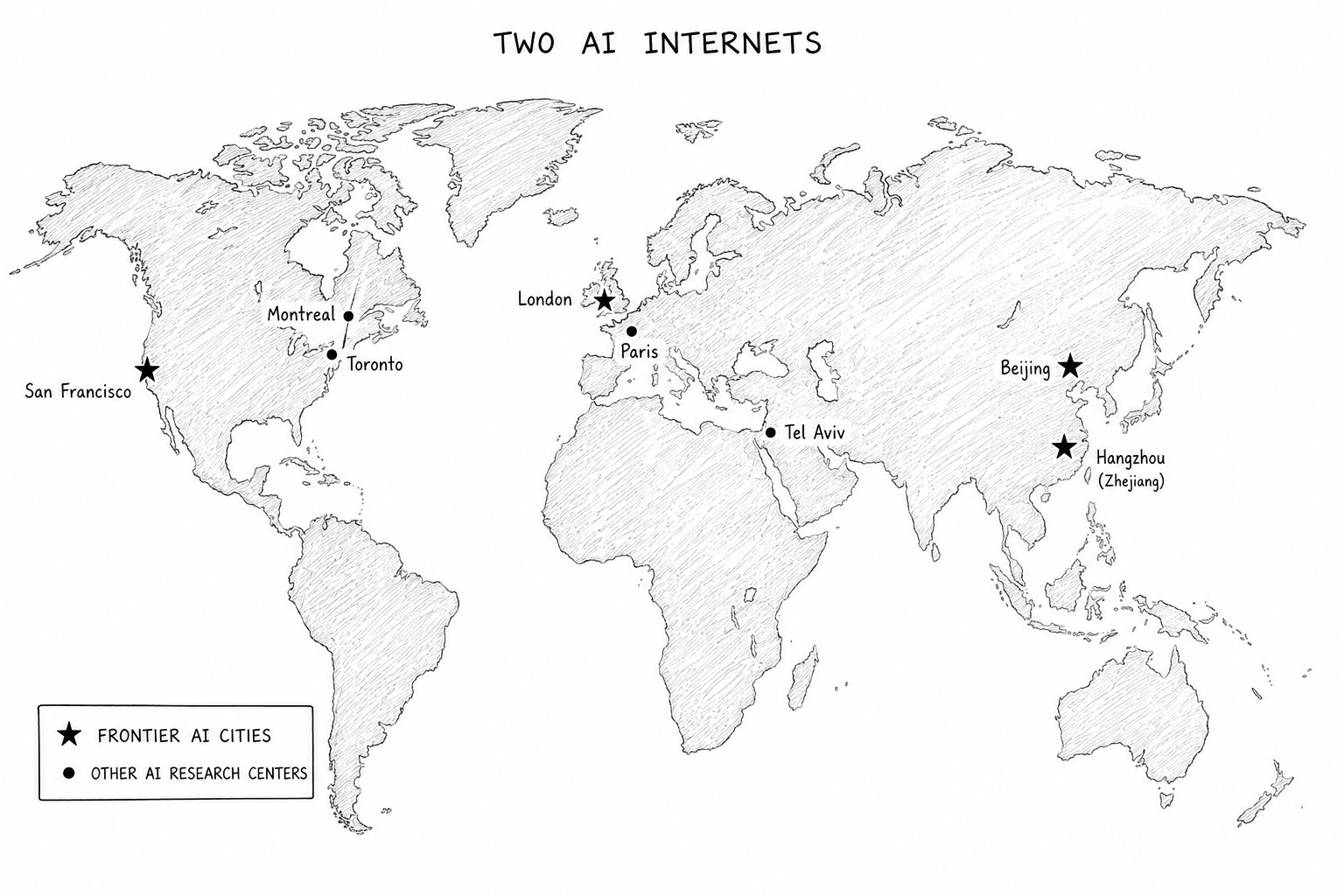
There is a map you can draw of the artificial intelligence race that is happening right now, while you read this book. It is a very small map.
The map has, essentially, three regions on it. The first is the San Francisco Bay Area in California. The second is a small part of central London. The third is a few cities in China — mostly Beijing and Hangzhou, with some activity in Shenzhen and Shanghai.
That is, more or less, the entire map.
There is good artificial intelligence work happening in many other places. In Montreal. In Paris. In Tel Aviv. In Toronto. In Boston. In Seattle. In a dozen smaller centers around the world. But the frontier — the place where the most powerful systems are being trained, where the hundreds of billions of dollars in investment are being absorbed, where the next generation of models is being decided — that frontier is in three metro areas. Everywhere else, including the places that produced the founders of the field, is in important ways downstream.
This chapter is about that map. It is also about why the AI race is going to be the central technological and political story of the next several decades of your life, and about the choices your generation will be asked to make about it.
It is also the last chapter of this book.
The Exiles
Let me start with something that is hard to explain, even for people who follow the technology closely.
In 1987, Geoffrey Hinton moved to Canada. Through the 1990s and 2000s, he trained a generation of brilliant graduate students at the University of Toronto. His colleague Yoshua Bengio, in Montreal, did the same. Between them, Toronto and Montreal produced an enormous fraction of the people who would go on to lead the deep learning revolution.
If you sit, today, in any serious mathematics seminar in New York or Boston or San Francisco, you will hear, frequently, people talking about Montreal. Researchers go there to give talks. Researchers come from there to give talks. A whole intellectual ecosystem has grown up around MILA — the Montreal Institute for Learning Algorithms — and around its founder, Yoshua Bengio. The work being done in Montreal, by Canadian standards, is some of the most important academic AI research in the world.
And yet.
Canada is not where the AI race is happening.
The companies that are right now training the largest, most powerful, most consequential artificial intelligence models in the world are, almost without exception, not Canadian. They are American, or — increasingly — Chinese. The students who trained in Hinton’s lab in Toronto and Bengio’s lab in Montreal mostly left. They went to OpenAI in San Francisco. They went to Anthropic in San Francisco. They went to Google DeepMind in London. They went to Meta’s research lab in California. The patient Canadian investment of decades — the modest grants from the Natural Sciences and Engineering Research Council, the CIFAR program Hinton ran, the universities that paid the salaries — produced a technological revolution that is now, by and large, being capitalized on somewhere else.
You have seen this pattern before in this book. Small countries pay for the foundations. Large companies in large countries build the wealth.
Bengio has stayed in Montreal. He is one of the most respected voices in the field, and like Hinton, he has spent recent years warning the world about what AI is becoming. But the frontier — the actual building of the most powerful systems — has, for reasons of capital and scale and energy and gravity, moved south.
The same thing is happening, in different forms, across most of Europe. Germany, despite being one of the largest economies in the world, has almost no frontier AI lab to speak of. The United Kingdom has Google DeepMind — but DeepMind, although it was British-founded, has been owned by Google since 2014. France has done better than most: a company called Mistral, founded in 2023, has built genuinely competitive open-source models. But Mistral, by global standards, is still small. The rest of Europe has produced some interesting research but nothing at the scale that defines the frontier.
There is a pattern here that you should notice clearly. The current race to build the most powerful artificial intelligence systems is being run, almost entirely, in two countries: the United States and China. Everywhere else has talent. Almost nowhere else has the combination of capital, energy infrastructure, regulatory permissiveness, and concentration of senior researchers willing to relocate that the frontier requires.
The internet, when it was built in the 1990s and 2000s, was much more geographically distributed. Hundreds of cities mattered. Today’s AI race has perhaps three cities that matter, and arguably one of those three (London) is mostly an outpost of an American company.
This is, I want to suggest gently, a strange situation. It is worth your noticing.
All 24 chapters of How the World Got Wired · Library · All courses