How the World Got Wired
Chapter 13 — What Survived
In the autumn of 2001, the chief executive of an internet company that almost everyone in America assumed was about to go bankrupt stood up in front of his employees and asked them not to worry.
Many of them were worried.
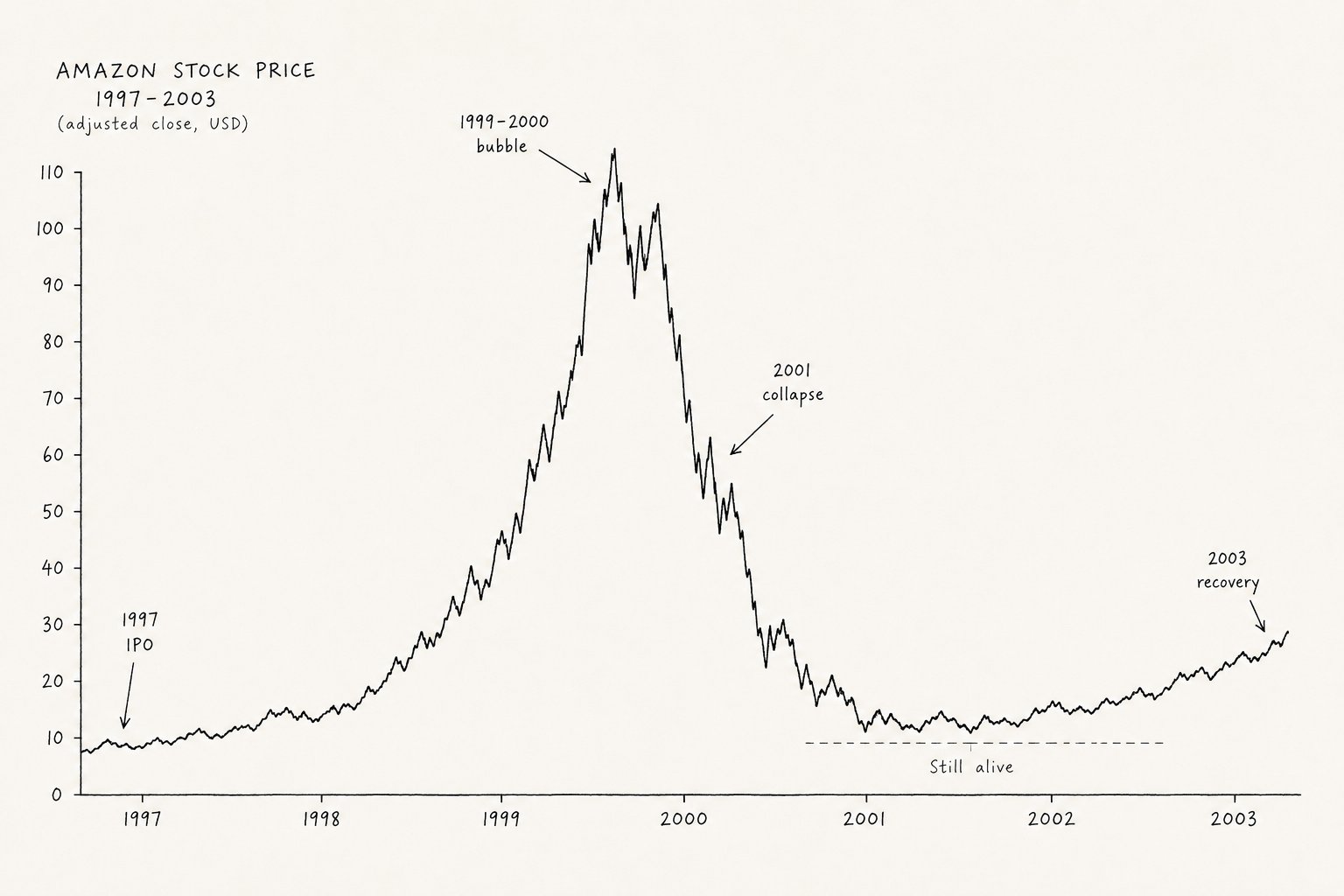
The company’s stock had been worth $113 a share two years earlier. It was now worth less than six dollars. Analysts at major Wall Street banks had recently predicted, in writing, that the company would run out of money before the end of the year. The previous January, the company had laid off 1,300 employees — about fifteen percent of its workforce. Newspapers wrote about the company the way they wrote about the other dot-com flops you read about in the last two chapters. It was, the conventional wisdom said, just a matter of time.
The chief executive’s name was Jeff Bezos. The company was called Amazon.com.
The conventional wisdom turned out to be wrong.
This chapter is about why.
Amazon, Almost
Jeff Bezos had founded Amazon seven years earlier, in 1994. He was thirty years old at the time. He had quit a comfortable job at a Wall Street hedge fund — where he had been making far more money than most people make in a lifetime — to drive across the country with his wife, in a Chevrolet Blazer, while she did the driving and he wrote a business plan on his laptop in the passenger seat. The business plan was for an online bookstore.
Books, he had decided after thinking carefully about the question, were the perfect product to sell over the early internet. There were too many books in print for any physical store to stock more than a tiny fraction of them. An online store, which only had to keep books in warehouses rather than on shelves, could carry every book in print. People who bought books already knew what they wanted before they bought it — they didn’t need to flip through the actual paper version to decide. And books were small, durable, and easy to ship.
He set up shop in a garage in Seattle. He opened the website on July 16, 1995. He gave it a name from a river in South America — the largest river in the world, by volume, just like he hoped his store would eventually be.
For the next four years, Amazon grew very fast and lost money every single quarter. This was, you should remember from Chapter 11, completely normal for that era. The strategy was get big fast. You raised money from investors, you used it to advertise and to expand into new product categories, and you worried about being profitable later.
Amazon’s investors were patient. The stock price climbed and climbed through the late 1990s, reaching its peak of $113 a share in December of 1999. Bezos, on paper, was a multi-billionaire. Time magazine named him Person of the Year — its highest annual honor, given that year not to a politician or a humanitarian but to a man who sold books over the internet.
Then March 2000 came, and the bubble burst, and everything turned around.
Amazon’s stock fell along with everything else. Then it kept falling. Through the year 2000, then 2001, the price collapsed by more than ninety-five percent. Bezos’s personal fortune, on paper, dropped by tens of billions of dollars in a year and a half. The press, which had loved Amazon during the boom, turned on it. A famous report by an analyst at Lehman Brothers in 2000 had predicted, bluntly, that Amazon’s debts would crush it before it ever became profitable.
The strange thing, looking back, is that the analysts were not wrong about the numbers. Amazon really was losing money. Its debts really were enormous. Its products — books, then CDs, then DVDs, then toys — really were sold at razor-thin margins, often at losses. By every traditional measure, Amazon in 2000 and 2001 was exactly the kind of company that should have failed.
The reason it didn’t fail is mostly two things.
The first thing is that Jeff Bezos had been writing, every single year since 1997, a letter to his shareholders explaining what kind of company he was trying to build. In every letter, he reprinted, at the end, the original 1997 letter. The original letter was titled simply It’s All About the Long Term. It explained that Amazon was not trying to maximize quarterly profits. It was trying to build a company that would matter for decades. It was going to take risks that wouldn’t pay off for years. It was going to disappoint shareholders who wanted quick returns. Anyone who didn’t want this should not invest.
Almost nobody in Silicon Valley wrote letters like that. Bezos wrote one every year, for over twenty years.
The second thing is that in early 2001, when the analysts were predicting Amazon’s death, Bezos got serious. He laid off the 1,300 employees. He closed an entire warehouse. He shut down a customer-service center. He cancelled programs that weren’t profitable. He demanded that every part of the business explain, in writing, why it deserved to keep existing.
By the end of 2001 — the same quarter when most of the dot-com sock-puppet companies were filing for bankruptcy — Amazon reported its first ever profitable quarter. The profit was tiny. Just five million dollars. But for the first time in seven years, the company had earned more than it had spent.
The stock began to climb back up. Slowly at first. Then faster. By 2007 it was higher than it had been at the bubble peak. By 2010 it had quadrupled from that.
Amazon today, when this book is being written, is one of the largest companies in the world. It has roughly a million employees, more than the entire population of many countries. It owns a major fraction of the global cloud computing market through a service called Amazon Web Services — a business that started, almost as a side project, in 2002. It owns the Whole Foods grocery chain. It owns Audible, the audiobook company. It owns the Washington Post newspaper. It builds movies and television shows.
But it nearly died in 2001. If Bezos had panicked, or if his shareholders had forced him to chase short-term profits earlier, or if he had not written those long-term letters and made his investors agree to them in advance — it would not have made it.
All 24 chapters of How the World Got Wired · Library · All courses