How the World Got Wired
Chapter 20 — Why Hinton Went North
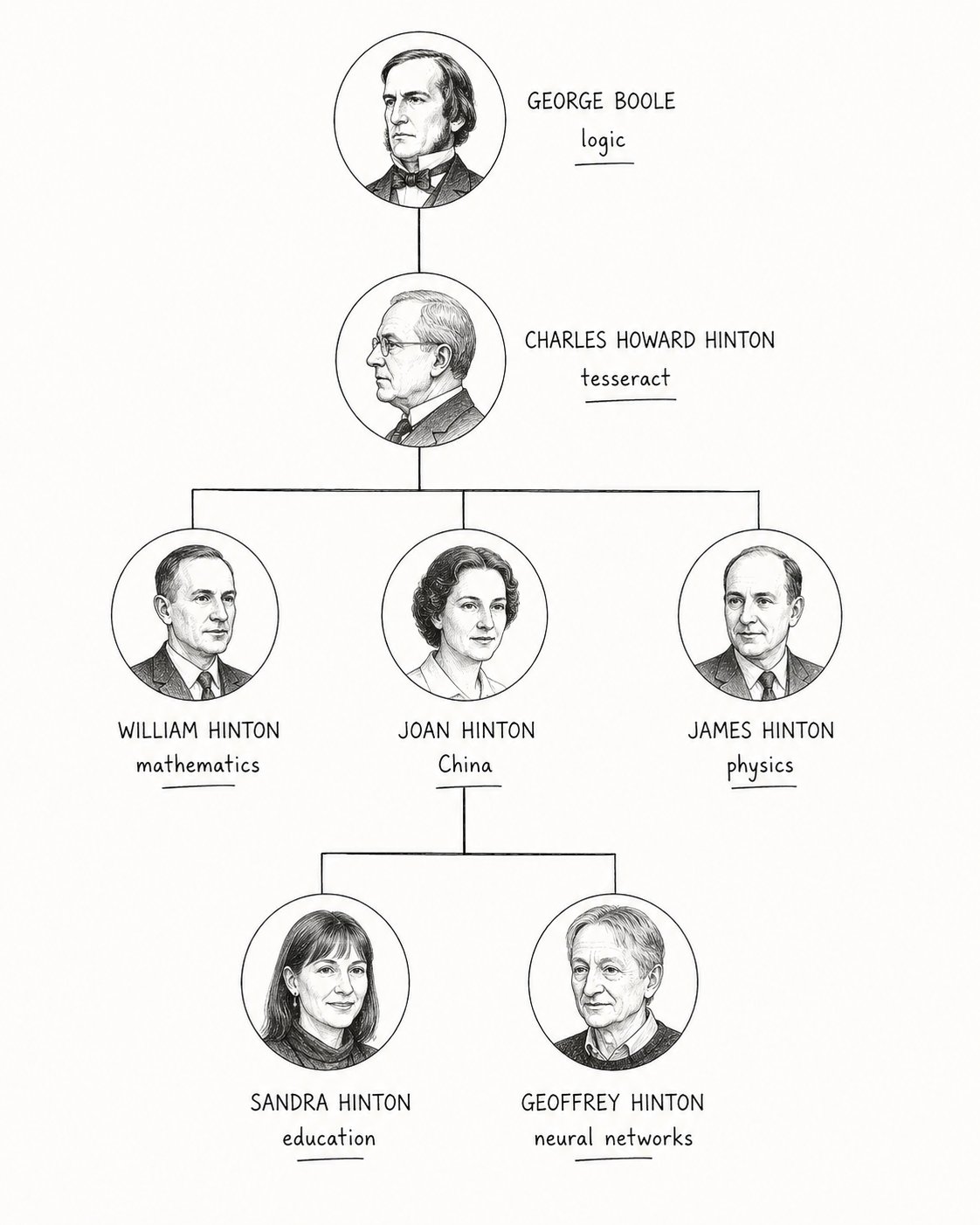
To understand Geoffrey Hinton, you have to understand his family.
Hinton’s great-great-grandfather was a man named George Boole. Boole was a mostly self-taught mathematician in nineteenth-century England who, in 1854, published a book about how the rules of human reasoning could be described using a kind of algebra. He defined a small set of logical operations — what we now call AND, OR, and NOT — and showed that complicated thoughts could be built up from them. The system he invented, now called Boolean logic, is the mathematical foundation of every digital computer ever built. Every microchip you have ever used, every program that has ever run, every line of this book that arrives on your screen, is in some way built on the work of one of Geoffrey Hinton’s great-great-grandparents.
This is, even by the standards of brilliant scientific families, an unusual ancestor.
The Boole-Hinton family has been producing original thinkers continuously, in different fields, for almost two hundred years. George Boole’s wife, Mary Everest Boole, was a mathematician and educator in her own right. Their daughters and granddaughters became mathematicians, writers, and scientists. Geoffrey’s great-grandfather, Charles Howard Hinton, was a mathematician who became famous in the late 1800s for his work on the geometry of four-dimensional space — he is the person who coined the word tesseract, which is the four-dimensional cousin of the cube. A different branch of the family produced Joan Hinton, a nuclear physicist who worked on the Manhattan Project, the American program that built the first atomic bombs in the 1940s. After the war, horrified by how the bomb had been used, Joan Hinton left the United States and moved to China, where she spent the rest of her life working on agricultural science. She died in 2010, still in China, having spent more than sixty years there.
This is the family Geoffrey Hinton was born into, in 1947, in a town called Wimbledon, just outside London.
You should not be surprised, after meeting that family, that Geoffrey Hinton would turn out to be both an extraordinarily original scientist and a person with strong, unconventional views about who his work should belong to. The pattern was set.
All 24 chapters of How the World Got Wired · Library · All courses