Reactions, Moles & Composition — Chapter Practice, Grade 11
Account for atoms, charge, particle counts, and measured composition.
Problem 1
- synthesis
- decomposition
- single replacement
- combustion
Answer and explanation
synthesis
Several substances combining into one product is the defining pattern of a synthesis (combination) reaction.
Problem 2
- CaCO₃ → CaO + CO₂
- CH₄ + 2O₂ → CO₂ + 2H₂O
- AgNO₃ + NaCl → AgCl + NaNO₃
- 2Na + Cl₂ → 2NaCl
Answer and explanation
CH₄ + 2O₂ → CO₂ + 2H₂O
A fuel (methane) reacting with oxygen to give carbon dioxide and water is complete combustion.
Problem 3
- synthesis
- decomposition
- single replacement
- double replacement
Answer and explanation
decomposition
A single compound breaking apart into simpler substances is decomposition (AB → A + B).
Problem 4
Answer and explanation
1 molecules
The coefficient in front of H₂ is 1, so one zinc atom releases one H₂ molecule.
Problem 5
Answer and explanation
It is a synthesis reaction. Magnesium combines with oxygen to form magnesium oxide, MgO. The balanced equation is 2Mg + O₂ → 2MgO.
Problem 6
- CaCO₃ → CaO + CO₂
- 2H₂ + O₂ → 2H₂O
- Fe + CuSO₄ → FeSO₄ + Cu
- HCl + NaOH → NaCl + H₂O
Answer and explanation
Fe + CuSO₄ → FeSO₄ + Cu
Iron (a lone element) replaces copper in copper sulfate, matching A + BC → AC + B. Because iron is more reactive than copper, the displacement actually occurs.
Problem 7
Hints
Use supplied products and states to justify the category.
Answer and explanation
Complete combustion under the given products; it is also a redox process.
Problem 8
Hints
State what the supplied observations or conditions establish, and separate that from any assumption.
Answer and explanation
Reactant identities and proton-transfer/stoichiometric evidence; warming alone occurs in other processes too.
Problem 9
Answer and explanation
It identifies a separate solid phase, distinguishing precipitation from ions simply remaining in the aqueous phase.
The state symbol (aq) means a species is dissolved in water, not that a solid formula unit is moving unchanged through solution. Precipitation forms a separate solid phase when conditions favor it. A supplied solubility rule can support an introductory prediction, while concentrations and equilibrium determine the more detailed outcome. Gas formation and acid–base reactions can also change aqueous species. A visible change suggests something to investigate but does not by itself establish the exact product identity or amount.
It identifies a separate solid phase, distinguishing precipitation from ions simply remaining in the aqueous phase.
Response criteria
- Interpret labels, structures, axes, units and directions correctly.
- Explain the chemistry relationship or mechanism.
- Respect stated assumptions and distinguish observation from inference.
Problem 10
Answer and explanation
Balance atoms of each element and total charge. A precipitate prediction also needs appropriate solubility/concentration evidence under the conditions; balanced pattern matching alone does not establish a separate solid phase.
Balance atoms of each element and total charge. A precipitate prediction also needs appropriate solubility/concentration evidence under the conditions; balanced pattern matching alone does not establish a separate solid phase.
Response criteria
- Use the stated measurements or conditions, with correct units.
- Connect the result to the chemical mechanism or evidence relationship.
- Identify the assumption, model limit or further evidence requested.
Problem 11
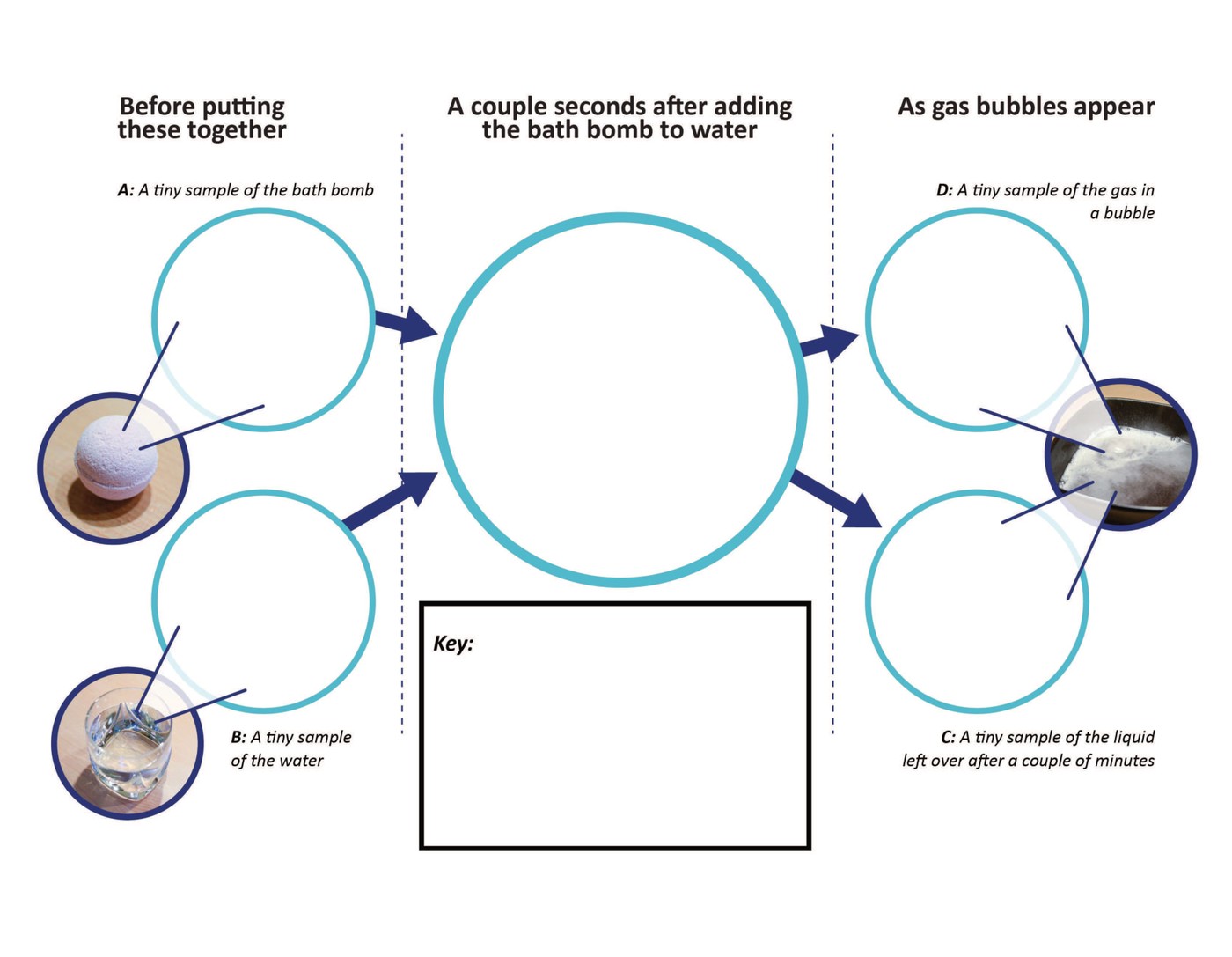
Answer and explanation
Record the visible solid/water and later bubbles or liquid. A completed model must define its species symbols and conserve atoms/material across the boundary, including dissolved and gas species. Bubbles can arise through reaction, vaporization or released dissolved gas; temperature and product evidence are needed to distinguish them.
Identify the source’s visible labels, scales and unfinished or omitted information.
Use the local complete explanations to connect the observation with an explicit mechanism.
State assumptions and a limit before extending the model.
Response criteria
- Interpret the source symbols and boundary correctly.
- Explain the relevant mechanism using quantities/species consistently.
- State a meaningful omission, assumption or evidence limitation.
Problem 12
- Subscripts must always be 1
- There is no real difference between them
- Coefficients are easier to write
- Changing a subscript would change the substance into a different chemical, while a coefficient only changes how many units you have
Answer and explanation
Changing a subscript would change the substance into a different chemical, while a coefficient only changes how many units you have
A subscript defines a substance's identity (H₂O vs H₂O₂), so only coefficients — the 'how many' — can be adjusted.
Problem 13
Answer and explanation
6 atoms
Left: 3H₂ = 3 × 2 = 6 H. Right: 2NH₃ = 2 × 3 = 6 H. They match.
Problem 14
- 1, 1, 1
- 2, 3, 1
- 4, 3, 2
- 2, 1, 2
Answer and explanation
4, 3, 2
4Al + 3O₂ → 2Al₂O₃ gives 4 Al and 6 O atoms on both sides — the smallest whole-number balance.
Problem 15
Answer and explanation
3
2KClO₃ → 2KCl + 3O₂ balances: K 2 = 2, Cl 2 = 2, O 6 = 6. The coefficient on O₂ is 3.
Problem 16
Answer and explanation
Conservation of mass says atoms are only rearranged, never created or destroyed, so the same number of each atom must appear on both sides. Balancing forces the atom counts to match, which guarantees the total mass of the reactants equals the total mass of the products.
Problem 17
Answer and explanation
25 molecules
The balanced coefficient on O₂ is 25: two octane molecules need 25 oxygen molecules for complete combustion.
Problem 18
Hints
Balanced coefficients are ratios, not proof of complete reaction under every condition.
Answer and explanation
4Al + 3O₂ → 2Al₂O₃; Al=4 and O=6 on both sides.
Problem 19
Hints
State what the supplied observations or conditions establish, and separate that from any assumption.
Answer and explanation
Atoms are conserved, but grouping those atoms into different molecules changes molecule counts.
Problem 20
Answer and explanation
The ratios are equivalent, but the thermochemical amount basis changes. Heat is extensive and must change with the equation amount.
Multiplying all coefficients by the same positive factor preserves the stoichiometric ratio and conservation. For an ordinary school balancing answer, report the smallest whole-number coefficients. A thermochemical equation may deliberately use a different scale, including a fraction, to define an energy change per specified amount. The equation’s normalization matters when relating it to moles or reaction enthalpy; reducing one coefficient alone would break the composition account. State the convention and scale the full equation consistently.
The ratios are equivalent, but the thermochemical amount basis changes. Heat is extensive and must change with the equation amount.
Response criteria
- Interpret labels, structures, axes, units and directions correctly.
- Explain the chemistry relationship or mechanism.
- Respect stated assumptions and distinguish observation from inference.
Problem 21
Answer and explanation
C₃H₈ +5O₂ →3CO₂ +4H₂O. Counts are C:3, H:8, O:10 on each side. Formula subscripts remain unchanged.
C₃H₈ +5O₂ →3CO₂ +4H₂O. Counts are C:3, H:8, O:10 on each side. Formula subscripts remain unchanged.
Response criteria
- Use the stated measurements or conditions, with correct units.
- Connect the result to the chemical mechanism or evidence relationship.
- Identify the assumption, model limit or further evidence requested.
Problem 22
Answer and explanation
44.01 g/mol
Molar mass = 12.01 + 2(16.00) = 12.01 + 32.00 = 44.01 g/mol.
Problem 23
- 6.022 × 10²³
- 3.14 × 10⁰
- 1.602 × 10⁻¹⁹
- 9.81 × 10⁰
Answer and explanation
6.022 × 10²³
One mole is defined as 6.022 × 10²³ particles.
Problem 24
Answer and explanation
2 mol
moles = mass ÷ molar mass = 88.02 g ÷ 44.01 g/mol = 2.00 mol.
Problem 25
Answer and explanation
54.06 g
mass = moles × molar mass = 3.00 mol × 18.02 g/mol = 54.06 g.
Problem 26
Answer and explanation
1.2044e+24 molecules
molecules = moles × Avogadro's number = 2.00 × 6.022 × 10²³ = 1.2044 × 10²⁴ molecules.
Problem 27
Answer and explanation
180.18 g/mol
6(12.01) + 12(1.01) + 6(16.00) = 72.06 + 12.12 + 96.00 = 180.18 g/mol.
Problem 28
Hints
Identify the requested entity before applying the mole conversion.
Answer and explanation
11.0/44.0=0.250 mol.
Problem 29
Hints
State what the supplied observations or conditions establish, and separate that from any assumption.
Answer and explanation
0.50 mol molecules×2=1.0 mol O atoms, or 6.02×10²³ atoms.
Problem 30
Answer and explanation
The grams would not cancel the mole denominator. First convert mass to moles with the substance’s molar mass.
Convert mass to amount using n=m/Mₘ, then multiply amount by the Avogadro constant to obtain specified-entity count. Each conversion factor must cancel the previous unit and retain the entity name. The selected 18.0 g/mol water value is a rounded school input; using it consistently gives 2.00 mol from 36.0 g and approximately 1.20×10²⁴ water molecules. Mole amount is not itself a mass or volume, so do not skip the chemical composition step.
The grams would not cancel the mole denominator. First convert mass to moles with the substance’s molar mass.
Response criteria
- Interpret labels, structures, axes, units and directions correctly.
- Explain the chemistry relationship or mechanism.
- Respect stated assumptions and distinguish observation from inference.
Problem 31
Answer and explanation
n=22.0/44.0=0.500 mol CO₂. Molecules≈3.01×10²³. Each has two O atoms, giving 1.00 mol O atoms. Keep the entity labels through every conversion.
n=22.0/44.0=0.500 mol CO₂. Molecules≈3.01×10²³. Each has two O atoms, giving 1.00 mol O atoms. Keep the entity labels through every conversion.
Response criteria
- Use the stated measurements or conditions, with correct units.
- Connect the result to the chemical mechanism or evidence relationship.
- Identify the assumption, model limit or further evidence requested.
Problem 32
Hints
Write the relationship first; substitute with consistent units.
Answer and explanation
27.27 %
12/44 ×100 = 27.27%.
Problem 33
Answer and explanation
Subscripts count atoms; convert mass to moles because elements have different atomic masses.
Response criteria
- State a scientifically accurate conclusion.
- Show the calculation or mechanism that supports it.
- Include units, conditions, or limits where relevant.
Problem 34
Hints
List the given quantities, select a relationship, and check units before substituting.
Answer and explanation
4
60/15=4.
Problem 35
Hints
Write the relationship first; substitute with consistent units.
Answer and explanation
2
92/46 = 2.
Problem 36
Hints
Percentages describe mass, so convert to moles before atom ratios.
Answer and explanation
90/30=3; multiply subscripts to get C₃H₆O₃.
Problem 37
Hints
State what the supplied observations or conditions establish, and separate that from any assumption.
Answer and explanation
Moles C=2, H=4; ratio 1:2, giving CH₂.
Problem 38
Answer and explanation
It preserves the measured proportional relationship, yielding 2:3; rounding one term changes the ratio.
An empirical ratio near 1:1.5 can support a 2:3 atom ratio after multiplying all terms by two. Premature rounding to 1:2 changes the composition substantially. Look for simple fractional relationships and compare the reconstructed percent composition with the original data and uncertainty. A complicated multiplier chosen only to force an answer can overfit noisy measurements. If several formulas fit within error, report that ambiguity and request more evidence rather than treating the nearest decimal as an exact atomic count.
It preserves the measured proportional relationship, yielding 2:3; rounding one term changes the ratio.
Response criteria
- Interpret labels, structures, axes, units and directions correctly.
- Explain the chemistry relationship or mechanism.
- Respect stated assumptions and distinguish observation from inference.
Problem 39
Answer and explanation
Amounts are 1.25 mol Fe and 1.875 mol O, ratio 1:1.5, hence Fe₂O₃. Assume the analyzed sample is one oxide accounted for by those elements and the input precision supports that ratio.
Amounts are 1.25 mol Fe and 1.875 mol O, ratio 1:1.5, hence Fe₂O₃. Assume the analyzed sample is one oxide accounted for by those elements and the input precision supports that ratio.
Response criteria
- Use the stated measurements or conditions, with correct units.
- Connect the result to the chemical mechanism or evidence relationship.
- Identify the assumption, model limit or further evidence requested.
Problem 40
Answer and explanation
Na⁺ and NO₃⁻ remain dissolved unchanged.
Response criteria
- State a scientifically accurate conclusion.
- Show the calculation or mechanism that supports it.
- Include units, conditions, or limits where relevant.
Problem 41
Answer and explanation
It is not represented as independently mobile aqueous ions.
Response criteria
- State a scientifically accurate conclusion.
- Show the calculation or mechanism that supports it.
- Include units, conditions, or limits where relevant.
Problem 42
Hints
List the given quantities, select a relationship, and check units before substituting.
Answer and explanation
0.3 mol
The ratio is 1:1.
Problem 43
Answer and explanation
If all species remain unchanged dissolved ions, no net chemical transformation is represented.
Response criteria
- State a scientifically accurate conclusion.
- Show the calculation or mechanism that supports it.
- Include units, conditions, or limits where relevant.
Problem 44
Hints
Atoms and total charge must balance.
Answer and explanation
Ba²⁺(aq)+SO₄²⁻(aq)→BaSO₄(s); total charge is zero on each side.
Problem 45
Hints
State what the supplied observations or conditions establish, and separate that from any assumption.
Answer and explanation
Its state is a solid lattice; representing free aqueous ions would describe a different state.
Problem 46
Answer and explanation
There are four hydrogen and two oxygen atoms on the reactant side; two H₂O preserve them along with total charge.
After cancellation, check atoms and total charge again. A precipitation equation can be neutral overall while containing charged reactants. For acid–base accounts, H⁺(aq) is a common shorthand; an explicit hydronium model uses H₃O⁺ and includes the corresponding water molecules. Do not mix notations in a way that loses hydrogen or oxygen atoms. The net equation identifies the dominant modeled transformation, not every short-lived microscopic intermediate or all equilibria in the solution.
There are four hydrogen and two oxygen atoms on the reactant side; two H₂O preserve them along with total charge.
Response criteria
- Interpret labels, structures, axes, units and directions correctly.
- Explain the chemistry relationship or mechanism.
- Respect stated assumptions and distinguish observation from inference.
Problem 47
Answer and explanation
Ba²⁺(aq)+SO₄²⁻(aq)→BaSO₄(s). Na⁺ and Cl⁻ are spectators in the selected account. One Ba and one sulfate group are conserved and total charge is zero on each side.
Ba²⁺(aq)+SO₄²⁻(aq)→BaSO₄(s). Na⁺ and Cl⁻ are spectators in the selected account. One Ba and one sulfate group are conserved and total charge is zero on each side.
Response criteria
- Use the stated measurements or conditions, with correct units.
- Connect the result to the chemical mechanism or evidence relationship.
- Identify the assumption, model limit or further evidence requested.