Reactions, Moles & Composition — Print · Physical Science: Chemistry, Grade 11
Account for atoms, charge, particle counts, and measured composition.
Printable chapter lessons and review.
Types of Reactions
Learning goals
- I can classify a reaction as synthesis, decomposition, single replacement, double replacement, or combustion by looking at the pattern of its reactants and products.
- I can predict the products of a simple reaction once I know its type and the way the atoms recombine.
Readings for this unit
Before this unit
Formulas, phases, and conservation.
Use the detailed parent plan: two core 50–60-minute sessions per focused unit, with a third assigned for selected calculation/modeling topics. First study the core explanation and Parts 1–2 with their figures/checks; next study Parts 3–4, the whole-unit application, worked cases, varied practice and exit check. Attempt reasoning before opening guidance. Extend time when actual understanding requires it; investigations and chapter assessments have separate sessions.
Start with something to explain
Do bubbles prove that a liquid is boiling?
Illustrative evidence case. A solid mixture added to room-temperature water releases gas bubbles.
Notice and wonder
Record two observations using the stated quantities or relationships. Keep observations separate from possible causes. Write one question that a new measurement could help answer.
Do bubbles prove that a liquid is boiling?
Your first model
Distinguish an observed bubble from a proposed gas identity or phase-change mechanism.
Build the language from the idea
- synthesis reaction
- A reaction where two or more simpler substances combine to form a single, more complex product (A + B → AB).
- decomposition reaction
- A reaction where a single compound breaks apart into two or more simpler substances (AB → A + B).
- single-replacement reaction
- A reaction where one element replaces another element in a compound (A + BC → AC + B).
- double-replacement reaction
- A reaction where two compounds swap partners, exchanging ions (AB + CD → AD + CB).
- combustion reaction
- A reaction in which a fuel (usually a hydrocarbon) reacts rapidly with oxygen, releasing energy and typically producing carbon dioxide and water.
- activity series
- A ranked list of metals from most to least reactive, used to predict whether a single-replacement reaction will actually happen.
There are millions of known chemical reactions, and trying to memorize them one at a time would be hopeless. Chemists tame that chaos the same way biologists tame the living world — by classifying. Almost every reaction you meet in this course falls into one of five recognizable families, and once you can spot which family a reaction belongs to, you can often predict what it will produce before you ever run it. That is the real payoff of this lesson: pattern recognition that turns into prediction.
The first family is the synthesis reaction, sometimes called a combination reaction, where two or more simpler substances join into a single, more complex product. The general shape is A + B → AB. When magnesium ribbon burns to form magnesium oxide (2Mg + O₂ → 2MgO), or hydrogen and oxygen combine into water (2H₂ + O₂ → 2H₂O), you are watching synthesis — many ingredients becoming one. Its mirror image is the decomposition reaction, AB → A + B, in which a single compound is torn apart into simpler pieces, usually by adding energy as heat or electricity. Heating limestone drives off carbon dioxide (CaCO₃ → CaO + CO₂), and running electricity through water splits it back into hydrogen and oxygen.
The next two families involve swapping. In a single-replacement reaction, one lone element muscles its way into a compound and kicks out another element: A + BC → AC + B. Drop a strip of zinc into hydrochloric acid and the zinc displaces hydrogen (Zn + 2HCl → ZnCl₂ + H₂), sending bubbles of hydrogen gas fizzing up. In a double-replacement reaction, two compounds trade partners like dancers changing hands: AB + CD → AD + CB. Mixing silver nitrate with sodium chloride swaps the ions to form a solid silver chloride precipitate (AgNO₃ + NaCl → AgCl + NaNO₃). Neutralizing an acid with a base — HCl + NaOH → NaCl + H₂O — is a double replacement too.
Complete combustion of a hydrocarbon in sufficient oxygen produces carbon dioxide and water in the introductory model. For methane, CH₄ + 2O₂ → CO₂ + 2H₂O. Limited oxygen or incomplete mixing can produce carbon monoxide or carbon-containing particles instead. Combustion of substances containing other elements can give other products, so the carbon-dioxide-and-water pattern is specific to the stated reactants and conditions. Balance the chosen equation; do not infer that every combustion reaction has those two products.
Classifying a proposed equation can suggest possible products, but prediction needs a suitable chemical model and conditions. A displacement needs relevant redox evidence; exchanging ion labels does not guarantee precipitation. Confirm product states and identities, use solubility or other reference evidence appropriately, and check atoms and charge. Reaction classes overlap and are not a complete mechanistic taxonomy.
These categories are not just bookkeeping; they map onto the machinery of modern life. Combustion powers engines, furnaces, and power plants, and it is even the basic pattern of the respiration happening in your cells right now. Decomposition inflates the airbag that could one day save your life, as sodium azide breaks down in milliseconds to release a cushion of nitrogen gas. Single-replacement 'thermite' reactions weld railroad tracks; double-replacement precipitations purify drinking water and diagnose disease in medical labs. Classify the reaction, and you hold the key to predicting — and engineering — what nature will do next.
Model check: Reaction categories overlap, and ion swapping alone does not guarantee reaction. A newly formed solid plus a balanced net ionic model; exclude existing suspended material as an alternative.
Build your understanding
Use the detailed parent plan: two core 50–60-minute sessions per focused unit, with a third assigned for selected calculation/modeling topics. First study the core explanation and Parts 1–2 with their figures/checks; next study Parts 3–4, the whole-unit application, worked cases, varied practice and exit check. Attempt reasoning before opening guidance. Extend time when actual understanding requires it; investigations and chapter assessments have separate sessions.
Part 1 · Describe composition before classifying a pattern
A chemical reaction changes the chemical species present through rearrangement of atoms and electrons. Names such as synthesis, decomposition, displacement and exchange describe patterns in a balanced representation. The letters here denote hypothetical components, not actual formulas. Recognizing a pattern does not prove products form under a given temperature, solvent or catalyst condition. Define reactants, products and physical states, then use evidence or an appropriate model to evaluate the proposed outcome rather than treating pattern matching as prediction by itself.
Read the visual model
Identify the labeled structures and units, then trace the arrows or compare values under the caption’s stated conditions. Separate the displayed evidence from a further inference. Write your reasoning before opening the guidance.
Why does an exchange-shaped equation not prove a precipitate forms?
Visual reasoning — after your attempt
The products may remain dissolved or no net change may occur; solubility and actual reaction conditions must be checked.
Reactants and products identify a change more precisely than a pattern name alone. Combination, decomposition, replacement, and combustion are useful organizational categories, but some reactions fit several descriptions. A pattern does not guarantee the reaction occurs under arbitrary conditions.
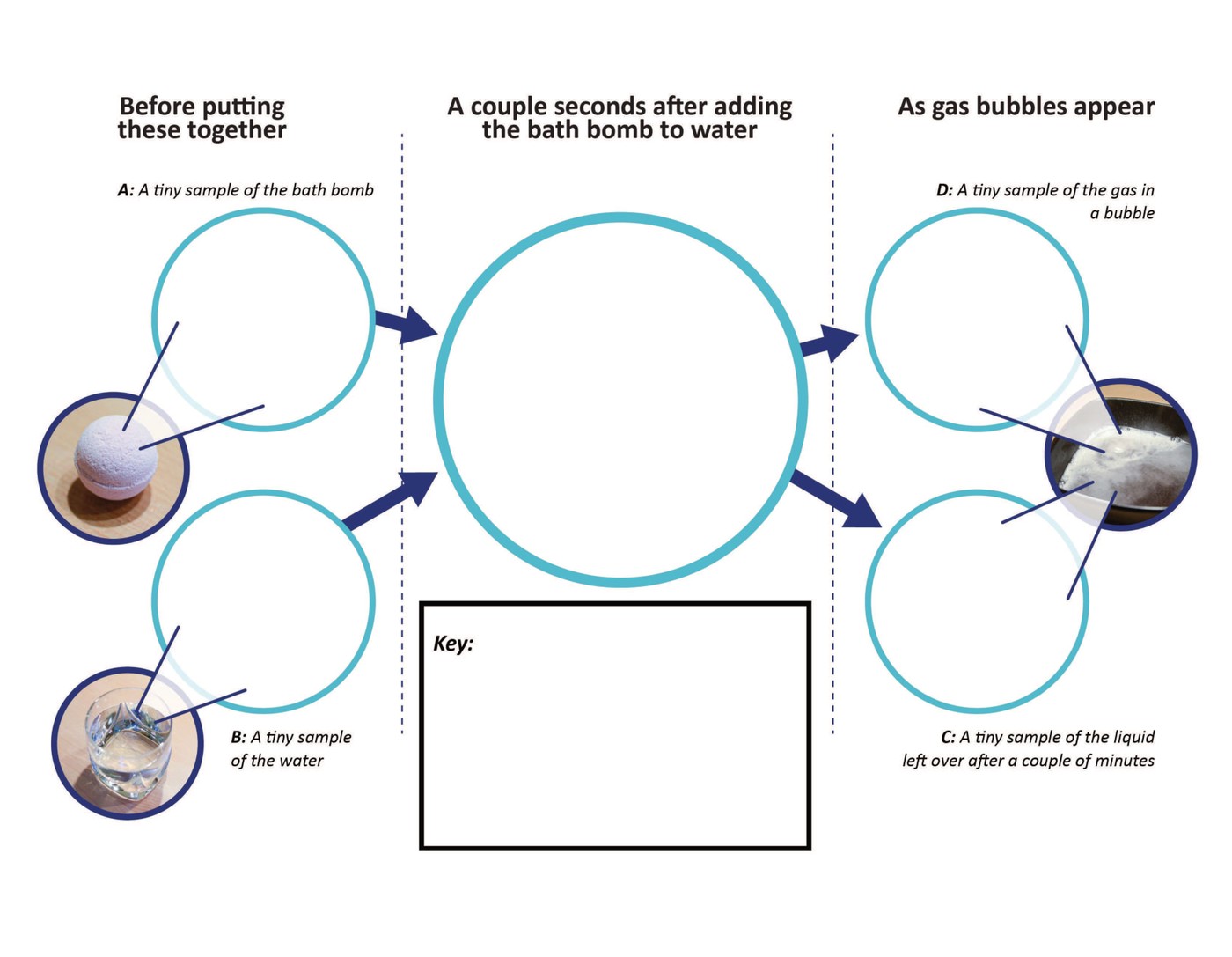
For a separately specified acid–bicarbonate case, bicarbonate (hydrogen carbonate, HCO₃⁻) and aqueous hydronium (H₃O⁺) are supplied reactant species. Their net account produces CO₂ and water: HCO₃⁻+H₃O⁺→CO₂+2H₂O. The formulas, not the bubble photograph alone, support the atom and charge model. Other dissolved ions may remain as spectators. Follow carbon, oxygen, hydrogen and total charge across this equation; the source template’s exact ingredients are not established by its empty circles.
Compare a supplied equation with known species and conditions. Keep observations, the balanced model, and the category in separate notebook columns.
Pause and explain
Does identifying a replacement pattern prove a reaction will occur?
Check your reasoning after answering
No. Activity, thermodynamics, conditions, and actual evidence still matter; the category describes a proposed or observed pattern.
Part 2 · Distinguish combustion from all oxidation
Combustion commonly describes rapid reaction with an oxidant and substantial energy transfer; introductory hydrocarbon combustion often uses O₂ and, under complete conditions, produces CO₂ and water. Oxidation is an increase in oxidation number and can occur without burning or even without oxygen. Incomplete combustion can produce other carbon-containing products, so a balanced complete-combustion equation is a stated model, not a guarantee for every real flame. Use oxidation numbers and conditions to distinguish classification from mechanism.
Read the visual model
Identify the labeled structures and units, then trace the arrows or compare values under the caption’s stated conditions. Separate the displayed evidence from a further inference. Write your reasoning before opening the guidance.
Is every oxidation reaction a flame-producing combustion?
Visual reasoning — after your attempt
No. Oxidation is electron/oxidation-number accounting and can occur slowly or in other nonflame contexts.
Combustion commonly involves a rapid energy-releasing reaction with an oxidizer. Redox is broader and can occur without flames or oxygen gas. Hydrocarbon complete-combustion models produce CO₂ and H₂O, while insufficient oxygen or other conditions can produce additional products.
The equation for complete methane combustion is a conditional model, not a promise that every burner forms only those products. State complete combustion and excess oxygen.
Pause and explain
Why should combustion products be conditional?
Check your reasoning after answering
Oxygen supply, reactant composition, and operating conditions affect the products. Incomplete combustion can produce substances outside the simplified complete-combustion model.
Part 3 · Predict aqueous outcomes from supplied evidence
The state symbol (aq) means a species is dissolved in water, not that a solid formula unit is moving unchanged through solution. Precipitation forms a separate solid phase when conditions favor it. A supplied solubility rule can support an introductory prediction, while concentrations and equilibrium determine the more detailed outcome. Gas formation and acid–base reactions can also change aqueous species. A visible change suggests something to investigate but does not by itself establish the exact product identity or amount.
Read the visual model
Identify the labeled structures and units, then trace the arrows or compare values under the caption’s stated conditions. Separate the displayed evidence from a further inference. Write your reasoning before opening the guidance.
What does the symbol (s) add to the AgCl product account?
Visual reasoning — after your attempt
It identifies a separate solid phase, distinguishing precipitation from ions simply remaining in the aqueous phase.
Aqueous exchange may form a precipitate, gas, or weakly ionized product such as water. Exchanging partners on paper without a chemical driving outcome can leave no net reaction. Use solubility or activity information supplied with the task rather than assuming every pair of solutions reacts.
If all ions remain dissolved and unchanged, a net ionic account can be empty even when a formal double-replacement arrangement can be written.
Pause and explain
Why might exchanging partners give no net reaction?
Check your reasoning after answering
If the ions remain the same dissolved species with no precipitate, gas, or other relevant transformation, the formal partner swap need not represent a net chemical change.
Part 4 · Check conservation and physical states
A balanced chemical representation conserves every element’s atom count and the total electric charge. State symbols distinguish solid, liquid, gas and aqueous species and help determine which processes the equation represents. Coefficients specify relative amounts; they do not determine how quickly a reaction occurs or guarantee complete conversion. A useful written explanation combines conservation with the evidence for product identity, the reaction conditions and limits on the model. Balance is a consistency requirement, not experimental proof.
Read the visual model
Identify the labeled structures and units, then trace the arrows or compare values under the caption’s stated conditions. Separate the displayed evidence from a further inference. Write your reasoning before opening the guidance.
Could a perfectly balanced equation describe a reaction that is extremely slow under room conditions?
Visual reasoning — after your attempt
Yes. Conservation does not establish kinetic accessibility, mechanism or measured rate.
A useful reaction equation preserves atom counts and, for ionic equations, charge. State symbols help distinguish a precipitate from an aqueous ion and a gas from a liquid. Category labels are secondary to a correct species account with relevant conditions.
Balance first, then explain the pattern and evidence. A predicted solid should agree with the supplied solubility reference rather than just a guess from formula appearance.
Pause and explain
What information do state symbols add?
Check your reasoning after answering
They distinguish physical form and solution status, helping identify outcomes such as precipitation and preventing incorrect ion splitting.
Apply the whole unit · Interpret a complete-combustion model
Illustrative model: methane reacts completely with oxygen to form carbon dioxide gas and water. Assume sufficient oxygen and complete combustion.
Your task
Write and balance the equation, classify the pattern, show atom counts, and explain why this equation cannot describe all real burner emissions without measured conditions.
What your response should show
- Choose the appropriate chemical model or relationship and state its conditions.
- Show substitutions, units, particle or charge counts, and intermediate reasoning as relevant.
- Use supplied evidence to justify the conclusion; distinguish observation from inference.
- Identify a meaningful limitation, uncertainty, or next measurement.
Response guidance — after your attempt
Write CH₄+O₂→CO₂+H₂O.
Use two H₂O for four hydrogen atoms and two O₂ for four oxygen atoms.
Verify CH₄+2O₂→CO₂+2H₂O: C1,H4,O4 on both sides.
The equation represents a complete hydrocarbon-combustion model and also a redox change. State conditions for water’s physical form if adding symbols. Incomplete combustion, mixing, and impurities can produce other emissions, so a balanced conditional equation is not a full measurement of real exhaust.
Scientific references and source-model foundations
- OpenSciEd 7.1 — public reaction/matter foundations
- OpenStax — reaction stoichiometry
- OpenSciEd public middle-school source license — CC BY 4.0
Parent / teacher teaching notes
Ask for conservation and conditions before the category. Do not use open-flame home tests; supplied reaction records are sufficient. Ask the learner to explain each particle symbol, axis, unit and arrow before calculating. Distinguish hypothetical models and calculated curves from measured records. Public OpenSciEd excerpts here are selected foundation prompts, not complete high-school teacher editions or an endorsement. All required advanced explanations and practice are provided locally.
The key idea
Reaction patterns are useful classifications that can overlap. Product predictions need chemical evidence and conditions in addition to a balanced formula pattern; conserve atoms, charge and species-state information.
Worked examples
Example 1
- Look at the pattern: two separate elements (sodium and chlorine) appear on the left, and a single compound (sodium chloride) appears on the right.
- Two or more substances combining into one product matches the form A + B → AB.
- That is the definition of a synthesis (combination) reaction.
Example 2 · Worked application
- Solid formation from solution is precipitation.
- If ions exchange partners, a double-replacement description can also apply.
- Classification does not alone determine mechanism or rate.
Use supplied products and states to justify the category.
Example 3
- A lone element (Zn) is reacting with a compound (HCl), which is the single-replacement pattern A + BC → AC + B.
- Zinc is more reactive than hydrogen (it sits above hydrogen in the activity series), so zinc replaces the hydrogen, bonding with chlorine to form zinc chloride and freeing hydrogen gas.
- Write and balance the products: Zn + 2HCl → ZnCl₂ + H₂.
Example 4 · Find and fix the mistake
- Test the claim against the stated conditions: Use supplied products and states to justify the category.
- Categories can overlap, such as combustion also being redox.
Use supplied products and states to justify the category.
Example 5 · Reason from the visual model
- The state symbol (aq) means a species is dissolved in water, not that a solid formula unit is moving unchanged through solution. Precipitation forms a separate solid phase when conditions favor it. A supplied solubility rule can support an introductory prediction, while concentrations and equilibrium determine the more detailed outcome. Gas formation and acid–base reactions can also change aqueous species. A visible change suggests something to investigate but does not by itself establish the exact product identity or amount.
- It identifies a separate solid phase, distinguishing precipitation from ions simply remaining in the aqueous phase.
Original qualitative silver-chloride precipitation model. Charges in the solid slice are schematic; no concentration or solubility-product calculation is supplied.
Avoid these mistakes
- Reaction categories overlap, and ion swapping alone does not guarantee reaction.
Check your understanding
What evidence supports a precipitation reaction?
Discuss the answer
A newly formed solid plus a balanced net ionic model; exclude existing suspended material as an alternative.
Return to the phenomenon
Return to the initial case. Do bubbles prove that a liquid is boiling? Revise your drawing or explanation using two named ideas and one stated limitation.
Compare explanations after your attempt
Bubbles can result from reaction, vaporization or released dissolved gas. Temperature, product tests and a conserved species model are needed to explain the event.
What should we investigate next?
Which comparison would test a remaining uncertainty? State what you would change, keep comparable and measure.
Investigate, calculate and revise
Keep a first model and an evidence-supported revision. Attempt each task before opening guidance; all required explanations and supplied-data routes are available locally.
Activity 1 · Return to the opening case
Use the opening phenomenon, unit definitions and explained Parts 1–4.
Your task
Return to the initial case. Do bubbles prove that a liquid is boiling? Revise your drawing or explanation using two named ideas and one stated limitation.
Success criteria
- Use the stated observations and appropriate units.
- Connect a labeled model with the chemical mechanism.
- State assumptions and an evidence limitation.
- Explain a substantive revision or next test.
Hint
Keep species identity, material transfer and energy account distinct.
Response guidance — discuss after your attempt
Bubbles can result from reaction, vaporization or released dissolved gas. Temperature, product tests and a conserved species model are needed to explain the event.
Activity 2 · Transfer to a changed case
Cover the worked answer and use the explained models, relationships and notebook.
Your task
A student writes an exchange equation for two clear ionic solutions and predicts a solid solely because the equation is balanced. Explain the missing evidence and give two quantities that still must balance.
Success criteria
- Use the stated measurements or conditions, with correct units.
- Connect the result to the chemical mechanism or evidence relationship.
- Identify the assumption, model limit or further evidence requested.
Hint
Name known quantities and conditions, show intermediate steps and check conservation.
Response guidance — discuss after your attempt
Balance atoms of each element and total charge. A precipitate prediction also needs appropriate solubility/concentration evidence under the conditions; balanced pattern matching alone does not establish a separate solid phase.
Words to know
- synthesis reaction
- A reaction where two or more simpler substances combine to form a single, more complex product (A + B → AB).
- decomposition reaction
- A reaction where a single compound breaks apart into two or more simpler substances (AB → A + B).
- single-replacement reaction
- A reaction where one element replaces another element in a compound (A + BC → AC + B).
- double-replacement reaction
- A reaction where two compounds swap partners, exchanging ions (AB + CD → AD + CB).
- combustion reaction
- A reaction in which a fuel (usually a hydrocarbon) reacts rapidly with oxygen, releasing energy and typically producing carbon dioxide and water.
- activity series
- A ranked list of metals from most to least reactive, used to predict whether a single-replacement reaction will actually happen.
One reaction can belong to two families at once
The five families are handy labels, not sealed boxes, and a single reaction is allowed to wear more than one at a time. When hydrogen burns, 2H₂ + O₂ → 2H₂O, two elements combine into one product — a textbook synthesis — yet a fuel is also reacting with oxygen and releasing energy, which is the very definition of combustion. The thermite reaction, Fe₂O₃ + 2Al → Al₂O₃ + 2Fe, is a single replacement and also one of the most violently exothermic reactions you can safely stage. Beginners often treat the categories as mutually exclusive and panic when a reaction seems to fit two of them. The fix is to remember that the families simply describe patterns of reactants and products, and one reaction can match several patterns simultaneously.
The activity series is a reactivity leaderboard
The rule that a single-replacement reaction only happens when the lone element is more reactive than the one it tries to replace is captured in the activity series, a ranking of metals from eager to inert. Its two ends explain everyday facts. At the top sit potassium and sodium, so violently reactive that they are stored under oil to keep them away from air and water. At the very bottom sit gold and platinum, so unreactive that they turn up in nature as pure, gleaming nuggets rather than locked inside ores — which is exactly why they became the metals of coins and jewelry. And it is why copper, sitting below zinc, can never displace zinc from a compound, even though zinc readily displaces copper.
Incomplete combustion: the silent killer
Complete combustion neatly yields carbon dioxide and water, but that tidy equation quietly assumes oxygen is plentiful. Starve a flame of air and the reaction turns dangerous, producing carbon monoxide (CO) and sooty carbon instead of CO₂. Carbon monoxide is colorless, odorless, and deadly: it binds to the hemoglobin in your blood more than two hundred times more tightly than oxygen does, quietly suffocating you from the inside. This is why furnaces, gas heaters, and car exhaust must be vented, why fuel-burning appliances need a supply of fresh air, and why a carbon-monoxide detector belongs in every home. The same reaction family that cooks your dinner can kill you when the oxygen supply runs short.
Thermite: a single replacement hot enough to weld steel
Some single-replacement reactions are gentle fizzes; one is a controlled inferno. In the thermite reaction, powdered aluminum strips the oxygen from iron(III) oxide — Fe₂O₃ + 2Al → Al₂O₃ + 2Fe — releasing so much energy that the iron product emerges as a white-hot liquid at roughly 2500°C, hot enough to melt straight through steel. Rail crews still use it to weld railroad tracks out in the field: they clamp a mold around the joint, ignite a thimbleful of thermite, and let the molten iron pour into the gap and fuse the rails as it cools. A reaction you could scribble on a single homework line is, quite literally, helping hold the world's railways together.
Decomposition by electricity rewired the modern world
Not every decomposition is driven by heat; many of the most important ones are driven by electricity, in a process called electrolysis. In 1807 the English chemist Humphry Davy passed current through molten compounds and, one after another, tore out elements no one had ever isolated — potassium, sodium, and soon calcium and magnesium — decomposition reactions that revealed whole new corners of the periodic table. The same idea powers industry today: the Hall–Héroult process decomposes aluminum oxide to give the cheap aluminum in every soda can, and electrolyzing water, 2H₂O → 2H₂ + O₂, is a leading way to make clean hydrogen fuel. Feed a stubborn compound enough electrical energy and you can pull it apart into treasures.
In the real world
An airbag fires by decomposition: a spark makes sodium azide (NaN₃) break down in about 30 milliseconds, releasing a burst of nitrogen gas that inflates the bag before your head can hit the wheel.
Exit check
What evidence supports a precipitation reaction?
Check your explanation after answering
A newly formed solid plus a balanced net ionic model; exclude existing suspended material as an alternative.
Explain your reasoning without notes. If a key idea is missing, revisit the lesson and try again.
Balancing Chemical Equations
Learning goals
- I can explain why a chemical equation must be balanced, connecting it to the conservation of atoms and mass.
- I can balance a chemical equation by adjusting coefficients while leaving subscripts unchanged, using the smallest whole-number ratio.
Readings for this unit
Before this unit
Atom counting with parentheses and coefficients.
Use the detailed parent plan: two core 50–60-minute sessions per focused unit, with a third assigned for selected calculation/modeling topics. First study the core explanation and Parts 1–2 with their figures/checks; next study Parts 3–4, the whole-unit application, worked cases, varied practice and exit check. Attempt reasoning before opening guidance. Extend time when actual understanding requires it; investigations and chapter assessments have separate sessions.
Start with something to explain
Can changing a coefficient fix an equation without changing its substances?
Illustrative evidence case. Hydrogen and oxygen form water under a specified reaction, but the initial 1:1:1 coefficients do not conserve atoms.
Notice and wonder
Record two observations using the stated quantities or relationships. Keep observations separate from possible causes. Write one question that a new measurement could help answer.
Can changing a coefficient fix an equation without changing its substances?
Your first model
Count atoms on each side while keeping H₂, O₂ and H₂O formulas intact.
Build the language from the idea
- chemical equation
- A symbolic representation of a reaction: reactant formulas on the left, an arrow, then product formulas on the right.
- coefficient
- A whole number written in front of a formula that tells how many units (molecules or formula units) of that substance take part.
- subscript
- The small number after an element's symbol showing how many atoms of that element are in one unit of the substance; changing it changes the substance itself.
- balanced equation
- An equation with the same number of each kind of atom on both sides, so mass is conserved.
- law of conservation of mass
- In any chemical reaction, atoms are only rearranged, so the total mass of reactants equals the total mass of products.
A chemical equation is chemistry's sentence structure: the reactants sit on the left, an arrow reads as 'reacts to form,' and the products sit on the right. But an equation is only trustworthy if it obeys the law of conservation of mass. Antoine Lavoisier established in the 1770 s that atoms are never created or destroyed in a reaction — they are only rearranged into new partnerships. So every atom that enters on the left must reappear on the right. An equation with the same count of each element on both sides is called a balanced equation, and an unbalanced one literally describes an impossible reaction, like a bank statement where money vanishes into thin air.
To balance an equation you adjust coefficients — the large numbers written in front of each formula — and you must never touch the subscripts, the small numbers tucked inside a formula. This distinction is the single most important rule of the entire skill. A subscript is part of a substance's identity: H₂O is water, but H₂O₂ is hydrogen peroxide, a bleach you would never drink. Changing a subscript secretly swaps one chemical for a completely different one. A coefficient, by contrast, just says 'how many' of that exact substance you have, the way a '3' in front of a recipe means three identical batches.
Because coefficients multiply through an entire formula, you have to read them carefully. The term 3H₂O means three water molecules, which contain 3 × 2 = 6 hydrogen atoms and 3 × 1 = 3 oxygen atoms in total. Counting atoms means multiplying each coefficient by each subscript and adding up the results for every element on both sides. Getting fluent at this multiply-and-total step is what makes balancing fast instead of frustrating.
There is a reliable rhythm to balancing by inspection. Count every atom on each side, find an element that does not match, and place a coefficient to even it out — then recount, because fixing one element almost always knocks another out of balance. Experienced chemists follow a helpful order: balance metals first, then other nonmetals, save hydrogen and oxygen for last (they tend to appear in the most formulas), and if a stubborn fraction appears, multiply the whole equation through to clear it. You keep cycling until, all at once, every element matches and the coefficients are in their smallest whole-number ratio.
Consider a selected iron(III)-oxide formation model, 4Fe + 3O₂ → 2Fe₂O₃. It looks intimidating until you work the oxygen: the product Fe₂O₃ carries 3 oxygens, while O₂ delivers them 2 at a time, so you need a common multiple of 6 — that is 3 O₂ on the left and 2 Fe₂O₃ on the right. Those 2 Fe₂O₃ units then demand 4 iron atoms, giving the coefficient of 4 on Fe. Recount and every atom matches: 4 iron and 6 oxygen on each side. The same patient logic tames even a combustion equation like C₃H₈ + 5O₂ → 3CO₂ + 4H₂O.
Balancing is worth the effort because a balanced equation is quantitative — it is the bridge to everything else in this unit. Those coefficients are not decoration; they are the exact whole-number ratio in which substances react, and in the next lessons they become the 'mole ratios' that let you calculate precisely how much product a reaction will make. A chemical plant relies on that ratio to combine tonnes of raw material with nothing wasted. Get the balance right, and a scribbled equation becomes a dependable recipe you can scale from a single test tube all the way up to an industrial reactor.
Model check: Never change formula subscripts to balance an equation. C₃H₈+5O₂→3CO₂+4H₂O; three C, eight H, and ten O are conserved.
Build your understanding
Use the detailed parent plan: two core 50–60-minute sessions per focused unit, with a third assigned for selected calculation/modeling topics. First study the core explanation and Parts 1–2 with their figures/checks; next study Parts 3–4, the whole-unit application, worked cases, varied practice and exit check. Attempt reasoning before opening guidance. Extend time when actual understanding requires it; investigations and chapter assessments have separate sessions.
Part 1 · Preserve formulas while balancing coefficients
A coefficient multiplies the entire chemical formula that follows it. A subscript belongs to the composition of the represented entity. Balancing 2H₂+O₂→2H₂O changes how many hydrogen, oxygen and water entities are counted without turning water into hydrogen peroxide. If a formula is wrong, correct its chemical identity using evidence before balancing; do not silently alter subscripts simply to make a count table work. Start from a species list and conserve each element.
Read the visual model
Identify the labeled structures and units, then trace the arrows or compare values under the caption’s stated conditions. Separate the displayed evidence from a further inference. Write your reasoning before opening the guidance.
Why is replacing H₂O by H₂O₂ not an allowed balancing move?
Visual reasoning — after your attempt
It changes the product’s chemical identity rather than only its amount. Coefficients must balance the correct formulas.
A coefficient multiplies an entire chemical formula. A subscript belongs to the species identity. Balancing changes coefficients to match element counts, not subscripts to invent different substances. Parentheses and polyatomic groups need explicit counting.
For 2Al(OH)₃, counts are Al2,O6,H6. Changing OH to another formula would change the substance rather than repair the equation.
Pause and explain
What is conserved while coefficients change?
Check your reasoning after answering
The supplied species formulas and identities remain unchanged, while the coefficients change the represented relative amounts.
Part 2 · Use a complete count table
An atom-count table multiplies each formula’s subscripts by its coefficient and adds contributions across all species on that side. For ethane combustion, balance carbon and hydrogen first, then oxygen; if a half-integer coefficient appears, multiply the entire equation to obtain the chosen whole-number convention. Check all elements again after the final change. Order of balancing is a useful strategy, not a different conservation law for each element, and physical phases remain separate information.
Read the visual model
Identify the labeled structures and units, then trace the arrows or compare values under the caption’s stated conditions. Separate the displayed evidence from a further inference. Write your reasoning before opening the guidance.
How many oxygen atoms occur on each side of the displayed balanced equation?
Visual reasoning — after your attempt
Fourteen: seven O₂ molecules supply fourteen, while four CO₂ and six H₂O supply eight plus six.
List each element and count it on both sides after every adjustment. Begin with a convenient less-repeated element and leave a freely occurring element such as O₂ until later when helpful. This is a method, not a universal order that solves every equation.
For Al+O₂→Al₂O₃, a common oxygen count of six helps obtain integer coefficients. Recheck aluminum after fixing oxygen.
Pause and explain
Why check every element after changing a coefficient?
Check your reasoning after answering
The coefficient multiplies all atoms in that formula, so fixing one count may alter another and require further adjustment.
Part 3 · Report the smallest whole-number ratio
Multiplying all coefficients by the same positive factor preserves the stoichiometric ratio and conservation. For an ordinary school balancing answer, report the smallest whole-number coefficients. A thermochemical equation may deliberately use a different scale, including a fraction, to define an energy change per specified amount. The equation’s normalization matters when relating it to moles or reaction enthalpy; reducing one coefficient alone would break the composition account. State the convention and scale the full equation consistently.
Read the visual model
Identify the labeled structures and units, then trace the arrows or compare values under the caption’s stated conditions. Separate the displayed evidence from a further inference. Write your reasoning before opening the guidance.
Why can 4:2:4 and 2:1:2 describe the same reaction ratio while an associated heat value must be scaled?
Visual reasoning — after your attempt
The ratios are equivalent, but the thermochemical amount basis changes. Heat is extensive and must change with the equation amount.
Balanced equations can be multiplied by any common factor. Standard reporting usually uses the smallest whole-number ratio. Coefficients represent particle or mole ratios, not gram ratios. The chemical equation also does not guarantee rate, completeness, or feasibility under all conditions.
4Al+3O₂→2Al₂O₃ is balanced. Doubling all coefficients preserves counts but is not the simplest ratio; interpreting 4: 3: 2 as grams is wrong.
Pause and explain
Why are coefficients not directly mass ratios?
Check your reasoning after answering
Species have different molar masses. Coefficients compare particle or mole amounts, which must be converted separately to mass.
Part 4 · Add charge conservation for ionic equations
An ionic equation displays charged species explicitly. Atom balance alone is insufficient: the total charge must also agree. A half-reaction includes electrons to track oxidation or reduction; zinc oxidation produces Zn²⁺ and two electrons. In a complete balanced redox reaction, electron production and consumption cancel between the half-reactions. A half-reaction is useful bookkeeping and does not mean an isolated solution continuously accumulates unlimited electrons without a coupled process.
Read the visual model
Identify the labeled structures and units, then trace the arrows or compare values under the caption’s stated conditions. Separate the displayed evidence from a further inference. Write your reasoning before opening the guidance.
Why are two electrons needed on the product side of the zinc oxidation half-reaction?
Visual reasoning — after your attempt
They offset the +2 zinc-ion charge so the total charge remains zero on both sides.
An ionic equation must conserve total charge as well as elements. A neutral atom equation can be balanced by atom counting, but half-reaction models introduce electrons explicitly. Do not add electrons to an ordinary molecular equation merely to repair a missing atom count.
Check a net ionic precipitation equation for balanced ions and total charge. Use a separate redox method where oxidation states change.
Pause and explain
Can an ionic equation with correct atoms still be wrong?
Check your reasoning after answering
Yes. Its total charges may differ, so atom balance alone is insufficient for an ionic or redox equation.
Apply the whole unit · Balance iron oxide formation
Illustrative proposed equation: Fe+O₂→Fe₂O₃. Use only these species and report the smallest whole-number coefficients.
Your task
Balance the equation, show an element-count table, interpret the coefficient ratio in moles, and explain why neither gram amounts nor actual reaction speed follows directly from those coefficients.
What your response should show
- Choose the appropriate chemical model or relationship and state its conditions.
- Show substitutions, units, particle or charge counts, and intermediate reasoning as relevant.
- Use supplied evidence to justify the conclusion; distinguish observation from inference.
- Identify a meaningful limitation, uncertainty, or next measurement.
Response guidance — after your attempt
Match oxygen using 3O₂ and 2Fe₂O₃, giving six O atoms per side.
Use 4Fe to supply four iron atoms.
Verify Fe4,O6 on both sides and write 4Fe+3O₂→2Fe₂O₃.
The ratio is 4 mol Fe to 3 mol O₂ to 2 mol Fe₂O₃ for the stated complete-reaction model. Mass ratios require molar masses, and actual rate depends on conditions. Keeping Fe₂O₃ unchanged is essential: replacing its subscripts would describe another substance rather than balance this reaction.
Scientific references and source-model foundations
Parent / teacher teaching notes
Use atom counters, then require a written count table. Distinguish conserving formulas from changing coefficients and mole ratios from gram ratios. Ask the learner to explain each particle symbol, axis, unit and arrow before calculating. Distinguish hypothetical models and calculated curves from measured records. Public OpenSciEd excerpts here are selected foundation prompts, not complete high-school teacher editions or an endorsement. All required advanced explanations and practice are provided locally.
An animation of a chemical reaction in which bonds break and reform, showing that the same atoms are conserved and simply rearranged into new molecules.
The key idea
Because atoms are conserved, balance an equation by changing only coefficients (never subscripts) until every element has equal atoms on both sides, using the smallest whole-number ratio.
Law of Conservation of Mass
total mass of reactants = total mass of products
true for every chemical reaction; balancing an equation is how this law is expressed symbolically, since equal atoms on both sides guarantee equal mass.
Worked examples
Example 1
- Count atoms: left has 1 Fe and 2 O; right has 2 Fe and 3 O. Neither element matches.
- Oxygen is the tricky one — it comes in 2 s on the left and 3 s on the right, so use their least common multiple, 6. Put 3 in front of O₂ (3 × 2 = 6 O) and 2 in front of Fe₂O₃ (2 × 3 = 6 O): Fe + 3O₂ → 2Fe₂O₃.
- Now the 2 Fe₂O₃ units contain 2 × 2 = 4 iron atoms, so place a 4 in front of Fe: 4Fe + 3O₂ → 2Fe₂O₃.
- Recount: left has 4 Fe and 6 O; right has 4 Fe and 6 O. Balanced!
Example 2 · Worked application
- Match carbon with 3CO₂ and hydrogen with 4H₂O.
- Products contain 6+4=10 O atoms, so use 5O₂.
- Check every element with the final coefficients.
Balanced coefficients are ratios, not proof of complete reaction under every condition.
Example 3
- Balance carbon first: the 3 carbons in C₃H₈ require 3 CO₂.
- Balance hydrogen next: the 8 hydrogens in C₃H₈ require 4 H₂O (4 × 2 = 8 H).
- Save oxygen for last. Count oxygen on the right: (3 × 2 from CO₂) + (4 × 1 from H₂O) = 6 + 4 = 10 oxygen atoms. Since O₂ supplies 2 at a time, you need 5 O₂.
- Final check: C 3 = 3, H 8 = 8, O 10 = 10. Balanced: C₃H₈ + 5O₂ → 3CO₂ + 4H₂O.
Example 4 · Find and fix the mistake
- Test the claim against the stated conditions: Balanced coefficients are ratios, not proof of complete reaction under every condition.
- Changing subscripts changes substances; use coefficients only.
Balanced coefficients are ratios, not proof of complete reaction under every condition.
Example 5 · Reason from the visual model
- Multiplying all coefficients by the same positive factor preserves the stoichiometric ratio and conservation. For an ordinary school balancing answer, report the smallest whole-number coefficients. A thermochemical equation may deliberately use a different scale, including a fraction, to define an energy change per specified amount. The equation’s normalization matters when relating it to moles or reaction enthalpy; reducing one coefficient alone would break the composition account. State the convention and scale the full equation consistently.
- The ratios are equivalent, but the thermochemical amount basis changes. Heat is extensive and must change with the equation amount.
Original coefficient-scaling comparison, not a claim that a reaction’s mechanism requires exactly this many simultaneous molecular collisions.
Avoid these mistakes
- Never change formula subscripts to balance an equation.
Check your understanding
Balance C₃H₈+O₂→CO₂+H₂O.
Discuss the answer
C₃H₈+5O₂→3CO₂+4H₂O; three C, eight H, and ten O are conserved.
Return to the phenomenon
Return to the initial case. Can changing a coefficient fix an equation without changing its substances? Revise your drawing or explanation using two named ideas and one stated limitation.
Compare explanations after your attempt
Using 2:1:2 conserves hydrogen and oxygen. A coefficient scales whole entities; changing water’s subscript would describe another substance.
What should we investigate next?
Which comparison would test a remaining uncertainty? State what you would change, keep comparable and measure.
Investigate, calculate and revise
Keep a first model and an evidence-supported revision. Attempt each task before opening guidance; all required explanations and supplied-data routes are available locally.
Activity 1 · Return to the opening case
Use the opening phenomenon, unit definitions and explained Parts 1–4.
Your task
Return to the initial case. Can changing a coefficient fix an equation without changing its substances? Revise your drawing or explanation using two named ideas and one stated limitation.
Success criteria
- Use the stated observations and appropriate units.
- Connect a labeled model with the chemical mechanism.
- State assumptions and an evidence limitation.
- Explain a substantive revision or next test.
Hint
Keep species identity, material transfer and energy account distinct.
Response guidance — discuss after your attempt
Using 2:1:2 conserves hydrogen and oxygen. A coefficient scales whole entities; changing water’s subscript would describe another substance.
Activity 2 · Transfer to a changed case
Cover the worked answer and use the explained models, relationships and notebook.
Your task
Balance C₃H₈ + O₂ → CO₂ + H₂O using the smallest whole-number coefficients, then show the atom counts.
Success criteria
- Use the stated measurements or conditions, with correct units.
- Connect the result to the chemical mechanism or evidence relationship.
- Identify the assumption, model limit or further evidence requested.
Hint
Name known quantities and conditions, show intermediate steps and check conservation.
Response guidance — discuss after your attempt
C₃H₈ +5O₂ →3CO₂ +4H₂O. Counts are C:3, H:8, O:10 on each side. Formula subscripts remain unchanged.
Words to know
- chemical equation
- A symbolic representation of a reaction: reactant formulas on the left, an arrow, then product formulas on the right.
- coefficient
- A whole number written in front of a formula that tells how many units (molecules or formula units) of that substance take part.
- subscript
- The small number after an element's symbol showing how many atoms of that element are in one unit of the substance; changing it changes the substance itself.
- balanced equation
- An equation with the same number of each kind of atom on both sides, so mass is conserved.
- law of conservation of mass
- In any chemical reaction, atoms are only rearranged, so the total mass of reactants equals the total mass of products.
The Lavoisiers were a team
The law of conservation of mass is credited to Antoine Lavoisier, but the discovery had a second author history often forgets: his wife and laboratory partner, Marie-Anne Paulze Lavoisier. She learned English and Latin so she could translate the work of foreign chemists for Antoine to read, and she translated one key text specifically so he could dismantle its claims about the imaginary substance 'phlogiston.' Trained as an artist, she also drew the precise engravings of the laboratory apparatus that let other scientists reproduce the careful weighing experiments behind the law. When you balance an equation to honor conservation of mass, you are relying on a principle that a working scientific partnership — not a lone genius — pinned down.
When inspection fails, balance with algebra
Trial and error handles most equations, but for stubborn ones chemists reach for a method borrowed straight from algebra class. Assign a variable to each coefficient — a, b, c, d — and write one equation per element stating that its atoms match on both sides. For propane, a C₃H₈ + b O₂ → c CO₂ + d H₂O gives 3a = c (carbon), 8a = 2d (hydrogen), and 2b = 2c + d (oxygen). Set a = 1 and the rest fall out: c = 3, d = 4, and b = 5, so C₃H₈ + 5O₂ → 3CO₂ + 4H₂O. It is the very same 'system of equations' skill from math, quietly doing chemistry — a reminder that these two subjects are far less separate than the class schedule pretends.
Are fractional coefficients ever allowed?
Textbooks insist on whole-number coefficients, so students are startled the first time they meet a real equation written with a fraction, like H₂ + ½O₂ → H₂O. It is not a mistake. When chemists want to describe the energy released per mole of one substance — say, per mole of water formed — they deliberately keep that substance's coefficient at 1 and let another become a fraction such as ½. You cannot have half an oxygen molecule sitting in a beaker, of course, so to count actual particles you clear the fraction by doubling everything. Fractional coefficients are a bookkeeping convenience for thermochemistry, not a violation of the whole-number rule you learned — just a different question being asked.
Some equations fight back: a peek at redox
A few equations resist every balancing trick you know, and that resistance is itself a clue: you have probably met a redox reaction, one where electrons — not just atoms — are being traded. Balancing the reaction inside a battery or the rusting of iron in acid by plain inspection can be maddening. Chemists tame these by splitting the reaction into two half-reactions, one showing the loss of electrons and one the gain, then balancing the electrons against each other before recombining the halves. The underlying principle is still conservation — now of electric charge as well as mass — but the toolkit grows. Think of ordinary balancing as the first level of a skill you will keep leveling up in later chemistry courses.
The most important balanced equation for life
One balanced equation quietly sustains nearly every living thing: photosynthesis, 6CO₂ + 6H₂O → C₆H₁₂O₆ + 6O₂. Count the atoms and it balances perfectly — 6 carbons, 12 hydrogens, and 18 oxygens on each side — as a plant weaves carbon dioxide and water into glucose using sunlight, exhaling the oxygen you are breathing in right now. Its near-mirror image, cellular respiration, runs almost the same equation in reverse to release that stored energy. Two reactions, balanced atom for atom, pass carbon and oxygen back and forth between plants and animals in an endless loop — proof that the tidy algebra of balancing describes some of the grandest cycles on Earth.
In the real world
Engineers balance the combustion equation of a fuel to calculate the exact air-to-fuel ratio an engine needs — too little oxygen wastes fuel and produces poisonous carbon monoxide instead of carbon dioxide.
Exit check
Balance C₃H₈+O₂→CO₂+H₂O.
Check your explanation after answering
C₃H₈+5O₂→3CO₂+4H₂O; three C, eight H, and ten O are conserved.
Explain your reasoning without notes. If a key idea is missing, revisit the lesson and try again.
The Mole & Molar Mass
Learning goals
- I can explain what a mole is and why chemists use Avogadro's number to count atoms and molecules.
- I can calculate the molar mass of a compound from atomic masses and convert among mass, moles, and number of particles.
Readings for this unit
Before this unit
Atomic masses and unit cancellation.
Use the detailed parent plan: two core 50–60-minute sessions per focused unit, with a third assigned for selected calculation/modeling topics. First study the core explanation and Parts 1–2 with their figures/checks; next study Parts 3–4, the whole-unit application, worked cases, varied practice and exit check. Attempt reasoning before opening guidance. Extend time when actual understanding requires it; investigations and chapter assessments have separate sessions.
Start with something to explain
Does one mole always mean the same mass?
Illustrative evidence case. One mole of helium atoms and one mole of CO₂ molecules have equal entity counts but different mass.
Notice and wonder
Record two observations using the stated quantities or relationships. Keep observations separate from possible causes. Write one question that a new measurement could help answer.
Does one mole always mean the same mass?
Your first model
Label the counted entity and its composition before comparing samples.
Build the language from the idea
- mole (mol)
- The chemist's counting unit: one mole is exactly 6.022 × 10²³ particles of a substance.
- Avogadro's number
- The exact entity count per mole, 6.02214076×10²³; the Avogadro constant carries unit mol⁻¹.
- molar mass
- The mass of one mole of a substance in grams, numerically equal to the sum of the atomic masses in its formula (g/mol).
- atomic mass
- The average mass of an atom of an element, in atomic mass units, read from the periodic table.
- representative particle
- The basic unit being counted — an atom for an element, a molecule for a molecular compound, or a formula unit for an ionic compound.
Atoms are impossibly small and unimaginably numerous — a single sip of water holds trillions of trillions of molecules — yet reactions happen atom by atom, in fixed whole-number ratios. Chemists face a puzzle: how do you count particles you can never see, in a lab where the only tool is a balance that reads grams? The answer is one of the most powerful ideas in all of chemistry: the mole, a bridge between the invisible world of atoms and the visible world of grams you can actually weigh.
The mole is the SI unit of amount of substance: one mole contains exactly 6.02214076×10²³ specified entities. A dozen is a helpful counting analogy, but a mole is a physical amount unit and must name what is counted: atoms, molecules, ions, electrons or formula units. The exact constant does not make a measured sample mass infinitely precise. For one mole of water molecules, the formula also implies two moles of hydrogen atoms and one mole of oxygen atoms.
That is the quiet genius of the system. The molar mass of a substance — the mass of one mole of it — is numerically equal to the sum of the atomic masses in its formula, just with the unit grams per mole. Carbon's atomic mass is 12.01, so one mole of carbon atoms weighs 12.01 g. To find the molar mass of a compound, you add up the molar masses of every atom in the formula. Water, H₂O, comes to 2(1.01) + 16.00 = 18.02 g/mol, which means a mere 18 grams of water — a little over a tablespoon — already contains a full mole, 6.022 × 10²³ molecules.
With molar mass in hand, converting between grams and moles becomes ordinary arithmetic. To go from a measured mass to a number of moles, you divide by the molar mass: moles = mass ÷ molar mass. To go the other way, from moles back to a mass you could weigh out, you multiply: mass = moles × molar mass. Molar mass acts like an exchange rate between two currencies — grams and moles — and every stoichiometry problem you meet later leans on this single conversion.
Moles also link to the actual count of particles. Because one mole is exactly 6.02214076 × 10²³ specified entities by the SI definition, you multiply moles by Avogadro's number to get the number of representative particles — atoms, molecules, or formula units — and you divide by it to go back. So there is a two-step highway running in both directions: mass ⇄ moles ⇄ particles, with molar mass governing the first stretch and Avogadro's number governing the second. Master that map and you can start from any one of the three and reach the other two.
This is not abstract bookkeeping — it is how real chemistry gets done. A pharmacist scaling a drug, an engineer sizing a fuel tank, and a factory mixing fertilizer all think in moles, because reactions obey mole ratios, not gram ratios. The mole is what lets a chemist weigh out a pinch of powder and know, to the particle, how many molecules are on the balance. It is the counting unit that turns the conservation of atoms into a calculation you can actually run, and it sets up everything in the next two lessons on stoichiometry.
Model check: A mole counts entities; it is not a fixed number of grams. Molar mass 18 g/mol, so 36/18=2 mol; identify molecules as the counted entities.
Build your understanding
Use the detailed parent plan: two core 50–60-minute sessions per focused unit, with a third assigned for selected calculation/modeling topics. First study the core explanation and Parts 1–2 with their figures/checks; next study Parts 3–4, the whole-unit application, worked cases, varied practice and exit check. Attempt reasoning before opening guidance. Extend time when actual understanding requires it; investigations and chapter assessments have separate sessions.
Part 1 · Name the entity counted by a mole
The mole is the SI unit of amount of substance. One mole contains exactly 6.02214076×10²³ specified entities, the Avogadro constant in mol⁻¹. Always name the entity: atoms, molecules, ions, electrons or formula units. One mole of water molecules contains two moles of hydrogen atoms and one mole of oxygen atoms, not one mole of total atoms. A mole of helium and a mole of water have equal specified-entity counts but different masses and compositions.
Read the visual model
Identify the labeled structures and units, then trace the arrows or compare values under the caption’s stated conditions. Separate the displayed evidence from a further inference. Write your reasoning before opening the guidance.
How many moles of total atoms are represented by one mole of H₂O molecules?
Visual reasoning — after your attempt
Three moles of atoms: two moles of hydrogen atoms plus one mole of oxygen atoms.
One mole contains exactly 6.02214076×10²³ specified entities. State whether those entities are atoms, molecules, ions, or formula units. A mole is a counting unit, not a fixed mass or a type of particle. Different substances have different mass per mole.
One mole of H₂O molecules includes two moles of H atoms and one mole of O atoms. Do not call a mole of water one mole of total atoms.
Pause and explain
Why must the entity be named?
Check your reasoning after answering
The same numerical mole amount can count different entities. Molecules, atoms, ions, and formula units give different composition interpretations.
Part 2 · Find molar mass from the formula
Molar mass is mass per mole of specified substance. Add the contributions of every atom in its formula, including parentheses and hydrates when present. Ca(OH)₂ contains one calcium, two oxygen and two hydrogen atoms per formula unit, so the hydroxide group is counted twice. Atomic-weight values have stated precision and isotope-composition conventions; choose a consistent supplied table. Molar mass is written in g/mol and is different from the molarity of a solution.
Read the visual model
Identify the labeled structures and units, then trace the arrows or compare values under the caption’s stated conditions. Separate the displayed evidence from a further inference. Write your reasoning before opening the guidance.
Why must both O and H be multiplied by two in Ca(OH)₂?
Visual reasoning — after your attempt
The subscript outside parentheses multiplies the entire OH group, not only the immediately preceding hydrogen.
Add atomic-mass contributions using every subscript and repeated group. Molar mass in g/mol converts amount to mass. A table atomic mass and a compound molar mass use related numerical contributions but describe different quantities and units.
Using H=1.0 and O=16.0, water has M=18.0 g/mol. Calcium hydroxide needs two O and two H contributions as well as calcium.
Pause and explain
What does 18.0 g/mol mean for this water model?
Check your reasoning after answering
It gives mass per mole of water molecules. It is not the mass of one molecule or the number of atoms in a molecule.
Part 3 · Convert through units rather than memorized arrows
Convert mass to amount using n=m/Mₘ, then multiply amount by the Avogadro constant to obtain specified-entity count. Each conversion factor must cancel the previous unit and retain the entity name. The selected 18.0 g/mol water value is a rounded school input; using it consistently gives 2.00 mol from 36.0 g and approximately 1.20×10²⁴ water molecules. Mole amount is not itself a mass or volume, so do not skip the chemical composition step.
Read the visual model
Identify the labeled structures and units, then trace the arrows or compare values under the caption’s stated conditions. Separate the displayed evidence from a further inference. Write your reasoning before opening the guidance.
What would be wrong with multiplying 36.0 g directly by a number in molecules/mol?
Visual reasoning — after your attempt
The grams would not cancel the mole denominator. First convert mass to moles with the substance’s molar mass.
Use n=m/M for mass to moles and N=nNₐ for moles to entities. Choose factors to cancel units. If the question asks constituent atoms, add the formula ratio after converting to molecular amount. Keep exact ratios separate from measured precision.
9.0 g water at 18.0 g/mol is 0.50 mol H₂O, containing 1.0 mol H atoms. The hydrogen amount uses a 2: 1 formula ratio, not a separate mass division.
Pause and explain
Why divide mass by molar mass?
Check your reasoning after answering
g divided by g/mol leaves mol. Multiplying mass by molar mass would give inappropriate units for an amount.
Part 4 · Use reasonable scale and composition checks
A formula supplies exact atom-number ratios for the named entity. Half a mole of CO₂ molecules contains half a mole of carbon atoms and one mole of oxygen atoms; their masses are not in a 1:2 ratio because carbon and oxygen atoms have different masses. Use both unit and entity labels to check a conversion. A result can look numerically large and still be reasonable for particle counts, while a mass fraction greater than one signals a likely composition or unit error.
Read the visual model
Identify the labeled structures and units, then trace the arrows or compare values under the caption’s stated conditions. Separate the displayed evidence from a further inference. Write your reasoning before opening the guidance.
Why does two oxygen atoms per carbon atom not mean twice as much oxygen mass as carbon mass?
Visual reasoning — after your attempt
Atom counts must be weighted by their different molar masses; count ratios and mass ratios are different quantities.
A mass equal to one molar mass should give one mole. Particle numbers should be enormous for gram-scale samples, while single-particle masses are tiny. Check formula ratios independently so correct arithmetic does not conceal counting the wrong entity.
A calculation reporting 18 g water as 18 molecules fails the scale check. A result of one mole water but one mole hydrogen atoms fails the composition check.
Pause and explain
Which two checks help catch a correct-looking wrong answer?
Check your reasoning after answering
Check magnitude against molar mass and Avogadro’s constant, and check that the named entities match the formula ratios.
Apply the whole unit · Count water molecules and constituent atoms
Illustrative sample mass is 9.0 g pure water. Use M(H₂O)=18.0 g/mol and Nₐ≈6.02×10²³ mol⁻¹.
Your task
Find water amount, molecule number, and the numbers of H and O atoms. Show unit cancellation and explain why the particle totals do not mean free hydrogen and oxygen gases are present.
What your response should show
- Choose the appropriate chemical model or relationship and state its conditions.
- Show substitutions, units, particle or charge counts, and intermediate reasoning as relevant.
- Use supplied evidence to justify the conclusion; distinguish observation from inference.
- Identify a meaningful limitation, uncertainty, or next measurement.
Response guidance — after your attempt
n=9.0 g/(18.0 g/mol)=0.50 mol H₂O.
N≈0.50×6.02×10²³≈3.0×10²³ water molecules to two significant figures.
Hydrogen atoms≈6.0×10²³; oxygen atoms≈3.0×10²³.
The atom counts describe atoms bound within water molecules. They do not imply free H₂ or O₂ in the sample. The conversion assumes purity and the supplied molar-mass approximation; entity labels, formula ratios, and appropriate precision are part of the answer rather than optional annotations.
Scientific references and source-model foundations
Parent / teacher teaching notes
Require labeled conversion factors. Use mass=moles×molar mass to verify the result, then check constituent-atom ratios. Ask the learner to explain each particle symbol, axis, unit and arrow before calculating. Distinguish hypothetical models and calculated curves from measured records. Public OpenSciEd excerpts here are selected foundation prompts, not complete high-school teacher editions or an endorsement. All required advanced explanations and practice are provided locally.
The key idea
One mole contains exactly 6.02214076×10²³ specified entities. Molar mass connects amount with mass, and formula composition connects molecule/formula-unit counts with constituent atom or ion counts.
Molar Mass
M = sum of the atomic masses of every atom in the formula
M is the molar mass in grams per mole (g/mol); read each element's atomic mass from the periodic table and multiply by how many of that atom appear.
Moles from Mass
n = m ÷ M
n = amount in moles (mol), m = mass (g), M = molar mass (g/mol). Rearranged, mass m = n × M.
Particles from Moles
N = n × 6.022 × 10²³
N = number of representative particles (atoms, molecules, or formula units), n = moles, and 6.022 × 10²³ is Avogadro's number.
Worked examples
Example 1
- Count the atoms in the formula: 2 hydrogen, 1 sulfur, 4 oxygen.
- Multiply each count by its atomic mass: H = 2 × 1.01 = 2.02; S = 1 × 32.07 = 32.07; O = 4 × 16.00 = 64.00.
- Add the totals: 2.02 + 32.07 + 64.00 = 98.09 g/mol.
Example 2 · Worked application
- Moles=18.0/18.0=1.00 mol.
- Multiply by Avogadro's constant to count molecules.
- Each molecule has three atoms, so molecules and total atoms are different counts.
Identify the requested entity before applying the mole conversion.
Example 3
- Convert mass to moles by dividing by molar mass: 54.06 g ÷ 18.02 g/mol = 3.00 mol.
- Convert moles to molecules by multiplying by Avogadro's number: 3.00 mol × 6.022 × 10²³ = 1.807 × 10²⁴ molecules.
- So 54.06 g of water is 3.00 mol, containing about 1.807 × 10²⁴ molecules.
Example 4 · Find and fix the mistake
- Test the claim against the stated conditions: Identify the requested entity before applying the mole conversion.
- One mole has the same number of entities; mass depends on the substance's molar mass.
Identify the requested entity before applying the mole conversion.
Example 5 · Reason from the visual model
- Convert mass to amount using n=m/Mₘ, then multiply amount by the Avogadro constant to obtain specified-entity count. Each conversion factor must cancel the previous unit and retain the entity name. The selected 18.0 g/mol water value is a rounded school input; using it consistently gives 2.00 mol from 36.0 g and approximately 1.20×10²⁴ water molecules. Mole amount is not itself a mass or volume, so do not skip the chemical composition step.
- The grams would not cancel the mole denominator. First convert mass to moles with the substance’s molar mass.
Original rounded conversion using a supplied water molar mass; entity count precision reflects the measured mass and chosen school constants.
Avoid these mistakes
- A mole counts entities; it is not a fixed number of grams.
Check your understanding
Using H=1 and O=16, how many moles are in 36 g water?
Discuss the answer
Molar mass 18 g/mol, so 36/18=2 mol; identify molecules as the counted entities.
Return to the phenomenon
Return to the initial case. Does one mole always mean the same mass? Revise your drawing or explanation using two named ideas and one stated limitation.
Compare explanations after your attempt
Mole amount fixes specified-entity number. Mass depends on the entity’s molar mass, and total atom count also depends on composition.
What should we investigate next?
Which comparison would test a remaining uncertainty? State what you would change, keep comparable and measure.
Investigate, calculate and revise
Keep a first model and an evidence-supported revision. Attempt each task before opening guidance; all required explanations and supplied-data routes are available locally.
Activity 1 · Return to the opening case
Use the opening phenomenon, unit definitions and explained Parts 1–4.
Your task
Return to the initial case. Does one mole always mean the same mass? Revise your drawing or explanation using two named ideas and one stated limitation.
Success criteria
- Use the stated observations and appropriate units.
- Connect a labeled model with the chemical mechanism.
- State assumptions and an evidence limitation.
- Explain a substantive revision or next test.
Hint
Keep species identity, material transfer and energy account distinct.
Response guidance — discuss after your attempt
Mole amount fixes specified-entity number. Mass depends on the entity’s molar mass, and total atom count also depends on composition.
Activity 2 · Transfer to a changed case
Cover the worked answer and use the explained models, relationships and notebook.
Your task
Using Mₘ(CO₂)=44.0 g/mol and Nₐ≈6.022×10²³ mol⁻¹, find moles, molecules and moles of oxygen atoms in 22.0 g CO₂.
Success criteria
- Use the stated measurements or conditions, with correct units.
- Connect the result to the chemical mechanism or evidence relationship.
- Identify the assumption, model limit or further evidence requested.
Hint
Name known quantities and conditions, show intermediate steps and check conservation.
Response guidance — discuss after your attempt
n=22.0/44.0=0.500 mol CO₂. Molecules≈3.01×10²³. Each has two O atoms, giving 1.00 mol O atoms. Keep the entity labels through every conversion.
Words to know
- mole (mol)
- The chemist's counting unit: one mole is exactly 6.022 × 10²³ particles of a substance.
- Avogadro's number
- The exact entity count per mole, 6.02214076×10²³; the Avogadro constant carries unit mol⁻¹.
- molar mass
- The mass of one mole of a substance in grams, numerically equal to the sum of the atomic masses in its formula (g/mol).
- atomic mass
- The average mass of an atom of an element, in atomic mass units, read from the periodic table.
- representative particle
- The basic unit being counted — an atom for an element, a molecule for a molecular compound, or a formula unit for an ionic compound.
Avogadro never knew his own number
The number 6.022 × 10²³ bears Amedeo Avogadro's name, yet Avogadro never calculated it and probably never imagined its size. In 1811 the Italian scientist proposed a modest-sounding idea: that equal volumes of any gases, at the same temperature and pressure, contain equal numbers of particles. That hypothesis was mostly ignored for half a century. Only decades after his death did others measure how many particles a mole actually holds, and in 1909 the French physicist Jean Perrin proposed naming the quantity 'Avogadro's number' in his honor. It is a fitting bit of scientific justice — the man whose insight made the counting unit possible finally got the credit, long after he could have enjoyed it.
Just how big is 6.022 × 10²³?
Avogadro's number is so large it defeats the imagination, so try anchoring it to time. If you had one mole of seconds to spend, you would hold more than a million times the entire age of the universe — the roughly 14 billion years since the Big Bang would not make the smallest dent in the account. One mole of ordinary marbles would bury the Earth's whole surface many kilometers deep. And yet one mole of water molecules fits in a single tablespoon. That contrast is the whole point of the mole: nature packs such staggering numbers of atoms into such tiny masses that we need a counting unit this enormous just to talk about a sip of water.
A mole is a count, not a weight
The most common mole misconception is to treat it as a fixed mass, but a mole is a count — a number of things, exactly like a dozen. A dozen eggs and a dozen watermelons are the same count with wildly different weights, and moles behave the same way. A mole of hydrogen atoms weighs only about 1 gram, while a mole of lead atoms weighs about 207 grams, even though each contains the identical 6.022 × 10²³ atoms. This is precisely why molar mass is so useful: it is the personalized conversion factor that tells you what one mole of a specific substance happens to weigh, translating the universal count into a number of grams you can actually measure on a balance.
In 2019, the mole was pinned down forever
For most of its life the mole was defined by a physical yardstick: it was the number of atoms in exactly 12 grams of carbon-12. That tied chemistry's counting unit to a particular lump of a particular isotope. In May 2019 the international science community modernized the definition, declaring that one mole simply is exactly 6.022 140 76 × 10²³ particles — a fixed, defined number, with no reference sample required. The change is invisible in your homework, where 6.022 × 10²³ still works fine, but it is philosophically clean: Avogadro's number is now a defined constant of nature, as exact and unchanging as the modern definitions of the meter and the second.
One mole of any gas fills the same space
Here is a startling payoff of Avogadro's 1811 insight: at the same temperature and pressure, one mole of any gas occupies the same volume, no matter what the gas is. At standard temperature and pressure — 0°C and 1 atmosphere — that molar volume is about 22.4 liters, roughly the size of a large beach ball. A mole of helium, a mole of carbon dioxide, and a mole of oxygen each fill that same 22.4 L, even though they weigh about 4, 44, and 32 grams respectively. This lets chemists count gas particles just by measuring a volume, and it turns the mole into a bridge that reaches all the way from mass to particles to the space a gas takes up.
In the real world
Every medicine dose is really a mole calculation: a chemist converts the number of active molecules a patient needs into a mass in milligrams that a machine can actually weigh into each tablet.
Exit check
Using H=1 and O=16, how many moles are in 36 g water?
Check your explanation after answering
Molar mass 18 g/mol, so 36/18=2 mol; identify molecules as the counted entities.
Explain your reasoning without notes. If a key idea is missing, revisit the lesson and try again.
Percent Composition, Empirical & Molecular Formulas
Learning goals
- I can convert mass composition to a simplest mole ratio.
- I can use molar mass to distinguish empirical and molecular formulas.
Readings for this unit
Before this unit
Molar mass, percent calculations, and proportional reasoning.
Use the detailed parent plan: two core 50–60-minute sessions per focused unit, with a third assigned for selected calculation/modeling topics. First study the core explanation and Parts 1–2 with their figures/checks; next study Parts 3–4, the whole-unit application, worked cases, varied practice and exit check. Attempt reasoning before opening guidance. Extend time when actual understanding requires it; investigations and chapter assessments have separate sessions.
Start with something to explain
Can two molecules share the same elemental percentages but have different molecular formulas?
Illustrative evidence case. CH₂O and C₂H₄O₂ have the same simplest atom ratio.
Notice and wonder
Record two observations using the stated quantities or relationships. Keep observations separate from possible causes. Write one question that a new measurement could help answer.
Can two molecules share the same elemental percentages but have different molecular formulas?
Your first model
Separate the ratio inferred from composition from the number of atoms in one molecule.
Build the language from the idea
- empirical formula
- Simplest whole-number atom ratio.
- molecular formula
- Actual atom counts in a molecule.
- percent composition
- Elemental mass divided by total mass, expressed as a percent.
Percent composition describes mass contribution: percent of an element = mass of that element in one mole of compound divided by the compound molar mass ×100%. Multiply each atomic mass by its subscript first. For CO₂, carbon contributes 12.01 of about 44.01 g/mol, or 27.29% by mass.
An empirical formula gives the simplest whole-number atom ratio. A molecular formula gives the actual atom count in a molecule. Glucose C₆H₁₂O₆ has empirical formula CH₂O; reducing the subscripts does not make glucose chemically identical to formaldehyde, which has that molecular formula.
To infer an empirical formula from measured composition, convert each elemental mass to moles and divide all by the smallest mole amount. If values are near whole numbers within experimental uncertainty, use that ratio. A 1:1.5 ratio needs multiplication by two; do not round 1.5 to 2 without checking.
If percentages are given, assume 100 g as a convenient mathematical basis. The percentage numbers then become grams, but they are still mass data. Converting to moles is necessary because atomic masses differ. A 1:1 mass ratio rarely gives a 1:1 atom ratio.
A known molecular molar mass allows recovery of a molecular formula. Calculate empirical-formula mass, divide molecular molar mass by it, and multiply every subscript by the resulting whole number. If the multiplier is not near an integer, examine measurement uncertainty or an incorrect starting model.
Chemical formulas inferred from bulk composition alone do not specify how atoms are connected. Distinct isomers can have the same formula. Keep composition, molecular count, and structure as different questions, with different evidence needed to answer each.
Build your understanding
Use the detailed parent plan: two core 50–60-minute sessions per focused unit, with a third assigned for selected calculation/modeling topics. First study the core explanation and Parts 1–2 with their figures/checks; next study Parts 3–4, the whole-unit application, worked cases, varied practice and exit check. Attempt reasoning before opening guidance. Extend time when actual understanding requires it; investigations and chapter assessments have separate sessions.
Part 1 · Distinguish percent mass from atom ratio
Mass percent is component mass divided by total sample mass times 100%. It is not an atom-number percentage. A formula can contain many light hydrogen atoms while hydrogen contributes a relatively small mass fraction. To compare a composition analysis with a formula, account for each element’s atomic mass and the measured sample boundary. Percentages should sum to approximately 100% only if all components are included and rounding/measurement uncertainty are understood. Missing components or water can change the inference.
Read the visual model
Identify the labeled structures and units, then trace the arrows or compare values under the caption’s stated conditions. Separate the displayed evidence from a further inference. Write your reasoning before opening the guidance.
Why is a 40% carbon mass fraction not proof that 40% of the atoms are carbon?
Visual reasoning — after your attempt
Carbon and other atoms have different masses; a mass ratio must be converted through molar masses to compare atom numbers.
Mass percent is component mass divided by total sample mass times 100%. Atom ratios require mole conversion because equal masses of different elements contain different atom counts. An empirical formula is the simplest whole-number ratio, not necessarily the molecular formula.
A 1: 1 mass ratio of carbon and hydrogen is not a 1: 1 atom ratio because their molar masses differ. Use the supplied atomic masses before simplifying.
Pause and explain
Why not use percentage numbers directly as subscripts?
Check your reasoning after answering
They represent masses, not atom amounts. Divide by atomic molar masses before finding a particle ratio.
Part 2 · Use a convenient 100 g basis
An empirical formula is the simplest whole-number atom ratio consistent with a composition model. Taking a 100 g basis turns each mass percent into grams without claiming the actual specimen weighs 100 g. Divide by the appropriate molar mass to get proportional mole amounts, then divide by the smallest. Here the approximate ratio is 1:2:1, giving CH₂O. The method assumes the listed elements account for the analyzed sample and that measurement/rounding permit a simple ratio.
Read the visual model
Identify the labeled structures and units, then trace the arrows or compare values under the caption’s stated conditions. Separate the displayed evidence from a further inference. Write your reasoning before opening the guidance.
Why divide the masses by atomic molar masses before reducing the ratio?
Visual reasoning — after your attempt
The empirical formula counts atoms; converting to proportional mole amounts removes the unequal per-atom masses.
For percentage composition, a hypothetical 100 g sample turns each percentage into grams. Divide each element mass by its molar mass, then divide all amounts by the smallest. This basis is a calculation convenience and does not assert that an actual 100 g sample was measured.
40% C, about 6.7% H, and about 53.3% O can give an approximately 1: 2: 1 atom ratio using suitable molar masses. Retain intermediate precision.
Pause and explain
Why does choosing 100 g not change the final ratio?
Check your reasoning after answering
Scaling all component masses equally scales all mole amounts equally, so their ratios remain unchanged.
Part 3 · Resolve near-fractional ratios carefully
An empirical ratio near 1:1.5 can support a 2:3 atom ratio after multiplying all terms by two. Premature rounding to 1:2 changes the composition substantially. Look for simple fractional relationships and compare the reconstructed percent composition with the original data and uncertainty. A complicated multiplier chosen only to force an answer can overfit noisy measurements. If several formulas fit within error, report that ambiguity and request more evidence rather than treating the nearest decimal as an exact atomic count.
Read the visual model
Identify the labeled structures and units, then trace the arrows or compare values under the caption’s stated conditions. Separate the displayed evidence from a further inference. Write your reasoning before opening the guidance.
Why is multiplying the entire 1:1.5 ratio by two preferable to rounding only 1.5?
Visual reasoning — after your attempt
It preserves the measured proportional relationship, yielding 2:3; rounding one term changes the ratio.
Ratios near simple fractions may require multiplying all terms by a common integer. Do not round 1.5 to 2 without considering a 2: 3 relationship. Measurement uncertainty and approximate percentages can shift values slightly, so explain the simplest ratio supported by the data.
A ratio 1: 1.5 suggests 2: 3 after multiplying both terms by two. A ratio far from a simple rational pattern may need checking for conversion or sample errors.
Pause and explain
What is wrong with independently rounding every ratio to the nearest integer?
Check your reasoning after answering
It can change a supported fractional relationship. Multiplying all ratios by a common factor preserves their relative values.
Part 4 · Find a molecular multiplier from molar mass
A molecular formula gives the actual atom counts in a discrete molecule. Composition alone gives only an empirical ratio; an independent molar mass can determine its integer multiplier. The selected CH₂O ratio has empirical formula mass about 30.0 g/mol, so a molecule near 180 g/mol has a multiplier of six and formula C₆H₁₂O₆. Several structures can still share that molecular formula. Ionic and network substances do not automatically have discrete molecules whose sizes this calculation can determine.
Read the visual model
Identify the labeled structures and units, then trace the arrows or compare values under the caption’s stated conditions. Separate the displayed evidence from a further inference. Write your reasoning before opening the guidance.
Does obtaining C₆H₁₂O₆ identify one unique molecular structure?
Visual reasoning — after your attempt
No. It gives composition per molecule under the model; multiple structural arrangements can share the same molecular formula.
Calculate the empirical-formula mass, then divide measured molecular molar mass by it. A near-integer multiplier scales every subscript. This applies when a discrete molecular formula and suitable molar mass are supplied; ionic or network materials need a different interpretation.
An empirical formula CH₂O has approximate mass 30 g/mol. A supplied molecular molar mass 180 g/mol gives multiplier six and C₆H₁₂O₆.
Pause and explain
Does an empirical formula uniquely establish a molecular formula?
Check your reasoning after answering
No. A molecular molar mass or equivalent evidence is needed to determine the whole-number multiplier.
Apply the whole unit · Infer a formula from a composition record
Illustrative composition: C40.0%, H6.67%, O53.33%; use C12.0,H1.00,O16.0 g/mol and molecular molar mass 180 g/mol.
Your task
Calculate an empirical formula, derive the molecular formula, and check the mass composition. Explain why percentages alone cannot uniquely distinguish every molecule with that empirical ratio.
What your response should show
- Choose the appropriate chemical model or relationship and state its conditions.
- Show substitutions, units, particle or charge counts, and intermediate reasoning as relevant.
- Use supplied evidence to justify the conclusion; distinguish observation from inference.
- Identify a meaningful limitation, uncertainty, or next measurement.
Response guidance — after your attempt
Use a 100 g basis: amounts are C3.333,H6.67,O3.333 mol.
Divide by 3.333 to obtain approximately 1: 2: 1, giving CH₂O.
Empirical mass=30.0 g/mol; multiplier=180/30.0=6.
Molecular formula=C₆H₁₂O₆.
The formula is supported by the supplied composition and molecular mass, with small deviations reflecting rounded inputs. Rechecking C gives 72/180=40.0%, H gives 12/180≈6.67%, and O gives 96/180≈53.33%. The formula does not specify molecular connectivity or identify a unique isomer without structural evidence.
Scientific references and source-model foundations
Parent / teacher teaching notes
Require a percent-to-mass-to-mole table. Keep guard digits and ask what additional information distinguishes composition from structure. Ask the learner to explain each particle symbol, axis, unit and arrow before calculating. Distinguish hypothetical models and calculated curves from measured records. Public OpenSciEd excerpts here are selected foundation prompts, not complete high-school teacher editions or an endorsement. All required advanced explanations and practice are provided locally.
The key idea
Convert elemental mass to mole ratios; use independent molar mass to find molecular subscripts.
Worked examples
Example 1
- C:12/12 = 1 mol; O:32/16 = 2 mol.
- Divide both by 1.
Example 2 · Worked application
- Assume 100 g: moles are 3.33 C, 6.7 H and 3.33 O.
- Divide by the smallest to obtain approximately 1:2:1.
- Write the simplest ratio, not an automatically known molecular formula.
Percentages describe mass, so convert to moles before atom ratios.
Example 3
- 180/30 = 6.
- Multiply every subscript by 6.
Example 4 · Find and fix the mistake
- Test the claim against the stated conditions: Percentages describe mass, so convert to moles before atom ratios.
- Different elements have different molar masses; equal masses do not contain equal atom counts.
Percentages describe mass, so convert to moles before atom ratios.
Example 5 · Reason from the visual model
- An empirical ratio near 1:1.5 can support a 2:3 atom ratio after multiplying all terms by two. Premature rounding to 1:2 changes the composition substantially. Look for simple fractional relationships and compare the reconstructed percent composition with the original data and uncertainty. A complicated multiplier chosen only to force an answer can overfit noisy measurements. If several formulas fit within error, report that ambiguity and request more evidence rather than treating the nearest decimal as an exact atomic count.
- It preserves the measured proportional relationship, yielding 2:3; rounding one term changes the ratio.
Original fractional-ratio demonstration without an assigned chemical species or measurement uncertainty.
Avoid these mistakes
- Mass percentage is not atom percentage.
Check your understanding
What extra information distinguishes empirical from molecular formula?
Discuss the answer
A molecular molar mass determines the integer multiple of the empirical formula.
Return to the phenomenon
Return to the initial case. Can two molecules share the same elemental percentages but have different molecular formulas? Revise your drawing or explanation using two named ideas and one stated limitation.
Compare explanations after your attempt
Composition can establish an empirical ratio; an independent molar mass provides the multiplier. Structural identity needs still more evidence.
What should we investigate next?
Which comparison would test a remaining uncertainty? State what you would change, keep comparable and measure.
Investigate, calculate and revise
Keep a first model and an evidence-supported revision. Attempt each task before opening guidance; all required explanations and supplied-data routes are available locally.
Activity 1 · Return to the opening case
Use the opening phenomenon, unit definitions and explained Parts 1–4.
Your task
Return to the initial case. Can two molecules share the same elemental percentages but have different molecular formulas? Revise your drawing or explanation using two named ideas and one stated limitation.
Success criteria
- Use the stated observations and appropriate units.
- Connect a labeled model with the chemical mechanism.
- State assumptions and an evidence limitation.
- Explain a substantive revision or next test.
Hint
Keep species identity, material transfer and energy account distinct.
Response guidance — discuss after your attempt
Composition can establish an empirical ratio; an independent molar mass provides the multiplier. Structural identity needs still more evidence.
Activity 2 · Transfer to a changed case
Cover the worked answer and use the explained models, relationships and notebook.
Your task
A selected oxide sample has 70.0 g Fe and 30.0 g O. Use Fe=56.0 and O=16.0 g/mol to find the simplest formula. State one assumption.
Success criteria
- Use the stated measurements or conditions, with correct units.
- Connect the result to the chemical mechanism or evidence relationship.
- Identify the assumption, model limit or further evidence requested.
Hint
Name known quantities and conditions, show intermediate steps and check conservation.
Response guidance — discuss after your attempt
Amounts are 1.25 mol Fe and 1.875 mol O, ratio 1:1.5, hence Fe₂O₃. Assume the analyzed sample is one oxide accounted for by those elements and the input precision supports that ratio.
Words to know
- empirical formula
- Simplest whole-number atom ratio.
- molecular formula
- Actual atom counts in a molecule.
- percent composition
- Elemental mass divided by total mass, expressed as a percent.
In the real world
Use the chapter investigation to connect this unit to measured evidence and a practical decision.
Exit check
What extra information distinguishes empirical from molecular formula?
Check your explanation after answering
A molecular molar mass determines the integer multiple of the empirical formula.
Explain your reasoning without notes. If a key idea is missing, revisit the lesson and try again.
Aqueous Reactions & Net Ionic Equations
Learning goals
- I can predict simple precipitation using supplied solubility information.
- I can write net ionic equations that conserve atoms and charge.
Readings for this unit
Before this unit
Names, formulas, charge neutrality, and balanced equations.
Use the detailed parent plan: two core 50–60-minute sessions per focused unit, with a third assigned for selected calculation/modeling topics. First study the core explanation and Parts 1–2 with their figures/checks; next study Parts 3–4, the whole-unit application, worked cases, varied practice and exit check. Attempt reasoning before opening guidance. Extend time when actual understanding requires it; investigations and chapter assessments have separate sessions.
Start with something to explain
Do canceled spectator ions disappear from the beaker?
Illustrative evidence case. A compact net equation omits sodium and nitrate after a selected precipitation.
Notice and wonder
Record two observations using the stated quantities or relationships. Keep observations separate from possible causes. Write one question that a new measurement could help answer.
Do canceled spectator ions disappear from the beaker?
Your first model
Draw the whole solution inventory separately from the reaction-only equation.
Build the language from the idea
- spectator ion
- An ion unchanged by the represented reaction.
- precipitate
- A solid formed from a solution.
- electrolyte
- A substance producing mobile ions in solution or melt.
In water, a soluble ionic compound separates into hydrated ions. An equation with (aq) identifies dissolved material; (s), (l), and (g) identify phases. Whether a proposed ion exchange actually reacts depends on the formation of a precipitate, gas, or weakly ionized substance such as water, rather than simply swapping names.
Useful introductory solubility rules are that alkali-metal and ammonium salts and nitrates are generally soluble. Many carbonates and phosphates are insoluble except with alkali metals or ammonium. Chlorides are generally soluble with important exceptions such as AgCl. A reference table is preferable when predicting an unfamiliar salt.
A complete ionic equation separates aqueous strong electrolytes into ions but leaves solids, liquids, gases, and weak electrolytes intact. A net ionic equation cancels spectator ions that appear unchanged on both sides. Check conservation of both atoms and total electric charge.
For AgNO₃(aq) + NaCl(aq) → AgCl(s) + NaNO₃(aq), sodium and nitrate are spectators. The net equation Ag⁺(aq) + Cl⁻(aq) → AgCl(s) states the chemical event directly. Do not split the solid AgCl into aqueous ions on the product side.
Acid-base neutralization of a strong acid and strong base can be written H₃O⁺ + OH⁻ → 2H₂O, or H⁺ + OH⁻ → H₂O using shorthand. These notations are compatible when balanced consistently; isolated bare protons are not actually floating unhydrated in liquid water.
A precipitate prediction is a model that depends on concentration and solubility. Very dilute solutions may not precipitate visibly. Work from supplied observations or data at home; silver salts and strong acids are not household investigation materials. State phases and limits rather than treating all double replacements as observable reactions.
Build your understanding
Use the detailed parent plan: two core 50–60-minute sessions per focused unit, with a third assigned for selected calculation/modeling topics. First study the core explanation and Parts 1–2 with their figures/checks; next study Parts 3–4, the whole-unit application, worked cases, varied practice and exit check. Attempt reasoning before opening guidance. Extend time when actual understanding requires it; investigations and chapter assessments have separate sessions.
Part 1 · Use states to decide which species to split
A complete ionic equation shows appropriate dissolved strong electrolytes as ions. It does not split solids, pure liquids, gases or every weak electrolyte into freely independent ions. The introductory treatment depends on the specified solvent, concentration and species model. A formula written (aq) means dissolved, but a molecular solute can remain mainly molecular. State what is actually present before canceling symbols; otherwise an attractive-looking net equation may erase the process it is supposed to explain.
Read the visual model
Identify the labeled structures and units, then trace the arrows or compare values under the caption’s stated conditions. Separate the displayed evidence from a further inference. Write your reasoning before opening the guidance.
Why is solid AgCl not split into freely dissolved Ag⁺ and Cl⁻ on the product side of this precipitation account?
Visual reasoning — after your attempt
The separate solid phase is the product being represented; splitting it as aqueous ions would remove the phase change from the equation.
In a complete ionic equation, strong soluble electrolytes are represented as dissolved ions. Solids, gases, liquids such as water, and weak electrolytes generally remain intact in the introductory model. Splitting every formula into ions regardless of state gives an incorrect species account.
AgNO₃(aq) supplies Ag⁺ and NO₃⁻ in the model, while AgCl(s) remains a precipitate formula. Use supplied solubility information to choose states.
Pause and explain
Why is AgCl(s) not canceled as dissolved Ag⁺ and Cl⁻?
Check your reasoning after answering
It is the solid product, not freely dispersed aqueous ions. Splitting it would erase the chemical precipitation outcome.
Part 2 · Identify spectators by identical species and states
A spectator ion appears as the same species in the same phase on both sides of the complete ionic equation. Canceling spectators yields the net ionic equation, emphasizing the modeled chemical change. Sodium and nitrate remain dissolved when suitable silver and chloride solutions form AgCl(s). Their omission from the net equation does not mean they disappear from the actual beaker, have zero concentration or stop affecting ionic strength and other conditions. Distinguish a compact reaction account from a complete solution inventory.
Read the visual model
Identify the labeled structures and units, then trace the arrows or compare values under the caption’s stated conditions. Separate the displayed evidence from a further inference. Write your reasoning before opening the guidance.
Where are the spectator sodium and nitrate ions after the precipitation is represented by the net equation?
Visual reasoning — after your attempt
They remain in the aqueous phase in this selected account; cancellation removes them only from the compact equation.
Spectator ions appear unchanged on both sides of the complete ionic equation. Cancel identical species with the same state and amounts. Similar element names do not justify canceling different species, and ions that form a solid are not spectators merely because their element identity remains unchanged.
Na⁺ and NO₃⁻ may remain aqueous while Ag⁺ and Cl⁻ form AgCl(s). Their roles differ even though all element counts are conserved.
Pause and explain
Does element conservation make every ion a spectator?
Check your reasoning after answering
No. Spectators retain the same chemical species and state on both sides. Participating ions can retain element identity while forming a new phase or substance.
Part 3 · Check charge and atoms in the net equation
After cancellation, check atoms and total charge again. A precipitation equation can be neutral overall while containing charged reactants. For acid–base accounts, H⁺(aq) is a common shorthand; an explicit hydronium model uses H₃O⁺ and includes the corresponding water molecules. Do not mix notations in a way that loses hydrogen or oxygen atoms. The net equation identifies the dominant modeled transformation, not every short-lived microscopic intermediate or all equilibria in the solution.
Read the visual model
Identify the labeled structures and units, then trace the arrows or compare values under the caption’s stated conditions. Separate the displayed evidence from a further inference. Write your reasoning before opening the guidance.
Why does H₃O⁺+OH⁻ produce two water molecules rather than one in this explicit notation?
Visual reasoning — after your attempt
There are four hydrogen and two oxygen atoms on the reactant side; two H₂O preserve them along with total charge.
After cancellation, the net ionic equation must conserve every element and total charge. Coefficients show the reacting ion ratio. A neutralization involving a weak acid differs from the strong-acid H⁺+OH⁻ model because the weak acid is not fully dissociated initially.
Ag⁺(aq)+Cl⁻(aq)→AgCl(s) has net charge zero on both sides. Keeping NO₃⁻ only on one side would fail conservation.
Pause and explain
What must be checked after spectator cancellation?
Check your reasoning after answering
Check atom counts, total charge, states, and lowest whole-number coefficients. Cancellation should not change the reaction’s conservation account.
Part 4 · Distinguish a prediction from measured precipitation
A solubility model can predict when a solid may form, while turbidity measures light scattering from suspended material under a defined method. Cloudiness alone cannot identify the solid or give its mass without calibration and composition evidence. Very small amounts may be hard to see; competing reactions, contamination and concentrations can change outcomes. Compare a suitable blank, record conditions and use additional measurements before treating a qualitative observation as an exact stoichiometric yield.
Read the visual model
Identify the labeled structures and units, then trace the arrows or compare values under the caption’s stated conditions. Separate the displayed evidence from a further inference. Write your reasoning before opening the guidance.
What extra information is needed to turn a turbidity index into grams of the target precipitate?
Visual reasoning — after your attempt
A relevant calibration and evidence of product identity, along with controlled conditions and uncertainty, are needed.
A solubility rule supports a conditional prediction; actual precipitation also depends on concentrations and equilibrium. A clear final mixture does not always prove no interaction, nor does cloudiness alone uniquely identify a precipitate. Supplied tests and quantities improve interpretation.
For dilute mixtures, an ion product may remain below the threshold for forming a solid. Later equilibrium work makes this quantitative; here state the concentration conditions and evidence.
Pause and explain
Why can two ions sometimes coexist without a visible solid?
Check your reasoning after answering
Their concentrations may be too low for precipitation under the conditions, or the relevant solid may be sufficiently soluble. The ion identities alone are not a complete threshold calculation.
Apply the whole unit · Build a precipitation equation
Illustrative supplied reaction: AgNO₃(aq)+NaCl(aq)→AgCl(s)+NaNO₃(aq), with soluble reactants and precipitation confirmed under the given conditions.
Your task
Write the complete and net ionic equations, identify spectator ions, check atoms and charge, and explain what extra information would be needed to predict precipitation in a very dilute new mixture.
What your response should show
- Choose the appropriate chemical model or relationship and state its conditions.
- Show substitutions, units, particle or charge counts, and intermediate reasoning as relevant.
- Use supplied evidence to justify the conclusion; distinguish observation from inference.
- Identify a meaningful limitation, uncertainty, or next measurement.
Response guidance — after your attempt
Split soluble salts: Ag⁺+NO₃⁻+Na⁺+Cl⁻→AgCl(s)+Na⁺+NO₃⁻.
Cancel identical aqueous Na⁺ and NO₃⁻.
Net: Ag⁺(aq)+Cl⁻(aq)→AgCl(s).
Check Ag1,Cl1 and charge zero on both sides.
Sodium and nitrate are spectators in this record, while silver and chloride form the solid. A different dilute mixture requires concentrations and appropriate solubility-equilibrium information before predicting a visible precipitate. The supplied confirmation supports this case, not an unconditional claim that every mixture of these ions precipitates.
Scientific references and source-model foundations
Parent / teacher teaching notes
Provide states and solubility data. Ask learners to explain each splitting and cancellation decision, not only reproduce the final equation. Ask the learner to explain each particle symbol, axis, unit and arrow before calculating. Distinguish hypothetical models and calculated curves from measured records. Public OpenSciEd excerpts here are selected foundation prompts, not complete high-school teacher editions or an endorsement. All required advanced explanations and practice are provided locally.
The key idea
Net ionic equations remove spectators and conserve atoms and charge.
Worked examples
Example 1
- Split the aqueous salts into ions.
- Cancel Na⁺ and Cl⁻.
- Check +2−2 = 0 on the reactant side.
Example 2 · Worked application
- Molecular equation produces AgCl(s) and NaNO₃(aq).
- Dissociate soluble strong electrolytes into ions.
- Cancel Na⁺ and NO₃⁻ spectators, preserving the solid.
Atoms and total charge must balance.
Example 3
- Both possible products KNO₃ and NaCl are soluble.
- All ions remain dissolved.
Example 4 · Find and fix the mistake
- Test the claim against the stated conditions: Atoms and total charge must balance.
- Spectators cancel because they remain unchanged; keep only species participating in the net change.
Atoms and total charge must balance.
Example 5 · Reason from the visual model
- After cancellation, check atoms and total charge again. A precipitation equation can be neutral overall while containing charged reactants. For acid–base accounts, H⁺(aq) is a common shorthand; an explicit hydronium model uses H₃O⁺ and includes the corresponding water molecules. Do not mix notations in a way that loses hydrogen or oxygen atoms. The net equation identifies the dominant modeled transformation, not every short-lived microscopic intermediate or all equilibria in the solution.
- There are four hydrogen and two oxygen atoms on the reactant side; two H₂O preserve them along with total charge.
Original selected conservation table; hydronium notation is a simplified aqueous proton account, not a complete hydration-cluster model.
Avoid these mistakes
- Only split aqueous strong electrolytes; do not split every chemical formula.
Check your understanding
What does a net ionic equation show that a molecular equation can hide?
Discuss the answer
It isolates the changing species and removes ions that do not participate.
Return to the phenomenon
Return to the initial case. Do canceled spectator ions disappear from the beaker? Revise your drawing or explanation using two named ideas and one stated limitation.
Compare explanations after your attempt
Spectators stay dissolved even though they cancel from the net equation. The equation emphasizes change rather than listing every species present.
What should we investigate next?
Which comparison would test a remaining uncertainty? State what you would change, keep comparable and measure.
Investigate, calculate and revise
Keep a first model and an evidence-supported revision. Attempt each task before opening guidance; all required explanations and supplied-data routes are available locally.
Activity 1 · Return to the opening case
Use the opening phenomenon, unit definitions and explained Parts 1–4.
Your task
Return to the initial case. Do canceled spectator ions disappear from the beaker? Revise your drawing or explanation using two named ideas and one stated limitation.
Success criteria
- Use the stated observations and appropriate units.
- Connect a labeled model with the chemical mechanism.
- State assumptions and an evidence limitation.
- Explain a substantive revision or next test.
Hint
Keep species identity, material transfer and energy account distinct.
Response guidance — discuss after your attempt
Spectators stay dissolved even though they cancel from the net equation. The equation emphasizes change rather than listing every species present.
Activity 2 · Transfer to a changed case
Cover the worked answer and use the explained models, relationships and notebook.
Your task
Write the net ionic equation when suitable aqueous BaCl₂ and Na₂SO₄ produce BaSO₄(s). Name spectators and verify charge. This is a supplied-species exercise, not a home experiment.
Success criteria
- Use the stated measurements or conditions, with correct units.
- Connect the result to the chemical mechanism or evidence relationship.
- Identify the assumption, model limit or further evidence requested.
Hint
Name known quantities and conditions, show intermediate steps and check conservation.
Response guidance — discuss after your attempt
Ba²⁺(aq)+SO₄²⁻(aq)→BaSO₄(s). Na⁺ and Cl⁻ are spectators in the selected account. One Ba and one sulfate group are conserved and total charge is zero on each side.
Words to know
- spectator ion
- An ion unchanged by the represented reaction.
- precipitate
- A solid formed from a solution.
- electrolyte
- A substance producing mobile ions in solution or melt.
In the real world
Use the chapter investigation to connect this unit to measured evidence and a practical decision.
Exit check
What does a net ionic equation show that a molecular equation can hide?
Check your explanation after answering
It isolates the changing species and removes ions that do not participate.
Explain your reasoning without notes. If a key idea is missing, revisit the lesson and try again.
Problem 1
Answer and explanation
Decomposition
A single compound (calcium carbonate) breaks apart into two simpler substances, matching AB → A + B. That is a decomposition reaction.
Problem 2
Answer and explanation
Single replacement; the products are zinc chloride (ZnCl₂) and hydrogen gas (H₂): Zn + 2HCl → ZnCl₂ + H₂.
A lone element reacting with a compound is a single-replacement reaction (A + BC → AC + B). Zinc is more reactive than hydrogen, so it displaces the hydrogen, bonding with chlorine to form ZnCl₂ and releasing H₂ gas. Balanced: Zn + 2HCl → ZnCl₂ + H₂.
Problem 3
Answer and explanation
2H₂ + O₂ → 2H₂O
Place a 2 in front of H₂O to balance oxygen (2 O on each side), then a 2 in front of H₂ to balance hydrogen (4 H on each side): 2H₂ + O₂ → 2H₂O.
Problem 4
Answer and explanation
C₃H₈ + 5O₂ → 3CO₂ + 4H₂O
Balance carbon: 3 C require 3 CO₂. Balance hydrogen: 8 H require 4 H₂O. Count oxygen on the right: (3 × 2) + (4 × 1) = 10, so 5 O₂ are needed on the left. Final: C₃H₈ + 5O₂ → 3CO₂ + 4H₂O.
Problem 5
Answer and explanation
2KClO₃ → 2KCl + 3O₂
Potassium and chlorine already pair up as KCl, so the challenge is oxygen: KClO₃ has 3 O per unit and O₂ comes in 2 s. Use 2 KClO₃ (6 O) and 3 O₂ (6 O), which then needs 2 KCl. Recount: K 2 = 2, Cl 2 = 2, O 6 = 6. Balanced: 2KClO₃ → 2KCl + 3O₂.
Problem 6
Answer and explanation
18.02 g/mol
Add the atomic masses: 2(1.01) + 16.00 = 2.02 + 16.00 = 18.02 g/mol.
Problem 7
Answer and explanation
2.00 mol
moles = mass ÷ molar mass = 36.04 g ÷ 18.02 g/mol = 2.00 mol.
Problem 8
Answer and explanation
180.18 g/mol; 0.500 mol
Molar mass = 6(12.01) + 12(1.01) + 6(16.00) = 72.06 + 12.12 + 96.00 = 180.18 g/mol. Then moles = 90.09 g ÷ 180.18 g/mol = 0.500 mol.
Problem 9
Answer and explanation
A newly formed solid plus a balanced net ionic model; exclude existing suspended material as an alternative.
Response criteria
- State a scientifically accurate conclusion.
- Show the calculation or mechanism that supports it.
- Include units, conditions, or limits where relevant.
Problem 10
Answer and explanation
Balance atoms of each element and total charge. A precipitate prediction also needs appropriate solubility/concentration evidence under the conditions; balanced pattern matching alone does not establish a separate solid phase.
Balance atoms of each element and total charge. A precipitate prediction also needs appropriate solubility/concentration evidence under the conditions; balanced pattern matching alone does not establish a separate solid phase.
Response criteria
- Use the stated measurements or conditions, with correct units.
- Connect the result to the chemical mechanism or evidence relationship.
- Identify the assumption, model limit or further evidence requested.
Problem 11
Answer and explanation
C₃H₈+5O₂→3CO₂+4H₂O; three C, eight H, and ten O are conserved.
Response criteria
- State a scientifically accurate conclusion.
- Show the calculation or mechanism that supports it.
- Include units, conditions, or limits where relevant.
Problem 12
Answer and explanation
C₃H₈ +5O₂ →3CO₂ +4H₂O. Counts are C:3, H:8, O:10 on each side. Formula subscripts remain unchanged.
C₃H₈ +5O₂ →3CO₂ +4H₂O. Counts are C:3, H:8, O:10 on each side. Formula subscripts remain unchanged.
Response criteria
- Use the stated measurements or conditions, with correct units.
- Connect the result to the chemical mechanism or evidence relationship.
- Identify the assumption, model limit or further evidence requested.
Problem 13
Answer and explanation
Molar mass 18 g/mol, so 36/18=2 mol; identify molecules as the counted entities.
Response criteria
- State a scientifically accurate conclusion.
- Show the calculation or mechanism that supports it.
- Include units, conditions, or limits where relevant.
Problem 14
Answer and explanation
n=22.0/44.0=0.500 mol CO₂. Molecules≈3.01×10²³. Each has two O atoms, giving 1.00 mol O atoms. Keep the entity labels through every conversion.
n=22.0/44.0=0.500 mol CO₂. Molecules≈3.01×10²³. Each has two O atoms, giving 1.00 mol O atoms. Keep the entity labels through every conversion.
Response criteria
- Use the stated measurements or conditions, with correct units.
- Connect the result to the chemical mechanism or evidence relationship.
- Identify the assumption, model limit or further evidence requested.
Problem 15
Answer and explanation
H₂O is the simplest ratio; composition alone does not establish molecular size or bonding.
Response criteria
- State a scientifically accurate conclusion.
- Show the calculation or mechanism that supports it.
- Include units, conditions, or limits where relevant.
Problem 16
Hints
Write the relationship first; substitute with consistent units.
Answer and explanation
2
92/46 = 2.
Problem 17
Answer and explanation
Amounts are 1.25 mol Fe and 1.875 mol O, ratio 1:1.5, hence Fe₂O₃. Assume the analyzed sample is one oxide accounted for by those elements and the input precision supports that ratio.
Amounts are 1.25 mol Fe and 1.875 mol O, ratio 1:1.5, hence Fe₂O₃. Assume the analyzed sample is one oxide accounted for by those elements and the input precision supports that ratio.
Response criteria
- Use the stated measurements or conditions, with correct units.
- Connect the result to the chemical mechanism or evidence relationship.
- Identify the assumption, model limit or further evidence requested.
Problem 18
Answer and explanation
Ca²⁺(aq)+CO₃²⁻(aq)→CaCO₃(s); one of each balances atoms and charge.
Response criteria
- State a scientifically accurate conclusion.
- Show the calculation or mechanism that supports it.
- Include units, conditions, or limits where relevant.
Problem 19
Answer and explanation
If all species remain unchanged dissolved ions, no net chemical transformation is represented.
Response criteria
- State a scientifically accurate conclusion.
- Show the calculation or mechanism that supports it.
- Include units, conditions, or limits where relevant.
Problem 20
Answer and explanation
Ba²⁺(aq)+SO₄²⁻(aq)→BaSO₄(s). Na⁺ and Cl⁻ are spectators in the selected account. One Ba and one sulfate group are conserved and total charge is zero on each side.
Ba²⁺(aq)+SO₄²⁻(aq)→BaSO₄(s). Na⁺ and Cl⁻ are spectators in the selected account. One Ba and one sulfate group are conserved and total charge is zero on each side.
Response criteria
- Use the stated measurements or conditions, with correct units.
- Connect the result to the chemical mechanism or evidence relationship.
- Identify the assumption, model limit or further evidence requested.