The Gas Laws — Print · Grade 11 Science
Chapter: States of Matter & GasesThe Gas Laws
Learning goals
- I can use Boyle's, Charles's, Gay-Lussac's, and the combined gas law to predict how a gas's pressure, volume, and temperature change.
- I can convert Celsius to kelvin and explain why gas-law calculations must use the Kelvin scale.
Readings for this unit
Before this unit
Ratios, kelvin, and a fixed amount of gas.
Use the detailed parent plan: two core 50–60-minute sessions per focused unit, with a third assigned for selected calculation/modeling topics. First study the core explanation and Parts 1–2 with their figures/checks; next study Parts 3–4, the whole-unit application, worked cases, varied practice and exit check. Attempt reasoning before opening guidance. Extend time when actual understanding requires it; investigations and chapter assessments have separate sessions.
Start with something to explain
Why can warming one gas sample increase pressure and another sample’s volume?
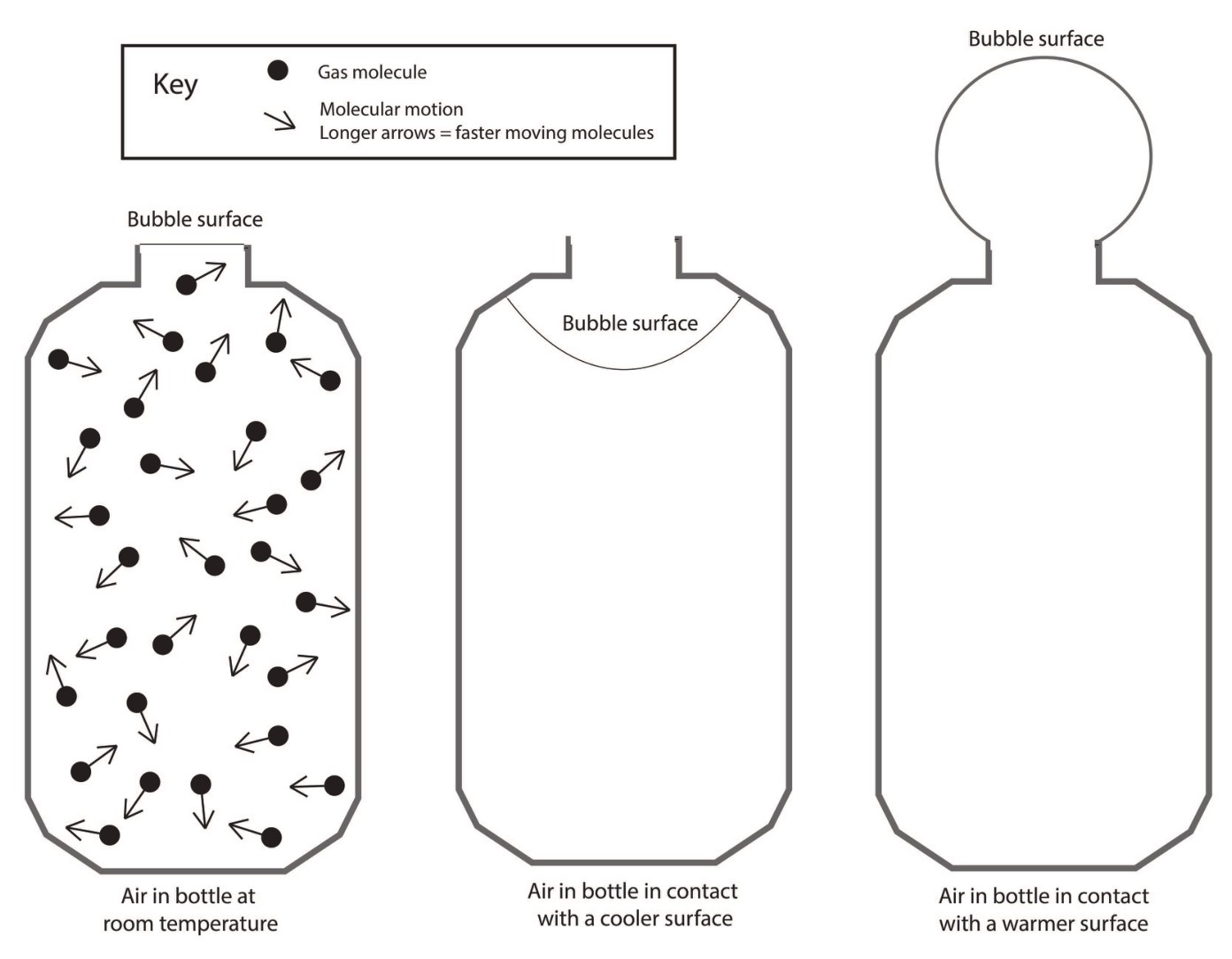
Illustrative evidence case. One selected vessel is rigid and sealed; another has a movable boundary under nearly constant outside pressure.
Notice and wonder
Record two observations using the stated quantities or relationships. Keep observations separate from possible causes. Write one question that a new measurement could help answer.
Why can warming one gas sample increase pressure and another sample’s volume?
Your first model
Label fixed and changing variables for both boundaries before drawing motion arrows.
Build the language from the idea
- Boyle's Law
- At constant temperature, the pressure and volume of a fixed amount of gas are inversely proportional: P₁V₁ = P₂V₂.
- Charles's Law
- At constant pressure, the volume of a fixed amount of gas is directly proportional to its Kelvin temperature: V₁/T₁ = V₂/T₂.
- Gay-Lussac's Law
- At constant volume, the pressure of a fixed amount of gas is directly proportional to its Kelvin temperature: P₁/T₁ = P₂/T₂.
- combined gas law
- A single relationship that merges the three individual laws: P₁V₁/T₁ = P₂V₂/T₂.
- Kelvin scale
- An absolute temperature scale whose zero point (0 K) is absolute zero; K = °C + 273.15.
- absolute zero
- The lowest possible temperature, 0 K (about −273°C), where particle motion is at its theoretical minimum.
- pressure
- The force per unit area exerted by gas particles colliding with the walls of their container; measured in atm, kPa, mmHg, or torr.
Gases are the most cooperative state of matter to study, because they all respond to squeezing and heating in the same predictable ways. Over the 1600 s and 1700 s, careful experimenters — Robert Boyle, Jacques Charles, and Joseph Gay-Lussac among them — pinned those responses down into simple mathematical gas laws. The trick behind every one of them is to hold some quantities fixed while watching how the rest trade off. Keep the amount of gas constant and you are left with three players to juggle: pressure (P), volume (V), and temperature (T).
Boyle's Law freezes the temperature and pins down the relationship between pressure and volume: they are *inversely* proportional. Squeeze a gas into half the space and its pressure doubles; let it expand into twice the room and its pressure is cut in half. It makes intuitive sense through KMT — cram the same fast-moving particles into a smaller box and they strike the walls more often, driving the pressure up. Mathematically, the product stays constant: P₁V₁ = P₂V₂. This is the physics of a syringe, a bicycle pump, and your own lungs.
Charles's Law freezes the pressure instead and links volume to temperature, and here the two rise together — they are *directly* proportional. Warm a gas and it expands; chill it and it shrinks, which is exactly why a balloon left in a hot car swells and a balloon dunked in liquid nitrogen collapses. The law is written V₁/T₁ = V₂/T₂, but there is a non-negotiable catch: T must be in kelvin. Double the Kelvin temperature and you genuinely double the volume; try that with Celsius and the math falls apart.
Gay-Lussac's Law freezes the volume — think of a rigid, sealed steel container that cannot expand — and links pressure to temperature, again directly proportional: P₁/T₁ = P₂/T₂. Heat the gas inside a can and the particles move faster and hit the walls harder, so the pressure climbs. This is the reason aerosol cans carry a warning never to incinerate them, and why a sealed container of gas can burst if it gets too hot. As always, temperature goes in as kelvin.
Why the constant insistence on kelvin? Because these laws describe proportionality with the *true* amount of particle motion, and only the Kelvin scale starts at the right place. Its zero, absolute zero (0 K ≈ −273°C), is the point of minimum particle motion — genuine zero energy. The Celsius zero, by contrast, is just the freezing point of water, an arbitrary landmark with plenty of motion still going on and negative numbers below it. Plug 0°C or a negative Celsius value into V/T and you get nonsense; convert with K = °C + 273.15 first and everything works.
Finally, the combined gas law stitches all three together for situations where pressure, volume, *and* temperature all change at once: P₁V₁/T₁ = P₂V₂/T₂. Every earlier law is just this equation with one variable held constant, so if you memorize this one you can recreate the others. The reliable strategy for any gas-law problem is the same: list what you know, convert every temperature to kelvin, make sure your pressure and volume units match on both sides, then rearrange and solve for the missing piece.
Model check: Use absolute pressure and kelvin; Celsius doubling is not absolute-temperature doubling. V₂=2(450/300)=3L; the larger absolute temperature gives proportionally larger volume.
Build your understanding
Use the detailed parent plan: two core 50–60-minute sessions per focused unit, with a third assigned for selected calculation/modeling topics. First study the core explanation and Parts 1–2 with their figures/checks; next study Parts 3–4, the whole-unit application, worked cases, varied practice and exit check. Attempt reasoning before opening guidance. Extend time when actual understanding requires it; investigations and chapter assessments have separate sessions.
Part 1 · Choose the held-constant quantities
Boyle’s law states that an ideal-gas sample at fixed amount and temperature has constant pressure–volume product. Doubling volume halves absolute pressure in that model. The pressure–volume curve is inverse, not a straight descending line. It does not apply unchanged if gas leaks, temperature changes substantially or the gas condenses. Identify the controlled variables and whether each quantity is absolute before selecting a proportionality or substituting numbers.
Read the visual model
Identify the labeled structures and units, then trace the arrows or compare values under the caption’s stated conditions. Separate the displayed evidence from a further inference. Write your reasoning before opening the guidance.
At 2 L the selected pressure is 200 kPa. What does this model predict at 4 L?
Visual reasoning — after your attempt
100 kPa, because fixed n and T give the same 400 kPa·L product.
Boyle’s relationship compares pressure and volume at constant amount and temperature; Charles’s compares volume and absolute temperature at constant amount and pressure. A gas-law name is incomplete without the controlled variables. Check whether the system leaks or changes phase before applying a simple relationship.
For a closed isothermal compression, halving volume ideally doubles pressure. If temperature also rises, Boyle’s simple comparison is insufficient.
Pause and explain
Why can a pressure-volume comparison need more than Boyle’s law?
Check your reasoning after answering
Temperature or gas amount may also change. The relationship applies only when its required constants are appropriate.
Part 2 · Use absolute temperature and absolute pressure
Charles’s law gives V/T constant for a fixed ideal-gas amount at constant pressure. Use kelvin, obtained by adding 273.15 to Celsius temperature. A graph extrapolated toward zero kelvin expresses the mathematical idealization, not a way to cool a real sample into zero volume; phase changes and quantum effects intervene. A flexible boundary can allow volume changes, while a rigid sealed vessel instead tends to change pressure when heated. Decide which boundary the experiment actually uses.
Read the visual model
Identify the labeled structures and units, then trace the arrows or compare values under the caption’s stated conditions. Separate the displayed evidence from a further inference. Write your reasoning before opening the guidance.
Why is changing from 20°C to 40°C not a doubling of absolute gas temperature?
Visual reasoning — after your attempt
Those temperatures are 293.15 and 313.15 K. The absolute ratio is about 1.068, not two.
Gas-law temperature ratios require Kelvin, not Celsius. Pressure must be absolute, not a gauge reading relative to atmospheric pressure. Use compatible units for both endpoints. A stated gauge pressure needs atmospheric pressure added before a gas-law ratio.
20°C is 293.15 K. A gauge reading of 50 kPa with atmospheric pressure 100 kPa corresponds to 150 kPa absolute.
Pause and explain
Why does zero gauge pressure not mean no gas pressure?
Check your reasoning after answering
It means pressure equals the atmospheric reference. Gas-law equations use pressure relative to vacuum, so the absolute pressure is not zero.
Part 3 · Use the combined law with its assumptions
Absolute pressure is measured relative to vacuum, while gauge pressure is measured relative to the surrounding atmosphere. An ordinary gauge reading of zero therefore does not mean zero molecular collisions or vacuum. In the selected example, a 150 kPa gauge reading with 100 kPa atmosphere corresponds to 250 kPa absolute. Gas-law equations use the absolute pressure; temperature also uses an absolute scale. State both reference conditions rather than treating the printed number on an instrument as automatically suitable.
Read the visual model
Identify the labeled structures and units, then trace the arrows or compare values under the caption’s stated conditions. Separate the displayed evidence from a further inference. Write your reasoning before opening the guidance.
If the gauge reads 150 kPa and the atmosphere is 100 kPa, what pressure enters the ideal-gas equation?
Visual reasoning — after your attempt
250 kPa absolute, the sum of the gauge reading and atmospheric reference.
For fixed amount of ideal gas, P₁V₁/T₁=P₂V₂/T₂. Solve algebraically before substituting and check whether compression or heating should raise pressure. The equation cannot silently accommodate added gas or a reaction that changes the gas amount.
If both volume and temperature change, account for both ratios. A numerator/denominator reversal can produce a plausible-looking but physically reversed result.
Pause and explain
What physical check helps identify an inverted volume ratio?
Check your reasoning after answering
At fixed temperature and amount, smaller final volume should give greater final pressure, not smaller pressure.
Part 4 · Separate mathematical extrapolation from physical feasibility
The combined gas law relates P, V and T for the same ideal-gas amount before and after a change. Rearranging before substitution helps keep the pressure and temperature ratios in the correct direction. If n changes, include it explicitly through PV=nRT rather than canceling it. A numerical result must also be checked for physical feasibility: condensation, chemical reaction, leakage or container limits can invalidate the simple model. Algebra alone does not establish that an imagined apparatus can realize the states.
Read the visual model
Identify the labeled structures and units, then trace the arrows or compare values under the caption’s stated conditions. Separate the displayed evidence from a further inference. Write your reasoning before opening the guidance.
Why can the combined expression fail when a vessel’s valve releases gas during the change?
Visual reasoning — after your attempt
The amount n is no longer fixed, so it cannot be canceled from the initial and final ideal-gas accounts.
A linear ideal-gas extrapolation is not evidence that an ordinary gas stays gaseous at every predicted temperature. Condensation and nonideal behavior intervene. A calculated endpoint should include phase and material constraints rather than being treated as an experimental instruction.
Predicting a very small ideal volume near absolute zero does not mean a real sample can be compressed or cooled according to the same line indefinitely.
Pause and explain
Why should a gas-law line not be extended without limit?
Check your reasoning after answering
The assumed gas phase, ideal interactions, and physical apparatus conditions eventually fail. The mathematical model has a limited range.
Apply the whole unit · Combine compression and heating
Illustrative ideal gas: P₁=100 kPa,V₁=2.00 L,T₁=300 K; final V₂=1.50 L,T₂=330 K, with amount fixed and pressures absolute.
Your task
Calculate final pressure, show a dimensional and qualitative check, and explain why the result would change if gas escaped or if gauge pressure were used incorrectly.
What your response should show
- Choose the appropriate chemical model or relationship and state its conditions.
- Show substitutions, units, particle or charge counts, and intermediate reasoning as relevant.
- Use supplied evidence to justify the conclusion; distinguish observation from inference.
- Identify a meaningful limitation, uncertainty, or next measurement.
Response guidance — after your attempt
Solve P₂=P₁(V₁/V₂)(T₂/T₁).
Substitute 100×(2.00/1.50)×(330/300)=146.7 kPa.
Report about 147 kPa with precision limited by the supplied data.
Compression and heating both raise pressure in this model, so a result below 100 kPa would require checking the ratio or assumptions. Gas escape changes n and invalidates the fixed-amount comparison. Gauge pressure is not interchangeable with the supplied absolute pressure. State actual phase and temperature-uniformity conditions for a real sample.
Scientific references and source-model foundations
- OpenStax — gas laws and the ideal-gas model
- OpenSciEd public middle-school source license — CC BY 4.0
Parent / teacher teaching notes
Have students list what stays constant before choosing an equation. Require Kelvin and an expected-trend prediction before arithmetic. Ask the learner to explain each particle symbol, axis, unit and arrow before calculating. Distinguish hypothetical models and calculated curves from measured records. Public OpenSciEd excerpts here are selected foundation prompts, not complete high-school teacher editions or an endorsement. All required advanced explanations and practice are provided locally.
The key idea
Gas-law ratios require fixed quantities to be identified, absolute pressure and kelvin temperature. The combined ideal relation applies to a fixed gas amount within its stated physical domain.
Boyle's Law
P₁V₁ = P₂V₂
constant temperature and amount of gas; P = pressure, V = volume. Pressure and volume are inversely proportional.
Charles's Law
V₁/T₁ = V₂/T₂
constant pressure and amount of gas; T must be in kelvin. Volume is directly proportional to absolute temperature.
Gay-Lussac's Law
P₁/T₁ = P₂/T₂
constant volume and amount of gas; T must be in kelvin. Pressure is directly proportional to absolute temperature.
Combined Gas Law
P₁V₁/T₁ = P₂V₂/T₂
constant amount of gas; T in kelvin. Merges Boyle's, Charles's, and Gay-Lussac's laws into one relationship.
Worked examples
Example 1
- Temperature is constant, so use Boyle's Law: P₁V₁ = P₂V₂.
- Substitute the knowns: (2.0 atm)(4.0 L) = P₂(1.0 L).
- Solve: P₂ = (2.0 × 4.0) / 1.0 = 8.0 atm.
Example 2 · Worked application
- Use P₁V₁=P₂V₂.
- P₂=150×2.0/3.0=100 kPa.
- Expansion at fixed temperature lowers pressure.
The qualitative direction is an independent check.
Example 3
- Convert both temperatures to kelvin: 27 + 273 = 300 K and 127 + 273 = 400 K.
- Pressure is constant, so use Charles's Law: V₁/T₁ = V₂/T₂, giving 1.5/300 = V₂/400.
- Solve: V₂ = 1.5 × (400 / 300) = 2.0 L.
Example 4 · Find and fix the mistake
- Test the claim against the stated conditions: The qualitative direction is an independent check.
- At fixed temperature and amount, pressure is inversely proportional to volume.
The qualitative direction is an independent check.
Example 5 · Reason from the visual model
- Absolute pressure is measured relative to vacuum, while gauge pressure is measured relative to the surrounding atmosphere. An ordinary gauge reading of zero therefore does not mean zero molecular collisions or vacuum. In the selected example, a 150 kPa gauge reading with 100 kPa atmosphere corresponds to 250 kPa absolute. Gas-law equations use the absolute pressure; temperature also uses an absolute scale. State both reference conditions rather than treating the printed number on an instrument as automatically suitable.
- 250 kPa absolute, the sum of the gauge reading and atmospheric reference.
Original selected pressure-reference example; atmospheric pressure is supplied as 100 kPa rather than asserted as universal.
Avoid these mistakes
- Use absolute pressure and kelvin; Celsius doubling is not absolute-temperature doubling.
Check your understanding
A2L gas at 300 K warms to 450 K at constant P and n. Find volume.
Discuss the answer
V₂=2(450/300)=3L; the larger absolute temperature gives proportionally larger volume.
Return to the phenomenon
Return to the initial case. Why can warming one gas sample increase pressure and another sample’s volume? Revise your drawing or explanation using two named ideas and one stated limitation.
Compare explanations after your attempt
The same temperature change can appear as different macroscopic responses. Use the relevant controlled quantities and absolute scales to choose the gas-law relation.
What should we investigate next?
Which comparison would test a remaining uncertainty? State what you would change, keep comparable and measure.
Investigate, calculate and revise
Keep a first model and an evidence-supported revision. Attempt each task before opening guidance; all required explanations and supplied-data routes are available locally.
Activity 1 · Return to the opening case
Use the opening phenomenon, unit definitions and explained Parts 1–4.
Your task
Return to the initial case. Why can warming one gas sample increase pressure and another sample’s volume? Revise your drawing or explanation using two named ideas and one stated limitation.
Success criteria
- Use the stated observations and appropriate units.
- Connect a labeled model with the chemical mechanism.
- State assumptions and an evidence limitation.
- Explain a substantive revision or next test.
Hint
Keep species identity, material transfer and energy account distinct.
Response guidance — discuss after your attempt
The same temperature change can appear as different macroscopic responses. Use the relevant controlled quantities and absolute scales to choose the gas-law relation.
Activity 2 · Transfer to a changed case
Cover the worked answer and use the explained models, relationships and notebook.
Your task
A fixed ideal-gas amount occupies 3.00 L at 100 kPa absolute and 300 K. Find its volume at 150 kPa and 350 K, and name one model limitation.
Success criteria
- Use the stated measurements or conditions, with correct units.
- Connect the result to the chemical mechanism or evidence relationship.
- Identify the assumption, model limit or further evidence requested.
Hint
Name known quantities and conditions, show intermediate steps and check conservation.
Response guidance — discuss after your attempt
V₂=3.00(100/150)(350/300)=2.33 L. Assume the same gas amount and ideal behavior; leakage, reaction or condensation would require another account.
Words to know
- Boyle's Law
- At constant temperature, the pressure and volume of a fixed amount of gas are inversely proportional: P₁V₁ = P₂V₂.
- Charles's Law
- At constant pressure, the volume of a fixed amount of gas is directly proportional to its Kelvin temperature: V₁/T₁ = V₂/T₂.
- Gay-Lussac's Law
- At constant volume, the pressure of a fixed amount of gas is directly proportional to its Kelvin temperature: P₁/T₁ = P₂/T₂.
- combined gas law
- A single relationship that merges the three individual laws: P₁V₁/T₁ = P₂V₂/T₂.
- Kelvin scale
- An absolute temperature scale whose zero point (0 K) is absolute zero; K = °C + 273.15.
- absolute zero
- The lowest possible temperature, 0 K (about −273°C), where particle motion is at its theoretical minimum.
- pressure
- The force per unit area exerted by gas particles colliding with the walls of their container; measured in atm, kPa, mmHg, or torr.
How a graph revealed absolute zero
When early scientists plotted the volume of a gas against its Celsius temperature and drew the line, they noticed every gas gave a straight line that, extended backward, hit zero volume at about −273°C. Different gases, different starting points — yet all the lines pointed to the same impossible floor, a temperature so cold a gas would shrink to nothing. That shared vanishing point had to be the coldest temperature possible, absolute zero, and it is exactly why William Thomson (Lord Kelvin) built a new temperature scale starting there. The gas laws didn't just use the Kelvin scale; they helped discover it.
Robert Boyle and the birth of the experiment
In 1662, Robert Boyle trapped a pocket of air in the sealed short arm of a J-shaped tube and poured mercury into the long arm to squeeze it. By carefully measuring how the trapped volume shrank as he added weight, he showed pressure and volume trade off in exact inverse proportion — one of the first physical laws pinned down by deliberate, quantitative experiment rather than pure reasoning. Boyle is often called a father of modern chemistry, and in France the same relationship is still credited to Edme Mariotte, who found it independently.
Why your tire-pressure light blinks on the first cold morning
Ever notice the low-tire warning glow after the season's first cold snap, even with no leak? That is Gay-Lussac's Law in your driveway. A tire is essentially a rigid, fixed-volume container, so when the overnight temperature plunges, the air inside cools, its molecules slow down, and the pressure drops — roughly 1 psi for every 10°F of cooling. Nothing escaped; the gas just pushes less hard when it is cold, and it climbs right back up once you drive and warm the tires.
The weather balloon that starts wrinkly and bursts fat
A weather balloon looks almost comically under-filled at launch — floppy and half-empty. That is deliberate Boyle's Law engineering. As the balloon climbs into the thin upper atmosphere, the outside pressure drops toward almost nothing, so the helium inside expands enormously, swelling the balloon to many times its launch size. By about 30 kilometers up the stretched latex finally can't take it and bursts, and the instrument package parachutes back to Earth.
The most common mistake: forgetting kelvin
Here is the error that wrecks more gas-law answers than any other: leaving temperature in Celsius. Suppose a gas at 27°C is heated to 54°C — the Celsius number doubled, so the volume doubles, right? Wrong. Convert first: 27°C is 300 K and 54°C is 327 K, a rise of only 9%, so the volume grows by just 9%, not 100%. The Celsius scale's arbitrary zero quietly poisons every ratio; always convert to kelvin before you divide, never after.
In the real world
Scuba divers live by these laws: as they descend, higher water pressure shrinks the air in their lungs and gear (Boyle's Law), which is why they must never hold their breath while rising — the expanding gas could rupture a lung.
Exit check
A2L gas at 300 K warms to 450 K at constant P and n. Find volume.
Check your explanation after answering
V₂=2(450/300)=3L; the larger absolute temperature gives proportionally larger volume.
Explain your reasoning without notes. If a key idea is missing, revisit the lesson and try again.
Problem 1
- completely unrelated
- inversely proportional
- directly proportional
- always equal
Answer and explanation
inversely proportional
Boyle's Law: as volume decreases, pressure increases in inverse proportion, so P₁V₁ = P₂V₂.
Problem 2
Answer and explanation
2 L
Boyle's Law: V₂ = P₁V₁/P₂ = (1.0 × 6.0)/3.0 = 2.0 L.
Problem 3
Answer and explanation
6 L
Charles's Law: V₂ = V₁ × (T₂/T₁) = 4.0 × (300/200) = 6.0 L.
Problem 4
Answer and explanation
4 atm
Gay-Lussac's Law (constant volume): P₂ = P₁ × (T₂/T₁) = 2.0 × (600/300) = 4.0 atm.
Problem 5
Answer and explanation
The gas laws describe direct proportionality with the true amount of particle motion, and only the Kelvin scale starts at absolute zero (genuine zero energy). Celsius has an arbitrary zero and negative values, so ratios like V/T come out wrong unless temperatures are first converted with K = °C + 273.
Problem 6
Answer and explanation
2.25 L
Combined gas law: V₂ = V₁ × (P₁/P₂) × (T₂/T₁) = 3.0 × (1.0/2.0) × (450/300) = 3.0 × 0.5 × 1.5 = 2.25 L.
Problem 7
Hints
The qualitative direction is an independent check.
Answer and explanation
V₂=2.0×450/300=3.0 L.
Problem 8
Hints
State what the supplied observations or conditions establish, and separate that from any assumption.
Answer and explanation
Absolute temperatures are about 293 K and 313 K; Celsius ratios do not measure proportional thermal energy.
Problem 9
Answer and explanation
250 kPa absolute, the sum of the gauge reading and atmospheric reference.
Absolute pressure is measured relative to vacuum, while gauge pressure is measured relative to the surrounding atmosphere. An ordinary gauge reading of zero therefore does not mean zero molecular collisions or vacuum. In the selected example, a 150 kPa gauge reading with 100 kPa atmosphere corresponds to 250 kPa absolute. Gas-law equations use the absolute pressure; temperature also uses an absolute scale. State both reference conditions rather than treating the printed number on an instrument as automatically suitable.
250 kPa absolute, the sum of the gauge reading and atmospheric reference.
Response criteria
- Interpret labels, structures, axes, units and directions correctly.
- Explain the chemistry relationship or mechanism.
- Respect stated assumptions and distinguish observation from inference.
Problem 10
Answer and explanation
V₂=3.00(100/150)(350/300)=2.33 L. Assume the same gas amount and ideal behavior; leakage, reaction or condensation would require another account.
V₂=3.00(100/150)(350/300)=2.33 L. Assume the same gas amount and ideal behavior; leakage, reaction or condensation would require another account.
Response criteria
- Use the stated measurements or conditions, with correct units.
- Connect the result to the chemical mechanism or evidence relationship.
- Identify the assumption, model limit or further evidence requested.
Problem 11
Answer and explanation
Mean translational energy increases with kelvin temperature, characteristic speed for the same species increases with √T, and volume increases proportionally to T under the fixed-pressure ideal model. Keep molecule identity and total count fixed. A rigid sealed vessel fixes volume, so pressure rises instead; blank template regions do not mean zero particles.
Identify the source’s visible labels, scales and unfinished or omitted information.
Use the local complete explanations to connect the observation with an explicit mechanism.
State assumptions and a limit before extending the model.
Response criteria
- Interpret the source symbols and boundary correctly.
- Explain the relevant mechanism using quantities/species consistently.
- State a meaningful omission, assumption or evidence limitation.