Forces, Rotation & Equilibrium — Chapter Practice, Grade 12
Use force diagrams, friction, circular motion, springs, and torque to explain motion and balance.
Problem 1
Answer and explanation
9 m/s²
a = ΣF ÷ m = 36 ÷ 4 = 9 m/s².
Problem 2
Answer and explanation
90 N
ΣF = ma = 0.045 × 2,000 = 90 N.
Problem 3
- The book pulling up on the Earth
- The book's inertia
- The table pushing up on the book
- The book pushing down on the table
Answer and explanation
The book pulling up on the Earth
A third-law pair acts on two different objects. If Earth pulls the book down, the reaction is the book pulling Earth up. (The table's push is a separate force, not the reaction to gravity.)
Problem 4
- Greater than its weight
- Zero
- 9,800 N upward
- 1,000 N upward
Answer and explanation
Zero
Constant velocity means zero acceleration, so by ΣF = ma the net force must be zero — the cable tension exactly balances the weight.
Problem 5
Answer and explanation
Before the impact the passenger's head is at rest. When the car and seat are suddenly pushed forward, the head tends to stay where it was because of inertia (Newton's first law), so it lags behind the moving body and appears to snap backward. A headrest supplies the force needed to accelerate the head along with the body, preventing whiplash.
Problem 6
Answer and explanation
5 m/s²
Net force = 40 − 15 = 25 N east. a = ΣF ÷ m = 25 ÷ 5 = 5 m/s² east.
Problem 7
Hints
The reaction to a push acts on the other object, not automatically in this force sum.
Answer and explanation
F_net=ma=6 N in the acceleration direction.
Problem 8
Hints
State what the supplied observations or conditions establish, and separate that from any assumption.
Answer and explanation
Their interaction forces are equal and opposite; acceleration magnitude depends on each mass.
Problem 9
Answer and explanation
No. Different masses can have different accelerations under equal-magnitude forces, and other forces may also act.
Newton’s third law pairs the force B exerts on A with the force A exerts on B. Their magnitudes match and directions oppose, but they act on different bodies. They therefore do not cancel when calculating the acceleration of A alone. In a combined A+B system these mutual forces are internal and cancel in the total external-force account. Identify the agent and receiving body for every arrow before deciding which sum it belongs in.
No. Different masses can have different accelerations under equal-magnitude forces, and other forces may also act.
Response criteria
- Interpret labels, structures, axes, units and directions correctly.
- Explain the physical or environmental relationship or mechanism.
- Respect stated assumptions and distinguish observation from inference.
Problem 10
Answer and explanation
Net=12 N east; a=3 m/s² east. Its third-law partner is the cart’s 18 N force on the pulling agent, not the 6 N resistance on the cart.
Net=12 N east; a=3 m/s² east.
Its third-law partner is the cart’s 18 N force on the pulling agent, not the 6 N resistance on the cart.
Response criteria
- Use the stated measurements or conditions, with correct units.
- Connect the result to the physical or environmental mechanism or evidence relationship.
- Identify the assumption, model limit or further evidence requested.
Problem 11
Answer and explanation
30 N
Net force = 50 − 20 = 30 N to the right (the vertical weight and normal force cancel).
Problem 12
Answer and explanation
10 N
Perpendicular forces combine by the Pythagorean theorem: √(6² + 8²) = √(36 + 64) = √100 = 10 N.
Problem 13
- Only the normal force, upward
- An applied force and friction
- Weight downward and the normal force upward
- Only the weight, downward
Answer and explanation
Weight downward and the normal force upward
A resting book feels gravity pulling it down and the table's normal force pushing it up. The two are equal, so it stays in equilibrium.
Problem 14
- include no forces at all
- grow larger over time
- point in the direction of motion
- add up to zero
Answer and explanation
add up to zero
Constant velocity means zero acceleration, so the net force is zero — the forces present must cancel out. (Forces can exist; they simply balance.)
Problem 15
Answer and explanation
Weight pulls straight down; the normal force from the snow pushes straight up; the rope's tension pulls forward (horizontal); and kinetic friction from the snow pushes backward, opposing the sled's motion. If the sled moves at steady speed, the up/down pair cancels and tension equals friction.
Problem 16
Answer and explanation
2 m/s²
Net force = √(12² + 5²) = √(144 + 25) = √169 = 13 N. Then a = ΣF ÷ m = 13 ÷ 6.5 = 2 m/s².
Problem 17
Hints
Normal equals weight only for the specified force and acceleration conditions.
Answer and explanation
30 N upward, balancing weight in the given model.
Problem 18
Hints
State what the supplied observations or conditions establish, and separate that from any assumption.
Answer and explanation
Newton's second law concerns that object's force sum; partner forces on other objects belong in other diagrams.
Problem 19
Answer and explanation
The upward tension component changes N, so using mg directly in μN would use the wrong contact force.
A vector equation becomes one scalar equation per perpendicular axis. Independent does not mean unrelated: the same tension angle enters both, and contact constraints can set a component of acceleration. For a block that remains on a horizontal table, ay=0 while ax may be nonzero. Assign signs to every component before substituting values; then solve the vertical support account before using a friction model that depends on N.
The upward tension component changes N, so using mg directly in μN would use the wrong contact force.
Response criteria
- Interpret labels, structures, axes, units and directions correctly.
- Explain the physical or environmental relationship or mechanism.
- Respect stated assumptions and distinguish observation from inference.
Problem 20
Answer and explanation
N=29.4−7.5=21.9 N. Horizontal net=15cos 30°−4≈8.99 N; ax≈3.00 m/s². The tension is counted once through its components.
N=29.4−7.5=21.9 N.
Horizontal net=15cos 30°−4≈8.99 N; ax≈3.00 m/s².
The tension is counted once through its components.
Response criteria
- Use the stated measurements or conditions, with correct units.
- Connect the result to the physical or environmental mechanism or evidence relationship.
- Identify the assumption, model limit or further evidence requested.
Problem 21
Answer and explanation
20 N
f = μₖN = 0.40 × 50 = 20 N.
Problem 22
Answer and explanation
36.75 N
N = mg = 15 × 9.8 = 147 N. f = μₖN = 0.25 × 147 = 36.75 N.
Problem 23
- The maximum static friction is greater than the kinetic friction
- The box loses mass once it moves
- Friction disappears the instant the box moves
- Kinetic friction is greater than static friction
Answer and explanation
The maximum static friction is greater than the kinetic friction
Maximum static friction (μₛN) exceeds kinetic friction (μₖN), so it takes a bigger force to break the box free than to keep it sliding.
Problem 24
- stays exactly the same
- decreases
- immediately becomes zero
- increases
Answer and explanation
decreases
The normal force equals mg cosθ. As θ grows, cosθ shrinks, so the normal force decreases (reaching zero only at a vertical 90° 'ramp').
Problem 25
Answer and explanation
Static friction acts between surfaces that aren't sliding yet and adjusts up to a maximum to prevent motion; kinetic friction acts between surfaces already sliding and is a bit weaker. You feel the switch when pushing a heavy couch: it resists until you push past the static maximum, then suddenly 'gives' and slides more easily under the smaller kinetic friction.
Problem 26
Answer and explanation
3.2 m/s²
Along the slope: a = g(sinθ − μₖcosθ) = 9.8(0.5 − 0.20 × 0.866) = 9.8(0.5 − 0.173) = 9.8 × 0.327 ≈ 3.2 m/s². (Mass cancels out.)
Problem 27
Hints
Static friction instead adjusts up to its limiting value.
Answer and explanation
12 N, enough to balance the required tangential force without exceeding the maximum.
Problem 28
Hints
State what the supplied observations or conditions establish, and separate that from any assumption.
Answer and explanation
It changes the normal force and potentially the sliding tendency; friction depends on N and the motion regime.
Problem 29
Answer and explanation
Recalculate N using the vertical force balance; then update the kinetic-friction estimate and horizontal net force.
Kinetic friction acts during relative sliding. The school approximation fk≈μkN can model a limited range of surface conditions, although real friction may depend on speed, temperature, deformation and wear. On a level table with no vertical acceleration or extra vertical forces, N=mg here. That equality came from the force account, not from the friction law. State the sliding direction before assigning the sign of fk in Newton’s second law.
Recalculate N using the vertical force balance; then update the kinetic-friction estimate and horizontal net force.
Response criteria
- Interpret labels, structures, axes, units and directions correctly.
- Explain the physical or environmental relationship or mechanism.
- Respect stated assumptions and distinguish observation from inference.
Problem 30
Answer and explanation
N=49 N; static limit=19.6 N, so 15 N is balanced by 15 N friction. During sliding fk=14.7 N; a=(25−14.7)/5=2.06 m/s² along the push.
N=49 N; static limit=19.6 N, so 15 N is balanced by 15 N friction.
During sliding fk=14.7 N; a=(25−14.7)/5=2.06 m/s² along the push.
Response criteria
- Use the stated measurements or conditions, with correct units.
- Connect the result to the physical or environmental mechanism or evidence relationship.
- Identify the assumption, model limit or further evidence requested.
Problem 31
Answer and explanation
2 m/s²
a = v²/r = 10² ÷ 50 = 100 ÷ 50 = 2 m/s², directed toward the center of the curve.
Problem 32
Answer and explanation
18 N
F = mv²/r = 2 × 6² ÷ 4 = 2 × 36 ÷ 4 = 72 ÷ 4 = 18 N.
Problem 33
- Along the direction of motion (tangent to the circle)
- Outward, away from the center
- Toward the center of the circle
- There is no net force
Answer and explanation
Toward the center of the circle
Uniform circular motion requires a center-seeking (centripetal) net force. The outward feeling is an illusion of the accelerating frame.
Problem 34
- one-half as strong
- twice as strong
- unchanged
- one-quarter as strong
Answer and explanation
one-quarter as strong
Gravitation is an inverse-square law (F ∝ 1/r²). Doubling r multiplies the force by 1/2² = 1/4.
Problem 35
Answer and explanation
Even at constant speed the satellite's direction is always changing, and any change in velocity is acceleration — here it is centripetal acceleration pointing toward Earth's center. The force supplying it is gravity: Earth's gravitational pull provides exactly the mv²/r needed to bend the satellite's path into a circle, so it 'falls around' the planet.
Problem 36
Answer and explanation
6000 N
F = mv²/r = 1,200 × 20² ÷ 80 = 1,200 × 400 ÷ 80 = 1,200 × 5 = 6,000 N, directed toward the center of the curve.
Problem 37
Hints
Centripetal describes net inward force, not an additional mysterious interaction.
Answer and explanation
It quadruples force because F=mv²/r.
Problem 38
Hints
State what the supplied observations or conditions establish, and separate that from any assumption.
Answer and explanation
g=GM/r² decreases with distance from the center; doubling r gives one quarter the field.
Problem 39
Answer and explanation
r=2R, so g is one quarter of its surface value.
For ideal point masses or a spherical source outside its surface, Newtonian gravitation gives F=GMm/r² with center-to-center separation r. A satellite’s altitude h above a spherical Earth is not r; use r=R+h. Doubling center distance reduces force and gravitational acceleration to one quarter. The familiar near-surface g≈9.8 m/s² is an approximation over modest height differences, not the same value at every orbital distance.
r=2R, so g is one quarter of its surface value.
Response criteria
- Interpret labels, structures, axes, units and directions correctly.
- Explain the physical or environmental relationship or mechanism.
- Respect stated assumptions and distinguish observation from inference.
Problem 40
Answer and explanation
ac=16/2=8.0 m/s² and inward net force=0.50×8=4.0 N. Tension equals that net only if the specified geometry and other forces establish it as the sole inward contribution.
ac=16/2=8.0 m/s² and inward net force=0.50×8=4.0 N.
Tension equals that net only if the specified geometry and other forces establish it as the sole inward contribution.
Response criteria
- Use the stated measurements or conditions, with correct units.
- Connect the result to the physical or environmental mechanism or evidence relationship.
- Identify the assumption, model limit or further evidence requested.
Problem 41
Hints
Write the relationship first; substitute with consistent units.
Answer and explanation
3 N
100×.03=3.
Problem 42
Answer and explanation
The force lines can produce a nonzero net torque about the object.
Response criteria
- State a scientifically accurate conclusion.
- Show the calculation or mechanism that supports it.
- Include units, conditions, or limits where relevant.
Problem 43
Hints
List the given quantities, select a relationship, and check units before substituting.
Answer and explanation
1 J
½×200×.10²=1.
Problem 44
Answer and explanation
Force varies with extension; integrate or use the triangular graph area.
Response criteria
- State a scientifically accurate conclusion.
- Show the calculation or mechanism that supports it.
- Include units, conditions, or limits where relevant.
Problem 45
Hints
Use perpendicular lever arm and rotational sign.
Answer and explanation
F=kx=10 N, directed toward restoring equilibrium.
Problem 46
Hints
State what the supplied observations or conditions establish, and separate that from any assumption.
Answer and explanation
Zero net force prevents translational acceleration; zero net torque prevents angular acceleration.
Problem 47
Answer and explanation
No. The vector force sum must also vanish, and the starting state must be at rest.
Static equilibrium means the body remains at rest without translational or rotational acceleration. It needs ΣF=0 and Στ=0 about a selected pivot in the rigid-body model. Equal opposing torques alone can coexist with nonzero net force, while balanced forces can still form a turning couple. For this weightless-bar example equal downward loads at equal opposite arms balance torque, and the upward support must balance their combined 60 N force.
No. The vector force sum must also vanish, and the starting state must be at rest.
Response criteria
- Interpret labels, structures, axes, units and directions correctly.
- Explain the physical or environmental relationship or mechanism.
- Respect stated assumptions and distinguish observation from inference.
Problem 48
Answer and explanation
Torque balance: F×2=60×0.50, so F=15 N upward. Vertical balance gives pivot reaction=60−15=45 N upward. Both balances are necessary.
Torque balance: F×2=60×0.50, so F=15 N upward.
Vertical balance gives pivot reaction=60−15=45 N upward.
Both balances are necessary.
Response criteria
- Use the stated measurements or conditions, with correct units.
- Connect the result to the physical or environmental mechanism or evidence relationship.
- Identify the assumption, model limit or further evidence requested.
Problem 49
Answer and explanation
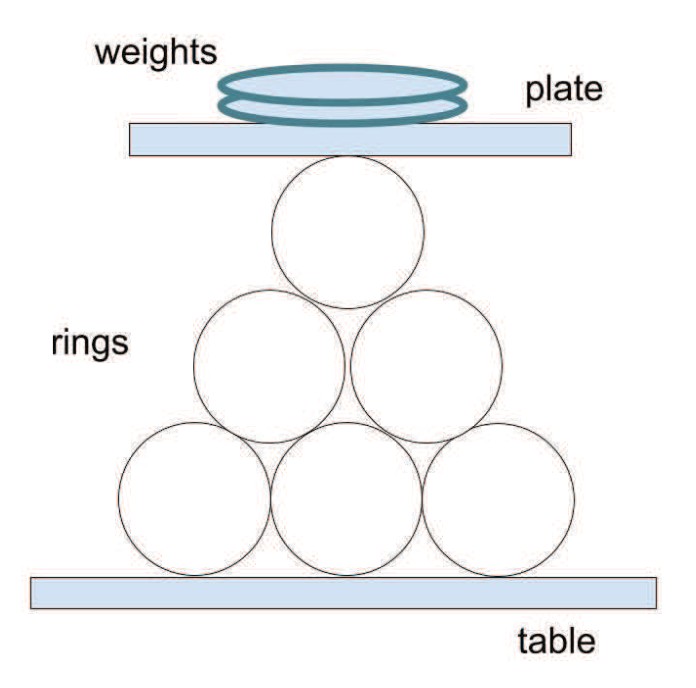
The rings push the loaded plate upward and Earth attracts that selected plate/load downward. Their magnitudes balance at rest but they are not a third-law pair. The plate pushes the rings downward as the support force’s partner on a different body. Impact peak force requires a time-resolved interaction and motion record, not a static layout.
Read source labels, scope, axes and intentional omissions.
Use the complete local explanation to draw a justified mechanism or calculate a supported quantity.
State what is observed, what is assumed and what evidence remains needed.
Response criteria
- Interpret the source labels, units and scope accurately.
- Explain the relevant mechanism with a labeled model or supported calculation.
- Identify a meaningful assumption, uncertainty or missing comparison.