Forces, Rotation & Equilibrium — Print · Physics & Environmental Science, Grade 12
Use force diagrams, friction, circular motion, springs, and torque to explain motion and balance.
Printable chapter lessons and review.
Newton's Three Laws of Motion
Learning goals
- I can state Newton's three laws of motion and explain inertia as an object's resistance to changes in motion.
- I can apply Newton's second law (F = ma) to solve for net force, mass, or acceleration.
- I can identify action-reaction force pairs and explain why the two forces act on different objects.
Readings for this unit
Before this unit
Mass versus weight and signed net force.
Use the detailed parent plan: two core 50–60-minute sessions per focused unit, with a third assigned for selected calculation/modeling topics. First study the core explanation and Parts 1–2 with their figures/checks; next study Parts 3–4, the whole-unit application, worked cases, varied practice and exit check. Attempt reasoning before opening guidance. Extend time when actual understanding requires it; investigations and chapter assessments have separate sessions.
Start with something to explain
Why can a moving cart have zero net force?
Illustrative evidence case. A steady cart is pulled forward while resistance acts backward.
Notice and wonder
Record two observations using the stated quantities or relationships. Keep observations separate from possible causes. Write one question that a new measurement could help answer.
Why can a moving cart have zero net force?
Your first model
Name each force’s agent and receiving body.
Build the language from the idea
- inertia
- The tendency of an object to resist any change in its state of motion; measured by its mass.
- Newton's first law
- An object at rest stays at rest, and an object in motion stays in motion at constant velocity, unless acted on by a nonzero net force.
- Newton's second law
- The net force on an object equals its mass times its acceleration: ΣF = ma.
- Newton's third law
- For every force one object exerts on a second, the second exerts an equal and opposite force back on the first.
- newton (N)
- The SI unit of force; 1 N is the force that accelerates 1 kg at 1 m/s², so 1 N = 1 kg·m/s².
Newton’s laws describe a powerful model for ordinary macroscopic motion in inertial frames. A force is an interaction that contributes to acceleration through the net-force account. Their range is not literally every physical situation: relativistic speeds, quantum-scale evidence and rotating frames need additional models. Within their useful range, identify the object, interactions, mass and coordinate directions to predict how its velocity changes.
Newton's first law, the law of inertia, states that an object keeps doing whatever it is already doing — sitting still or gliding at constant velocity in a straight line — unless a nonzero net force acts on it. Inertia is simply an object's built-in resistance to any change in its motion, and its mass is the direct measure of that resistance. This law overturned a 2,000-year-old belief, going back to Aristotle, that motion needs a continuous push to keep going. The truth is the reverse: a rolling ball slows only because friction and air resistance push back on it. Remove those forces, as in deep space, and the ball glides on forever with no engine at all.
Newton's second law turns that idea into an equation: ΣF = ma, the net force on an object equals its mass times its acceleration. Read carefully, it says two intuitive things at once. First, for a given mass, a larger net force produces a larger acceleration — push harder and it speeds up faster. Second, for a given net force, a larger mass produces a smaller acceleration — that is inertia again. The Greek letter Σ (sigma) means 'sum of,' a crucial reminder that acceleration depends on the *net* force, the single vector left after every push and pull is combined. Force is measured in newtons (N), where one newton accelerates one kilogram at one meter per second squared.
Because it is a vector equation, the second law also tells you the *direction* of the acceleration: an object always accelerates in the same direction as the net force acting on it. Rearranged, the same relationship lets you solve for whatever is unknown — acceleration a = ΣF ÷ m, or mass m = ΣF ÷ a. This one compact formula is the workhorse of the entire unit; nearly every problem you meet, from a sliding crate to an orbiting satellite, comes down to finding the net force and dividing by the mass.
Newton’s third law describes equal-magnitude opposite-direction interaction forces acting on two different bodies. They do not cancel in a free-body diagram of one body. A swimmer pushes water backward and receives a forward force from it. In walking, the foot can push the ground backward while static friction from the ground acts forward on the foot; vertical support is a separate component. Identify the receiving body for every arrow before summing forces.
This third law explains how a rocket accelerates through the vacuum of space, where there is nothing outside to push against. The rocket hurls hot exhaust gas downward, and by the third law that gas pushes the rocket upward with equal force — the action-reaction pair is entirely between the rocket and its own exhaust. From walking to swimming to spaceflight, the three laws work as a team: the first tells you an object's motion only changes when forces are unbalanced, the second tells you exactly how much it changes, and the third reminds you that forces always come in pairs. Learn to read these three ideas together and you can predict the motion of almost anything.
Model check: Action/reaction forces act on different objects, so they do not cancel in one object’s diagram. a=Fnet/m=2 m/s² along the net force.
Build your understanding
Use the detailed parent plan: two core 50–60-minute sessions per focused unit, with a third assigned for selected calculation/modeling topics. First study the core explanation and Parts 1–2 with their figures/checks; next study Parts 3–4, the whole-unit application, worked cases, varied practice and exit check. Attempt reasoning before opening guidance. Extend time when actual understanding requires it; investigations and chapter assessments have separate sessions.
Part 1 · Use inertia without inventing a sustaining force
Inertia is the tendency to retain velocity when net force is zero in an inertial frame. An inertial frame is one where an unforced body moves at constant velocity. The displayed driving and resistance forces cancel horizontally; normal support and weight cancel vertically. This says acceleration is zero, not that the cart is necessarily at rest. Maintaining real steady motion often requires a drive to balance resistance, which differs from needing a forward net force.
Read the visual model
Identify the labeled structures and units, then trace the arrows or compare values under the caption’s stated conditions. Separate the displayed evidence from a further inference. Write your reasoning before opening the guidance.
Could this cart move at 3 m/s?
Visual reasoning — after your attempt
Yes. Balanced forces permit any constant velocity under this model.
In an inertial frame, zero net force means constant velocity, including the special case of rest. A moving object does not need a continuing forward net force to maintain ideal constant velocity. Real resistance often makes a driving interaction necessary to balance other forces.
A cart moving steadily can have several forces whose vector sum is zero. Zero net force is not the same as no interactions.
Pause and explain
Does constant velocity prove there are no forces?
Check your reasoning after answering
No. Forces can balance. It establishes zero acceleration in the model, not absence of all individual forces.
Part 2 · Apply the second law to the net force
For a constant-mass object in an inertial frame, Newton’s second law is ΣF=ma. Sigma means sum: use all external force components on that selected object. A 12 N pull opposed by 8 N produces 4 N net force, not 12 N. Dividing by 2 kg gives 2 m/s² along the net force. Vertical forces are omitted from this horizontal-only panel but must also be accounted for when the full motion requires them.
Read the visual model
Identify the labeled structures and units, then trace the arrows or compare values under the caption’s stated conditions. Separate the displayed evidence from a further inference. Write your reasoning before opening the guidance.
What acceleration results if both horizontal forces double?
Visual reasoning — after your attempt
The net becomes 24−16=8 N, giving 4 m/s² for unchanged 2 kg mass.
For constant mass in an inertial frame, ΣF=ma relates total external force to acceleration. Use all relevant forces on the chosen body, with consistent directions. A large single force can coexist with small acceleration if another force nearly balances it.
A 12 N pull and 8 N opposing resistance on a 2 kg cart give a 4 N net force and 2 m/s² acceleration.
Pause and explain
Which force belongs in ma?
Check your reasoning after answering
The vector sum of external forces on the chosen body, not merely the largest force or the force applied by one agent.
Part 3 · Place action-reaction forces on different bodies
Newton’s third law pairs the force B exerts on A with the force A exerts on B. Their magnitudes match and directions oppose, but they act on different bodies. They therefore do not cancel when calculating the acceleration of A alone. In a combined A+B system these mutual forces are internal and cancel in the total external-force account. Identify the agent and receiving body for every arrow before deciding which sum it belongs in.
Read the visual model
Identify the labeled structures and units, then trace the arrows or compare values under the caption’s stated conditions. Separate the displayed evidence from a further inference. Write your reasoning before opening the guidance.
Do equal interaction forces require equal accelerations of A and B?
Visual reasoning — after your attempt
No. Different masses can have different accelerations under equal-magnitude forces, and other forces may also act.
An interaction produces equal-magnitude opposite-direction forces on the two interacting bodies. They do not cancel in a free-body diagram of just one body because the partner force acts on the other. The resulting accelerations can differ because masses and other interactions differ.
A hand pushes a cart while the cart pushes the hand. The cart’s acceleration depends on forces on the cart, not a sum including the cart’s force on the hand.
Pause and explain
Why do third-law pairs not prevent acceleration?
Check your reasoning after answering
They act on different bodies. A net force calculation for one body includes only forces on that body.
Part 4 · Separate mass, weight, and measured support
Mass measures inertia in kilograms. Weight here means Earth’s gravitational force mg, while a scale reads a support interaction often called apparent weight. For a 50 kg person accelerating upward at 1.96 m/s², N=50(9.8+1.96)=588 N although mg remains 490 N. The normal force equals mg only when the vertical acceleration and other relevant vertical forces allow that balance. A scale reading change need not mean mass or local gravity changed.
Read the visual model
Identify the labeled structures and units, then trace the arrows or compare values under the caption’s stated conditions. Separate the displayed evidence from a further inference. Write your reasoning before opening the guidance.
What would the ideal scale read during downward acceleration of 1.96 m/s²?
Visual reasoning — after your attempt
N=50(9.8−1.96)=392 N; mass remains 50 kg.
Mass measures inertia in this model. Weight mg is the gravitational force near Earth; a scale commonly measures a support interaction. A scale reading can differ from mg during acceleration. Describe the actual measured force rather than using mass and weight interchangeably.
A scale in an upward-accelerating lift can report a support force greater than mg while the person’s mass stays unchanged.
Pause and explain
Does a larger lift scale reading mean mass increased?
Check your reasoning after answering
No. It reflects a changed support force needed for the acceleration; mass remains the same in this ordinary mechanical model.
Apply the whole unit · Explain an accelerating lift
Illustrative person of mass 60.0 kg accelerates upward at 2.0 m/s². Use g=10.0 m/s² and an ideal floor scale.
Your task
Draw forces on the person, find the scale reading, identify the floor-person third-law pair, and explain how the result differs from steady motion.
What your response should show
- Define the system, quantities, units, and relevant conditions before selecting a model.
- Show intermediate calculations or a labeled evidence account, including signs or denominators.
- Explain how the supplied evidence supports the conclusion rather than reporting only an answer.
- Identify a meaningful uncertainty, model limit, or measurement needed to test the conclusion.
Response guidance — after your attempt
Weight=mg=600 N downward.
N−600=60×2; support N=720 N upward.
The person exerts 720 N downward on the floor; for steady velocity N would be 600 N.
The scale measures support, which exceeds weight during this upward acceleration. The floor’s support on the person and the person’s force on the floor are the third-law pair; support and gravity on the person are not that pair. A constant upward velocity would have zero acceleration and a different force balance.
Scientific references and source-model foundations
Parent / teacher teaching notes
Ask students to identify the receiver of every force. A correct numerical scale reading is insufficient if the proposed third-law pair acts on the same body. Ask the learner to explain each symbol, axis, unit and arrow before calculating. Calculated examples, supplied illustrative records and actual historical observations are labeled separately. Selected public OpenSciEd middle-school source figures are foundation examples, not complete high-school editions or an endorsement; all advanced explanations are supplied locally.
A free-body diagram showing force vectors acting on an object, illustrating how net force and mass set its acceleration under Newton's laws.
The key idea
First law: objects resist changes in motion (inertia). Second law: ΣF = ma. Third law: every force comes with an equal, opposite force on a different object.
Newton's Second Law
ΣF = ma
ΣF is the net force in newtons (N); m is mass in kg; a is acceleration in m/s². Rearranges to a = ΣF ÷ m or m = ΣF ÷ a.
The Newton
1 N = 1 kg·m/s²
one newton is the force that accelerates a 1 kg mass at 1 m/s².
Worked examples
Example 1
- Rearrange ΣF = ma to solve for acceleration: a = ΣF ÷ m.
- a = 84 ÷ 12.
- = 7.
Example 2 · Worked application
- Net force=18−6=12 N right.
- a=F_net/m=12/4=3 m/s² right.
- Sum forces on the cart only.
The reaction to a push acts on the other object, not automatically in this force sum.
Example 3
- Use ΣF = ma.
- ΣF = 1,500 × 4.
- = 6,000.
Example 4 · Find and fix the mistake
- Test the claim against the stated conditions: The reaction to a push acts on the other object, not automatically in this force sum.
- A nonzero net force changes velocity; constant velocity is consistent with zero net force.
The reaction to a push acts on the other object, not automatically in this force sum.
Example 5 · Reason from the visual model
- Newton’s third law pairs the force B exerts on A with the force A exerts on B. Their magnitudes match and directions oppose, but they act on different bodies. They therefore do not cancel when calculating the acceleration of A alone. In a combined A+B system these mutual forces are internal and cancel in the total external-force account. Identify the agent and receiving body for every arrow before deciding which sum it belongs in.
- No. Different masses can have different accelerations under equal-magnitude forces, and other forces may also act.
Original separated-body interaction diagram; arrow locations separate labels and are not a contact-geometry claim.
Avoid these mistakes
- Action/reaction forces act on different objects, so they do not cancel in one object’s diagram.
Check your understanding
A 3 kg cart has 6N net force. Find acceleration.
Discuss the answer
a=Fnet/m=2 m/s² along the net force.
Return to the phenomenon
Return to the initial case. Why can a moving cart have zero net force? Revise your drawing or explanation using two named ideas and one stated limitation.
Compare explanations after your attempt
Balanced forces give zero acceleration, not necessarily zero velocity; interaction partners belong to different objects.
What should we investigate next?
Which comparison would test a remaining uncertainty? State what you would change, keep comparable and measure.
Investigate, calculate and revise
Keep a first model and an evidence-supported revision. Attempt each task before opening guidance; all required explanations and supplied-data routes are available locally.
Activity 1 · Return to the opening case
Use the opening phenomenon, unit definitions and explained Parts 1–4.
Your task
Return to the initial case. Why can a moving cart have zero net force? Revise your drawing or explanation using two named ideas and one stated limitation.
Success criteria
- Use the stated observations and appropriate units.
- Connect a labeled model with the physical/environmental mechanism.
- State assumptions and an evidence limitation.
- Explain a substantive revision or next test.
Hint
Keep object/material identity, material transfer and energy account distinct.
Response guidance — discuss after your attempt
Balanced forces give zero acceleration, not necessarily zero velocity; interaction partners belong to different objects.
Activity 2 · Transfer to a changed case
Cover the worked answer and use the explained models, relationships and notebook.
Your task
A 4 kg cart has forces 18 N east and 6 N west. Find acceleration and the partner of the 18 N force.
Success criteria
- Use the stated measurements or conditions, with correct units.
- Connect the result to the physical or environmental mechanism or evidence relationship.
- Identify the assumption, model limit or further evidence requested.
Hint
Name known quantities and conditions, show intermediate steps and check conservation.
Response guidance — discuss after your attempt
Net=12 N east; a=3 m/s² east. Its third-law partner is the cart’s 18 N force on the pulling agent, not the 6 N resistance on the cart.
Words to know
- inertia
- The tendency of an object to resist any change in its state of motion; measured by its mass.
- Newton's first law
- An object at rest stays at rest, and an object in motion stays in motion at constant velocity, unless acted on by a nonzero net force.
- Newton's second law
- The net force on an object equals its mass times its acceleration: ΣF = ma.
- Newton's third law
- For every force one object exerts on a second, the second exerts an equal and opposite force back on the first.
- newton (N)
- The SI unit of force; 1 N is the force that accelerates 1 kg at 1 m/s², so 1 N = 1 kg·m/s².
From Aristotle to the Principia: a 2,000-year correction
For nearly two millennia, the ancient Greek philosopher Aristotle taught that objects have a 'natural' state of rest and that a continuous force is required to keep anything moving — an idea that matches everyday experience, since carts stop when you stop pushing. Galileo Galilei challenged this in the early 1600 s by imagining perfectly smooth surfaces, reasoning that a ball would roll forever if friction could be removed. In 1687 Isaac Newton published his Principia Mathematica, one of the most influential books in the history of science, which gathered these insights into three crisp laws. The first law's radical claim — that constant velocity, not rest, is the natural state when no net force acts — overturned common sense and launched modern physics.
Does motion require a force? The stubborn misconception
The single most common error in introductory physics is believing that a moving object must have a force pushing it in its direction of travel. It feels obvious: stop pedaling and your bike coasts to a halt. But the bike slows because of friction and air resistance pushing backward, not because it 'ran out of force.' A hockey puck on near-frictionless ice glides at nearly constant speed with no forward force at all. Whenever you see something moving steadily in a straight line, the correct conclusion is that the net force on it is zero — the forces are balanced, exactly as they are for an object sitting still.
Momentum and impulse: the deeper form of the second law
Newton originally framed his second law in terms of momentum, p = mv — a kind of 'quantity of motion.' In this form, force is the rate at which momentum changes: F = Δp/Δt, which rearranges to the impulse relationship F·Δt = Δp. This explains why airbags and crumple zones save lives: they stretch out the time Δt over which a crash brings you to a stop, so the same change in momentum happens with a much smaller force on your body. The familiar ΣF = ma is just this deeper law written for the common case where mass stays constant, which is why momentum ideas underlie collisions, rockets, and recoil.
Rockets in a vacuum: the third law at full throttle
A persistent myth says rockets work by 'pushing against the air,' which would make spaceflight impossible. In truth, a rocket obeys Newton's third law: it throws exhaust gas out the back at high speed, and the gas pushes the rocket forward with an equal and opposite force. The Saturn V that carried astronauts to the Moon weighed roughly 2.9 million kilograms fully fueled and produced about 34 million newtons of thrust at liftoff — enough to overcome its enormous weight. Because the action–reaction pair is entirely between the rocket and its own expelled gas, a rocket accelerates just as well in the vacuum of space as in the atmosphere.
In the real world
Every rocket launch is Newton's third law at full power: engines fling exhaust gas downward, and the gas pushes the rocket up — which is why rockets work even in the vacuum of space.
Exit check
A3 kg cart has 6N net force. Find acceleration.
Check your explanation after answering
a=Fnet/m=2 m/s² along the net force.
Explain your reasoning without notes. If a key idea is missing, revisit the lesson and try again.
Free-Body Diagrams & Net Force
Learning goals
- I can draw a free-body diagram that shows every force acting on a single object as a labeled vector.
- I can compute the net force from several forces, including forces at right angles, and use ΣF = ma to find the resulting acceleration.
- I can recognize when an object is in equilibrium because its forces sum to zero.
Readings for this unit
Before this unit
Vectors and Newton’s second law.
Use the detailed parent plan: two core 50–60-minute sessions per focused unit, with a third assigned for selected calculation/modeling topics. First study the core explanation and Parts 1–2 with their figures/checks; next study Parts 3–4, the whole-unit application, worked cases, varied practice and exit check. Attempt reasoning before opening guidance. Extend time when actual understanding requires it; investigations and chapter assessments have separate sessions.
Start with something to explain
Why can an upward-angled pull change friction?
Illustrative evidence case. A rope pulls a block forward and partly upward while the block stays on a table.
Notice and wonder
Record two observations using the stated quantities or relationships. Keep observations separate from possible causes. Write one question that a new measurement could help answer.
Why can an upward-angled pull change friction?
Your first model
Draw only real interactions and then resolve the tension.
Build the language from the idea
- free-body diagram
- A simplified sketch of a single object with an arrow drawn for every force acting on it, pointed in the correct direction and sized to show relative strength.
- net force (ΣF)
- The single overall force found by adding every force on an object as a vector, accounting for direction.
- equilibrium
- The condition in which the net force on an object is zero, so its velocity does not change.
- normal force
- The support force a surface pushes back with, always directed perpendicular to the surface.
- vector
- A quantity that has both magnitude and direction, such as force, velocity, or acceleration.
Real objects rarely feel just one force. A crate being dragged across a warehouse floor feels its own weight pulling down, the floor pushing up, a rope pulling forward, and friction dragging back — four forces at once. To predict how it moves, you cannot juggle all of that in your head; you need a system. That system is the free-body diagram, the single most-used tool in all of mechanics, and it is the bridge between a messy real scene and the clean equation ΣF = ma.
To draw one, you mentally cut the object free from its surroundings and represent it as a simple dot or box. Then you draw an arrow for every force *acting on that object* — and only those. Each arrow starts at the object, points the way the force pushes or pulls, and is drawn longer for a stronger force. The usual cast of characters is small and worth memorizing: weight (gravity, always straight down), the normal force (a surface pushing perpendicular to itself), tension (a rope or cable pulling along its length), an applied force (a direct push or pull), and friction (always opposing sliding). Naming the forces correctly is more than half the battle.
Once every force is on the diagram, you find the net force by adding the arrows as vectors — quantities with both size and direction. Forces along the same line are easy: add them if they point the same way, subtract them if they oppose. The net force is what actually goes into Newton's second law, which in its full form reads ΣF = ma. A common and costly mistake is to plug a single force into that equation; only the *sum* of all forces determines the acceleration, and the object always accelerates in the direction of that net force.
Because forces are vectors, it usually pays to split the problem into directions and handle each independently. Physicists resolve forces into perpendicular components, typically horizontal (x) and vertical (y), then apply Newton's second law separately to each: ΣFₓ = maₓ and ΣF_y = ma_y. For a crate sliding along level ground, the vertical forces (weight down, normal up) cancel, so all the acceleration comes from the horizontal forces. Breaking a two-dimensional problem into two one-dimensional problems is the standard professional move, and it keeps the arithmetic honest.
When two forces act at a right angle instead of along one line, you combine them with the Pythagorean theorem, exactly as in geometry. A 9 N pull east and a 12 N pull north do not add to 21 N; the true net force is √(9² + 12²) = √225 = 15 N, aimed diagonally between them. This is a beautiful moment where math and physics turn out to be the same tool: the resultant of two perpendicular forces is literally the hypotenuse of a right triangle whose legs are those forces.
A special and important case is equilibrium, when all the forces sum to exactly zero. A book resting on a table, a lamp hanging motionless from a cord, and an airplane cruising at a steady altitude and speed are all in equilibrium — not because no forces act, but because the forces perfectly cancel. By the first law, zero net force means the velocity never changes, so an object in equilibrium is either sitting still or moving at constant velocity. Reading a free-body diagram tells you instantly which case you are in: if the arrows balance, motion holds steady; if they don't, the leftover net force sets the acceleration through ΣF = ma.
Model check: Draw only forces exerted on the selected object; motion arrows are not forces. Net 12N right; a=12/4=3 m/s² right.
Build your understanding
Use the detailed parent plan: two core 50–60-minute sessions per focused unit, with a third assigned for selected calculation/modeling topics. First study the core explanation and Parts 1–2 with their figures/checks; next study Parts 3–4, the whole-unit application, worked cases, varied practice and exit check. Attempt reasoning before opening guidance. Extend time when actual understanding requires it; investigations and chapter assessments have separate sessions.
Part 1 · Draw forces on one selected object
A free-body diagram isolates one object and shows the external interactions acting on it. A rope pulls, Earth attracts and a table supports the block; the block’s forces on these agents belong in their diagrams instead. The boundary determines the force list. Motion arrows and acceleration arrows describe responses, so distinguish them from force arrows with labels and units rather than adding them to the net-force sum.
Read the visual model
Identify the labeled structures and units, then trace the arrows or compare values under the caption’s stated conditions. Separate the displayed evidence from a further inference. Write your reasoning before opening the guidance.
Should “the block pushes the table” appear in this diagram?
Visual reasoning — after your attempt
No. That force acts on the table, outside the selected block boundary.
Choose a body and draw external interactions acting on it. Label each arrow by its agent and direction. Do not add velocity or acceleration as if they were forces. Forces exerted by the body on other objects belong in their diagrams, not this one.
A box on a rough floor may have weight, support, an applied pull, and friction. A motion arrow can be drawn separately with a different label.
Pause and explain
Why should the object boundary be chosen first?
Check your reasoning after answering
It determines which interactions are external and which body receives each force, preventing mixed-body force sums.
Part 2 · Resolve angled forces before balancing
An angled force can be represented by two perpendicular components that together equal the original vector. Use either the original vector or its components in a sum, not all three as separate forces. With θ measured above horizontal, a 10 N tension at 30° has components 8.66 N right and 5.00 N up. The upward part reduces the support needed for vertical equilibrium, so normal force cannot automatically be replaced by mg.
Read the visual model
Identify the labeled structures and units, then trace the arrows or compare values under the caption’s stated conditions. Separate the displayed evidence from a further inference. Write your reasoning before opening the guidance.
For a 2 kg block with no vertical acceleration, what normal force remains?
Visual reasoning — after your attempt
N=mg−Fy=19.6−5.0=14.6 N, assuming those are the only vertical forces.
An angled force can contribute to both horizontal and vertical sums. Resolve components using an explicitly labeled angle. A pulling force angled upward can reduce normal support and thereby change the available friction in a suitable contact model. Normal force is not automatically mg.
For a 20 N pull at 30° above horizontal, upward component is 10 N and horizontal component is about 17.3 N.
Pause and explain
Why does upward pulling change the normal force?
Check your reasoning after answering
If vertical acceleration is zero, the upward pull carries part of the weight, leaving less force required from the floor.
Part 3 · Write independent component equations
A vector equation becomes one scalar equation per perpendicular axis. Independent does not mean unrelated: the same tension angle enters both, and contact constraints can set a component of acceleration. For a block that remains on a horizontal table, ay=0 while ax may be nonzero. Assign signs to every component before substituting values; then solve the vertical support account before using a friction model that depends on N.
Read the visual model
Identify the labeled structures and units, then trace the arrows or compare values under the caption’s stated conditions. Separate the displayed evidence from a further inference. Write your reasoning before opening the guidance.
Why must N be found before μN in this pulled-block example?
Visual reasoning — after your attempt
The upward tension component changes N, so using mg directly in μN would use the wrong contact force.
Use ΣFx=max and ΣFy=may with the same selected body and coordinate convention. Zero acceleration in one direction does not require zero acceleration in the other. State the constraint that makes one component zero, such as remaining on a horizontal surface.
A box can accelerate horizontally while vertical forces balance. Solve the vertical balance before using a friction expression that depends on normal force.
Pause and explain
Does vertical equilibrium imply complete equilibrium?
Check your reasoning after answering
No. It only constrains the vertical component; the horizontal net force can remain nonzero.
Part 4 · Check a diagram against the physical contact
A simple support can push normal to a surface but cannot pull an object toward it without adhesion or another mechanism. Similarly an ideal flexible rope transmits tension but cannot push. If an assumed contact solution requires negative N, the starting constraint has failed and the object may leave the surface. Return to the geometry and interactions rather than accepting an algebraic negative contact force as a valid physical result.
Read the visual model
Identify the labeled structures and units, then trace the arrows or compare values under the caption’s stated conditions. Separate the displayed evidence from a further inference. Write your reasoning before opening the guidance.
What changes if the upward pull exceeds the weight of an unrestrained block?
Visual reasoning — after your attempt
Contact is lost in the simple model; set N=0 and allow upward acceleration rather than retaining an impossible negative normal force.
The result must respect physical constraints. A floor cannot provide a negative upward normal force in the simple nonadhesive contact model; such a result can indicate lost contact or an invalid assumption. Check directions and contact state before accepting algebra.
If a calculated support becomes negative, reconsider whether the object remains on the floor rather than reporting a downward floor support.
Pause and explain
What should be done with an impossible support result?
Check your reasoning after answering
Revisit the assumed contact and constraints, then choose the appropriate motion model; an algebraic answer alone cannot preserve an invalid physical assumption.
Apply the whole unit · Analyze an angled pull
Illustrative 4.00 kg box is pulled by 20.0 N at 30° above horizontal. Kinetic friction coefficient is 0.200; g=10.0 m/s². Assume sliding contact and zero vertical acceleration.
Your task
Draw and resolve the forces, calculate support and friction, find horizontal acceleration, and explain why using μmg gives the wrong friction here.
What your response should show
- Define the system, quantities, units, and relevant conditions before selecting a model.
- Show intermediate calculations or a labeled evidence account, including signs or denominators.
- Explain how the supplied evidence supports the conclusion rather than reporting only an answer.
- Identify a meaningful uncertainty, model limit, or measurement needed to test the conclusion.
Response guidance — after your attempt
Weight=40.0 N; pull upward component=10.0 N; N=30.0 N.
Friction=0.200×30.0=6.00 N; horizontal pull≈17.32 N.
Net horizontal≈11.32 N; a≈11.32/4.00=2.83 m/s².
The inclined pull reduces floor support, so friction in this model is less than μmg. These equations assume the box is already sliding and retains contact. For a stationary box, static friction must be evaluated instead; substituting a kinetic coefficient would describe the wrong regime.
Scientific references and source-model foundations
Parent / teacher teaching notes
Require a diagram before numbers and ask which force changes when the pull angle changes. Check whether friction is static or kinetic before evaluating it. Ask the learner to explain each symbol, axis, unit and arrow before calculating. Calculated examples, supplied illustrative records and actual historical observations are labeled separately. Selected public OpenSciEd middle-school source figures are foundation examples, not complete high-school editions or an endorsement; all advanced explanations are supplied locally.
The key idea
A free-body diagram includes external forces on one selected body. Their vector sum determines acceleration; static rigid-body equilibrium also requires torque balance.
Net Force (same line)
ΣF = F₁ + F₂ + …
add forces pointing the same way; subtract forces pointing opposite ways, to get the net force along one direction.
Resultant of Perpendicular Forces
F net = √(Fₓ² + F_y²)
Fₓ and F_y are two forces (or force components) at right angles; their vector sum has this magnitude.
Worked examples
Example 1
- Vertical forces cancel: normal force up equals weight down, so no vertical acceleration.
- Horizontal net force = 60 − 20 = 40 N to the right.
- a = ΣF ÷ m = 40 ÷ 8 = 5.
Example 2 · Worked application
- Weight=mg=5×10=50 N down.
- Vertical acceleration is zero, so net vertical force is zero.
- Normal force must be 50 N up.
Normal equals weight only for the specified force and acceleration conditions.
Example 3
- The forces are perpendicular, so use the Pythagorean theorem: net = √(Fₓ² + F_y²).
- net = √(9² + 12²) = √(81 + 144) = √225.
- = 15.
Example 4 · Find and fix the mistake
- Test the claim against the stated conditions: Normal equals weight only for the specified force and acceleration conditions.
- Inclines, vertical pushes and accelerating supports can change the normal force; use the force diagram and equations.
Normal equals weight only for the specified force and acceleration conditions.
Example 5 · Reason from the visual model
- A vector equation becomes one scalar equation per perpendicular axis. Independent does not mean unrelated: the same tension angle enters both, and contact constraints can set a component of acceleration. For a block that remains on a horizontal table, ay=0 while ax may be nonzero. Assign signs to every component before substituting values; then solve the vertical support account before using a friction model that depends on N.
- The upward tension component changes N, so using mg directly in μN would use the wrong contact force.
Original force equations for a level-table contact model with a single angled tension.
Avoid these mistakes
- Draw only forces exerted on the selected object; motion arrows are not forces.
Check your understanding
A 4 kg block has 20N right and 8N left. Find acceleration.
Discuss the answer
Net 12N right; a=12/4=3 m/s² right.
Return to the phenomenon
Return to the initial case. Why can an upward-angled pull change friction? Revise your drawing or explanation using two named ideas and one stated limitation.
Compare explanations after your attempt
The upward component reduces N; a friction model depending on N changes with it. Check contact remains possible.
What should we investigate next?
Which comparison would test a remaining uncertainty? State what you would change, keep comparable and measure.
Investigate, calculate and revise
Keep a first model and an evidence-supported revision. Attempt each task before opening guidance; all required explanations and supplied-data routes are available locally.
Activity 1 · Return to the opening case
Use the opening phenomenon, unit definitions and explained Parts 1–4.
Your task
Return to the initial case. Why can an upward-angled pull change friction? Revise your drawing or explanation using two named ideas and one stated limitation.
Success criteria
- Use the stated observations and appropriate units.
- Connect a labeled model with the physical/environmental mechanism.
- State assumptions and an evidence limitation.
- Explain a substantive revision or next test.
Hint
Keep object/material identity, material transfer and energy account distinct.
Response guidance — discuss after your attempt
The upward component reduces N; a friction model depending on N changes with it. Check contact remains possible.
Activity 2 · Transfer to a changed case
Cover the worked answer and use the explained models, relationships and notebook.
Your task
A 3 kg block is pulled by 15 N at 30° above horizontal. No vertical acceleration; resistance is 4 N. Find N and ax.
Success criteria
- Use the stated measurements or conditions, with correct units.
- Connect the result to the physical or environmental mechanism or evidence relationship.
- Identify the assumption, model limit or further evidence requested.
Hint
Name known quantities and conditions, show intermediate steps and check conservation.
Response guidance — discuss after your attempt
N=29.4−7.5=21.9 N. Horizontal net=15cos 30°−4≈8.99 N; ax≈3.00 m/s². The tension is counted once through its components.
Words to know
- free-body diagram
- A simplified sketch of a single object with an arrow drawn for every force acting on it, pointed in the correct direction and sized to show relative strength.
- net force (ΣF)
- The single overall force found by adding every force on an object as a vector, accounting for direction.
- equilibrium
- The condition in which the net force on an object is zero, so its velocity does not change.
- normal force
- The support force a surface pushes back with, always directed perpendicular to the surface.
- vector
- A quantity that has both magnitude and direction, such as force, velocity, or acceleration.
The free-body diagram: mechanics' most-used tool
Ask any physicist or engineer for the first step in a force problem and they will say the same thing: draw a free-body diagram. The technique is powerful precisely because it forces you to make three decisions explicit — which object you are analyzing, which forces act on it (and which do not), and which direction each one points. A frequent beginner mistake is to include forces the object exerts on other things; a free-body diagram shows only the forces acting on the chosen object itself. Done carefully, it converts a confusing real-world scene into a clean set of vectors ready for ΣF = ma.
Resolving forces into components
Because forces are vectors, the professional approach to any two-dimensional problem is to choose perpendicular axes (often x and y, sometimes tilted to match a ramp) and break every force into components along them. Then Newton's second law is applied separately in each direction: ΣFₓ = maₓ and ΣF_y = ma_y. A force F at angle θ splits into F cosθ and F sinθ, the same trigonometry used throughout geometry. This is why a rope pulled at an angle is less effective at dragging a sled than a horizontal pull — part of its force goes into lifting rather than pulling, and only the horizontal component contributes to forward motion.
Constant velocity is not the same as 'no forces'
It is tempting to think that if an object's engine is running, it must be accelerating — but an airplane cruising at a steady altitude and speed is in perfect equilibrium. Lift balances weight, and the engines' thrust balances air drag; the net force is zero even though four large forces are acting. The engines run constantly not to speed the plane up, but simply to cancel the drag trying to slow it down. The same logic explains terminal velocity: a skydiver stops accelerating once air resistance grows to equal their weight, after which they fall at a constant speed with zero net force.
Static equilibrium: why bridges and buildings stand
Structural engineering is, at heart, the art of keeping enormous objects in static equilibrium — every net force (and every net rotational effect, called torque) balanced to zero. Engineers draw free-body diagrams of individual joints, beams, and cables to verify that the forces of traffic, wind, snow, and a structure's own weight are exactly opposed by the supports and tension members holding it up. When a designer gets a single force balance wrong, the consequence is not a lost point on a test but a structure that can sag, crack, or collapse — which is why the humble free-body diagram is a genuine matter of public safety.
In the real world
Structural engineers draw free-body diagrams of every joint in a bridge to confirm the forces of traffic, wind, and the bridge's own weight all cancel — an unbalanced joint is a bridge that could fail.
Exit check
A4 kg block has 20N right and 8N left. Find acceleration.
Check your explanation after answering
Net 12N right; a=12/4=3 m/s² right.
Explain your reasoning without notes. If a key idea is missing, revisit the lesson and try again.
Friction & Common Forces
Learning goals
- I can distinguish static from kinetic friction and calculate a friction force using f = μN.
- I can identify the normal force, tension, and weight acting on an object.
- I can resolve weight into components on an inclined plane and predict the resulting motion.
Readings for this unit
Before this unit
Normal force, gravity components, and friction models.
Use the detailed parent plan: two core 50–60-minute sessions per focused unit, with a third assigned for selected calculation/modeling topics. First study the core explanation and Parts 1–2 with their figures/checks; next study Parts 3–4, the whole-unit application, worked cases, varied practice and exit check. Attempt reasoning before opening guidance. Extend time when actual understanding requires it; investigations and chapter assessments have separate sessions.
Start with something to explain
Why does a lightly pushed heavy box stay still?
Illustrative evidence case. The box remains at rest under several increasing small pushes, then starts sliding.
Notice and wonder
Record two observations using the stated quantities or relationships. Keep observations separate from possible causes. Write one question that a new measurement could help answer.
Why does a lightly pushed heavy box stay still?
Your first model
Draw static response and its possible limit separately.
Build the language from the idea
- static friction
- The friction force between two surfaces that are not yet sliding; it adjusts up to a maximum to prevent motion.
- kinetic friction
- The friction force between two surfaces that are already sliding past each other; f = μₖN.
- coefficient of friction (μ)
- A number describing how rough a pair of surfaces is; larger μ means more friction. Static μₛ is usually greater than kinetic μₖ.
- normal force (N)
- The support force a surface exerts perpendicular to itself; on level ground it equals the object's weight, but on an incline it is only mg cosθ.
- tension
- The pulling force carried along a rope, string, or cable, directed along its length.
Friction at a dry contact resists relative slipping or its tendency. Microscopic contact interactions involve adhesion, deformation, and surface structure; roughness alone is not a universal predictor. In a simple model, sliding friction has magnitude approximately μkN, while static friction adjusts up to a limit μsN. Both models depend on specified surfaces and conditions. They should not be treated as one exact force formula for every contact.
Static friction adjusts to meet a no-slip requirement up to its modeled maximum μsN. Kinetic friction applies while surfaces slide and is often modeled as μkN. In many introductory examples μk is smaller than μs, but that relationship and constant coefficients are not universal for all materials and conditions. Decide whether contact is resting, impending slip, or sliding before selecting a force model.
To use f = μN you must first find the normal force, and this is where students most often stumble. The normal force is the perpendicular push a surface gives back, and it is *not* automatically equal to weight. On flat, level ground with nothing pressing down but gravity, it happens that N = mg — but tilt the surface, add a downward push, or pull upward on the object, and the normal force changes accordingly. Because friction depends on N, anything that changes the normal force also changes the friction. Getting the normal force right is the whole game.
Near Earth in a suitable uniform-field approximation, weight is gravitational force mg downward, with a commonly used g around 9.8 m/s² unless another value is supplied. Its value varies with location and is not a universal exact constant. Tension in an ideal taut rope pulls along the connector. A massive rope, nonideal pulley, or changing contact can require additional forces and constraints beyond the simplest weight-normal-tension-friction model.
Inclined planes are where all of this comes together, and they reveal a slick trick. When an object sits on a ramp tilted at angle θ, its weight still points straight down, but it is convenient to split that weight into two pieces: a component *along* the slope, mg sinθ, which tries to slide the object downhill, and a component *pressing into* the slope, mg cosθ, which the surface must support. The normal force therefore equals only mg cosθ, not the full weight — steeper ramps press less directly into the surface. This is why, on a frictionless ramp, an object accelerates downhill at exactly a = g sinθ, independent of its mass: the heavier object feels a bigger pull but has proportionally more inertia, and the two effects cancel.
For many dry contacts, a useful first approximation takes kinetic friction proportional to normal force and relatively insensitive to apparent contact area over a suitable range. Real contact mechanics, pressure, deformation, surface treatment, and speed can change that behavior. An area-independent model should be tested under stated conditions rather than justified by an exact cancellation of macroscopic area and pressure. Record variation and limitations when comparing different object orientations.
Model check: Static friction adjusts up toμsN; it is not always equal to that maximum. Static friction is 2N opposite the push, so net force is zero. It need not reach 5N.
Build your understanding
Use the detailed parent plan: two core 50–60-minute sessions per focused unit, with a third assigned for selected calculation/modeling topics. First study the core explanation and Parts 1–2 with their figures/checks; next study Parts 3–4, the whole-unit application, worked cases, varied practice and exit check. Attempt reasoning before opening guidance. Extend time when actual understanding requires it; investigations and chapter assessments have separate sessions.
Part 1 · Distinguish the roles of common forces
A normal force is a contact push perpendicular to a surface; tension is a pull through a taut connector; friction acts tangentially at contact. Friction opposes relative sliding or its tendency, not every object’s motion in a universal direction. Static friction can propel a walking foot or driven wheel forward. Identify the contact and the tendency of surfaces to slide before choosing its direction, and distinguish these forces from gravitational weight.
Read the visual model
Identify the labeled structures and units, then trace the arrows or compare values under the caption’s stated conditions. Separate the displayed evidence from a further inference. Write your reasoning before opening the guidance.
Can static friction point in the direction a person moves?
Visual reasoning — after your attempt
Yes. The ground can push the planted foot forward when the foot tends to slip backward relative to it.
Weight, normal force, tension, spring force, and friction describe different interactions. A normal force is perpendicular to a local contact surface; tension follows a suitable taut connector. Their magnitudes depend on constraints and motion, not just familiar names.
Normal support on an incline is not generally equal to weight. Tension can differ across a real rope with mass or a pulley with significant friction.
Pause and explain
Is normal force always vertical?
Check your reasoning after answering
No. It is perpendicular to the local surface, so its direction changes with the orientation of the contact.
Part 2 · Treat static friction as a needed response
Static friction prevents relative slipping while its required magnitude stays within fs≤μsN in the elementary model. It need not always equal μsN. If 2 N is needed to balance a small push and the maximum is 8 N, static friction is 2 N. Once the required magnitude exceeds the limit, the assumed no-slip state cannot persist. The coefficient and limit depend on the actual surfaces and conditions; they are not universal material constants for every use.
Read the visual model
Identify the labeled structures and units, then trace the arrows or compare values under the caption’s stated conditions. Separate the displayed evidence from a further inference. Write your reasoning before opening the guidance.
With an 8 N limit, what friction acts against a 5 N push while the block stays at rest?
Visual reasoning — after your attempt
5 N opposite the push, not automatically 8 N.
In the simple dry-contact model, static friction adjusts up to a maximum μsN. It need not equal that maximum. Determine the force needed to prevent relative slipping, then test whether the contact can supply it. Static friction can provide a forward interaction in walking or rolling.
A 3 N horizontal push can be balanced by 3 N static friction even if the maximum is 8 N.
Pause and explain
Why is fs=μsN not always the actual force?
Check your reasoning after answering
That value is a limit. Below impending slipping, the actual friction is the force required by the equilibrium or no-slip constraint.
Part 3 · Use kinetic friction under stated conditions
Kinetic friction acts during relative sliding. The school approximation fk≈μkN can model a limited range of surface conditions, although real friction may depend on speed, temperature, deformation and wear. On a level table with no vertical acceleration or extra vertical forces, N=mg here. That equality came from the force account, not from the friction law. State the sliding direction before assigning the sign of fk in Newton’s second law.
Read the visual model
Identify the labeled structures and units, then trace the arrows or compare values under the caption’s stated conditions. Separate the displayed evidence from a further inference. Write your reasoning before opening the guidance.
What changes first if the pull is angled partly upward?
Visual reasoning — after your attempt
Recalculate N using the vertical force balance; then update the kinetic-friction estimate and horizontal net force.
For sliding contact, fk≈μkN is an introductory approximation with direction opposing relative sliding at the contact. Coefficients summarize material and surface conditions; they are not universal constants for every speed or temperature. Fluid drag follows other models and is not ordinary dry friction.
A moving box pulled forward can have friction backward. A moving conveyor belt can exert friction in a different direction depending on relative motion.
Pause and explain
Which motion determines friction direction?
Check your reasoning after answering
Relative sliding or its tendency at the contact, not a rule that friction must oppose every object’s velocity in the room frame.
Part 4 · Compare force evidence with model assumptions
A model test compares predicted resistance with measured support under matched conditions. The selected illustrative values roughly follow fk≈0.31N, but scatter and possible offsets remain. Repeating a pull without controlling contact area condition, loading, speed and instrument zero can confound the interpretation. A fitted slope summarizes this dataset; it does not certify the same coefficient for every surface preparation or every speed. Keep anomalous records and examine why they differ.
Read the visual model
Identify the labeled structures and units, then trace the arrows or compare values under the caption’s stated conditions. Separate the displayed evidence from a further inference. Write your reasoning before opening the guidance.
Why does one ratio not establish a universal μk?
Visual reasoning — after your attempt
It samples one condition and may include measurement error; comparable repetitions and a tested range are needed.
Record surface condition, load, motion regime, and trial variation when estimating friction. Roughness alone is not a universal predictor. An inferred coefficient depends on an appropriate force balance; an accelerating trial cannot be analyzed as steady motion without introducing error.
For a box sliding steadily, measured horizontal pull can equal kinetic friction if other horizontal forces are negligible.
Pause and explain
What would invalidate that direct equality?
Check your reasoning after answering
Acceleration, an angled pull, or additional horizontal forces would require a fuller force account rather than equating the entire pull to friction.
Apply the whole unit · Predict rest versus sliding
Illustrative 5.0 kg box on a horizontal floor has μs=0.40 and μk=0.30. Use g=10 m/s². Compare horizontal pushes of 15 N and 25 N.
Your task
Find the static-friction limit, describe the 15 N case from rest, and estimate acceleration after sliding begins under 25 N. State the model limits.
What your response should show
- Define the system, quantities, units, and relevant conditions before selecting a model.
- Show intermediate calculations or a labeled evidence account, including signs or denominators.
- Explain how the supplied evidence supports the conclusion rather than reporting only an answer.
- Identify a meaningful uncertainty, model limit, or measurement needed to test the conclusion.
Response guidance — after your attempt
N=50 N; maximum static friction=0.40×50=20 N.
At rest under 15 N, actual static friction is 15 N, giving zero acceleration.
A 25 N push exceeds the limit; sliding friction≈15 N, so a=(25−15)/5=2.0 m/s².
The limit is not the actual friction for every push. The sliding result assumes unchanged horizontal support and a constant kinetic coefficient after motion starts. Real surfaces and transitions can differ; repeated force and motion observations are needed to assess the approximation.
Scientific references and source-model foundations
Parent / teacher teaching notes
Ask why the resting 15 N case does not use 20 N friction. Use a no-slip versus sliding decision before choosing a coefficient. Ask the learner to explain each symbol, axis, unit and arrow before calculating. Calculated examples, supplied illustrative records and actual historical observations are labeled separately. Selected public OpenSciEd middle-school source figures are foundation examples, not complete high-school editions or an endorsement; all advanced explanations are supplied locally.
The key idea
Static friction adjusts up to a modeled limit μsN; kinetic friction is approximately μkN for specified sliding conditions. Find N from actual force components before using either model.
Friction Force
f = μN
N is the normal force in newtons; μ is the coefficient of friction (μₛ for static, μₖ for kinetic, with μₛ > μₖ); f is the friction force.
Weight
W = mg
m is mass in kg; g = 9.8 m/s² near Earth's surface; W (weight) comes out in newtons.
Incline Components
F∥ = mg sinθ, N = mg cosθ
θ is the incline angle; F∥ is the weight component down the slope; N is the normal force. On a frictionless ramp, a = g sinθ.
Worked examples
Example 1
- On level ground the normal force equals the weight: N = mg = 20 × 9.8 = 196 N.
- Apply f = μₖN = 0.30 × 196.
- = 58.8.
Example 2 · Worked application
- With no other vertical forces, N=mg=100 N.
- f_k=μ_kN=0.20×100=20 N.
- Direction opposes sliding relative to the floor.
Static friction instead adjusts up to its limiting value.
Example 3
- The down-slope component of weight is mg sinθ.
- = 10 × 9.8 × sin 30° = 98 × 0.5.
- = 49.
Example 4 · Find and fix the mistake
- Test the claim against the stated conditions: Static friction instead adjusts up to its limiting value.
- That is its maximum in the simple model; the actual value can be smaller to prevent slipping.
Static friction instead adjusts up to its limiting value.
Example 5 · Reason from the visual model
- Kinetic friction acts during relative sliding. The school approximation fk≈μkN can model a limited range of surface conditions, although real friction may depend on speed, temperature, deformation and wear. On a level table with no vertical acceleration or extra vertical forces, N=mg here. That equality came from the force account, not from the friction law. State the sliding direction before assigning the sign of fk in Newton’s second law.
- Recalculate N using the vertical force balance; then update the kinetic-friction estimate and horizontal net force.
Illustrative supplied coefficient and forces; not an experimental coefficient determination.
Avoid these mistakes
- Static friction adjusts up toμsN; it is not always equal to that maximum.
Check your understanding
An object rests on a horizontal floor with a 2N push and max static friction 5N. Find friction.
Discuss the answer
Static friction is 2N opposite the push, so net force is zero. It need not reach 5N.
Return to the phenomenon
Return to the initial case. Why does a lightly pushed heavy box stay still? Revise your drawing or explanation using two named ideas and one stated limitation.
Compare explanations after your attempt
Static friction matches the required tangential balance up to a limit; sliding requires a different model.
What should we investigate next?
Which comparison would test a remaining uncertainty? State what you would change, keep comparable and measure.
Investigate, calculate and revise
Keep a first model and an evidence-supported revision. Attempt each task before opening guidance; all required explanations and supplied-data routes are available locally.
Activity 1 · Return to the opening case
Use the opening phenomenon, unit definitions and explained Parts 1–4.
Your task
Return to the initial case. Why does a lightly pushed heavy box stay still? Revise your drawing or explanation using two named ideas and one stated limitation.
Success criteria
- Use the stated observations and appropriate units.
- Connect a labeled model with the physical/environmental mechanism.
- State assumptions and an evidence limitation.
- Explain a substantive revision or next test.
Hint
Keep object/material identity, material transfer and energy account distinct.
Response guidance — discuss after your attempt
Static friction matches the required tangential balance up to a limit; sliding requires a different model.
Activity 2 · Transfer to a changed case
Cover the worked answer and use the explained models, relationships and notebook.
Your task
A 5 kg block has μs=0.40 and μk=0.30 on a level surface. For a 15 N push, find static friction; for a 25 N push during sliding, find acceleration.
Success criteria
- Use the stated measurements or conditions, with correct units.
- Connect the result to the physical or environmental mechanism or evidence relationship.
- Identify the assumption, model limit or further evidence requested.
Hint
Name known quantities and conditions, show intermediate steps and check conservation.
Response guidance — discuss after your attempt
N=49 N; static limit=19.6 N, so 15 N is balanced by 15 N friction. During sliding fk=14.7 N; a=(25−14.7)/5=2.06 m/s² along the push.
Words to know
- static friction
- The friction force between two surfaces that are not yet sliding; it adjusts up to a maximum to prevent motion.
- kinetic friction
- The friction force between two surfaces that are already sliding past each other; f = μₖN.
- coefficient of friction (μ)
- A number describing how rough a pair of surfaces is; larger μ means more friction. Static μₛ is usually greater than kinetic μₖ.
- normal force (N)
- The support force a surface exerts perpendicular to itself; on level ground it equals the object's weight, but on an incline it is only mg cosθ.
- tension
- The pulling force carried along a rope, string, or cable, directed along its length.
What friction really is, at the atomic scale
Under a microscope, even a mirror-polished surface is a landscape of jagged peaks and valleys. When two surfaces touch, they actually meet only at a few tiny high points, where atoms come close enough to form weak bonds — a process sometimes called cold welding. Sliding requires continually breaking and reforming these microscopic contacts, and that resistance is what we experience as friction. This picture explains why smoother, cleaner, or lubricated surfaces slide more easily: a lubricant like oil keeps the peaks apart so they never bond. It also explains why friction generates heat, as the constant making and breaking of contacts dumps energy into the material.
Why the first push is the hardest — and why ABS brakes work
Static friction (between surfaces not yet sliding) can grow larger than kinetic friction (between sliding surfaces), because the microscopic contacts have time to settle and bond more firmly before motion begins. That is why a heavy box resists your first shove, then suddenly 'gives' and slides more easily once moving. The same physics is behind anti-lock braking systems (ABS): a rolling tire grips the road with strong static friction, but a locked, skidding tire slides under weaker kinetic friction. By rapidly pulsing the brakes to keep the tires rolling rather than skidding, ABS shortens stopping distances and lets the driver steer while braking.
The surprising rule: friction ignores contact area
Most people expect that a wider tire or a book lying on its large face should feel more friction — but to a good approximation, friction does not depend on the contact area at all. The friction force is f = μN, which contains the normal force and the coefficient of friction, but not area. The reason is a neat cancellation: spreading the same weight over a larger area lowers the pressure at each point by exactly the factor that the extra area adds back. What actually matters is the pair of materials (through μ) and how hard they are pressed together (through N). Wide tires improve grip mostly through heat, wear, and material effects, not raw contact area.
Banked curves and the inclined plane in the wild
The inclined plane is more than a textbook prop — it is one of the classic simple machines and it appears everywhere. Highway on-ramps, wheelchair ramps, and switchback mountain roads all trade a shorter, steeper climb for a longer, gentler one, reducing the force needed at the cost of more distance. Banked curves on racetracks and highways tilt the road so that part of the normal force points inward, helping supply the centripetal force a turning car needs and reducing its reliance on tire friction. Analyzing these real structures uses exactly the weight-component method — mg sinθ along the slope and mg cosθ into it — from this lesson.
In the real world
Anti-lock brakes (ABS) keep tires rolling instead of skidding, which keeps them in the stronger static-friction regime — letting a car stop faster and steer while braking.
Exit check
An object rests on a horizontal floor with a 2N push and max static friction 5N. Find friction.
Check your explanation after answering
Static friction is 2N opposite the push, so net force is zero. It need not reach 5N.
Explain your reasoning without notes. If a key idea is missing, revisit the lesson and try again.
Circular Motion & Gravitation
Learning goals
- I can calculate centripetal acceleration (a = v²/r) and centripetal force (F = mv²/r) for uniform circular motion.
- I can apply Newton's law of universal gravitation (F = Gm₁m₂/r²) to find the gravitational force between two masses.
- I can explain how gravity supplies the centripetal force that holds a satellite in orbit.
Readings for this unit
Before this unit
Acceleration direction and inverse-square laws.
Use the detailed parent plan: two core 50–60-minute sessions per focused unit, with a third assigned for selected calculation/modeling topics. First study the core explanation and Parts 1–2 with their figures/checks; next study Parts 3–4, the whole-unit application, worked cases, varied practice and exit check. Attempt reasoning before opening guidance. Extend time when actual understanding requires it; investigations and chapter assessments have separate sessions.
Start with something to explain
How can a satellite fall without striking the ground?
Illustrative evidence case. A satellite has tangential motion while gravity turns its velocity inward.
Notice and wonder
Record two observations using the stated quantities or relationships. Keep observations separate from possible causes. Write one question that a new measurement could help answer.
How can a satellite fall without striking the ground?
Your first model
Label the center, tangent and actual inward interaction.
Build the language from the idea
- centripetal acceleration
- The acceleration of an object moving in a circle, always directed toward the center; a = v²/r.
- centripetal force
- The net inward force required to keep an object moving in a circle; F = mv²/r. It is supplied by a real force such as tension, friction, or gravity.
- period (T)
- The time it takes an object to complete one full revolution around a circle.
- Newton's law of universal gravitation
- Every pair of masses attracts with a force F = Gm₁m₂/r², where r is the distance between their centers.
- gravitational constant (G)
- The fixed number in the gravitation equation, G = 6.67 × 10⁻¹¹ N·m²/kg², measured first by Henry Cavendish.
An object can move at a perfectly constant speed and still be accelerating — a fact that feels wrong until you remember that acceleration means any change in velocity, and velocity includes direction. A car rounding a curve at a steady 50 km/h is constantly changing direction, so it is constantly accelerating. This is uniform circular motion: constant speed, continuously turning. The acceleration always points toward the center of the circle and is called centripetal acceleration, given by the clean formula a = v²/r, where v is the speed and r is the radius. Notice that tighter turns (smaller r) and higher speeds (larger v) both demand more acceleration — which is exactly why a sharp turn at high speed feels so violent.
By Newton's second law, an acceleration requires a net force in the same direction, so circular motion demands a net inward force called the centripetal force, F = ma = mv²/r. Here is the single most important idea in this topic: *centripetal is not a new kind of force.* The word simply means 'center-seeking' and describes the *direction* of whatever real force is doing the job. For a ball on a string it is tension; for a car on a curve it is friction between tires and road; for the Moon circling Earth it is gravity. Whenever you see circular motion, ask: which real force is pointing toward the center and supplying the mv²/r that the motion requires?
This clears up the most stubborn misconception in the whole unit — the so-called centrifugal 'force.' When a car turns left, you feel flung to the right and swear something is pushing you outward. Nothing is. Your body, obeying the first law, simply wants to continue straight ahead while the car turns underneath you; the door then pushes you inward to make you turn with it. The outward 'force' is an illusion of riding in an accelerating frame. The only real force in play points *inward*, toward the center.
Newton's greatest leap was realizing that the same force pulling an apple to the ground also holds the Moon in its orbit — and that gravity is universal, acting between *every* pair of masses in the cosmos. He captured it in Newton's law of universal gravitation: F = Gm₁m₂/r². The force grows with each mass and shrinks with the square of the distance r between their centers, and G is the gravitational constant, a very small fixed number, 6.67 × 10⁻¹¹ N·m²/kg². Because G is so tiny, the gravitational pull between everyday objects is utterly negligible; it takes a body as massive as a planet for gravity to become the dominant force we feel every second of our lives.
The r² in the denominator makes gravity an inverse-square law, and its consequences are dramatic. Double the distance between two objects and the force drops not to half but to one-quarter; triple the distance and it falls to one-ninth. This same equation, evaluated at Earth's surface, reproduces the familiar weight W = mg — plug in Earth's mass and radius and out comes an acceleration of about 9.8 m/s² for every object, regardless of its own mass. Universal gravitation and everyday weight are not two separate ideas; they are the same law seen at two different scales.
Orbits are the grand payoff, and Newton explained them with a famous thought experiment: imagine a cannon on a mountaintop firing a ball ever faster. Fired gently, the ball arcs down and lands; fired fast enough, the ground curves away beneath it just as quickly as it falls, and the ball 'falls around' the planet forever. That is an orbit — continuous free-fall in which gravity supplies exactly the centripetal force the circular path requires, so Gm₁m₂/r² = mv²/r. This is also why astronauts on the space station float: they are not beyond gravity's reach (Earth's gravity is still nearly as strong up there) but are in constant free-fall together with their station, endlessly falling around the Earth.
Model check: Centripetal force is the net inward force, not an extra interaction added to gravity or tension. ac=v²/r=8 m/s². Speed can be constant while velocity direction changes.
Build your understanding
Use the detailed parent plan: two core 50–60-minute sessions per focused unit, with a third assigned for selected calculation/modeling topics. First study the core explanation and Parts 1–2 with their figures/checks; next study Parts 3–4, the whole-unit application, worked cases, varied practice and exit check. Attempt reasoning before opening guidance. Extend time when actual understanding requires it; investigations and chapter assessments have separate sessions.
Part 1 · Identify centripetal acceleration without a new force
Uniform circular motion has constant speed but changing velocity direction. Its centripetal acceleration points toward the circle’s center with magnitude v²/r. “Centripetal force” is the inward net-force role, supplied by real interactions such as tension, friction or gravity; it is not an extra force added to those interactions. At each point velocity is tangent while inward acceleration changes its direction. Draw them separately and identify the actual force agent.
Read the visual model
Identify the labeled structures and units, then trace the arrows or compare values under the caption’s stated conditions. Separate the displayed evidence from a further inference. Write your reasoning before opening the guidance.
For a satellite, what supplies the inward force rather than a new “centripetal” interaction?
Visual reasoning — after your attempt
Earth’s gravitational attraction supplies the inward net force in the simple circular-orbit model.
Uniform circular motion has acceleration toward the center because velocity direction changes. The required radial net force is mv²/r; centripetal names the role of the net force, not an additional interaction to draw alongside gravity or tension.
A horizontal ideal turn may obtain radial force from friction. An orbit may obtain it from gravitational attraction.
Pause and explain
Should centripetal force be added to gravity in an orbital diagram?
Check your reasoning after answering
No. Gravity can supply the radial net force; adding a second centripetal interaction double-counts the same requirement.
Part 2 · Check speed and radius dependence
In ac=v²/r, speed is squared but radius is in the denominator. Doubling speed at a fixed radius requires four times the inward acceleration; doubling radius at fixed speed halves it. A larger required acceleration means a larger inward force for unchanged mass. This does not guarantee that friction or tension can supply it: if the available interaction is too small, the assumed circular path cannot continue.
Read the visual model
Identify the labeled structures and units, then trace the arrows or compare values under the caption’s stated conditions. Separate the displayed evidence from a further inference. Write your reasoning before opening the guidance.
What happens to ac if both speed and radius double?
Visual reasoning — after your attempt
It changes by 2²/2=2, so it doubles.
Radial acceleration v²/r increases with the square of speed at fixed radius and decreases with radius at fixed speed. Angular speed descriptions give v=ωr and a=ω²r. State which quantity is held constant before making comparisons.
Doubling radius at fixed speed halves acceleration; doubling radius at fixed angular speed doubles it. The conditions determine the comparison.
Pause and explain
Why can radius comparisons give opposite answers?
Check your reasoning after answering
Holding speed and holding angular speed are different experiments because v=ωr links the quantities.
Part 3 · Measure gravitational separation correctly
For ideal point masses or a spherical source outside its surface, Newtonian gravitation gives F=GMm/r² with center-to-center separation r. A satellite’s altitude h above a spherical Earth is not r; use r=R+h. Doubling center distance reduces force and gravitational acceleration to one quarter. The familiar near-surface g≈9.8 m/s² is an approximation over modest height differences, not the same value at every orbital distance.
Read the visual model
Identify the labeled structures and units, then trace the arrows or compare values under the caption’s stated conditions. Separate the displayed evidence from a further inference. Write your reasoning before opening the guidance.
At altitude h=R, what fraction of surface g does this model predict?
Visual reasoning — after your attempt
r=2R, so g is one quarter of its surface value.
Newton’s point-mass gravitational model uses F=Gm₁m₂/r², with r the separation between centers for suitable spherical bodies. Height above a surface must be added to body radius. A doubled height does not mean a doubled center separation.
At a distance twice Earth’s radius from its center, the inverse-square model predicts one-quarter of the near-surface gravitational acceleration.
Pause and explain
Why is altitude alone not the r in the gravity equation?
Check your reasoning after answering
The equation measures center-to-center separation; the surface is already one body radius from the center.
Part 4 · Explain orbital free fall and limitations
In an ideal circular orbit, gravitational acceleration continuously turns a tangential velocity so the object falls around the source. An astronaut can feel weightless because there is little supporting contact force, although gravitational force remains substantial. The circular speed √(GM/r) follows by equating inward acceleration with GM/r². Real orbits can be elliptical and can involve drag or additional bodies, so a circular calculation must state its approximation.
Read the visual model
Identify the labeled structures and units, then trace the arrows or compare values under the caption’s stated conditions. Separate the displayed evidence from a further inference. Write your reasoning before opening the guidance.
Does apparent weightlessness establish g=0?
Visual reasoning — after your attempt
No. Orbiting objects and astronauts can accelerate together under gravity with little support force.
An ideal circular orbit is continuous free fall with inward acceleration, not absence of gravity. Combining gravity with radial acceleration gives v=√(GM/r). The model neglects drag, nonspherical fields, and other bodies; real trajectories can be elliptical and perturbed.
An orbiting astronaut and spacecraft can share free-fall acceleration, producing little support force even though gravity is present.
Pause and explain
Does weightlessness in orbit imply zero gravitational force?
Check your reasoning after answering
No. It commonly indicates little support interaction while both astronaut and craft accelerate together under gravity.
Apply the whole unit · Calculate a model circular turn
Illustrative 1000 kg vehicle moves at 10.0 m/s around a flat curve of radius 50.0 m. Use g=10.0 m/s² and assume tire static friction supplies the horizontal radial force.
Your task
Find radial acceleration, required force, and minimum friction coefficient in the model. Predict how doubling speed changes the requirement and identify missing real-road evidence.
What your response should show
- Define the system, quantities, units, and relevant conditions before selecting a model.
- Show intermediate calculations or a labeled evidence account, including signs or denominators.
- Explain how the supplied evidence supports the conclusion rather than reporting only an answer.
- Identify a meaningful uncertainty, model limit, or measurement needed to test the conclusion.
Response guidance — after your attempt
a=v²/r=100/50=2.00 m/s²; required radial force=2000 N.
N≈mg=10000 N; μs must be at least 2000/10000=0.200 in this model.
At 20.0 m/s, required force is 8000 N and modeled minimum μs=0.800.
The squared-speed dependence makes the force requirement rise fourfold, not twofold. This is a supplied mechanics model, not a driving recommendation. Real conditions need evidence about surface, tires, banking, vehicle dynamics, and available friction; the calculation does not certify a safe speed.
Scientific references and source-model foundations
Parent / teacher teaching notes
Require students to name the interaction supplying radial force. Use diagrams and supplied records rather than attempting a circular-motion vehicle test. Ask the learner to explain each symbol, axis, unit and arrow before calculating. Calculated examples, supplied illustrative records and actual historical observations are labeled separately. Selected public OpenSciEd middle-school source figures are foundation examples, not complete high-school editions or an endorsement; all advanced explanations are supplied locally.
The key idea
Circular motion needs a center-seeking net force: a = v²/r and F = mv²/r, supplied by a real force. Gravity is universal, F = Gm₁m₂/r² (inverse-square), and it supplies the centripetal force that holds satellites in orbit.
Centripetal Acceleration
a = v² ÷ r
v is speed in m/s; r is the radius of the circular path in meters; a points toward the center.
Centripetal Force
F = mv² ÷ r
m is mass in kg; this is the net inward force required for circular motion, supplied by a real force like tension, friction, or gravity.
Universal Gravitation
F = G m₁m₂ ÷ r²
m₁ and m₂ are the two masses in kg; r is the distance between their centers in meters; G = 6.67 × 10⁻¹¹ N·m²/kg².
Worked examples
Example 1
- Use F = mv²/r.
- F = 0.5 × (4²) ÷ 2 = 0.5 × 16 ÷ 2.
- = 8 ÷ 2 = 4.
Example 2 · Worked application
- a_c=v²/r=16/2=8 m/s².
- F_net=ma_c=2×8=16 N.
- Identify actual forces supplying that inward sum in the physical setup.
Centripetal describes net inward force, not an additional mysterious interaction.
Example 3
- Use F = Gm₁m₂/r² = (6.67 × 10⁻¹¹)(50)(5.97 × 10²⁴) ÷ (6.37 × 10⁶)².
- Numerator ≈ 1.99 × 10¹⁶; denominator = 4.06 × 10¹³.
- F ≈ 491 N — which is just the student's weight, mg = 50 × 9.8 ≈ 490 N.
Example 4 · Find and fix the mistake
- Test the claim against the stated conditions: Centripetal describes net inward force, not an additional mysterious interaction.
- Direction changes, so velocity changes and inward acceleration is nonzero.
Centripetal describes net inward force, not an additional mysterious interaction.
Example 5 · Reason from the visual model
- For ideal point masses or a spherical source outside its surface, Newtonian gravitation gives F=GMm/r² with center-to-center separation r. A satellite’s altitude h above a spherical Earth is not r; use r=R+h. Doubling center distance reduces force and gravitational acceleration to one quarter. The familiar near-surface g≈9.8 m/s² is an approximation over modest height differences, not the same value at every orbital distance.
- r=2R, so g is one quarter of its surface value.
Original spherical-source separation model; Earth/satellite sizes and distances are not to scale.
Avoid these mistakes
- Centripetal force is the net inward force, not an extra interaction added to gravity or tension.
Check your understanding
v=4 m/s,r=2 m. Find inward acceleration.
Discuss the answer
ac=v²/r=8 m/s². Speed can be constant while velocity direction changes.
Return to the phenomenon
Return to the initial case. How can a satellite fall without striking the ground? Revise your drawing or explanation using two named ideas and one stated limitation.
Compare explanations after your attempt
Tangential velocity and inward acceleration combine into free fall around the source; a circular model has v²/r=GM/r².
What should we investigate next?
Which comparison would test a remaining uncertainty? State what you would change, keep comparable and measure.
Investigate, calculate and revise
Keep a first model and an evidence-supported revision. Attempt each task before opening guidance; all required explanations and supplied-data routes are available locally.
Activity 1 · Return to the opening case
Use the opening phenomenon, unit definitions and explained Parts 1–4.
Your task
Return to the initial case. How can a satellite fall without striking the ground? Revise your drawing or explanation using two named ideas and one stated limitation.
Success criteria
- Use the stated observations and appropriate units.
- Connect a labeled model with the physical/environmental mechanism.
- State assumptions and an evidence limitation.
- Explain a substantive revision or next test.
Hint
Keep object/material identity, material transfer and energy account distinct.
Response guidance — discuss after your attempt
Tangential velocity and inward acceleration combine into free fall around the source; a circular model has v²/r=GM/r².
Activity 2 · Transfer to a changed case
Cover the worked answer and use the explained models, relationships and notebook.
Your task
A 0.50 kg mass moves at 4.0 m/s in a 2.0 m horizontal circle. Find inward acceleration and required net force; name what else is needed to identify tension.
Success criteria
- Use the stated measurements or conditions, with correct units.
- Connect the result to the physical or environmental mechanism or evidence relationship.
- Identify the assumption, model limit or further evidence requested.
Hint
Name known quantities and conditions, show intermediate steps and check conservation.
Response guidance — discuss after your attempt
ac=16/2=8.0 m/s² and inward net force=0.50×8=4.0 N. Tension equals that net only if the specified geometry and other forces establish it as the sole inward contribution.
Words to know
- centripetal acceleration
- The acceleration of an object moving in a circle, always directed toward the center; a = v²/r.
- centripetal force
- The net inward force required to keep an object moving in a circle; F = mv²/r. It is supplied by a real force such as tension, friction, or gravity.
- period (T)
- The time it takes an object to complete one full revolution around a circle.
- Newton's law of universal gravitation
- Every pair of masses attracts with a force F = Gm₁m₂/r², where r is the distance between their centers.
- gravitational constant (G)
- The fixed number in the gravitation equation, G = 6.67 × 10⁻¹¹ N·m²/kg², measured first by Henry Cavendish.
Newton's apple and the unification of the heavens
The famous story of an apple falling in Newton's garden captures a genuine breakthrough: Newton realized that the force pulling the apple down might be the same force holding the Moon in its orbit. This was a stunning claim, because for centuries the heavens and the Earth were thought to obey entirely different rules. His law of universal gravitation, F = Gm₁m₂/r², proposed that every pair of masses in the universe attracts, from apples to moons to distant galaxies. Using it, Newton could explain Kepler's laws of planetary motion, the tides, and the paths of comets with a single equation — one of the greatest unifications in the history of thought.
Cavendish 'weighs the Earth': measuring G
Newton's equation contained the constant G, but he never knew its value. In 1798, more than a century later, the British scientist Henry Cavendish measured it using an exquisitely sensitive torsion balance: two small lead balls on a suspended rod, twisted ever so slightly by the gravitational pull of larger lead spheres brought nearby. From the tiny twist he extracted G ≈ 6.67 × 10⁻¹¹ N·m²/kg². Once G was known, scientists could rearrange the surface-gravity relationship g = GM/r² to calculate Earth's mass for the first time — which is why Cavendish's delicate experiment earned the nickname 'weighing the Earth.'
There is no centrifugal force
When a car turns sharply, you feel thrown against the door and might swear an outward force is pushing you — the so-called centrifugal force. Physically, no such force exists. Your body, obeying Newton's first law, simply tries to continue in a straight line while the car curves underneath you; the door then pushes you inward to make you turn with the car. The outward sensation is an artifact of observing motion from within an accelerating (rotating) frame of reference. In an inertial frame, the only real horizontal force in a turn is the centripetal one, pointing toward the center — supplied here by friction and the car's door.
Orbits, GPS, and Newton's cannonball
Newton explained orbits with a thought experiment: a cannon fired from a tall mountain shoots a ball that arcs to the ground, but fired fast enough, the ground curves away beneath it as quickly as it falls, so the ball circles the planet — an orbit is simply perpetual free-fall. Real satellites embody this: the International Space Station circles about 400 km up at roughly 7.7 km/s, completing an orbit every 90 minutes, while GPS satellites sit much higher and time their signals so precisely that engineers must even correct for effects of relativity. In every case, gravity supplies exactly the centripetal force the circular path demands, setting Gm₁m₂/r² equal to mv²/r.
In the real world
GPS satellites stay in orbit because Earth's gravity supplies precisely the centripetal force their circular paths require — the same physics that keeps the Moon circling Earth.
Exit check
v=4 m/s,r=2 m. Find inward acceleration.
Check your explanation after answering
ac=v²/r=8 m/s². Speed can be constant while velocity direction changes.
Explain your reasoning without notes. If a key idea is missing, revisit the lesson and try again.
Springs, Torque & Static Equilibrium
Learning goals
- I can calculate spring force and energy within an elastic model.
- I can apply both force and torque balance about a stated pivot.
Readings for this unit
Before this unit
Vectors, force, energy, graph area, and ratios.
Use the detailed parent plan: two core 50–60-minute sessions per focused unit, with a third assigned for selected calculation/modeling topics. First study the core explanation and Parts 1–2 with their figures/checks; next study Parts 3–4, the whole-unit application, worked cases, varied practice and exit check. Attempt reasoning before opening guidance. Extend time when actual understanding requires it; investigations and chapter assessments have separate sessions.
Start with something to explain
Why can a small force turn a door more easily near its edge?
Illustrative evidence case. The same perpendicular push is applied at two distances from a hinge.
Notice and wonder
Record two observations using the stated quantities or relationships. Keep observations separate from possible causes. Write one question that a new measurement could help answer.
Why can a small force turn a door more easily near its edge?
Your first model
Draw the force line and shortest pivot distance.
Build the language from the idea
- spring constant
- Stiffness parameter in a linear elastic model.
- torque
- Turning effect of a force about a specified pivot.
- lever arm
- Perpendicular distance from pivot to force line.
Hooke’s law models a spring within its linear elastic range: restoring force Fs=−kx, with x measured from the natural equilibrium length and k in N/m. The force magnitude is k times the absolute extension. The minus sign expresses opposition to displacement, not a negative stiffness. Outside this tested range the relation can fail or permanent deformation can occur.
Elastic potential energy is Us=½kx². Work needed to stretch a spring gradually from zero to x is the area under the force-displacement graph. Because force grows from zero to kx, the triangular area is ½kx², not simply final force times total stretch.
A force can also cause rotation. Torque magnitude about a chosen pivot is τ=rF sinθ, with θ between the radius-to-application-point and the force. The perpendicular lever arm version τ=F dperp is equivalent. A force through the pivot produces no torque about it.
A rigid object in static equilibrium needs both zero net force and zero net torque. Balancing upward and downward forces alone does not guarantee it will not rotate. Choose a pivot that removes an unknown support force from the torque equation, then solve remaining force balances.
Ideal levers trade force for motion without creating energy. A longer input lever arm can allow a smaller force to balance a larger load; the input moves farther. Actual mechanisms have friction, flexing, and mass, so evaluate efficiency and stresses before applying an ideal ratio.
A household ruler balance or a gentle small spring is suitable with adult setup and soft light loads. Do not use heavy suspended objects or overstretch an elastic band toward a face. This unit’s equations describe a bounded model, not a structural safety rating.
Build your understanding
Use the detailed parent plan: two core 50–60-minute sessions per focused unit, with a third assigned for selected calculation/modeling topics. First study the core explanation and Parts 1–2 with their figures/checks; next study Parts 3–4, the whole-unit application, worked cases, varied practice and exit check. Attempt reasoning before opening guidance. Extend time when actual understanding requires it; investigations and chapter assessments have separate sessions.
Part 1 · Use the elastic range for Hooke’s law
Extension x is the change from a spring’s natural length. In its linear elastic range, the restoring force is −kx: its sign opposes displacement from equilibrium. A quasistatic applied force balancing it has magnitude kx, producing the plotted positive slope. Past the elastic range a spring may not return to its original length or obey the same linear law. Distinguish the force exerted by the spring from the external force required to hold it stretched.
Read the visual model
Identify the labeled structures and units, then trace the arrows or compare values under the caption’s stated conditions. Separate the displayed evidence from a further inference. Write your reasoning before opening the guidance.
What balancing force is needed at x=0.03 m for this model?
Visual reasoning — after your attempt
F=kx=200×0.03=6 N; the spring exerts 6 N in the opposite direction.
An ideal linear spring exerts restoring force F=−kx along a chosen displacement axis. The minus sign indicates opposition to displacement from equilibrium. Real springs follow this approximation only over a suitable range; k is a stiffness, not a force by itself.
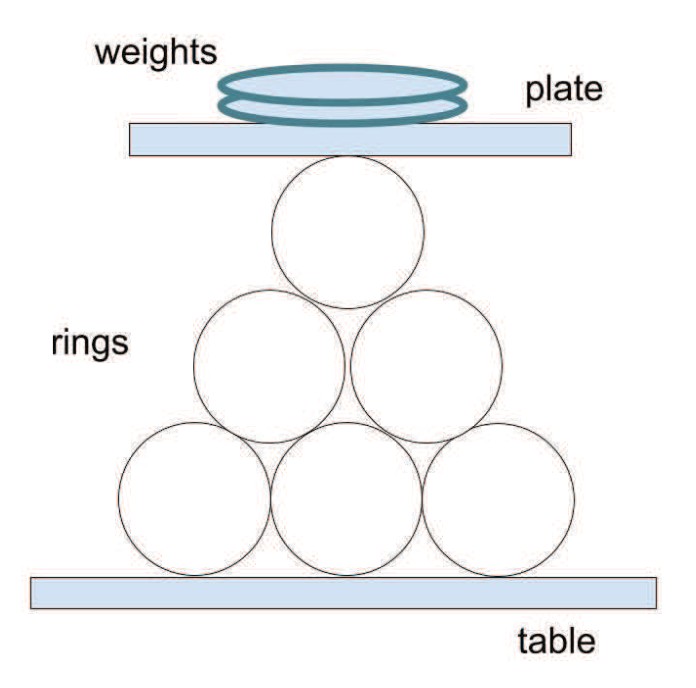
A 200 N/m spring stretched 0.050 m has a restoring-force magnitude 10 N in the linear model.
Pause and explain
Why is k not measured in newtons alone?
Check your reasoning after answering
Since force is proportional to extension, k has units N/m so multiplying by displacement gives force.
Part 2 · Use the perpendicular moment arm
Torque measures a force’s turning effect about a chosen pivot. Its magnitude is rFsinθ=F r⊥, where r⊥ is the shortest distance from pivot to the force’s line of action. A large force aimed directly through the pivot can have zero torque even with a long position vector. Assign a turning sign convention, such as counterclockwise positive, and retain N·m units; torque and energy share dimensions but describe different quantities.
Read the visual model
Identify the labeled structures and units, then trace the arrows or compare values under the caption’s stated conditions. Separate the displayed evidence from a further inference. Write your reasoning before opening the guidance.
What torque results if this 20 N force acts along the bar through the pivot?
Visual reasoning — after your attempt
Zero, because its perpendicular moment arm is zero.
Torque about a specified pivot has magnitude rF sinθ, or force times the perpendicular distance from pivot to the force’s line of action. A force through the pivot gives zero torque even if large. Specify clockwise and counterclockwise signs before summing.
For a perpendicular 10 N force at 0.40 m, torque magnitude is 4.0 N·m. An angled force at that radius has a smaller perpendicular contribution.
Pause and explain
Why can a long lever arm still yield zero torque?
Check your reasoning after answering
If the force’s line of action passes through the pivot, perpendicular distance is zero; the physical handle length alone does not determine torque.
Part 3 · Require both force and torque balance
Static equilibrium means the body remains at rest without translational or rotational acceleration. It needs ΣF=0 and Στ=0 about a selected pivot in the rigid-body model. Equal opposing torques alone can coexist with nonzero net force, while balanced forces can still form a turning couple. For this weightless-bar example equal downward loads at equal opposite arms balance torque, and the upward support must balance their combined 60 N force.
Read the visual model
Identify the labeled structures and units, then trace the arrows or compare values under the caption’s stated conditions. Separate the displayed evidence from a further inference. Write your reasoning before opening the guidance.
Could a zero-torque calculation alone establish static equilibrium?
Visual reasoning — after your attempt
No. The vector force sum must also vanish, and the starting state must be at rest.
Static equilibrium needs zero net external force and zero net torque. Torque balance alone does not guarantee no translation. Choose a convenient pivot to eliminate an unknown support torque, then use the force balance to determine that support.
A beam may have balanced moments but still an unbalanced total downward force unless the support force is included.
Pause and explain
Can force balance alone establish static equilibrium?
Check your reasoning after answering
No. Equal opposite forces at different lines of action can produce a nonzero turning effect; torque must also balance.
Part 4 · Account for distributed weight and assumptions
A center of mass summarizes a body’s mass distribution. In a uniform gravitational field, its total weight can be represented at that point for external force and torque calculations. A uniform bar’s center lies at its midpoint, but an attached load or nonuniform density changes it. The small arrows show distributed weight and the larger arrow is an equivalent alternative representation, not an additional force to add on top of them.
Read the visual model
Identify the labeled structures and units, then trace the arrows or compare values under the caption’s stated conditions. Separate the displayed evidence from a further inference. Write your reasoning before opening the guidance.
Should the distributed arrows and equivalent mg both enter the same torque sum?
Visual reasoning — after your attempt
No. They are two representations of the same weight; counting both would double it.
For a uniform beam in a uniform gravitational field, weight acts effectively at its midpoint. A nonuniform beam requires its center of mass. Draw each load and support; indicate whether beam weight, friction, or connector mass is neglected.
A light beam assumption can simplify torque, but a real heavy beam can substantially change the support and spring requirement.
Pause and explain
What is needed if beam mass is not negligible?
Check your reasoning after answering
Its weight and center of mass must enter the force and torque account, along with the existing loads and supports.
Apply the whole unit · Balance a load with an ideal spring
Illustrative massless horizontal beam pivots at its left end. A 10.0 N downward load acts 0.40 m from the pivot; an upward linear spring acts 0.20 m from it, k=200 N/m.
Your task
Find spring force and extension, then determine the signed vertical pivot force. Explain why torque balance does not answer the pivot-force question alone.
What your response should show
- Define the system, quantities, units, and relevant conditions before selecting a model.
- Show intermediate calculations or a labeled evidence account, including signs or denominators.
- Explain how the supplied evidence supports the conclusion rather than reporting only an answer.
- Identify a meaningful uncertainty, model limit, or measurement needed to test the conclusion.
Response guidance — after your attempt
Torque balance: Fspring×0.20=10.0×0.40; Fspring=20.0 N upward.
Extension magnitude=20.0/200=0.100 m in the linear range.
Vertical balance: Rpivot+20.0−10.0=0; pivot force is 10.0 N downward.
The downward pivot force is consistent with the assumed fixed pivot, which can exert force in either vertical direction. A simple unfastened support that can only push upward would not fit this arrangement. Beam weight and an out-of-range spring would require a revised model.
Scientific references and source-model foundations
- OpenStax — Newton laws and friction
- OpenSciEd 8.1 — contact-force foundations
- OpenSciEd public middle-school figure license — CC BY 4.0
Parent / teacher teaching notes
Use separate force and torque sums. Ask whether the support can physically provide the calculated direction rather than treating every algebraic support as feasible. Ask the learner to explain each symbol, axis, unit and arrow before calculating. Calculated examples, supplied illustrative records and actual historical observations are labeled separately. Selected public OpenSciEd middle-school source figures are foundation examples, not complete high-school editions or an endorsement; all advanced explanations are supplied locally.
The key idea
Equilibrium requires balanced forces and torques; spring energy grows with displacement squared.
Worked examples
Example 1
- F=kx=10N.
- U=½(200)(.050)².
Example 2 · Worked application
- τ=rF=0.30×20=6.0 N·m.
- For opposite balancing torque, F×0.60=6.0.
- F=10 N, assuming other torques balance.
Use perpendicular lever arm and rotational sign.
Example 3
- Equal opposite torques:6(.20)=F(.60).
- F=1.20/.60.
Example 4 · Find and fix the mistake
- Test the claim against the stated conditions: Use perpendicular lever arm and rotational sign.
- Its lever arm about that pivot is zero, so its torque is zero.
Use perpendicular lever arm and rotational sign.
Example 5 · Reason from the visual model
- Static equilibrium means the body remains at rest without translational or rotational acceleration. It needs ΣF=0 and Στ=0 about a selected pivot in the rigid-body model. Equal opposing torques alone can coexist with nonzero net force, while balanced forces can still form a turning couple. For this weightless-bar example equal downward loads at equal opposite arms balance torque, and the upward support must balance their combined 60 N force.
- No. The vector force sum must also vanish, and the starting state must be at rest.
Original symmetric weightless-bar model; distributed bar weight is intentionally excluded here.
Avoid these mistakes
- Torque’s N·m unit does not make it the same physical quantity as energy.
Check your understanding
Why does a force through a pivot have zero torque?
Discuss the answer
The perpendicular distance from pivot to force line is zero.
Return to the phenomenon
Return to the initial case. Why can a small force turn a door more easily near its edge? Revise your drawing or explanation using two named ideas and one stated limitation.
Compare explanations after your attempt
Torque grows with the perpendicular arm, while static equilibrium also requires net-force balance.
What should we investigate next?
Which comparison would test a remaining uncertainty? State what you would change, keep comparable and measure.
Investigate, calculate and revise
Keep a first model and an evidence-supported revision. Attempt each task before opening guidance; all required explanations and supplied-data routes are available locally.
Activity 1 · Return to the opening case
Use the opening phenomenon, unit definitions and explained Parts 1–4.
Your task
Return to the initial case. Why can a small force turn a door more easily near its edge? Revise your drawing or explanation using two named ideas and one stated limitation.
Success criteria
- Use the stated observations and appropriate units.
- Connect a labeled model with the physical/environmental mechanism.
- State assumptions and an evidence limitation.
- Explain a substantive revision or next test.
Hint
Keep object/material identity, material transfer and energy account distinct.
Response guidance — discuss after your attempt
Torque grows with the perpendicular arm, while static equilibrium also requires net-force balance.
Activity 2 · Transfer to a changed case
Cover the worked answer and use the explained models, relationships and notebook.
Your task
A weightless 2 m beam is pivoted at its left end. A 60 N load acts 0.50 m from the pivot. An upward force acts at the right end. Find that force and vertical pivot reaction for equilibrium.
Success criteria
- Use the stated measurements or conditions, with correct units.
- Connect the result to the physical or environmental mechanism or evidence relationship.
- Identify the assumption, model limit or further evidence requested.
Hint
Name known quantities and conditions, show intermediate steps and check conservation.
Response guidance — discuss after your attempt
Torque balance: F×2=60×0.50, so F=15 N upward. Vertical balance gives pivot reaction=60−15=45 N upward. Both balances are necessary.
Words to know
- spring constant
- Stiffness parameter in a linear elastic model.
- torque
- Turning effect of a force about a specified pivot.
- lever arm
- Perpendicular distance from pivot to force line.
In the real world
Use the chapter investigation to connect this unit to measured evidence and a practical decision.
Exit check
Why does a force through a pivot have zero torque?
Check your explanation after answering
The perpendicular distance from pivot to force line is zero.
Explain your reasoning without notes. If a key idea is missing, revisit the lesson and try again.
Problem 1
Answer and explanation
5 m/s²
a = ΣF ÷ m = 60 ÷ 12 = 5 m/s².
Problem 2
Answer and explanation
36.25 N
ΣF = ma = 0.145 × 250 = 36.25 N.
Problem 3
Answer and explanation
150 N on each; the 75 kg skater accelerates at 2 m/s²
Force on the 50 kg skater: F = ma = 50 × 3 = 150 N. By Newton's third law the 75 kg skater feels the same 150 N: a = F ÷ m = 150 ÷ 75 = 2 m/s². The heavier skater accelerates less from the same force.
Problem 4
Answer and explanation
50 N to the right
Net force = 80 − 30 = 50 N. The larger force points right, so the net force is 50 N to the right.
Problem 5
Answer and explanation
(a) 49 N (b) 4.9 m/s²
(a) Down-slope weight component = mg sinθ = 10 × 9.8 × sin 30° = 98 × 0.5 = 49 N. (b) a = g sinθ = 9.8 × 0.5 = 4.9 m/s² (mass cancels).
Problem 6
Answer and explanation
25 N
f = μₖN = 0.25 × 100 = 25 N.
Problem 7
Answer and explanation
58.8 N
On level ground N = mg = 20 × 9.8 = 196 N. Then f = μₖN = 0.30 × 196 = 58.8 N.
Problem 8
Answer and explanation
About 3.2 m/s²
Along the slope: a = g(sinθ − μₖcosθ) = 9.8(sin 30° − 0.20 cos 30°) = 9.8(0.5 − 0.20 × 0.866) = 9.8(0.5 − 0.173) = 9.8 × 0.327 ≈ 3.2 m/s². (Mass cancels.)
Problem 9
Answer and explanation
8 m/s²
a = v²/r = 4² ÷ 2 = 16 ÷ 2 = 8 m/s², directed toward the center.
Problem 10
Answer and explanation
72 N
F = mv²/r = 3 × 6² ÷ 1.5 = 3 × 36 ÷ 1.5 = 108 ÷ 1.5 = 72 N (supplied by the string's tension).
Problem 11
Answer and explanation
About 2.7 × 10⁻⁶ N
F = Gm₁m₂/r² = (6.67 × 10⁻¹¹)(800)(800) ÷ 4² = (6.67 × 10⁻¹¹)(640,000) ÷ 16 = (6.67 × 10⁻¹¹)(40,000) ≈ 2.67 × 10⁻⁶ N — far too small to notice, which is why we never feel the pull between ordinary objects.
Problem 12
Answer and explanation
12,000 N
F = mv²/r = 1,500 × 20² ÷ 50 = 1,500 × 400 ÷ 50 = 1,500 × 8 = 12,000 N, directed toward the center of the curve.
Problem 13
Answer and explanation
About 1.6 m/s²
g = GM/r² = (6.67 × 10⁻¹¹)(7.35 × 10²²) ÷ (1.74 × 10⁶)² = (4.90 × 10¹²) ÷ (3.03 × 10¹²) ≈ 1.6 m/s² — about one-sixth of Earth's 9.8 m/s², which is why astronauts could bound across the Moon.
Problem 14
Answer and explanation
a=Fnet/m=2 m/s² along the net force.
Response criteria
- State a scientifically accurate conclusion.
- Show the calculation or mechanism that supports it.
- Include units, conditions, or limits where relevant.
Problem 15
Answer and explanation
Net=12 N east; a=3 m/s² east. Its third-law partner is the cart’s 18 N force on the pulling agent, not the 6 N resistance on the cart.
Net=12 N east; a=3 m/s² east.
Its third-law partner is the cart’s 18 N force on the pulling agent, not the 6 N resistance on the cart.
Response criteria
- Use the stated measurements or conditions, with correct units.
- Connect the result to the physical or environmental mechanism or evidence relationship.
- Identify the assumption, model limit or further evidence requested.
Problem 16
Answer and explanation
Net 12N right; a=12/4=3 m/s² right.
Response criteria
- State a scientifically accurate conclusion.
- Show the calculation or mechanism that supports it.
- Include units, conditions, or limits where relevant.
Problem 17
Answer and explanation
N=29.4−7.5=21.9 N. Horizontal net=15cos30°−4≈8.99 N; ax≈3.00 m/s². The tension is counted once through its components.
N=29.4−7.5=21.9 N.
Horizontal net=15cos30°−4≈8.99 N; ax≈3.00 m/s².
The tension is counted once through its components.
Response criteria
- Use the stated measurements or conditions, with correct units.
- Connect the result to the physical or environmental mechanism or evidence relationship.
- Identify the assumption, model limit or further evidence requested.
Problem 18
Answer and explanation
Static friction is 2N opposite the push, so net force is zero. It need not reach 5N.
Response criteria
- State a scientifically accurate conclusion.
- Show the calculation or mechanism that supports it.
- Include units, conditions, or limits where relevant.
Problem 19
Answer and explanation
N=49 N; static limit=19.6 N, so 15 N is balanced by 15 N friction. During sliding fk=14.7 N; a=(25−14.7)/5=2.06 m/s² along the push.
N=49 N; static limit=19.6 N, so 15 N is balanced by 15 N friction.
During sliding fk=14.7 N; a=(25−14.7)/5=2.06 m/s² along the push.
Response criteria
- Use the stated measurements or conditions, with correct units.
- Connect the result to the physical or environmental mechanism or evidence relationship.
- Identify the assumption, model limit or further evidence requested.
Problem 20
Answer and explanation
ac=v²/r=8 m/s². Speed can be constant while velocity direction changes.
Response criteria
- State a scientifically accurate conclusion.
- Show the calculation or mechanism that supports it.
- Include units, conditions, or limits where relevant.
Problem 21
Answer and explanation
ac=16/2=8.0 m/s² and inward net force=0.50×8=4.0 N. Tension equals that net only if the specified geometry and other forces establish it as the sole inward contribution.
ac=16/2=8.0 m/s² and inward net force=0.50×8=4.0 N.
Tension equals that net only if the specified geometry and other forces establish it as the sole inward contribution.
Response criteria
- Use the stated measurements or conditions, with correct units.
- Connect the result to the physical or environmental mechanism or evidence relationship.
- Identify the assumption, model limit or further evidence requested.
Problem 22
Hints
Write the relationship first; substitute with consistent units.
Answer and explanation
2 N·m
.25×8=2.
Problem 23
Answer and explanation
Force varies with extension; integrate or use the triangular graph area.
Response criteria
- State a scientifically accurate conclusion.
- Show the calculation or mechanism that supports it.
- Include units, conditions, or limits where relevant.
Problem 24
Answer and explanation
Torque balance: F×2=60×0.50, so F=15 N upward. Vertical balance gives pivot reaction=60−15=45 N upward. Both balances are necessary.
Torque balance: F×2=60×0.50, so F=15 N upward.
Vertical balance gives pivot reaction=60−15=45 N upward.
Both balances are necessary.
Response criteria
- Use the stated measurements or conditions, with correct units.
- Connect the result to the physical or environmental mechanism or evidence relationship.
- Identify the assumption, model limit or further evidence requested.