Springs, Torque & Static Equilibrium — Print · Grade 12 Science
Chapter: Forces, Rotation & EquilibriumSprings, Torque & Static Equilibrium
Learning goals
- I can calculate spring force and energy within an elastic model.
- I can apply both force and torque balance about a stated pivot.
Readings for this unit
Before this unit
Vectors, force, energy, graph area, and ratios.
Use the detailed parent plan: two core 50–60-minute sessions per focused unit, with a third assigned for selected calculation/modeling topics. First study the core explanation and Parts 1–2 with their figures/checks; next study Parts 3–4, the whole-unit application, worked cases, varied practice and exit check. Attempt reasoning before opening guidance. Extend time when actual understanding requires it; investigations and chapter assessments have separate sessions.
Start with something to explain
Why can a small force turn a door more easily near its edge?
Illustrative evidence case. The same perpendicular push is applied at two distances from a hinge.
Notice and wonder
Record two observations using the stated quantities or relationships. Keep observations separate from possible causes. Write one question that a new measurement could help answer.
Why can a small force turn a door more easily near its edge?
Your first model
Draw the force line and shortest pivot distance.
Build the language from the idea
- spring constant
- Stiffness parameter in a linear elastic model.
- torque
- Turning effect of a force about a specified pivot.
- lever arm
- Perpendicular distance from pivot to force line.
Hooke’s law models a spring within its linear elastic range: restoring force Fs=−kx, with x measured from the natural equilibrium length and k in N/m. The force magnitude is k times the absolute extension. The minus sign expresses opposition to displacement, not a negative stiffness. Outside this tested range the relation can fail or permanent deformation can occur.
Elastic potential energy is Us=½kx². Work needed to stretch a spring gradually from zero to x is the area under the force-displacement graph. Because force grows from zero to kx, the triangular area is ½kx², not simply final force times total stretch.
A force can also cause rotation. Torque magnitude about a chosen pivot is τ=rF sinθ, with θ between the radius-to-application-point and the force. The perpendicular lever arm version τ=F dperp is equivalent. A force through the pivot produces no torque about it.
A rigid object in static equilibrium needs both zero net force and zero net torque. Balancing upward and downward forces alone does not guarantee it will not rotate. Choose a pivot that removes an unknown support force from the torque equation, then solve remaining force balances.
Ideal levers trade force for motion without creating energy. A longer input lever arm can allow a smaller force to balance a larger load; the input moves farther. Actual mechanisms have friction, flexing, and mass, so evaluate efficiency and stresses before applying an ideal ratio.
A household ruler balance or a gentle small spring is suitable with adult setup and soft light loads. Do not use heavy suspended objects or overstretch an elastic band toward a face. This unit’s equations describe a bounded model, not a structural safety rating.
Build your understanding
Use the detailed parent plan: two core 50–60-minute sessions per focused unit, with a third assigned for selected calculation/modeling topics. First study the core explanation and Parts 1–2 with their figures/checks; next study Parts 3–4, the whole-unit application, worked cases, varied practice and exit check. Attempt reasoning before opening guidance. Extend time when actual understanding requires it; investigations and chapter assessments have separate sessions.
Part 1 · Use the elastic range for Hooke’s law
Extension x is the change from a spring’s natural length. In its linear elastic range, the restoring force is −kx: its sign opposes displacement from equilibrium. A quasistatic applied force balancing it has magnitude kx, producing the plotted positive slope. Past the elastic range a spring may not return to its original length or obey the same linear law. Distinguish the force exerted by the spring from the external force required to hold it stretched.
Read the visual model
Identify the labeled structures and units, then trace the arrows or compare values under the caption’s stated conditions. Separate the displayed evidence from a further inference. Write your reasoning before opening the guidance.
What balancing force is needed at x=0.03 m for this model?
Visual reasoning — after your attempt
F=kx=200×0.03=6 N; the spring exerts 6 N in the opposite direction.
An ideal linear spring exerts restoring force F=−kx along a chosen displacement axis. The minus sign indicates opposition to displacement from equilibrium. Real springs follow this approximation only over a suitable range; k is a stiffness, not a force by itself.
A 200 N/m spring stretched 0.050 m has a restoring-force magnitude 10 N in the linear model.
Pause and explain
Why is k not measured in newtons alone?
Check your reasoning after answering
Since force is proportional to extension, k has units N/m so multiplying by displacement gives force.
Part 2 · Use the perpendicular moment arm
Torque measures a force’s turning effect about a chosen pivot. Its magnitude is rFsinθ=F r⊥, where r⊥ is the shortest distance from pivot to the force’s line of action. A large force aimed directly through the pivot can have zero torque even with a long position vector. Assign a turning sign convention, such as counterclockwise positive, and retain N·m units; torque and energy share dimensions but describe different quantities.
Read the visual model
Identify the labeled structures and units, then trace the arrows or compare values under the caption’s stated conditions. Separate the displayed evidence from a further inference. Write your reasoning before opening the guidance.
What torque results if this 20 N force acts along the bar through the pivot?
Visual reasoning — after your attempt
Zero, because its perpendicular moment arm is zero.
Torque about a specified pivot has magnitude rF sinθ, or force times the perpendicular distance from pivot to the force’s line of action. A force through the pivot gives zero torque even if large. Specify clockwise and counterclockwise signs before summing.
For a perpendicular 10 N force at 0.40 m, torque magnitude is 4.0 N·m. An angled force at that radius has a smaller perpendicular contribution.
Pause and explain
Why can a long lever arm still yield zero torque?
Check your reasoning after answering
If the force’s line of action passes through the pivot, perpendicular distance is zero; the physical handle length alone does not determine torque.
Part 3 · Require both force and torque balance
Static equilibrium means the body remains at rest without translational or rotational acceleration. It needs ΣF=0 and Στ=0 about a selected pivot in the rigid-body model. Equal opposing torques alone can coexist with nonzero net force, while balanced forces can still form a turning couple. For this weightless-bar example equal downward loads at equal opposite arms balance torque, and the upward support must balance their combined 60 N force.
Read the visual model
Identify the labeled structures and units, then trace the arrows or compare values under the caption’s stated conditions. Separate the displayed evidence from a further inference. Write your reasoning before opening the guidance.
Could a zero-torque calculation alone establish static equilibrium?
Visual reasoning — after your attempt
No. The vector force sum must also vanish, and the starting state must be at rest.
Static equilibrium needs zero net external force and zero net torque. Torque balance alone does not guarantee no translation. Choose a convenient pivot to eliminate an unknown support torque, then use the force balance to determine that support.
A beam may have balanced moments but still an unbalanced total downward force unless the support force is included.
Pause and explain
Can force balance alone establish static equilibrium?
Check your reasoning after answering
No. Equal opposite forces at different lines of action can produce a nonzero turning effect; torque must also balance.
Part 4 · Account for distributed weight and assumptions
A center of mass summarizes a body’s mass distribution. In a uniform gravitational field, its total weight can be represented at that point for external force and torque calculations. A uniform bar’s center lies at its midpoint, but an attached load or nonuniform density changes it. The small arrows show distributed weight and the larger arrow is an equivalent alternative representation, not an additional force to add on top of them.
Read the visual model
Identify the labeled structures and units, then trace the arrows or compare values under the caption’s stated conditions. Separate the displayed evidence from a further inference. Write your reasoning before opening the guidance.
Should the distributed arrows and equivalent mg both enter the same torque sum?
Visual reasoning — after your attempt
No. They are two representations of the same weight; counting both would double it.
For a uniform beam in a uniform gravitational field, weight acts effectively at its midpoint. A nonuniform beam requires its center of mass. Draw each load and support; indicate whether beam weight, friction, or connector mass is neglected.
A light beam assumption can simplify torque, but a real heavy beam can substantially change the support and spring requirement.
Pause and explain
What is needed if beam mass is not negligible?
Check your reasoning after answering
Its weight and center of mass must enter the force and torque account, along with the existing loads and supports.
Apply the whole unit · Balance a load with an ideal spring
Illustrative massless horizontal beam pivots at its left end. A 10.0 N downward load acts 0.40 m from the pivot; an upward linear spring acts 0.20 m from it, k=200 N/m.
Your task
Find spring force and extension, then determine the signed vertical pivot force. Explain why torque balance does not answer the pivot-force question alone.
What your response should show
- Define the system, quantities, units, and relevant conditions before selecting a model.
- Show intermediate calculations or a labeled evidence account, including signs or denominators.
- Explain how the supplied evidence supports the conclusion rather than reporting only an answer.
- Identify a meaningful uncertainty, model limit, or measurement needed to test the conclusion.
Response guidance — after your attempt
Torque balance: Fspring×0.20=10.0×0.40; Fspring=20.0 N upward.
Extension magnitude=20.0/200=0.100 m in the linear range.
Vertical balance: Rpivot+20.0−10.0=0; pivot force is 10.0 N downward.
The downward pivot force is consistent with the assumed fixed pivot, which can exert force in either vertical direction. A simple unfastened support that can only push upward would not fit this arrangement. Beam weight and an out-of-range spring would require a revised model.
Scientific references and source-model foundations
- OpenStax — Newton laws and friction
- OpenSciEd 8.1 — contact-force foundations
- OpenSciEd public middle-school figure license — CC BY 4.0
Parent / teacher teaching notes
Use separate force and torque sums. Ask whether the support can physically provide the calculated direction rather than treating every algebraic support as feasible. Ask the learner to explain each symbol, axis, unit and arrow before calculating. Calculated examples, supplied illustrative records and actual historical observations are labeled separately. Selected public OpenSciEd middle-school source figures are foundation examples, not complete high-school editions or an endorsement; all advanced explanations are supplied locally.
The key idea
Equilibrium requires balanced forces and torques; spring energy grows with displacement squared.
Worked examples
Example 1
- F=kx=10N.
- U=½(200)(.050)².
Example 2 · Worked application
- τ=rF=0.30×20=6.0 N·m.
- For opposite balancing torque, F×0.60=6.0.
- F=10 N, assuming other torques balance.
Use perpendicular lever arm and rotational sign.
Example 3
- Equal opposite torques:6(.20)=F(.60).
- F=1.20/.60.
Example 4 · Find and fix the mistake
- Test the claim against the stated conditions: Use perpendicular lever arm and rotational sign.
- Its lever arm about that pivot is zero, so its torque is zero.
Use perpendicular lever arm and rotational sign.
Example 5 · Reason from the visual model
- Static equilibrium means the body remains at rest without translational or rotational acceleration. It needs ΣF=0 and Στ=0 about a selected pivot in the rigid-body model. Equal opposing torques alone can coexist with nonzero net force, while balanced forces can still form a turning couple. For this weightless-bar example equal downward loads at equal opposite arms balance torque, and the upward support must balance their combined 60 N force.
- No. The vector force sum must also vanish, and the starting state must be at rest.
Original symmetric weightless-bar model; distributed bar weight is intentionally excluded here.
Avoid these mistakes
- Torque’s N·m unit does not make it the same physical quantity as energy.
Check your understanding
Why does a force through a pivot have zero torque?
Discuss the answer
The perpendicular distance from pivot to force line is zero.
Return to the phenomenon
Return to the initial case. Why can a small force turn a door more easily near its edge? Revise your drawing or explanation using two named ideas and one stated limitation.
Compare explanations after your attempt
Torque grows with the perpendicular arm, while static equilibrium also requires net-force balance.
What should we investigate next?
Which comparison would test a remaining uncertainty? State what you would change, keep comparable and measure.
Investigate, calculate and revise
Keep a first model and an evidence-supported revision. Attempt each task before opening guidance; all required explanations and supplied-data routes are available locally.
Activity 1 · Return to the opening case
Use the opening phenomenon, unit definitions and explained Parts 1–4.
Your task
Return to the initial case. Why can a small force turn a door more easily near its edge? Revise your drawing or explanation using two named ideas and one stated limitation.
Success criteria
- Use the stated observations and appropriate units.
- Connect a labeled model with the physical/environmental mechanism.
- State assumptions and an evidence limitation.
- Explain a substantive revision or next test.
Hint
Keep object/material identity, material transfer and energy account distinct.
Response guidance — discuss after your attempt
Torque grows with the perpendicular arm, while static equilibrium also requires net-force balance.
Activity 2 · Transfer to a changed case
Cover the worked answer and use the explained models, relationships and notebook.
Your task
A weightless 2 m beam is pivoted at its left end. A 60 N load acts 0.50 m from the pivot. An upward force acts at the right end. Find that force and vertical pivot reaction for equilibrium.
Success criteria
- Use the stated measurements or conditions, with correct units.
- Connect the result to the physical or environmental mechanism or evidence relationship.
- Identify the assumption, model limit or further evidence requested.
Hint
Name known quantities and conditions, show intermediate steps and check conservation.
Response guidance — discuss after your attempt
Torque balance: F×2=60×0.50, so F=15 N upward. Vertical balance gives pivot reaction=60−15=45 N upward. Both balances are necessary.
Words to know
- spring constant
- Stiffness parameter in a linear elastic model.
- torque
- Turning effect of a force about a specified pivot.
- lever arm
- Perpendicular distance from pivot to force line.
In the real world
Use the chapter investigation to connect this unit to measured evidence and a practical decision.
Exit check
Why does a force through a pivot have zero torque?
Check your explanation after answering
The perpendicular distance from pivot to force line is zero.
Explain your reasoning without notes. If a key idea is missing, revisit the lesson and try again.
Problem 1
Hints
Write the relationship first; substitute with consistent units.
Answer and explanation
3 N
100×.03=3.
Problem 2
Answer and explanation
The force lines can produce a nonzero net torque about the object.
Response criteria
- State a scientifically accurate conclusion.
- Show the calculation or mechanism that supports it.
- Include units, conditions, or limits where relevant.
Problem 3
Hints
List the given quantities, select a relationship, and check units before substituting.
Answer and explanation
1 J
½×200×.10²=1.
Problem 4
Answer and explanation
Force varies with extension; integrate or use the triangular graph area.
Response criteria
- State a scientifically accurate conclusion.
- Show the calculation or mechanism that supports it.
- Include units, conditions, or limits where relevant.
Problem 5
Hints
Use perpendicular lever arm and rotational sign.
Answer and explanation
F=kx=10 N, directed toward restoring equilibrium.
Problem 6
Hints
State what the supplied observations or conditions establish, and separate that from any assumption.
Answer and explanation
Zero net force prevents translational acceleration; zero net torque prevents angular acceleration.
Problem 7
Answer and explanation
No. The vector force sum must also vanish, and the starting state must be at rest.
Static equilibrium means the body remains at rest without translational or rotational acceleration. It needs ΣF=0 and Στ=0 about a selected pivot in the rigid-body model. Equal opposing torques alone can coexist with nonzero net force, while balanced forces can still form a turning couple. For this weightless-bar example equal downward loads at equal opposite arms balance torque, and the upward support must balance their combined 60 N force.
No. The vector force sum must also vanish, and the starting state must be at rest.
Response criteria
- Interpret labels, structures, axes, units and directions correctly.
- Explain the physical or environmental relationship or mechanism.
- Respect stated assumptions and distinguish observation from inference.
Problem 8
Answer and explanation
Torque balance: F×2=60×0.50, so F=15 N upward. Vertical balance gives pivot reaction=60−15=45 N upward. Both balances are necessary.
Torque balance: F×2=60×0.50, so F=15 N upward.
Vertical balance gives pivot reaction=60−15=45 N upward.
Both balances are necessary.
Response criteria
- Use the stated measurements or conditions, with correct units.
- Connect the result to the physical or environmental mechanism or evidence relationship.
- Identify the assumption, model limit or further evidence requested.
Problem 9
Answer and explanation
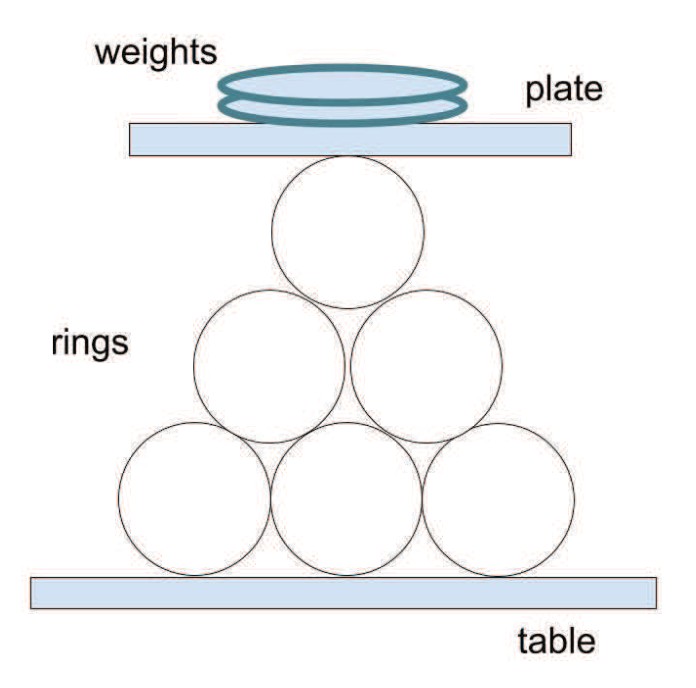
The rings push the loaded plate upward and Earth attracts that selected plate/load downward. Their magnitudes balance at rest but they are not a third-law pair. The plate pushes the rings downward as the support force’s partner on a different body. Impact peak force requires a time-resolved interaction and motion record, not a static layout.
Read source labels, scope, axes and intentional omissions.
Use the complete local explanation to draw a justified mechanism or calculate a supported quantity.
State what is observed, what is assumed and what evidence remains needed.
Response criteria
- Interpret the source labels, units and scope accurately.
- Explain the relevant mechanism with a labeled model or supported calculation.
- Identify a meaningful assumption, uncertainty or missing comparison.