Waves, Sound & Optics — Chapter Practice, Grade 12
Connect wave patterns, sound, electromagnetic radiation, interference, and refraction.
Problem 1
Answer and explanation
30 m/s
v = f × λ = 10 × 3 = 30 m/s.
Problem 2
Answer and explanation
250 Hz
f = 1 ÷ T = 1 ÷ 0.004 = 250 Hz.
Problem 3
Answer and explanation
3 m
λ = v ÷ f = 12 ÷ 4 = 3 m.
Problem 4
- parallel to the wave's motion
- perpendicular to the wave's motion
- in the exact direction the wave travels
- only when the wave stops
Answer and explanation
perpendicular to the wave's motion
Transverse means the vibration is perpendicular (at right angles) to the direction the wave travels.
Problem 5
- the frequency doubles
- the wavelength doubles
- they cancel to zero amplitude
- their amplitudes double
Answer and explanation
they cancel to zero amplitude
Equal waves exactly out of phase interfere destructively and cancel — this is destructive interference.
Problem 6
Answer and explanation
5 m
λ = v ÷ f = 1500 ÷ 300 = 5 m.
Problem 7
Hints
Check v=fλ independently.
Answer and explanation
v=30 m/s.
Problem 8
Hints
State what the supplied observations or conditions establish, and separate that from any assumption.
Answer and explanation
Particles oscillate locally while interactions pass the disturbance and energy onward.
Problem 9
Answer and explanation
λ=v/f=0.50 m under the stated medium conditions.
Wave speed satisfies v=fλ for a steady periodic traveling wave. Frequency is cycles per second and wavelength is meters per cycle, so their product gives meters per second. In a nondispersive medium, changing source frequency changes wavelength while speed stays approximately fixed. In a dispersive medium, speed can depend on frequency, so “speed is always fixed” is too broad. Identify the medium, wave type and relevant approximation.
λ=v/f=0.50 m under the stated medium conditions.
Response criteria
- Interpret labels, structures, axes, units and directions correctly.
- Explain the physical or environmental relationship or mechanism.
- Respect stated assumptions and distinguish observation from inference.
Problem 10
Answer and explanation
f=50 Hz and v=40 m/s. At100 Hz with the same 40 m/s speed, λ=0.40 m.
f=50 Hz and v=40 m/s.
At100 Hz with the same 40 m/s speed, λ=0.40 m.
Response criteria
- Use the stated measurements or conditions, with correct units.
- Connect the result to the physical or environmental mechanism or evidence relationship.
- Identify the assumption, model limit or further evidence requested.
Problem 11
Answer and explanation
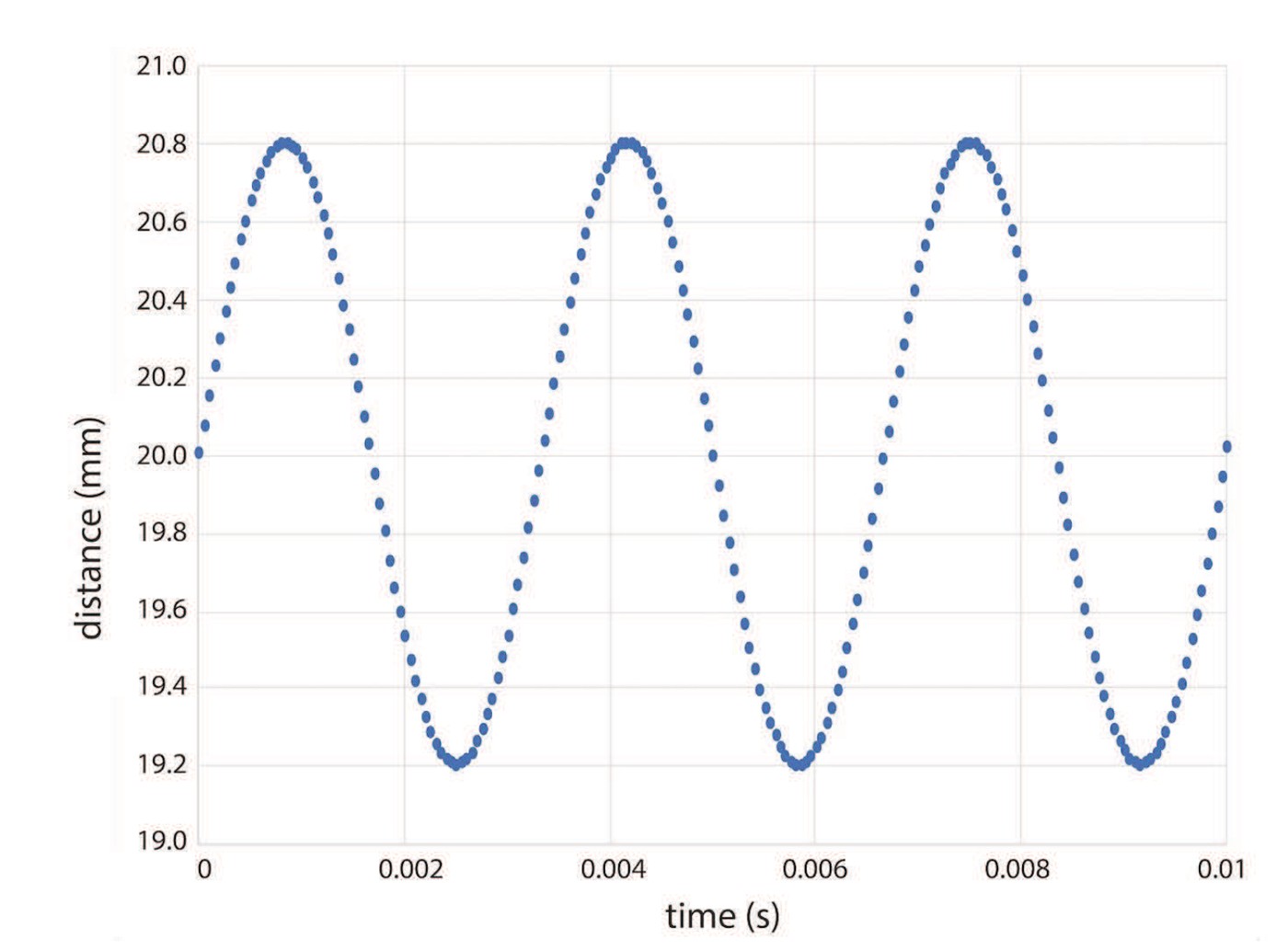
The equilibrium is about 20 mm and amplitude about 0.8 mm, measured from that mean rather than from zero. Roughly three cycles occupy 0.01 s, givingT≈0.0033 s andf≈300 Hz. These are approximate visual readings. Time at one source does not provide spatial wavelength or wave speed without additional information.
Read source labels, scope, axes and intentional omissions.
Use the complete local explanation to draw a justified mechanism or calculate a supported quantity.
State what is observed, what is assumed and what evidence remains needed.
Response criteria
- Interpret the source labels, units and scope accurately.
- Explain the relevant mechanism with a labeled model or supported calculation.
- Identify a meaningful assumption, uncertainty or missing comparison.
Problem 12
Answer and explanation
1020 m
distance = speed × time = 340 × 3 = 1,020 m.
Problem 13
- amplitude
- loudness
- the medium's color
- frequency
Answer and explanation
frequency
Pitch depends on frequency — higher frequency means higher pitch.
Problem 14
- the waves stretch out behind it, lowering the frequency you hear
- the sound doubles in speed
- the pitch rises as the waves compress
- the pitch stays exactly the same
Answer and explanation
the waves stretch out behind it, lowering the frequency you hear
For a receding source, the wavefronts stretch out, so the observed wavelength grows and the frequency (pitch) drops — the Doppler effect.
Problem 15
Answer and explanation
500 Hz
f = v ÷ λ = 340 ÷ 0.68 = 500 Hz.
Problem 16
Answer and explanation
Resonance is the large build-up of vibration that happens when a system is driven at its natural frequency. Pushing a swing in time with its natural back-and-forth rhythm makes it go higher and higher; other examples include a singer shattering a wine glass by matching its natural frequency, or a guitar string producing a loud clear note.
Problem 17
Answer and explanation
680 Hz
The source recedes, so f′ = f × v ÷ (v + vₛ) = 800 × 340 ÷ (340 + 60) = 800 × 340 ÷ 400 = 800 × 0.85 = 680 Hz.
Problem 18
Hints
Beat frequency is distinct from the approximately 442 Hz pitch region.
Answer and explanation
340×0.20/2=34 m, including the round trip.
Problem 19
Hints
State what the supplied observations or conditions establish, and separate that from any assumption.
Answer and explanation
Elastic and inertial properties of the medium affect propagation; speed is not fixed by loudness alone.
Problem 20
Answer and explanation
10^(30/10)=1000, provided the levels use the same intensity reference.
A sound-intensity level is β=10log₁₀(I/I₀) for a stated reference intensity I₀. Differences in decibels compare ratios: a 20 dB increase means 100 times the intensity, not 20 times. Decibels are not a direct linear loudness scale. The plotted points show selected calculated ratios on a linear horizontal axis; between-point connections are a guide rather than an exact smooth logarithmic curve.
10^(30/10)=1000, provided the levels use the same intensity reference.
Response criteria
- Interpret labels, structures, axes, units and directions correctly.
- Explain the physical or environmental relationship or mechanism.
- Respect stated assumptions and distinguish observation from inference.
Problem 21
Answer and explanation
The intensity ratio is 10^1.5≈31.6. Echo distance=340×0.30/2=51 m; the two calculations use different models and quantities.
The intensity ratio is 10^1.5≈31.6.
Echo distance=340×0.30/2=51 m; the two calculations use different models and quantities.
Response criteria
- Use the stated measurements or conditions, with correct units.
- Connect the result to the physical or environmental mechanism or evidence relationship.
- Identify the assumption, model limit or further evidence requested.
Problem 22
Answer and explanation
5 m
λ = c ÷ f = (3 × 10⁸) ÷ (6 × 10⁷) = 5 m.
Problem 23
- visible light
- gamma rays
- radio waves
- infrared
Answer and explanation
gamma rays
Gamma rays sit at the short-wavelength end of the spectrum, giving them the highest frequency and energy.
Problem 24
- a longitudinal wave
- a sound wave
- a stream of particles called photons
- a purely continuous wave
Answer and explanation
a stream of particles called photons
The photoelectric effect requires the particle (photon) model: energy arrives in discrete packets whose energy depends on frequency.
Problem 25
Answer and explanation
6.63e-19 J
E = h f = (6.63 × 10⁻³⁴) × (1 × 10¹⁵) = 6.63 × 10⁻¹⁹ J.
Problem 26
Answer and explanation
Wave-particle duality means light behaves as both a wave and a stream of particles, depending on how you observe it. In experiments like interference and diffraction it acts like a wave, but in the photoelectric effect it acts like discrete particles (photons). Neither model alone is complete — you choose whichever one best describes the situation.
Problem 27
Answer and explanation
500000000000000 Hz
f = c ÷ λ = (3 × 10⁸) ÷ (6 × 10⁻⁷) = 0.5 × 10¹⁵ = 5 × 10¹⁴ Hz.
Problem 28
Hints
Keep powers of ten and length conversion consistent.
Answer and explanation
f=c/λ=1.0×10¹⁰ Hz.
Problem 29
Hints
State what the supplied observations or conditions establish, and separate that from any assumption.
Answer and explanation
Frequency stays constant across the boundary; speed and wavelength can change.
Problem 30
Answer and explanation
Photon energy, material interaction, absorbed amount and exposure conditions differ across situations.
The electromagnetic spectrum orders radiation by frequency or vacuum wavelength. Radio, microwave, infrared, visible, ultraviolet, X-ray and gamma labels cover ranges, not separate fundamental wave species. A material may transmit, reflect or absorb different ranges depending on its structure. Ionization removes an electron and requires enough interaction energy under the relevant conditions; heating and photochemical changes can occur through other mechanisms. Explain an application using energy, material response and dose rather than a color label alone.
Photon energy, material interaction, absorbed amount and exposure conditions differ across situations.
Response criteria
- Interpret labels, structures, axes, units and directions correctly.
- Explain the physical or environmental relationship or mechanism.
- Respect stated assumptions and distinguish observation from inference.
Problem 31
Answer and explanation
λ=4.00×10⁻⁷ m; f=7.50×10¹⁴ Hz and E=4.97×10⁻¹⁹ J per photon. This is not total beam energy without photon number.
λ=4.00×10⁻⁷ m; f=7.50×10¹⁴ Hz and E=4.97×10⁻¹⁹ J per photon.
This is not total beam energy without photon number.
Response criteria
- Use the stated measurements or conditions, with correct units.
- Connect the result to the physical or environmental mechanism or evidence relationship.
- Identify the assumption, model limit or further evidence requested.
Problem 32
- the horizon
- the edge of the mirror
- the surface itself
- the normal (the perpendicular to the surface)
Answer and explanation
the normal (the perpendicular to the surface)
All angles in optics are measured from the normal, the line perpendicular to the surface at the point of contact.
Problem 33
Answer and explanation
1.5
n = c ÷ v = (3 × 10⁸) ÷ (2 × 10⁸) = 1.5.
Problem 34
- bends toward the normal and slows down
- bends toward the normal and speeds up
- bends away from the normal and speeds up
- passes straight through with no change
Answer and explanation
bends toward the normal and slows down
Entering a denser, higher-index medium, light slows down and bends toward the normal.
Problem 35
Answer and explanation
30 cm
1 ÷ dᵢ = 1 ÷ f − 1 ÷ dₒ = 1 ÷ 15 − 1 ÷ 30 = 2 ÷ 30 − 1 ÷ 30 = 1 ÷ 30, so dᵢ = 30 cm.
Problem 36
Answer and explanation
A real image forms where light rays actually converge, so it can be projected onto a screen (like the image on a camera sensor or a movie screen); it is usually inverted. A virtual image forms where rays only appear to come from — they never actually meet there — so it cannot be projected; it is upright, like the enlarged image seen through a magnifying glass or your reflection in a flat mirror.
Problem 37
Answer and explanation
6 cm
Magnification magnitude = dᵢ ÷ dₒ = 30 ÷ 10 = 3, so the image height = 3 × 2 cm = 6 cm.
Problem 38
Hints
State the sign convention; a negative image distance has a different interpretation.
Answer and explanation
1/d_i=1/10−1/20=1/20; d_i=20 cm.
Problem 39
Hints
State what the supplied observations or conditions establish, and separate that from any assumption.
Answer and explanation
Refraction changes propagation speed and wavelength while frequency is continuous across a stationary boundary.
Problem 40
Answer and explanation
di=−10 cm and m=+2: an upright enlarged virtual image on the object side.
In the stated thin-lens convention, 1/f=1/do+1/di, with f positive for a converging lens, do positive for a real object and di positive for a real image on the far side. Magnification m=−di/do gives image height divided by object height. For f=10 cm and do=20 cm, di=20 cm and m=−1: the real image is inverted and equal in height. State the convention rather than interpreting every negative sign as an error.
di=−10 cm and m=+2: an upright enlarged virtual image on the object side.
Response criteria
- Interpret labels, structures, axes, units and directions correctly.
- Explain the physical or environmental relationship or mechanism.
- Respect stated assumptions and distinguish observation from inference.
Problem 41
Answer and explanation
1/di=1/12−1/36=1/18, so di=18 cm and m=−18/36=−0.50. It is real, inverted and half the object height in this paraxial model.
1/di=1/12−1/36=1/18, so di=18 cm and m=−18/36=−0.50.
It is real, inverted and half the object height in this paraxial model.
Response criteria
- Use the stated measurements or conditions, with correct units.
- Connect the result to the physical or environmental mechanism or evidence relationship.
- Identify the assumption, model limit or further evidence requested.
Problem 42
Answer and explanation
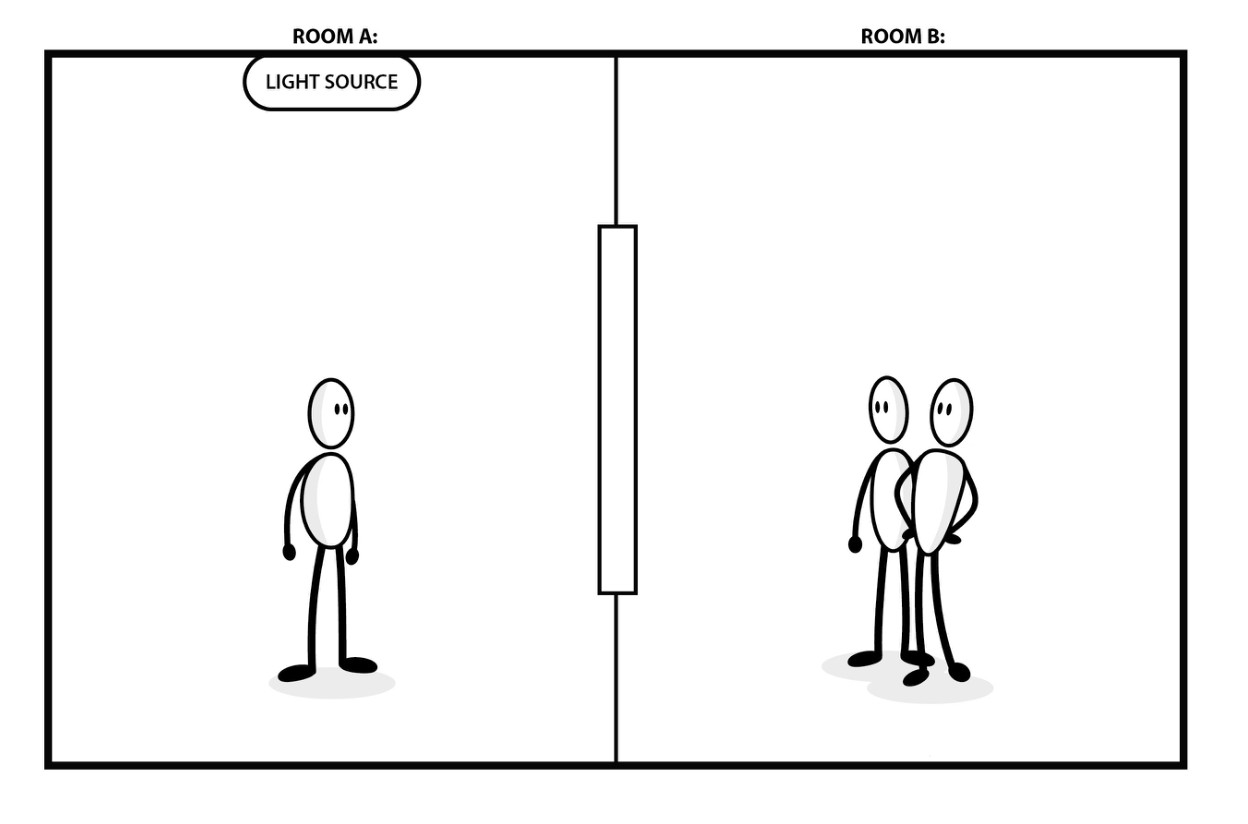
Draw source-to-surface rays, then reflected or transmitted paths that actually reach the observer. Light enters the eye from the path; the eye does not emit rays that create sight. Angles are measured from the boundary normal, reflection uses equal angles and transmitted direction requires the indices and geometry.
Read source labels, scope, axes and intentional omissions.
Use the complete local explanation to draw a justified mechanism or calculate a supported quantity.
State what is observed, what is assumed and what evidence remains needed.
Response criteria
- Interpret the source labels, units and scope accurately.
- Explain the relevant mechanism with a labeled model or supported calculation.
- Identify a meaningful assumption, uncertainty or missing comparison.
Problem 43
Hints
Write the relationship first; substitute with consistent units.
Answer and explanation
0.6 m
Node spacing=λ/2.
Problem 44
Answer and explanation
No; it describes local combined displacement. The waves can continue and energy distribution must be considered.
Response criteria
- State a scientifically accurate conclusion.
- Show the calculation or mechanism that supports it.
- Include units, conditions, or limits where relevant.
Problem 45
Hints
List the given quantities, select a relationship, and check units before substituting.
Answer and explanation
60 Hz
4×15=60.
Problem 46
Answer and explanation
Fixed, free, open, and closed boundaries allow different mode patterns.
Response criteria
- State a scientifically accurate conclusion.
- Show the calculation or mechanism that supports it.
- Include units, conditions, or limits where relevant.
Problem 47
Hints
Boundary conditions determine allowed wavelengths.
Answer and explanation
f₂=2f₁=20 Hz.
Problem 48
Hints
State what the supplied observations or conditions establish, and separate that from any assumption.
Answer and explanation
Their displacements cancel locally by superposition; this does not imply energy is destroyed everywhere.
Problem 49
Answer and explanation
L=2λ/2, so λ=1.2 m.
A standing wave has nodes of zero displacement amplitude and antinodes of maximum amplitude, produced by counterpropagating coherent waves under appropriate conditions. A string fixed at both ends has nodes there and supports L=nλ/2. The displayed second harmonic has an additional middle node. Air columns with an open end have different displacement/pressure boundary conditions; do not transfer the fixed-string formula without identifying what is constrained.
L=2λ/2, so λ=1.2 m.
Response criteria
- Interpret labels, structures, axes, units and directions correctly.
- Explain the physical or environmental relationship or mechanism.
- Respect stated assumptions and distinguish observation from inference.
Problem 50
Answer and explanation
f1=v/(2L)=10 Hz; f3=30 Hz. λ3=2L/3=1.0 m, with fixed-end nodes in this ideal string model.
f1=v/(2L)=10 Hz; f3=30 Hz. λ3=2L/3=1.0 m, with fixed-end nodes in this ideal string model.
Response criteria
- Use the stated measurements or conditions, with correct units.
- Connect the result to the physical or environmental mechanism or evidence relationship.
- Identify the assumption, model limit or further evidence requested.
Problem 51
Hints
Write the relationship first; substitute with consistent units.
Answer and explanation
514.71 Hz
500×350/340≈514.71.
Problem 52
Answer and explanation
No; it changes front spacing, while medium properties largely determine speed.
Response criteria
- State a scientifically accurate conclusion.
- Show the calculation or mechanism that supports it.
- Include units, conditions, or limits where relevant.
Problem 53
Hints
List the given quantities, select a relationship, and check units before substituting.
Answer and explanation
320 Hz
300×320/(320−20)=320.
Problem 54
Answer and explanation
No. Light requires electromagnetic relativistic Doppler relationships.
Response criteria
- State a scientifically accurate conclusion.
- Show the calculation or mechanism that supports it.
- Include units, conditions, or limits where relevant.
Problem 55
Hints
The formula changes for moving observers or other geometries.
Answer and explanation
f'=500×340/(340+34)≈455 Hz.
Problem 56
Hints
State what the supplied observations or conditions establish, and separate that from any assumption.
Answer and explanation
Sound has a material medium and different source/observer roles; light requires the appropriate relativistic model.
Problem 57
Answer and explanation
√(0.40/1.60)=0.50; the observed frequency is half under the stated inertial model.
Light in vacuum does not use a stationary air-like medium. Its relativistic Doppler shift depends on the observer–source geometry and consistent inertial-frame definitions. For longitudinal recession, fobs=femit√[(1−β)/(1+β)] with β=v/c. This differs from simply replacing sound speed by c in the moving-source formula. The low-speed approximations can be similar, but their underlying assumptions and behavior at high speed differ.
√(0.40/1.60)=0.50; the observed frequency is half under the stated inertial model.
Response criteria
- Interpret labels, structures, axes, units and directions correctly.
- Explain the physical or environmental relationship or mechanism.
- Respect stated assumptions and distinguish observation from inference.
Problem 58
Answer and explanation
Receding:600×330/360=550 Hz. Approaching:600×330/300=660 Hz. The shifts are not symmetric about 600 in this finite-speed source model.
Receding:600×330/360=550 Hz.
Approaching:600×330/300=660 Hz.
The shifts are not symmetric about 600 in this finite-speed source model.
Response criteria
- Use the stated measurements or conditions, with correct units.
- Connect the result to the physical or environmental mechanism or evidence relationship.
- Identify the assumption, model limit or further evidence requested.