Bones, Muscles & Structure-Function Models · Grade 7 Science
Chapter: Body Organization, Transport & MovementBones, Muscles & Structure-Function Models
Learning goals
- I can explain bones, muscles & structure-function models.
- I can use evidence, a model, and stated assumptions to support a biological explanation.
Before this unit
Use the supplied vocabulary, distinguish an observation from an explanation, and identify any units or model assumptions. Revisit a connected earlier unit if needed; new terms are explained here.
Use three flexible 40–45-minute sessions: core background and Parts 1–2 with their checks; Parts 3–4 and the worked application; then remaining practice, a labeled model, revision, and the exit check. Checks completed during reading can count toward the practice set. Read one short part at a time. Investigations and chapter review/quiz have separate sessions, and flexible weeks allow more time.
Pick up a pencil and watch the back of your hand. The muscles that move your fingers are not in your fingers — they are mostly in your forearm, pulling on cords that run across the wrist. That is why your fingers can be slim enough to be useful. It is a design decision visible in your own hand, and it introduces the three parts of this unit: bones that provide rigid levers, skeletal muscle that can only pull, and tendons, the tough cords that transmit that pull from a muscle to a bone, sometimes across a considerable distance.
Muscle has one trick. Contraction shortens it and generates a pull; relaxing lets it be stretched again but produces no push. A single muscle can therefore move a bone one way and has no way of returning it, which is why skeletal muscles work in opposing pairs. Your biceps contracts to bend the elbow and your triceps contracts to straighten it, and each one stretches the other as it works. Every movement of a joint — the place where bones meet and motion is possible — is produced by one of a pair shortening while its partner lengthens.
Put a rigid bone, a pivot at a joint, and a pull from a muscle together and you have a lever. In your forearm the elbow is the pivot, the forearm bone is the lever, the biceps supplies the effort close to the pivot, and the load sits far out at your hand. That arrangement is poor at force and excellent at speed and range: a small shortening of the biceps swings your hand through a large arc quickly, at the cost of having to pull many times harder than the weight you are lifting. Most of your limbs are built this way, trading force for speed, which tells you something about what bodies are usually for.
Build your understanding
Where this fits
Materials now reach the cells that need them. This unit asks what those cells do with the energy in one particular case: movement. It is also the chapter's clearest example of structure explaining function, and of how far a physical model of the body can be trusted before it starts to mislead.
Use three flexible 40–45-minute sessions: core background and Parts 1–2 with their checks; Parts 3–4 and the worked application; then remaining practice, a labeled model, revision, and the exit check. Checks completed during reading can count toward the practice set. Read one short part at a time. Investigations and chapter review/quiz have separate sessions, and flexible weeks allow more time.
Part 1 · Three structures, three jobs
Bone is rigid, which is what makes leverage possible, and it is not inert — it is living tissue with cells, a blood supply and the ability to repair and remodel. Its rigidity comes from mineral deposits, and its resistance to shattering from protein fibres woven through them, a composite rather like reinforced concrete.
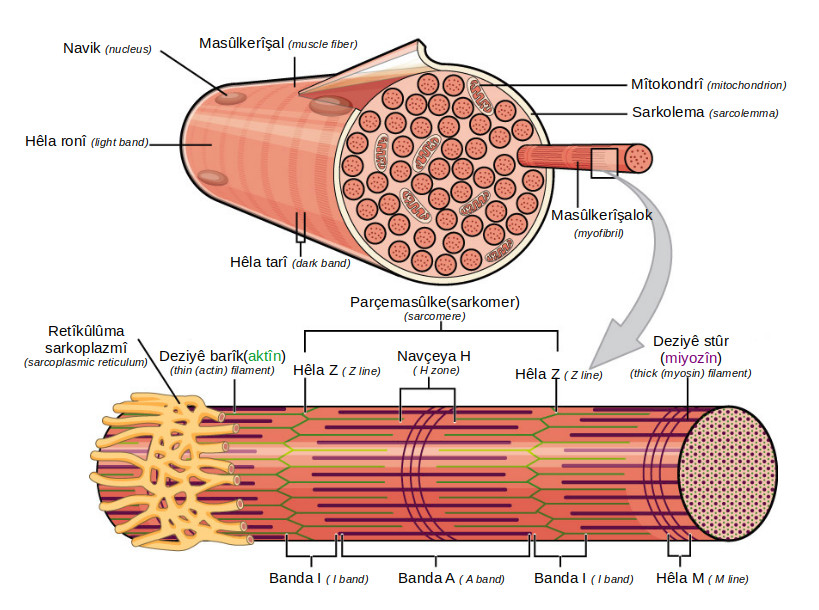
Skeletal muscle is built of long fibres that shorten when stimulated, and it is attached at both ends. One attachment is usually to a bone that stays relatively fixed and the other to the bone that moves. Tendons make those attachments: dense cords of collagen, barely stretchy, so that a muscle's shortening is transmitted rather than absorbed. A stretchy tendon would waste the contraction.
Joints are where motion becomes possible, and their shape sets the motion allowed. A hinge at the elbow permits bending in one plane; a ball and socket at the shoulder permits rotation in many; the bones of the skull are joined so firmly that no movement occurs at all. Cartilage at the surfaces and fluid in the cavity reduce friction and absorb shock. Structure, in each case, is a statement about what is permitted.
Pause and explain
Why would a stretchy tendon be a problem?
Check your reasoning after answering
Because a tendon's job is to transmit a muscle's shortening to a bone. If the tendon stretched, part of the contraction would be used extending the tendon rather than moving the bone, so the movement would be smaller, later and less precise. Tendons are made of dense, barely stretchy collagen for exactly that reason.
Part 2 · Muscles pull, which is why they come in pairs
A contracting muscle shortens and pulls. It cannot lengthen itself, and it cannot push. Everything about how limbs are arranged follows from that single limitation. To move a bone back the way it came, a second muscle is needed on the opposite side, and its contraction both produces the return movement and restores the first muscle to its original length.
The biceps and triceps are the standard pair. The biceps crosses the front of the elbow, so contracting it bends the joint; the triceps crosses the back, so contracting it straightens the joint. When one contracts the other relaxes and is stretched — and when you hold a position steady, both contract at once with their pulls balanced, which is why holding a weight still is tiring even though nothing moves.
Coordination comes from outside the muscles. Nerves carry the signals that time the contractions, and the next chapter takes that up. Here the point is structural: opposing pairs are not a redundancy but a necessary consequence of a tissue that can only pull, and the same arrangement appears everywhere, from your jaw to a bird's wing.
Pause and explain
Why can't the biceps straighten the arm by relaxing?
Check your reasoning after answering
Because relaxing only allows the muscle to be stretched; it generates no force. Something has to do the stretching, and that is the triceps on the opposite side of the elbow, which contracts to straighten the joint and lengthens the biceps as it does. A muscle that can only pull requires a partner that pulls the other way.
Part 3 · Using a lever model, and stating its assumptions
The forearm is usefully modelled as a rigid bar on a pivot. Three things matter: where the pivot is, where the effort is applied, and where the load acts. At the elbow the biceps attaches only a few centimetres from the joint while a weight in the hand is perhaps thirty centimetres away, so the muscle works at a large mechanical disadvantage and must pull several times harder than the weight it lifts.
What the body buys with that disadvantage is speed and range. A small shortening of the biceps near the pivot swings the hand through a wide arc, and quickly. For an animal that needs to throw, run or catch, that trade is worth making, and limbs built the other way — with the muscle attached far from the joint — are found where force matters more than speed, as in a digging mole's forelimb.
The model earns its keep and then has to be bounded. It treats the bone as weightless and perfectly rigid, the pivot as frictionless, and the muscle's pull as a single force of constant size acting at one point. None is true. Real muscle force varies with how stretched it is and how fast it is shortening, the attachment covers an area, and the joint has friction and soft tissue. The model predicts the direction of the trade well and the exact numbers poorly.
Pause and explain
The biceps attaches close to the elbow. What does the body gain and lose from that arrangement?
Check your reasoning after answering
It loses force efficiency: because the muscle acts close to the pivot while the load is far from it, the biceps must pull several times harder than the weight being lifted. It gains speed and range — a small contraction near the pivot moves the hand through a large arc quickly, which is worth more to an animal that throws, runs or catches than raw lifting force would be.
Part 4 · Movement depends on every other system
A contraction costs energy, and the energy comes from respiration in the muscle cells' mitochondria, using glucose delivered by the circulation from the digestive system and oxygen delivered from the lungs. Working muscle also produces heat and carbon dioxide faster than resting muscle, which is why exercise makes you warm and makes you breathe harder.
The signal to contract comes from the nervous system, and its timing is what turns a set of pulls into a movement rather than a spasm. Bone itself depends on the blood supply for the materials to repair and remodel, and on the hormonal system for the regulation of the minerals it is built from.
So the paper-and-string models used to demonstrate a joint show one thing honestly — that two opposing pulls can rotate a hinge in two directions — and leave out everything that makes the real system work: living tissue, energy supply, nerves, variable force and the changing geometry as a joint moves through its range. A model is worth using and worth bounding, which is the habit from Chapter 1 applied to an arm.
Pause and explain
Name two systems a single arm movement depends on, and what each supplies.
Check your reasoning after answering
The circulatory system, which delivers the glucose absorbed by the digestive system and the oxygen taken up by the lungs, so the muscle's mitochondria can release the energy contraction costs. And the nervous system, which carries the signals that time the contractions of the opposing pair, turning separate pulls into a controlled movement.
Apply the whole unit · Analyze an opposing-pull model
Illustrative paper model, not a measured apparatus: a card hinge has two strings attached. Pulling string A bends the hinge; pulling string B straightens it. The hinge and the attachment points are unchanged throughout.
Your task
Explain the mechanism the model represents, connect it to muscles at a real joint, and state two limits of the analogy.
What your response should show
- Explain the relevant biological process accurately.
- Use the supplied evidence and show calculation steps with units where needed.
- Connect a labeled model or mechanism with the claim.
- State an assumption, evidence limitation, or useful next observation.
Response guidance — after your attempt
Identify what the strings represent: two pulls applied on opposite sides of a pivot, each able to rotate the hinge one way.
Map it onto the body: string A corresponds to a muscle such as the biceps crossing the front of the elbow, string B to the triceps crossing the back.
State why two are needed: a muscle, like a string, can only pull, so a second one on the opposite side is required to reverse the movement and restore the first to length.
Name limits: the model has no energy supply, no nerves, no living tissue, a constant pull rather than a force that varies with length and speed, and no realistic anatomical scale.
The model represents a pair of opposing pulls acting on a pivot. Each string can only pull, and because they attach on opposite sides of the hinge, pulling A rotates it one way and pulling B rotates it back — which is exactly the arrangement of skeletal muscles at a joint. At the elbow the biceps crosses the front and bends the joint when it contracts; the triceps crosses the back and straightens it. Each one stretches the other as it works, which is the only way a tissue that can only shorten can produce movement in two directions. The model is honest about that mechanism and silent about everything else. It has no energy supply, where a real contraction is paid for by respiration in the muscle cells using glucose and oxygen delivered by two other systems. It has no nervous control, where real timing and the graded strength of a contraction come from nerve signals. Beyond those, the strings pull with whatever force you apply, while real muscle produces a force that varies with how stretched it is and how fast it is shortening; the attachments are points, while real tendons attach over an area; and the paper is not living tissue that repairs, fatigues and remodels. The model is adequate for explaining why muscles come in pairs and inadequate for predicting how hard a biceps pulls, which is the right way to judge any model: against the question being asked.
Scientific references for this unit
Parent / teacher teaching notes
Ask for a because-statement and a labeled relationship, not just a memorized word. Work through one calculation step at a time, permit oral or diagram responses, and use flexible sessions for difficult reading. Compare the learner’s actual evidence with the supplied model; do not reward copying or agreement with a personal preference. No private family, genetic, or medical records are required.
The key idea
Animal movement involves support structures, muscles, joints, and coordination. Bones provide support, protect some organs, and form parts of movable arrangements. Skeletal muscles contract and pull through connections such as tendons. A contraction can produce movement only in relation to the structures and forces involved.
Worked examples
Example 1 · Explain an arrangement from its trade-off
- Recall the lever trade: effort applied far from the pivot gives more force and less speed; applied close to the pivot it gives more speed and range and less force.
- Match each animal to what it needs: a mole digs through soil, which demands force against resistance rather than quick wide movements.
- Match the other: a cheetah needs its limbs to swing through a long arc very fast, and can accept that its muscles must pull much harder than the load.
The same lever principle explains both; only the demand differs.
Example 2 · Bound a model before trusting a number
- Check the direction of the result: the muscle acts far closer to the pivot than the load, so a force several times the weight is the right shape of answer.
- List what the model assumed: a weightless rigid bone, a frictionless pivot, a single point of attachment, and a pull of constant size.
- Decide what to claim: the calculation establishes the order of magnitude and the direction of the trade, not an accurate physiological value.
State what a model is adequate for. Here: the direction of the trade, not the precise number.
Avoid these mistakes
- Mistake: a muscle pushes to straighten a joint. Muscles only pull; straightening the elbow is the triceps contracting, not the biceps pushing.
- Mistake: relaxing a muscle moves the bone back. Relaxing generates no force — the opposing muscle of the pair does the work and stretches the relaxed one.
- Mistake: a limb lever is built for lifting power. Most limbs attach the muscle close to the joint, trading force for speed and range, which is why the biceps pulls far harder than the weight it lifts.
- Mistake: a paper hinge model shows how an arm works. It shows why opposing pairs are needed and omits energy supply, nerves, living tissue and the way real muscle force varies with length and speed.
Check your understanding
Why is listing bones alone not a structure-function explanation?
Discuss the answer
It identifies parts but does not explain how their arrangement contributes to support, protection, or movement.
Why are opposing muscle actions useful?
Discuss the answer
They allow movement in different directions because a contracting muscle pulls rather than actively pushes along the same attachment.
Words to know
- skeletal muscle
- Muscle attached to bones that shortens when stimulated, generating a pull; it cannot push, which is why muscles work in opposing pairs.
- tendon
- A dense, barely stretchy cord of collagen attaching muscle to bone, so that a contraction is transmitted rather than absorbed.
- joint
- A place where bones meet and movement is possible; its shape sets what movement is allowed — a hinge at the elbow, a ball and socket at the shoulder.
- contraction
- The shortening of a muscle that generates force; relaxing produces no push, only the possibility of being stretched by a partner.
- lever
- A rigid bar turning about a pivot; limbs trade force for speed and range by attaching the muscle close to the joint.
Extend your scientific explanation
Compare a second supplied example or the linked educational reference. Identify a connection, a model limit, and an additional observation that would test the explanation.
In the real world
Use a clear question, reliable observations, and a biological mechanism to evaluate a claim. State what remains uncertain before applying a classroom model to a different setting.
Exit check
Why does movement depend on more than muscles?
Check your explanation after answering
Coordination, support, exchange, and cellular energy processes interact with muscle contraction.
Explain your reasoning without notes. If a key idea is missing, revisit the lesson and try again.