Evolution, Evidence & Life History — Print · Life Science & Scientific Inquiry, Grade 7
Five focused units, a three-session investigation, chapter review, and chapter quiz.
Printable chapter lessons and review.
Fossils, Rock Layers & Life History
Learning goals
- I can explain fossils, rock layers & life history.
- I can use evidence, a model, and stated assumptions to support a biological explanation.
Before this unit
Use the supplied vocabulary, distinguish an observation from an explanation, and identify any units or model assumptions. Revisit a connected earlier unit if needed; new terms are explained here.
Use three flexible 40–45-minute sessions: core background and Parts 1–2 with their checks; Parts 3–4 and the worked application; then remaining practice, a labeled model, revision, and the exit check. Checks completed during reading can count toward the practice set. Read one short part at a time. Investigations and chapter review/quiz have separate sessions, and flexible weeks allow more time.
An animal dies. Almost always, it is eaten, scattered, and decomposed within weeks, and nothing remains. Occasionally it is buried quickly in sediment where decomposers cannot reach it, and over long periods minerals replace its hard parts and the sediment turns to rock. A fossil is what survives that extremely unlikely sequence, which is the single most important thing to know about the fossil record: it is not a sample of past life, it is a sample of the organisms that happened to die in the right circumstances and were later found.
That bias runs in predictable directions. Hard parts survive and soft bodies rarely do, so shells and bones are overrepresented and worms and jellyfish are nearly absent. Organisms living where sediment accumulates — coasts, lake beds, floodplains — are far more likely to be preserved than those on dry uplands where rock erodes. And a fossil must also be exposed and found, so the record reflects where geologists have worked. A trace fossil — a footprint, a burrow, a tooth mark, droppings — preserves no part of the organism and records behaviour instead, which is why traces are valuable rather than second-best.
Dating comes in two kinds and they answer different questions. Relative age is order without numbers: in undisturbed layers, deeper means older, so a fossil below another is earlier. That principle is simple, reliable where the layers are undisturbed, and gives no years at all. Numerical ages come from other methods entirely. Extinction — a species ceasing to exist — is read from the record too, and carefully, because the fossil record is patchy: a species vanishing from one sequence of layers may have died out, or moved, or simply stopped being preserved there. Several of the species declared extinct from the record have later been found alive.
Build your understanding
Where this fits
Everything so far has been about how living things work now. This last chapter asks how they came to be as they are, and it starts with the only direct evidence of life in the past. The unit's main business is learning what that evidence can establish and what it cannot, because the fossil record is both remarkable and deeply incomplete.
Use three flexible 40–45-minute sessions: core background and Parts 1–2 with their checks; Parts 3–4 and the worked application; then remaining practice, a labeled model, revision, and the exit check. Checks completed during reading can count toward the practice set. Read one short part at a time. Investigations and chapter review/quiz have separate sessions, and flexible weeks allow more time.
Part 1 · Types of evidence, and what each one preserves
Body fossils preserve part of the organism — bone, shell, wood, occasionally an impression of softer tissue. They answer questions about structure: size, shape, how parts fitted together, sometimes growth and injury. What they rarely preserve is anything soft, so the picture is skewed towards animals with hard parts.
Trace fossils preserve activity instead. A trackway records how an animal moved, how fast, and whether it travelled alone or in a group. A burrow records how it lived; coprolites record what it ate. None of these tells you what the animal looked like, and no body fossil tells you how it behaved — the two kinds of evidence answer different questions and are strongest together.
Both have the same fundamental limit: they record what was preserved. An absence in the record is therefore weak evidence of absence in life, and the strength of that weakness depends on the setting. No trace of soft-bodied animals in a coarse sandstone means very little; their absence from a fine-grained deposit that preserves soft tissue elsewhere means considerably more.
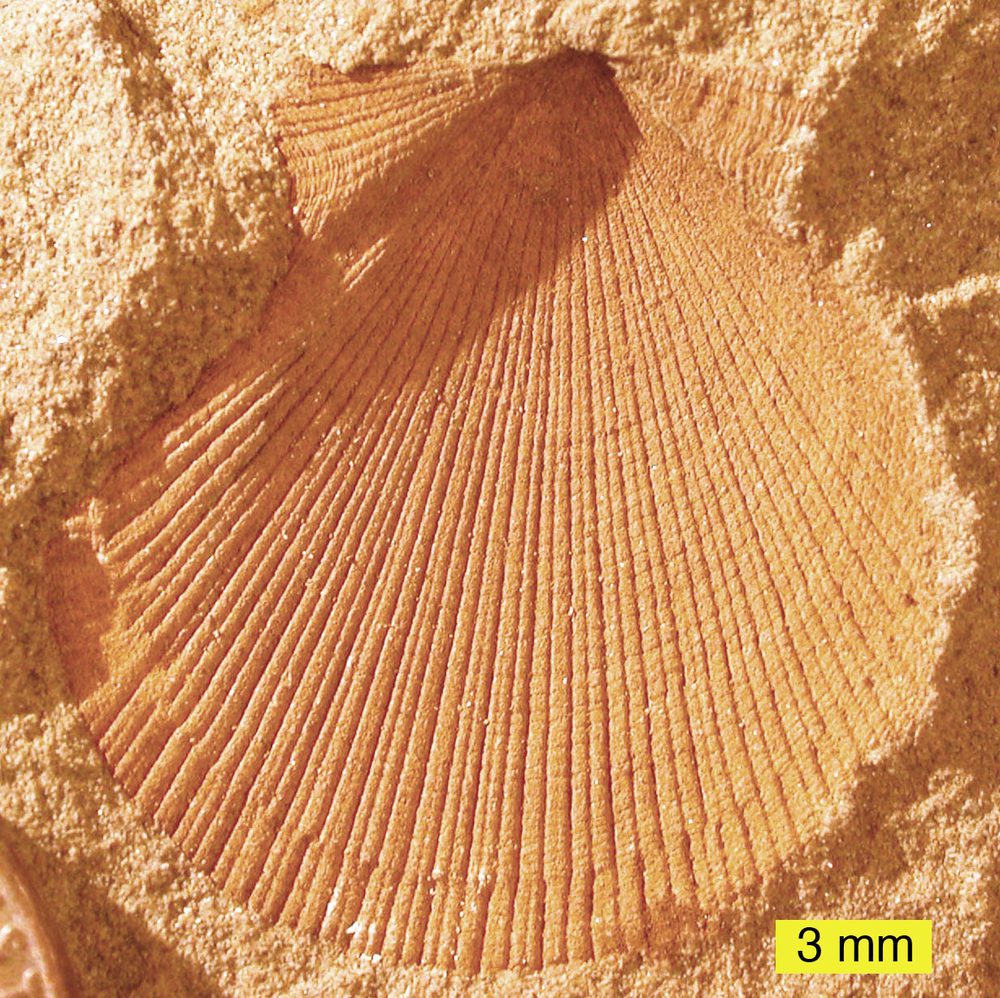
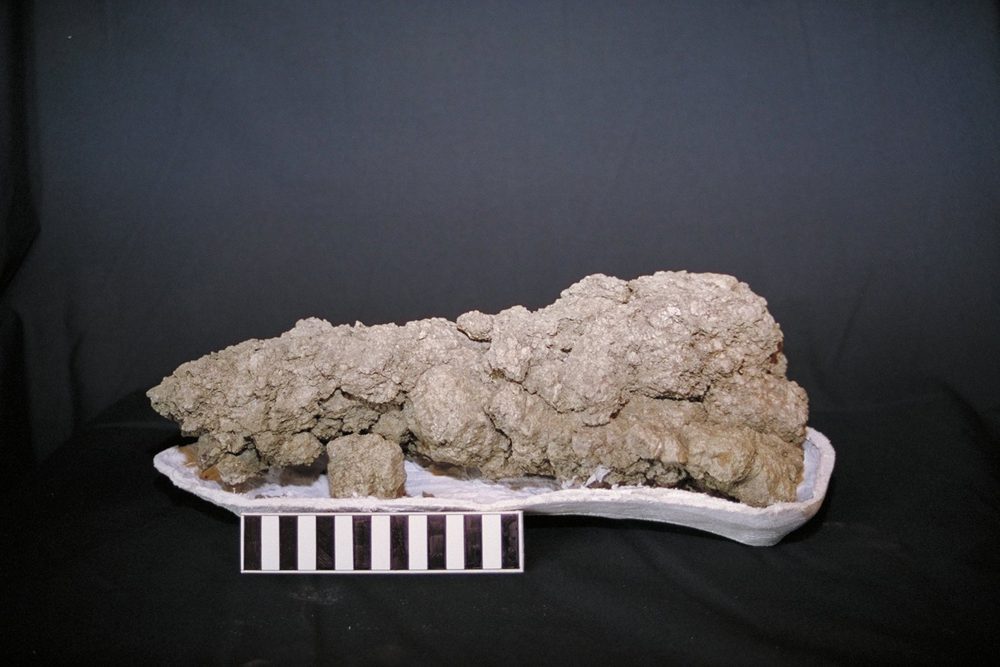
Pause and explain
What can a trackway tell you that a skeleton cannot, and the reverse?
Check your reasoning after answering
A trackway records behaviour — how the animal moved, its speed and stride, whether it travelled in a group — none of which a skeleton preserves. A skeleton records structure: size, shape, how the parts fitted together, sometimes injury or growth. Neither substitutes for the other, which is why trace fossils are a different kind of evidence rather than a lesser one.
Part 2 · Reading order from undisturbed layers
Sediment accumulates from the bottom up, so in a sequence that has not been disturbed, each layer is younger than the one beneath it. That gives relative age: a fossil in a lower layer lived earlier than one above. The word undisturbed is doing real work, since layers can be folded, overturned or cut through, and geologists check for that before applying the principle.
Work a sequence. The bottom layer contains Species A; the middle contains A and B; the top contains B. The relative order is bottom then middle then top, so A appears first, A and B overlap for a period, and in the uppermost layer only B is detected. That is a clear pattern and it is a pattern of detection rather than of existence.
Relative order gives no durations. Those three layers might represent three thousand years or three million; a thick layer can form quickly in a flood and a thin one over millennia. Saying "A is older than B" is supported; saying "A lived for ten thousand years" is not, without dating of a different kind.
Pause and explain
In undisturbed layers, the bottom contains Species A, the middle A and B, and the top B. What is supported?
Check your reasoning after answering
That A appears earlier in the sequence than B, that the two overlap in the middle layer, and that only B is detected in the uppermost. The order is relative: it gives no years, no durations, and no indication of how much time any layer represents. It is also a record of what was detected, not of everything that lived.
Part 3 · Gaps, and what an absence can support
The record has gaps at every scale. Periods when no sediment was laid down leave nothing. Erosion removes layers that did form. Preservation requires conditions that are rare. Finding requires exposure and someone looking. Each stage filters what survives to be studied, and the filters are not random.
So a species disappearing from a sequence of layers has several possible explanations. It became extinct. It moved somewhere the conditions preserved nothing. The environment changed so that fossils stopped forming. Or nobody has found the later specimens yet. Distinguishing these needs evidence from a wider area — other sequences, other regions, continuous deposits — rather than a deeper reading of the same cliff.
The honest claim is therefore about detection: "Species A is not detected above the middle layer at this site." An extinction claim is stronger, and the evidence for one is a species absent across many well-sampled sequences over a sustained period, not absent from one. Coelacanths were known only as fossils and declared long extinct until a living one was landed off South Africa in 1938.
Pause and explain
A species appears in lower layers and not in upper ones at a site. Why is "it went extinct" more than the evidence supports?
Check your reasoning after answering
Because several other explanations fit equally. The species may have moved elsewhere, conditions may have stopped preserving it, the layers may have eroded, or later specimens may simply not have been found. The supported claim is that it is not detected above a certain layer at this site; extinction needs absence across many well-sampled sequences.
Part 4 · Change over time is not a ladder
The record shows change: different organisms in different layers, lineages appearing and disappearing, forms that no longer exist. What it does not show is progress towards anything. Later does not mean better, and no organism in the record was working towards a current one.
The ladder picture is tempting because we read sequences from bottom to top and we are at the top of our own. But bacteria, which appear in the oldest rocks, are also in the newest, and they are not an early stage of anything — they have been adapting throughout, as everything else has. A branching tree is the right shape, and the final units of this chapter build it.
That framing also protects a scientific habit. If change is read as progress, every fossil gets slotted into a march towards the present and the actual question — which lineage split from which, and when — disappears. Reading the record as a set of relationships rather than a ranking is what makes the next three units possible.
Pause and explain
Why is it wrong to read a sequence of fossils as a ladder of progress?
Check your reasoning after answering
Because later organisms are not improvements on earlier ones and nothing in the past was working towards the present. Bacteria appear in the oldest rocks and in the newest, adapting throughout rather than being an early stage. The record shows which lineages existed when and how they relate, which is a branching tree rather than a ranking.
Apply the whole unit · Read a fossil-layer model
Illustrative upright undisturbed layers, not a surveyed site: the bottom layer contains Species A; the middle contains A and B; the top contains B. No numerical ages are given and no complete regional survey is supplied.
Your task
State the relative order, describe the pattern of detected species, and qualify a claim that Species A became extinct.
What your response should show
- Explain the relevant biological process accurately.
- Use the supplied evidence and show calculation steps with units where needed.
- Connect a labeled model or mechanism with the claim.
- State an assumption, evidence limitation, or useful next observation.
Response guidance — after your attempt
Apply the principle of undisturbed layers: the bottom is oldest and the top is youngest, so the order is bottom, middle, top.
Describe the pattern: A is detected in the bottom and middle layers, B in the middle and top, so the two overlap in the middle.
State what is not available: no numerical ages, so no durations, and no indication of how much time each layer represents.
Qualify the extinction claim: A is not detected above the middle layer at this site, which is consistent with extinction and also with movement, a change in preservation conditions, or incomplete searching.
The relative order is bottom, then middle, then top, since in undisturbed layers each is younger than the one beneath. The detected pattern is that Species A appears in the bottom and middle layers, Species B in the middle and top, and the two overlap in the middle — so A appears earlier in this sequence than B, and the uppermost layer contains only B. That is as much as the sequence supports on its own, and two qualifications matter. First, there are no numerical ages, so nothing can be said about durations: the three layers might represent thousands of years or millions, and a thick layer can form quickly in a flood while a thin one takes millennia. Second, and more important, this is a record of detection rather than of existence. An extinction claim for Species A goes beyond it. The species may have become extinct, but it may equally have moved to a region where conditions preserved nothing, or the environment at this site may have changed so that fossils of that kind stopped forming, or later specimens may exist and not yet have been found. The fossil record filters at every stage — preservation requires rare conditions, layers erode, and finding requires exposure and someone looking. Supporting extinction would need absence across many well-sampled sequences in different regions over a sustained period. The coelacanth is the standing warning: known only as a fossil and considered long extinct until a living one was landed in 1938.
Scientific references for this unit
Parent / teacher teaching notes
Ask for a because-statement and a labeled relationship, not just a memorized word. Work through one calculation step at a time, permit oral or diagram responses, and use flexible sessions for difficult reading. Compare the learner’s actual evidence with the supplied model; do not reward copying or agreement with a personal preference. No private family, genetic, or medical records are required.
The key idea
Fossils preserve evidence of past life, including remains, impressions, and traces such as tracks. Preservation is uncommon and depends on conditions. Hard parts, rapid burial, and particular environments are often more likely to leave records than soft material exposed to decay. The fossil record is therefore informative and incomplete.
Worked examples
Example 1 · Explain a bias in the record
- Identify what preservation requires: rapid burial away from decomposers, and usually hard parts that minerals can replace.
- Apply it to shells: hard calcium carbonate shells in sediment-rich coastal waters meet both conditions routinely.
- Apply it to worms: soft bodies decompose within days and leave nothing unless conditions are exceptional.
Ask what the record selects for before treating a pattern in it as a pattern in life.
Example 2 · Judge an order claim with disturbed layers
- State the condition the rule requires: layers must be undisturbed and still the way up they were deposited.
- Identify the problem: in an overturned section, the deeper layer is the younger one, so the rule gives the reverse answer.
- Say what comes first: establishing which way up the sequence is, using features that record the original top, before reading any order.
Check the condition before applying the principle. Undisturbed is doing the work in that sentence.
Avoid these mistakes
- Mistake: the fossil record is a sample of past life. It is a sample of organisms that died in rare preserving conditions and were later found — biased towards hard parts, sediment-rich settings and well-searched regions.
- Mistake: a species absent from upper layers went extinct. It may have moved, stopped being preserved, or not yet been found; the coelacanth was declared extinct and landed alive in 1938.
- Mistake: relative age gives time. Deeper is older gives order only; a thick layer can form in a flood and a thin one over millennia.
- Mistake: the record shows progress. Bacteria are in the oldest rocks and the newest; the shape is a branching tree, not a ladder towards the present.
Check your understanding
Can a footprint be a fossil without a preserved body?
Discuss the answer
Yes. It can preserve evidence of an organism’s activity and is a trace fossil.
Does the relative order give exact years?
Discuss the answer
No. It gives an older-younger relationship under the assumptions; numerical ages need additional dating evidence.
Words to know
- fossil
- Remains or traces of past life preserved in rock through a rare sequence of events, so the record samples what was preserved rather than what lived.
- trace fossil
- A footprint, burrow, tooth mark or dropping, preserving behaviour rather than any part of the organism.
- relative age
- Order without numbers: in undisturbed layers, deeper is older, which gives sequence but no durations.
- extinction
- A species ceasing to exist; claiming it from one site confuses absence of detection with absence of the species.
- fossil record
- The whole body of fossil evidence — biased towards hard parts, towards places where sediment accumulates, and towards places geologists have searched.
Extend your scientific explanation
Compare a second supplied example or the linked educational reference. Identify a connection, a model limit, and an additional observation that would test the explanation.
In the real world
Use a clear question, reliable observations, and a biological mechanism to evaluate a claim. State what remains uncertain before applying a classroom model to a different setting.
Exit check
Why is “newer means more perfect” not a scientific conclusion?
Check your explanation after answering
Perfection is not a defined biological measure, and evolution involves branching and context-dependent traits rather than one universal ranking.
Explain your reasoning without notes. If a key idea is missing, revisit the lesson and try again.
Natural Selection, Adaptation & Population Change
Learning goals
- I can explain natural selection, adaptation & population change.
- I can use evidence, a model, and stated assumptions to support a biological explanation.
Before this unit
Use the supplied vocabulary, distinguish an observation from an explanation, and identify any units or model assumptions. Revisit a connected earlier unit if needed; new terms are explained here.
Use three flexible 40–45-minute sessions: core background and Parts 1–2 with their checks; Parts 3–4 and the worked application; then remaining practice, a labeled model, revision, and the exit check. Checks completed during reading can count toward the practice set. Read one short part at a time. Investigations and chapter review/quiz have separate sessions, and flexible weeks allow more time.
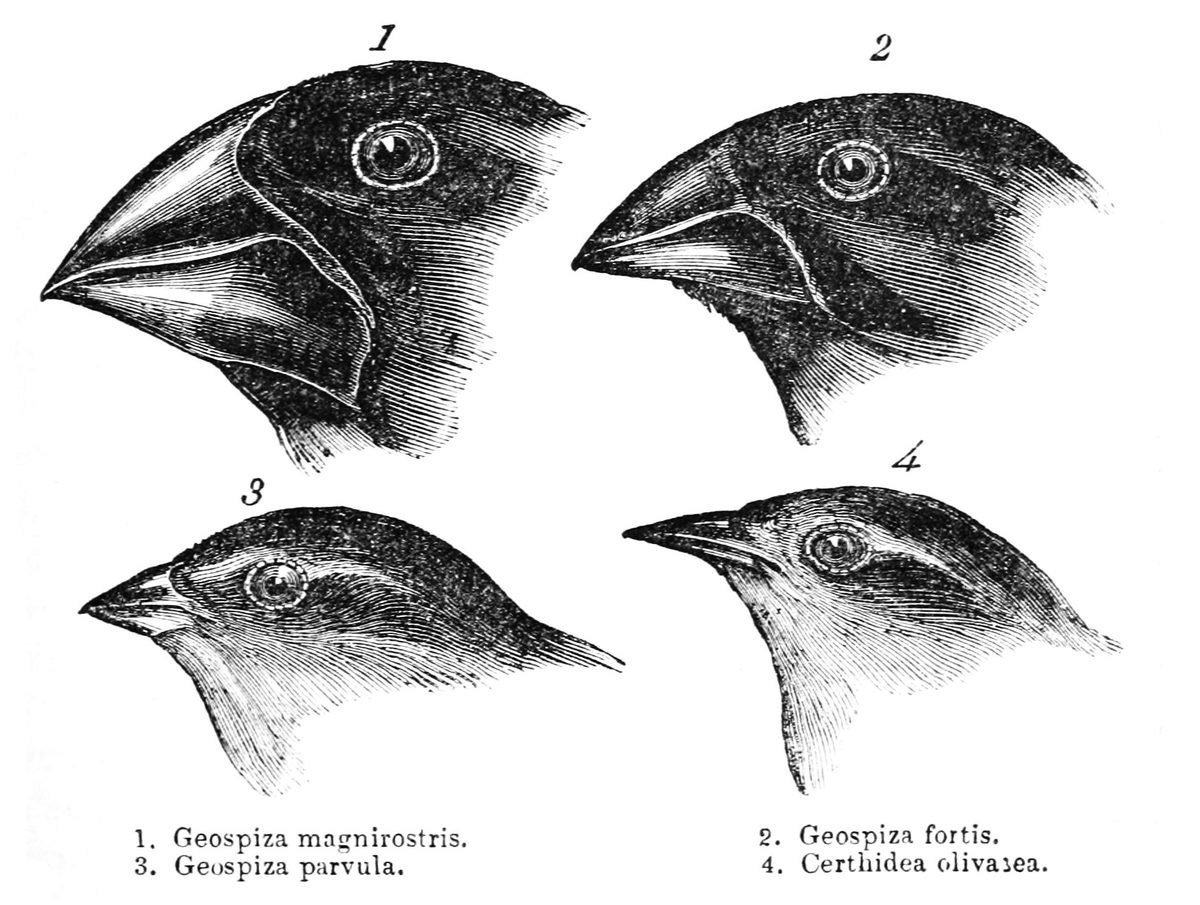
In 1977 a drought on the Galápagos island of Daphne Major killed most of the medium ground finches. The small soft seeds ran out first, and the birds that survived were disproportionately those with larger, deeper beaks able to crack the big tough seeds that remained. The next generation had measurably larger beaks than the generation before the drought — a change of a few per cent in a single year, measured bird by bird by researchers who had already been ringing and weighing the whole population for years. When the rains returned and small seeds became abundant again, beak size drifted back. That is natural selection observed directly, in the wild, with numbers.
The mechanism needs only three ingredients, and all three are things this course has already covered. First, heritable variation: individuals differ, and some of those differences are passed to offspring — which meiosis, recombination and mutation supply. Second, differences in survival and reproduction: some variants leave more offspring than others in the conditions that prevail. Third, inheritance doing its work, so the variants that left more offspring are more common in the next generation. Nothing else is required, and no intention anywhere.
The vocabulary needs care. Fitness in biology means reproductive contribution — how many surviving offspring an individual leaves — not strength or health, and a slower, weaker individual that leaves more offspring has higher fitness. An adaptation is a heritable feature that was favoured because of what it did for survival and reproduction in a particular environment, which means it is always an adaptation to something and can become a liability when conditions change. What natural selection changes is the frequency of variants in a population — the proportion carrying each — not the individuals themselves. No finch's beak grew during the drought; the population's composition changed.
Build your understanding
Where this fits
The last unit established that species change over time and that the fossil record shows it without explaining it. This unit is the mechanism. It depends on two things already covered: the variation meiosis and mutation produce in Chapter 5, and the population pathways from Chapter 6.
Use three flexible 40–45-minute sessions: core background and Parts 1–2 with their checks; Parts 3–4 and the worked application; then remaining practice, a labeled model, revision, and the exit check. Checks completed during reading can count toward the practice set. Read one short part at a time. Investigations and chapter review/quiz have separate sessions, and flexible weeks allow more time.
Part 1 · Three ingredients and nothing else
Variation comes first, and it comes from the processes in Chapter 5 rather than from need. Mutation changes sequences at random with respect to usefulness; meiosis and recombination deal those variants into new combinations every generation. By the time any environmental pressure arrives, the variation is already present.
Differential reproduction is the second ingredient and the one the environment supplies. In the conditions prevailing, some variants leave more surviving offspring than others. On Daphne Major in 1977 that was beak depth, because of which seeds remained. In other years, with other seeds, it was not.
Inheritance closes the loop. Because the favoured variants are heritable, the next generation contains a higher proportion of them. Repeat over many generations and the population can change substantially — and the process stops being directional the moment the conditions change, which is why the finches' beaks drifted back when the rains returned.
Pause and explain
What three things must be true for natural selection to occur?
Check your reasoning after answering
Individuals must vary; some of that variation must be heritable; and the variants must differ in how many surviving offspring they leave under the conditions prevailing. If all three hold, the proportion carrying the favoured variant rises in the next generation. Nothing else is needed, and no intention is involved at any stage.
Part 2 · Conditions decide which variant is favoured
No variant is better in general. A deep beak was an advantage on Daphne Major in 1977 and a disadvantage afterwards, because deep-beaked birds are less efficient on small seeds. An adaptation is always relative to an environment, and when the environment changes the same feature can become a cost.
This is why the phrase survival of the fittest misleads. Fitness is measured by surviving offspring in a given environment, so the statement is close to circular unless the environment is named. The useful version states the condition: in drought years with only large hard seeds, deeper-beaked finches left more offspring.
It also explains why selection does not produce perfection. It can only work on the variation present, it is pushed in different directions as conditions change, and a feature favoured for one reason may be costly for another. Organisms are full of compromises, which is what you would expect from this mechanism and not what you would expect from a design process.
Pause and explain
Why did the finches' average beak size drift back after the rains returned?
Check your reasoning after answering
Because the conditions that favoured deep beaks ended. With small soft seeds abundant again, smaller-beaked birds fed efficiently and left more offspring, so the frequency moved back. No variant is advantageous in general: an adaptation is relative to an environment, and the same feature can be a cost when conditions change.
Part 3 · Tracking a frequency, with its denominator
Selection is a change in proportions, so it is measured as a frequency: the number carrying a variant divided by the total examined. Stating the denominator is essential, because a count without it cannot be compared with anything.
Work the model. Generation one has 20 dark beetles out of 100, a frequency of 20 ÷ 100 = 0.2, or 20%. Generation two has 50 dark out of 100, a frequency of 0.5, or 50%. The frequency of the dark variant has risen by 30 percentage points in one generation, which is a large change.
The denominator matters because the alternative is misleading. Twenty dark beetles becoming fifty sounds like a change in the dark beetles, and it is not — it is a change in the population's composition. If the second sample had been 50 dark out of 400, the frequency would have fallen to 12.5% while the count rose. Always divide.
Pause and explain
Generation one has 20 dark beetles of 100 and generation two has 50 of 100. Calculate both frequencies and say what changed.
Check your reasoning after answering
20 ÷ 100 = 0.2 or 20%, and 50 ÷ 100 = 0.5 or 50%, so the frequency of the dark variant rose by 30 percentage points. What changed is the population's composition, not any individual beetle — no beetle became darker. Stating the denominator matters, since 50 of 400 would be a fall despite the higher count.
Part 4 · Selection is not the only thing that changes a frequency
A rising frequency is consistent with selection and with several other things. Dark beetles may have immigrated from elsewhere. Light ones may have emigrated. In a small population, chance alone shifts frequencies from generation to generation. Or the sampling method may detect dark beetles more readily on some backgrounds than others, which would change the measurement without changing the population.
The model states what strengthens the selection case here: dark beetles are harder to detect on the stated ground, which supplies a mechanism, and greater reproductive contribution is recorded, which supplies the second ingredient directly. A mechanism plus a measured reproductive difference is much stronger than a frequency change alone.
The clinching distinction, though, is the one from Chapter 5. A single beetle changing colour would not be evidence of selection at all — it would be a change within an individual's lifetime, which is not inherited. Evidence of selection is a change in the proportions of a population across generations, with the variation heritable and the reproductive difference measured. That is why the beetle model is evidence and an individual's change would not be.
Pause and explain
Name two explanations other than selection for a rising frequency of a variant.
Check your reasoning after answering
Movement — individuals carrying the variant moving in, or others moving out — and chance, which shifts frequencies noticeably in small populations regardless of any advantage. A third is measurement: if the sampling method detects one variant more readily, the recorded frequency changes while the population does not. Each needs ruling out before attributing a change to selection.
Apply the whole unit · Evaluate a selection model
Illustrative inherited-colour model, not a surveyed population: generation one has 20 dark beetles of 100; generation two has 50 dark of 100. Dark beetles are harder to detect on the stated ground, and a greater reproductive contribution from dark beetles is recorded.
Your task
Calculate both frequencies, explain the selection, and say why this evidence is stronger than a single beetle changing colour would be.
What your response should show
- Explain the relevant biological process accurately.
- Use the supplied evidence and show calculation steps with units where needed.
- Connect a labeled model or mechanism with the claim.
- State an assumption, evidence limitation, or useful next observation.
Response guidance — after your attempt
Calculate generation one: 20 ÷ 100 = 0.2, a frequency of 20%.
Calculate generation two: 50 ÷ 100 = 0.5, a frequency of 50%, a rise of 30 percentage points.
Apply the three ingredients: colour is inherited, dark beetles are harder to detect on this ground, and they are recorded as contributing more offspring.
Contrast with an individual: one beetle changing colour in its lifetime would not be heritable and would say nothing about the population's composition across generations.
The frequency of the dark variant rises from 20 ÷ 100 = 20% to 50 ÷ 100 = 50%, an increase of 30 percentage points in one generation. All three ingredients of natural selection are present in the model. The colour is stated to be inherited, so the variation is heritable. The ground makes dark beetles harder to detect, which supplies a mechanism by which they would survive better — fewer taken by predators that hunt by sight. And a greater reproductive contribution from dark beetles is recorded directly, which is the differential reproduction the mechanism requires rather than something inferred. With heritable variation, a plausible mechanism and a measured reproductive difference, the selection explanation is well supported. This is stronger evidence than a single beetle changing colour would be, for two separate reasons. A change within one individual's lifetime is not heritable, so it could not be passed to offspring and could not change the next generation whatever caused it. And selection is a change in the proportions of a population across generations, not a change in individuals: no beetle here became darker, and the composition of the population changed. Stating the denominator is part of that — 50 dark beetles would be a fall in frequency if the sample were 400. Two alternatives remain worth checking even so: movement of beetles into or out of the area, and the possibility that the same ground that hides dark beetles from predators also hides them from the people counting, which would bias the measurement in the same direction as the effect.
Scientific references for this unit
Parent / teacher teaching notes
Ask for a because-statement and a labeled relationship, not just a memorized word. Work through one calculation step at a time, permit oral or diagram responses, and use flexible sessions for difficult reading. Compare the learner’s actual evidence with the supplied model; do not reward copying or agreement with a personal preference. No private family, genetic, or medical records are required.
The key idea
Natural selection can change the frequency of inherited variants across generations when individuals differ in reproductive success related to those variants. Individuals must vary, some variation must be heritable, and conditions must affect outcomes. Merely noticing that survivors differ is not a complete demonstration of an inherited population change.
Worked examples
Example 1 · Put the order of events right
- Identify the reversed order: the account has the need producing the variation.
- State what actually comes first: mutation produces variation at random with respect to usefulness, so in a large population some cells already carry resistance before exposure.
- State what the antibiotic does: it determines which cells survive and reproduce, raising the frequency of the resistant variant in the next generation.
If an account has an organism changing because it needed to, the order is wrong.
Example 2 · Test a frequency change for alternatives
- Check movement: moths of that variant may have immigrated, or others emigrated, which changes composition without selection.
- Check population size: in a small population, chance alone shifts frequencies substantially between generations.
- Check the measurement: if the trapping method catches one variant more readily, the recorded frequency changes while the population does not.
A frequency change is the observation. Selection is one explanation among several.
Avoid these mistakes
- Mistake: organisms develop traits because they need them. Variation arises before the pressure, from mutation and recombination; the environment then determines which variants leave more offspring.
- Mistake: individuals evolve. No finch's beak grew in the drought — the population's composition changed, which is what a frequency measures.
- Mistake: fitness means strength. It means surviving offspring left; a weaker individual that leaves more offspring has higher fitness.
- Mistake: an adaptation is good in general. Deep beaks helped in the drought and cost afterwards; adaptations are relative to conditions that change.
Check your understanding
Why must inherited variation be specified?
Discuss the answer
A temporary acquired difference may not be passed to offspring, so it cannot support the same across-generation mechanism.
Is one color universally the fittest?
Discuss the answer
No. Advantage depends on conditions and effects on reproductive success.
Words to know
- natural selection
- The process by which variants leaving more surviving offspring become more common; it needs heritable variation, differential reproduction and inheritance, and nothing else.
- adaptation
- A heritable feature favoured for what it did in a particular environment; always an adaptation to something, and able to become a cost when conditions change.
- fitness
- Reproductive contribution — surviving offspring left — rather than strength or health.
- frequency
- The proportion of a population carrying a variant; a count without its denominator cannot be compared.
- heritable variation
- Differences between individuals that can be passed to offspring, supplied by mutation, meiosis and recombination before any pressure arrives.
Extend your scientific explanation
Compare a second supplied example or the linked educational reference. Identify a connection, a model limit, and an additional observation that would test the explanation.
In the real world
Use a clear question, reliable observations, and a biological mechanism to evaluate a claim. State what remains uncertain before applying a classroom model to a different setting.
Exit check
Does a small frequency change alone prove selection?
Check your explanation after answering
No. Sampling, movement, and other processes may contribute; evidence about inheritance and reproductive success is needed.
Explain your reasoning without notes. If a key idea is missing, revisit the lesson and try again.
Common Ancestry, Evidence & Branching Trees
Learning goals
- I can explain common ancestry, evidence & branching trees.
- I can use evidence, a model, and stated assumptions to support a biological explanation.
Before this unit
Use the supplied vocabulary, distinguish an observation from an explanation, and identify any units or model assumptions. Revisit a connected earlier unit if needed; new terms are explained here.
Use three flexible 40–45-minute sessions: core background and Parts 1–2 with their checks; Parts 3–4 and the worked application; then remaining practice, a labeled model, revision, and the exit check. Checks completed during reading can count toward the practice set. Read one short part at a time. Investigations and chapter review/quiz have separate sessions, and flexible weeks allow more time.
A human arm, a bat's wing, a whale's flipper and a horse's front leg do completely different jobs, and inside each one are the same bones in the same arrangement: one long bone, then two, then a cluster, then five sets of digits. Nothing about flying requires that pattern — an insect wing manages without it — and nothing about swimming does either. The shared arrangement is not explained by the shared function, because there is no shared function. It is explained by shared inheritance from an ancestor that had that limb, modified in each lineage for a different use. Structures related in this way are homologous structures, and they are among the strongest evidence for a common ancestor.
The contrast makes the argument sharper. A bird's wing and an insect's wing do the same job and are built on entirely different plans — bone and feather against a membrane with no bones at all. Similar function has produced similar shape independently in lineages that were never closely related, which is why function is a poor guide to relationship and internal structure is a good one. The question is always whether a similarity was inherited or arrived at separately.
Two further lines of evidence matter. Vestigial structures are reduced features that are clearly the remnants of something larger in ancestors — the small hip bones embedded in a whale, the reduced wings of a flightless bird. Calling them useless is a step too far, since several have turned out to retain functions, and the evidence they provide is about history rather than uselessness. And the strongest line is molecular: DNA sequences can be compared directly, and more closely related organisms share more sequence. A phylogenetic tree summarises the conclusions, with each node representing a common ancestor from which two lineages diverged. The real weight of the argument comes from independent lines agreeing — anatomy, fossils and molecules producing the same tree.
Build your understanding
Where this fits
Selection explains how a population changes. Run that over long enough, with populations separated, and lineages diverge — which is where the branching tree from the first chapter comes from. This unit is the evidence for shared ancestry and how to read a tree without misreading it, which is most of what people get wrong about this topic.
Use three flexible 40–45-minute sessions: core background and Parts 1–2 with their checks; Parts 3–4 and the worked application; then remaining practice, a labeled model, revision, and the exit check. Checks completed during reading can count toward the practice set. Read one short part at a time. Investigations and chapter review/quiz have separate sessions, and flexible weeks allow more time.
Part 1 · Inherited structure against shared function
Homologous structures share an underlying plan and may do quite different things. The forelimb pattern across mammals is the standard case: one bone, two bones, wrist bones, digits, whether the limb is used for flying, swimming, running or writing. The shared plan is what needs explaining, and inheritance from a common ancestor explains it.
The opposite case is similarity produced independently. A bird's wing and an insect's wing, a shark's body and a dolphin's, a cactus's spines and a thorny shrub's — in each pair, similar demands have produced similar solutions in lineages that are not close relatives. Looking inside separates the cases: the dolphin has the mammal forelimb inside its flipper and the shark does not.
The practical rule is to compare structure rather than function or outward form. Two organisms that look alike may be distantly related; two that look nothing alike may be close. A dolphin is more closely related to a cow than to a shark, which is counter-intuitive from the outside and obvious from the bones.
Pause and explain
Why is a dolphin more closely related to a cow than to a shark?
Check your reasoning after answering
Because the similarities between dolphin and shark are in outward form, produced independently by similar demands of swimming, while the similarities between dolphin and cow are structural and inherited — the mammal forelimb inside the flipper, lungs, warm-bloodedness, milk. Shared inheritance shows in internal structure; shared function shows in outward shape.
Part 2 · Reduced structures, used carefully
A vestigial structure is a reduced version of something that was larger and functional in ancestors. Whales have small hip and sometimes leg bones with no connection to a limb; some flightless birds have wings far too small to fly; some cave-dwelling animals have eyes that cannot see. Each is hard to explain except as a remnant.
What they are not is necessarily useless. Whale pelvic bones anchor muscles; the human appendix, long cited as a classic example, appears to have a role in the gut's bacterial community. The evidence vestigial structures provide is that the ancestor had something larger and the lineage reduced it, which is a claim about history and not about current function.
That distinction keeps the argument honest. If the case rested on uselessness, finding a function would defeat it. Resting it on reduction from an ancestral form keeps it intact, and makes it testable against fossils, which can show the intermediate stages — and in whales they do, with a sequence of fossil forms showing hind limbs becoming smaller.
Pause and explain
Why is "vestigial means useless" a poor way to define the term?
Check your reasoning after answering
Because several vestigial structures turn out to have functions — whale pelvic bones anchor muscles, and the human appendix appears to have a role in the gut's bacteria. Vestigial means reduced from a larger ancestral form, which is a claim about history. Resting the argument on uselessness would make it collapse the moment a function was found.
Part 3 · Independent lines of evidence agreeing
Any single line of evidence can be questioned. Anatomical similarity could in principle be coincidence; the fossil record is patchy, as the first unit of this chapter stressed; a molecular comparison depends on the method used. What makes the conclusion strong is that these independent lines produce the same answer.
Molecular evidence is the most recent and in some ways the most decisive, because DNA sequences can be compared directly and quantitatively. Organisms judged close relatives from anatomy share more sequence; organisms judged distant share less. That agreement was not guaranteed — the molecular evidence could have contradicted the anatomy, and in a few cases it has, prompting revisions that are themselves evidence the method is working.
When independent methods with different assumptions and different failure modes converge, the conclusion is far stronger than any one of them. That is a general principle of evidence, not a fact about biology, and it is the same logic as corroborating a historical claim from unrelated records.
Pause and explain
Why does agreement between anatomical and molecular evidence strengthen a conclusion more than either alone?
Check your reasoning after answering
Because the two methods have different assumptions and different ways of going wrong. An error in reading anatomy would not produce the same error in a DNA comparison, so if both point to the same relationships, the chance that both are wrong in the same direction is small. Independent methods converging is stronger than one method repeated.
Part 4 · Reading a tree without misreading it
A tree shows branching order. A node is a point where a lineage split, representing a common ancestor of everything above it. Relative closeness is read by where lineages share nodes: two that share a recent node are more closely related than either is to one that branched off earlier.
Take a tree in which A splits from a lineage before B and C split from each other. B and C are the closest pair, because they share the more recent node. A is equally related to both B and C — it branched off before they separated, so neither is closer to it than the other, however the tree happens to be drawn on the page.
Two misreadings are worth naming. First, living species do not descend from other living species: C did not come from B, and both descend from a shared ancestor at their node that is not shown and no longer exists. Second, unless a tree is explicitly drawn to a time scale, branch lengths carry no information about when splits happened or how much change occurred. A tree without a stated scale gives order and relationship, and nothing about timing.
Pause and explain
In a tree where A splits before B and C split from each other, which pair is closest, and is A closer to B or to C?
Check your reasoning after answering
B and C are the closest pair, because they share the most recent node. A is equally related to B and to C: it branched off before they separated, so it shares the same older ancestor with both. How near A is drawn to one of them on the page carries no information about relationship.
Apply the whole unit · Interpret a fictional tree
Illustrative tree, not real species: lineage A splits from the line before B and C split from each other. No times, no branch-length scale and no species identities are supplied.
Your task
Identify the closest pair, explain why C need not descend from living B, and state what the tree cannot say about timing.
What your response should show
- Explain the relevant biological process accurately.
- Use the supplied evidence and show calculation steps with units where needed.
- Connect a labeled model or mechanism with the claim.
- State an assumption, evidence limitation, or useful next observation.
Response guidance — after your attempt
Find the most recent node: B and C share it, so they are the closest pair in the model.
Place A: it branched before that node, so it is equally related to B and to C.
Explain the descent point: B and C both descend from the ancestor at their shared node, which is not either of them and is not alive.
State the timing limit: with no scale, branch lengths carry no information about when splits occurred or how much change happened.
B and C are the closest pair in this tree, because they share the most recent node — the point representing their common ancestor. A branched from the line before that split, which means A is equally related to B and to C; it shares the same older ancestor with both, and nothing about how near A is drawn to one of them on the page changes that. The second point is the one most often got wrong. C does not descend from living B, and B does not descend from living C. Both descend from the ancestor represented by the node they share, a population that is not identical to either of them and is no longer alive. Living species are the tips of a tree, never the branching points, which is the same error as thinking humans descended from chimpanzees rather than both descending from a shared ancestor that was neither. On timing, the tree supports nothing at all. Unless branch lengths are explicitly drawn to a stated scale, they are a drawing convention: they do not say when A diverged, how long ago B and C split, or how much change occurred along any branch. A tree gives branching order and relative relationship. Adding timing requires dated fossils, or molecular estimates with stated assumptions, and either should be shown as a scale on the diagram so a reader knows the lengths mean something.
Scientific references for this unit
Parent / teacher teaching notes
Ask for a because-statement and a labeled relationship, not just a memorized word. Work through one calculation step at a time, permit oral or diagram responses, and use flexible sessions for difficult reading. Compare the learner’s actual evidence with the supplied model; do not reward copying or agreement with a personal preference. No private family, genetic, or medical records are required.
The key idea
Common ancestry explains inherited similarities among organisms through shared predecessors. Homologous structures share underlying inherited relationships even when functions differ, while similar functions can arise through different histories. A butterfly wing and a bird wing both support flight but do not have the same underlying wing construction.
Worked examples
Example 1 · Separate inherited similarity from independent similarity
- Look past function to internal structure: bat and whale both have the mammal forelimb plan — one bone, two bones, wrist, digits.
- Compare bat and bird: both are wings, and the bird's is built on a different arrangement, with feathers and a reduced, fused hand.
- Apply the rule: shared plan despite different function indicates inheritance; shared function with different plans indicates independent solutions.
Ask what needs explaining. Shared plan with different jobs is the signature of inheritance.
Example 2 · Correct two tree misreadings at once
- Address descent: both are living species at the tips of the tree, so neither descends from the other; they descend from the ancestor at their shared node.
- Address branch length: unless the tree states a time scale, lengths are a drawing convention and carry no temporal information.
- Say what the tree does support: the branching order and which species share more recent ancestors.
Tips are living species; nodes are ancestors. Length means nothing without a scale.
Avoid these mistakes
- Mistake: similar function means close relationship. Bird and insect wings are built on entirely different plans; a dolphin's flipper contains the mammal forelimb and a shark's fin does not.
- Mistake: vestigial means useless. It means reduced from a larger ancestral form — whale pelvic bones anchor muscles, and the claim is about history.
- Mistake: one living species descended from another. Living species are the tips of a tree; two of them descend from a shared ancestor at their node that is neither and is extinct.
- Mistake: branch length shows time. Unless a scale is stated, lengths are a drawing convention and say nothing about when a split happened.
Check your understanding
Does the same function alone prove close ancestry?
Discuss the answer
No. Similar functions can arise through different histories; structural and other evidence must be compared.
Why is “vestigial means no function whatsoever” too strong?
Discuss the answer
Reduced ancestral roles can coexist with remaining or changed functions.
Words to know
- common ancestor
- A population from which two lineages diverged; it is represented by a node on a tree and is not any living species.
- homologous structure
- A feature sharing an underlying plan through inheritance, such as the one-bone, two-bone, digits forelimb across mammals doing quite different jobs.
- vestigial structure
- A feature reduced from a larger ancestral form, such as a whale's hip bones; reduced is the claim, not useless.
- phylogenetic tree
- A diagram of branching order and relationship; without a stated scale, branch lengths say nothing about timing.
- node
- A branching point representing a common ancestor; two lineages sharing a recent node are more closely related than either is to one branching earlier.
Extend your scientific explanation
Compare a second supplied example or the linked educational reference. Identify a connection, a model limit, and an additional observation that would test the explanation.
In the real world
Use a clear question, reliable observations, and a biological mechanism to evaluate a claim. State what remains uncertain before applying a classroom model to a different setting.
Exit check
Does rotating B and C around their node change their relationship?
Check your explanation after answering
No. The shared node and connections remain the same; visual left-right order is not the ancestry criterion.
Explain your reasoning without notes. If a key idea is missing, revisit the lesson and try again.
Selective Breeding & Genetic Diversity
Learning goals
- I can explain selective breeding & genetic diversity.
- I can use evidence, a model, and stated assumptions to support a biological explanation.
Before this unit
Use the supplied vocabulary, distinguish an observation from an explanation, and identify any units or model assumptions. Revisit a connected earlier unit if needed; new terms are explained here.
Use three flexible 40–45-minute sessions: core background and Parts 1–2 with their checks; Parts 3–4 and the worked application; then remaining practice, a labeled model, revision, and the exit check. Checks completed during reading can count toward the practice set. Read one short part at a time. Investigations and chapter review/quiz have separate sessions, and flexible weeks allow more time.
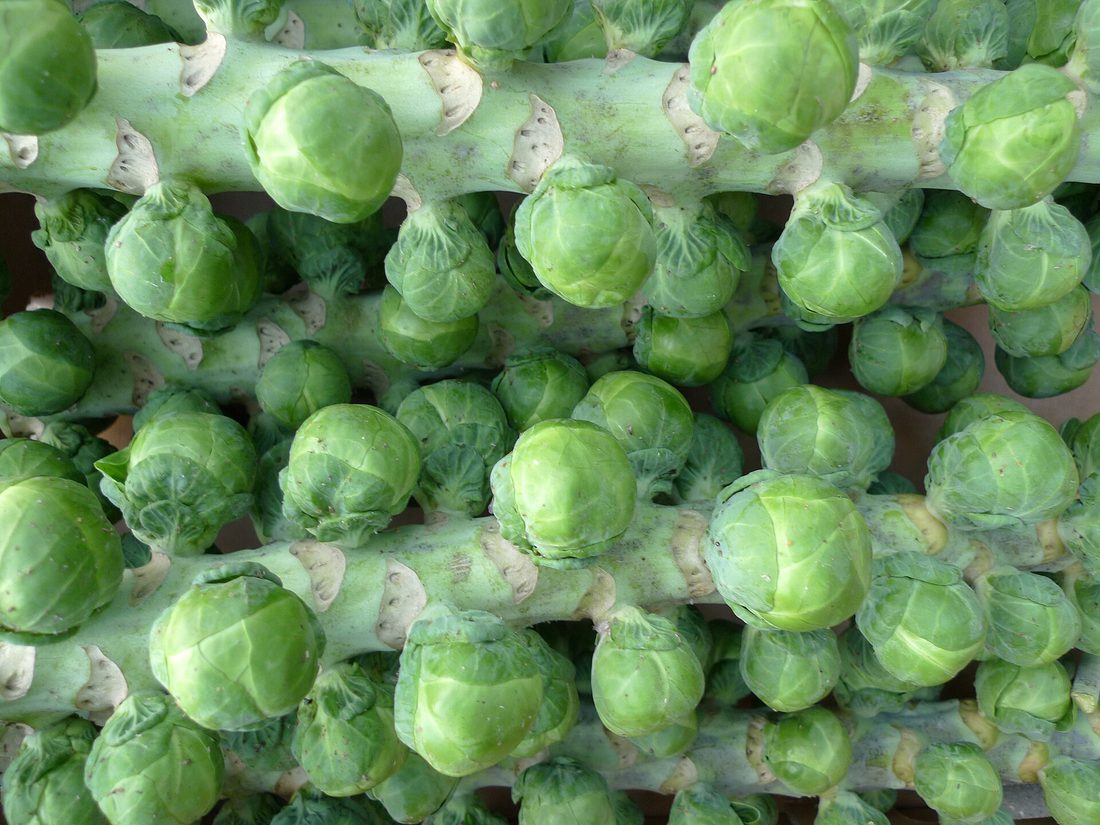
Broccoli, cabbage, cauliflower, kale, Brussels sprouts and kohlrabi are all the same species: Brassica oleracea, a scrubby wild coastal plant. People selected the plants with the largest flower buds and eventually had broccoli; selected for a tight terminal bud and had cabbage; for side buds and had sprouts; for leaves and had kale; for stem and had kohlrabi. Each is the result of choosing which individuals bred, generation after generation. If the question is whether selection can change a population substantially, the answer is in any vegetable aisle.
Artificial selection, or selective breeding, is the same mechanism as natural selection with a different source of the differential reproduction. The three ingredients are unchanged: heritable variation must exist, some individuals must leave more offspring than others, and the variation must be inherited. What differs is who decides — a breeder choosing which individuals reproduce rather than the environment doing it. That is why it is such good evidence for the natural process: the mechanism is visible, the generations are short enough to watch, and the results are dramatic.
The cost is in the gene pool — the total genetic variation present in a population. Breeding only from a few individuals with a desired characteristic means the next generation descends from those few, so variation is lost across the whole genome, not only at the gene being selected. A selection pressure applied hard and long produces a population that is excellent at one thing and has little variation left to meet anything else, which is why uniform crops are vulnerable to new diseases. And establishing that an improvement is inherited at all requires heritability evidence — a comparison in matched conditions, because a plant grown in better soil yields more regardless of its genes.
Build your understanding
Where this fits
Natural selection works through differences in reproductive success produced by the environment. This unit looks at what happens when people supply the selection instead, which is both the oldest evidence that populations can be changed and the clearest case of the cost that comes with it.
Use three flexible 40–45-minute sessions: core background and Parts 1–2 with their checks; Parts 3–4 and the worked application; then remaining practice, a labeled model, revision, and the exit check. Checks completed during reading can count toward the practice set. Read one short part at a time. Investigations and chapter review/quiz have separate sessions, and flexible weeks allow more time.
Part 1 · Who supplies the selection
In natural selection the environment determines which individuals leave more offspring: predators, drought, disease, competition. In artificial selection a person does, by choosing which individuals breed. The mechanism downstream is identical, which is exactly why the comparison is useful.
The requirements are also identical. There must be variation to select among — a breeder cannot create a characteristic that does not appear, only increase what does. The variation must be heritable, or selecting the best performers achieves nothing in the next generation. And the selection must be applied repeatedly, since one generation shifts a frequency only slightly.
The differences are in pace and direction. Artificial selection can be intense and consistent in a way natural conditions rarely are, which is why it produces large changes in dozens of generations rather than thousands. It also selects for what a person wants, which may be actively harmful to the organism — many breeds have health problems arising directly from characteristics that were selected for.
Pause and explain
Why can a breeder not select for a characteristic that no individual shows?
Check your reasoning after answering
Because selection acts on existing variation; it chooses among individuals rather than creating new forms. If no individual carries the characteristic, there is nothing to breed from. New variation arrives only through mutation and recombination, which is why breeders work with large and varied populations and why losing variation limits what can be selected for later.
Part 2 · Separating inherited performance from conditions
A high-performing individual may be high-performing because of its genes, because of the conditions it grew in, or both — which is the Chapter 5 problem in a practical setting. A breeder who selects the best plants in the best soil may simply be selecting the plants that had the best soil, and the next generation will disappoint.
The model shows the trap clearly. Plant A averages 12 seeds in favourable soil; plant B averages 9 in poorer soil. The difference of 3 seeds has two available explanations — inherited capacity and soil — and the comparison cannot separate them because both varied together. Breeding only A on the strength of this evidence may propagate nothing more than a memory of good soil.
The stronger comparison is the one Chapter 1 described. Grow A and B in matched conditions, with several plants of each and conditions randomised across positions, and compare yields. Better still, grow their offspring in matched conditions, since what a breeder needs to know is whether the advantage is transmitted — which is what heritability means.
Pause and explain
Plant A yields 12 seeds in good soil, plant B yields 9 in poor soil. Why can't you conclude A is genetically superior?
Check your reasoning after answering
Because genotype and soil differed together, so the 3-seed difference could come from either. This is a confound: the comparison cannot attribute the difference. Growing both in matched conditions, with several plants each and positions randomised, would isolate the inherited contribution — and growing their offspring in matched conditions would test whether any advantage is transmitted.
Part 3 · What is gained and what is given up
Selective breeding has produced most of the food people eat, and the gains are real: higher yields, disease resistance, animals suited to particular conditions, crops that ripen together or store well. None of this is in question.
The cost is variation. Breeding from a few selected individuals means the next generation descends from a narrow base, and the loss is across the whole genome rather than only at the characteristic selected for. Repeat over many generations and the population becomes genetically uniform — excellent at the selected trait and carrying little of anything else.
Uniformity is a vulnerability for the reason the biodiversity unit gave. A population of near-identical individuals meets a new disease with the same resources, so what defeats one defeats all. The Irish potato failure of the 1840s is the standard case: a crop grown overwhelmingly from a very narrow genetic base, and a new disease to which almost none of it was resistant.
Pause and explain
Why does breeding from a few selected individuals reduce variation across the whole genome, not just at the selected gene?
Check your reasoning after answering
Because the whole next generation descends from those few individuals, inheriting their entire genomes and not only the alleles that were selected for. Whatever variation existed elsewhere in the population, at genes nobody was looking at, is simply not passed on. Repeated over generations this produces a uniform population with little to draw on if conditions change.
Part 4 · Keeping variation for conditions that have not arrived
The response to the trade-off is to retain variation deliberately rather than to stop selecting. Seed banks hold many varieties, including ones with no current commercial value. Wild relatives of crops are collected and maintained, and have repeatedly supplied disease resistance that cultivated varieties had lost. Breeders keep diverse lines rather than a single best one.
The reasoning is the same as for insurance. The variation needed cannot be identified in advance, because the threat has not arrived — which is precisely why it must be kept rather than selected for. A variety that yields poorly today may carry the resistance that matters in twenty years, and once it is gone it cannot be recovered.
That connects this chapter back to the one before it. Diversity is worth maintaining because conditions change and the future cannot be specified, and that argument applies equally to a wild community and a cultivated one. It is also the last substantive idea of the course, which the capstone unit asks you to use.
Pause and explain
Why keep crop varieties that yield poorly today?
Check your reasoning after answering
Because the variation that will be needed cannot be identified in advance. A low-yielding variety may carry resistance to a disease that has not yet appeared, and wild relatives of crops have repeatedly supplied resistance that cultivated varieties had lost. Once a variety is gone the variation is unrecoverable, so it has to be kept before the need is known.
Apply the whole unit · Evaluate a fictional breeding proposal
Illustrative plants, not a real trial: plant A averages 12 seeds in favourable soil; plant B averages 9 seeds in poorer soil. A proposal states that breeding only from A proves an inherited yield improvement.
Your task
Explain the confound, propose a stronger comparison, and identify a diversity trade-off in the proposal.
What your response should show
- Explain the relevant biological process accurately.
- Use the supplied evidence and show calculation steps with units where needed.
- Connect a labeled model or mechanism with the claim.
- State an assumption, evidence limitation, or useful next observation.
Response guidance — after your attempt
Identify what varied together: genotype and soil quality both differ between A and B, so the 3-seed difference cannot be attributed to either.
Name the consequence: selecting A may propagate the effect of good soil rather than any inherited capacity.
Propose the stronger comparison: grow both in matched conditions, several plants of each, positions randomised, and ideally test their offspring in matched conditions too.
Identify the trade-off: breeding only from A narrows the gene pool across the whole genome, leaving less variation to meet a disease or a change in conditions.
The confound is that genotype and soil differ together. Plant A is both the plant with the higher yield and the plant in the favourable soil, so the 3-seed difference — 12 against 9 — could come from inherited capacity, from the soil, or from both in any proportion. The comparison cannot separate them, and acting on it risks propagating nothing more than the effect of good soil, which will not be inherited. A stronger comparison holds the conditions matched and varies only the plants: grow A and B in the same soil, with several plants of each rather than one, and positions randomised so that no line sits permanently in a better spot. Stronger still is to grow their offspring in matched conditions, because what a breeder needs is not whether A yields more but whether A's advantage is transmitted — which is what heritability means and what the original comparison never tested. The trade-off concerns the gene pool. Breeding only from A means the next generation descends from one line, so variation is lost across the whole genome and not only at whatever genes affect yield. Repeated over generations this produces a uniform crop that performs well under the conditions it was selected for and has little to draw on when conditions change — the vulnerability behind the Irish potato failure of the 1840s. Keeping other lines, including lower-yielding ones and wild relatives, preserves variation whose value cannot be identified until the threat arrives.
Scientific references for this unit
Parent / teacher teaching notes
Ask for a because-statement and a labeled relationship, not just a memorized word. Work through one calculation step at a time, permit oral or diagram responses, and use flexible sessions for difficult reading. Compare the learner’s actual evidence with the supplied model; do not reward copying or agreement with a personal preference. No private family, genetic, or medical records are required.
The key idea
Artificial selection occurs when people influence which organisms reproduce according to desired characteristics. It acts on available heritable variation and reproductive outcomes, while mutations can introduce new variation over time. A desired trait does not appear automatically because a breeder wants it.
Worked examples
Example 1 · Explain a dramatic result from an ordinary mechanism
- Variation: the wild plant's population varied in flower buds, terminal buds, side buds, leaves and stem.
- Differential reproduction: people bred only from the individuals strongest in whichever part they wanted, generation after generation.
- Inheritance: those features were heritable, so each line's offspring were shifted a little further in that direction each generation.
The mechanism is ordinary. The scale of the result comes from intensity and repetition.
Example 2 · Decide what a yield trial establishes
- Check the design: matched conditions and randomised positions mean the difference is attributable to the varieties rather than to location.
- State what is supported: X outyielded Y by 15% in this field, this season, under these conditions.
- State what is not: whether the advantage holds in other soils or seasons, and whether it is transmitted to offspring.
A good comparison supports a claim about the conditions it ran under. Transmission needs the next generation.
Avoid these mistakes
- Mistake: breeders create new characteristics. Selection acts on variation already present; new variation comes only from mutation and recombination.
- Mistake: the best-performing individual has the best genes. Plant A's 12 seeds in good soil against B's 9 in poor soil confounds genotype with conditions; matched conditions are needed.
- Mistake: narrowing a gene pool only affects the selected trait. The next generation inherits whole genomes from a few individuals, so variation is lost everywhere.
- Mistake: low-yielding varieties are worth discarding. The variation that will matter cannot be identified before the threat arrives, which is why seed banks keep what has no current value.
Check your understanding
Does training an individual automatically count as selective breeding?
Discuss the answer
No. Selective breeding changes which organisms reproduce based on traits; training changes an individual’s experience.
Why compare environments before selecting for size?
Discuss the answer
Resource differences can affect size; without comparable conditions, the chosen characteristic may not reflect an inherited contribution.
Words to know
- artificial selection
- Selection in which a person rather than the environment decides which individuals reproduce; the mechanism downstream is identical to natural selection.
- selective breeding
- Repeatedly breeding from individuals with a desired characteristic; it acts on existing variation and cannot create a characteristic nothing shows.
- gene pool
- The total genetic variation in a population; breeding from a few individuals narrows it across the whole genome, not only at the selected gene.
- heritability evidence
- A comparison in matched conditions, ideally of offspring, showing that an advantage is transmitted rather than produced by circumstances.
- selection pressure
- The force determining which individuals leave more offspring; applied hard and long it produces a population excellent at one thing and uniform in everything else.
Extend your scientific explanation
Compare a second supplied example or the linked educational reference. Identify a connection, a model limit, and an additional observation that would test the explanation.
In the real world
Use a clear question, reliable observations, and a biological mechanism to evaluate a claim. State what remains uncertain before applying a classroom model to a different setting.
Exit check
Why can a uniform variety be vulnerable to one particular threat?
Check your explanation after answering
If individuals share a susceptible inherited response, a threat targeting that response can affect many; the actual effect needs evidence.
Explain your reasoning without notes. If a key idea is missing, revisit the lesson and try again.
Life Science Capstone: Explain, Test & Revise
Learning goals
- I can explain life science capstone: explain, test & revise.
- I can use evidence, a model, and stated assumptions to support a biological explanation.
Before this unit
Use the supplied vocabulary, distinguish an observation from an explanation, and identify any units or model assumptions. Revisit a connected earlier unit if needed; new terms are explained here.
Use three flexible 40–45-minute sessions: core background and Parts 1–2 with their checks; Parts 3–4 and the worked application; then remaining practice, a labeled model, revision, and the exit check. Checks completed during reading can count toward the practice set. Read one short part at a time. Investigations and chapter review/quiz have separate sessions, and flexible weeks allow more time.
A year ago this course opened with James Lind giving six pairs of sailors six different remedies while keeping everything else the same. Everything since has been variations on that move: decide what to compare, hold the rest steady, measure something stated, and say what the result can carry. The biology has changed from scurvy to cells to ecosystems to beak depth; the method has not. This unit asks you to run it yourself, on a question that needs more than one chapter to answer.
A good inquiry report does four things, in order. It states a bounded question — what is being compared, measured how, where, over what period. It presents the evidence with numbers, units and the conditions it was gathered under. It supplies reasoning that connects evidence to claim through a mechanism rather than restating the evidence. And it states the assumptions it rests on, the alternative explanations it has not ruled out, and the qualifications that limit the claim. The last of those is the part most often missing and the part that most distinguishes a scientific report from an opinion.
Revision is the expected ending, not a failure. A claim narrowed to the conditions it was tested under, with its mechanism stated and its main rival addressed, is better work than a bold claim resting on the same evidence. The habit worth leaving the course with is writing the limitation yourself, before anyone else points it out — and proposing the observation that would settle what the evidence left open.
Build your understanding
Where this fits
This is the last unit of the course, and it introduces nothing new. Everything needed is already in place: the method from Chapter 1, cells and bodies from Chapters 2 to 4, inheritance from Chapter 5, ecosystems and evidence from Chapters 6 and 7, and selection from this one. The unit is about putting them together into a single piece of reasoning you could defend.
Use three flexible 40–45-minute sessions: core background and Parts 1–2 with their checks; Parts 3–4 and the worked application; then remaining practice, a labeled model, revision, and the exit check. Checks completed during reading can count toward the practice set. Read one short part at a time. Investigations and chapter review/quiz have separate sessions, and flexible weeks allow more time.
Part 1 · Bounding the question before answering it
A bounded question names four things: the population or system, the comparison, the measurement with units, and the period. "Does variant A do better?" has none of them. "In this field population, did the proportion of plants carrying Variant A change between the 2025 and 2026 generations, measured as a percentage of 100 plants sampled each year?" has all four, and can be answered or shown to be unanswerable with the evidence available.
Bounding also fixes what counts as an answer. With the question above, the answer is a pair of percentages and a difference, and anything beyond that — why it changed, whether it will continue — is a further question needing further evidence. Separating those saves a great deal of confused argument later.
The boundary should match the evidence you can actually obtain. A question about an entire species cannot be answered by sampling one field, and a question about long-term change cannot be answered in one year. Matching the question's scope to the evidence's scope at the start is easier than retreating from an overreaching claim at the end.
Pause and explain
What four things does a bounded biological question have to name?
Check your reasoning after answering
The population or system being studied, the comparison being made, the measurement with its units, and the period over which it was taken. Without all four the question cannot be answered definitely or shown to be unanswerable. The scope also has to match the evidence available — one field for one year cannot answer a question about a species over decades.
Part 2 · Combining evidence without conflating it
Most interesting questions need several kinds of evidence, and the skill is keeping them distinct while using them together. A frequency change is a measurement. A mechanism — why one variant would leave more offspring here — is an explanation. A record of reproductive contribution is a third thing again. Each supports the conclusion differently and each can fail differently.
Conflation usually looks like a single confident sentence that merges a measurement with its interpretation. "Variant A is better adapted, which is why it rose to 45%" collapses what was measured into why it happened. Separating them — the frequency rose from 30% to 45%, and the proposed mechanism is this, and the evidence for that mechanism is this — makes each part checkable on its own.
Independent lines agreeing is the strongest position, as the common ancestry unit showed. A frequency change, a plausible mechanism and a measured reproductive difference, each gathered differently, support a conclusion that no one of them would. Say which lines you have and which you do not.
Pause and explain
Why is "Variant A is better adapted, which is why it rose to 45%" a problem as a single sentence?
Check your reasoning after answering
Because it merges a measurement with an interpretation and makes neither checkable. The frequency rising from 30% to 45% is what was observed; better adapted is a proposed explanation needing its own evidence — a mechanism by which A would leave more offspring here, and ideally a measured reproductive difference. Keeping them in separate sentences lets a reader evaluate each.
Part 3 · Checking the arithmetic and the assumptions behind it
Every calculation in this course has rested on assumptions worth stating. A frequency needs its denominator. A density scaled to an area assumes the sample represents it and that detection was complete. A balance assumes all pathways are listed. A transfer efficiency assumes the two figures cover the same interval. None of these is exotic, and each has been the difference between a sound answer and a confident wrong one.
So check twice: that the arithmetic is right, and that the quantities being combined are the same kind of thing over the same period and boundary. Dividing a yearly figure by a daily one, or comparing a standing stock with a flow, produces a number that looks fine and means nothing.
Then write the assumptions down beside the result. It costs a sentence and it is what allows someone else to find the weakness — which is the point. A result presented without its assumptions is not being offered for checking, and anything not offered for checking is not yet science.
Pause and explain
Name two assumptions behind scaling a quadrat density up to a whole habitat.
Check your reasoning after answering
That the quadrats represent the whole area, which depends on positions having been fixed by a procedure before looking, and that detection was complete within each quadrat, since consistently missing small or hidden individuals biases the estimate low in a way more sampling will not fix. Correct identification and an accurate habitat area are two more.
Part 4 · Ending with an alternative and a next observation
The last section of a report is the most useful one to a reader. Name the alternative explanation you could not rule out, say what evidence would distinguish it from yours, and propose the next observation. That turns a conclusion into a position someone can act on.
Choose the alternative honestly, which means the strongest available rather than the easiest to dismiss. For a frequency change in a field population, movement in or out is usually the strongest, because it produces exactly the same measurement as selection and is rarely measured. Chance in a small population is the second.
And aim the next observation at that alternative rather than at a more precise version of what you already have. Measuring the same frequency again with more plants sharpens a number you already trust; marking individuals, or sampling neighbouring populations, addresses the thing that could actually overturn the conclusion. That is the final habit of the course: put the next effort where the argument is weakest.
Pause and explain
Why should the next observation target the alternative explanation rather than improve the existing measurement?
Check your reasoning after answering
Because improving a measurement you already trust sharpens a number without addressing what could overturn the conclusion. The alternative is the weak point of the argument, so evidence aimed at distinguishing it — marking individuals to detect movement, or sampling neighbouring populations — changes what you know. Effort belongs where the argument is weakest.
Apply the whole unit · Write and defend a complete explanation
Illustrative inherited-seed model, not surveyed data: generation one has 30 of 100 plants carrying Variant A; generation two has 45 of 100. Variant A is recorded as contributing more surviving offspring under the stated conditions. Movement of plants or seeds, and the composition of neighbouring populations, were not measured.
Your task
Calculate the change, explain a selection mechanism, identify an alternative explanation or limit the evidence cannot exclude, and propose the next observation.
What your response should show
- Explain the relevant biological process accurately.
- Use the supplied evidence and show calculation steps with units where needed.
- Connect a labeled model or mechanism with the claim.
- State an assumption, evidence limitation, or useful next observation.
Response guidance — after your attempt
Calculate the frequencies: 30 ÷ 100 = 30% in generation one and 45 ÷ 100 = 45% in generation two, a rise of 15 percentage points.
Apply the three ingredients of selection: the variant is inherited, a reproductive difference is recorded, and inheritance carries the difference into the next generation.
Identify the alternative the evidence cannot exclude: seeds carrying Variant A arriving from neighbouring populations would produce the same frequency change without any selection in this population.
Propose the next observation: sample neighbouring populations and track seed movement, since that distinguishes immigration from selection, and repeat over further generations.
The frequency of Variant A rises from 30 ÷ 100 = 30% to 45 ÷ 100 = 45%, an increase of 15 percentage points in one generation. The selection explanation fits well. The variant is inherited, so it can be transmitted; a greater contribution of surviving offspring by plants carrying A is recorded, which is the differential reproduction the mechanism requires rather than something assumed; and inheritance then carries that difference into the next generation's composition. The mechanism to propose is whatever makes A leave more offspring under these conditions — more seeds set, better germination, or better survival of seedlings — and it is worth stating which, because each predicts something different and testable. The evidence does not exclude a straightforward alternative. Seeds carrying Variant A arriving from a neighbouring population would raise the frequency here with no selection operating in this population at all, and movement was explicitly not measured. Chance is a second alternative if the population is small, since frequencies drift noticeably between generations regardless of advantage, and the sample of 100 does not tell us the population's size. A third limit is that one generation is one observation: a change this size could be part of a trend or a fluctuation, and nothing here distinguishes them. The next observation should target the strongest alternative rather than refine a number already trusted. Sampling the neighbouring populations and tracking seed movement would distinguish immigration from selection directly; recording the population's size would bear on chance; and repeating the frequency measurement over several further generations would show whether this is a trend. If the frequency continues to rise while neighbouring populations show no excess of A, the selection explanation becomes much harder to argue against.
Scientific references for this unit
Parent / teacher teaching notes
Ask for a because-statement and a labeled relationship, not just a memorized word. Work through one calculation step at a time, permit oral or diagram responses, and use flexible sessions for difficult reading. Compare the learner’s actual evidence with the supplied model; do not reward copying or agreement with a personal preference. No private family, genetic, or medical records are required.
The key idea
A life-science inquiry report connects a question, biological mechanism, relevant evidence, calculations or models, and a qualified conclusion. It can draw on cells, inheritance, body systems, or ecosystem relationships without pretending one small dataset answers every topic. Choose a bounded question that can be addressed with the supplied records.
Worked examples
Example 1 · Narrow an overreaching claim
- Identify the overreach: superior in general, and a prediction about the whole species, from one population over one generation.
- State what the evidence carries: a frequency change in this population between these two generations, with a recorded reproductive difference under the stated conditions.
- Add the qualification and the open question: conditions may change, movement was not measured, and one generation does not establish a trend.
Replace superior with the conditions it held under. An adaptation is always to something.
Example 2 · Pick the observation that would change the answer
- Assess the larger sample: it reduces random error in a frequency already measured consistently, sharpening a number rather than testing the explanation.
- Assess seed movement: it distinguishes immigration from selection, which are the two explanations the evidence cannot currently separate.
- Assess height: it measures something not in the question and would not bear on either explanation.
Ask which observation could change your mind. That is the one to make.
Avoid these mistakes
- Mistake: a conclusion should sound confident. A claim narrowed to the conditions tested, with its mechanism and its strongest rival named, is better work than a bold claim on the same evidence.
- Mistake: a measurement and its interpretation can share a sentence. The frequency rose from 30% to 45% is an observation; better adapted is an explanation needing its own evidence.
- Mistake: the alternative to name is the easiest to dismiss. Here it is immigration, which produces the identical measurement and was not measured.
- Mistake: the next step is a better measurement. Refining a trusted number changes nothing; aim the next observation at what could overturn the conclusion.
Check your understanding
Why define the population and interval?
Discuss the answer
They determine what the measured change concerns and prevent a local record from becoming a universal claim.
Why must the report explain what each source contributes?
Discuss the answer
Different records answer different questions; combining names without connections does not establish the mechanism.
Words to know
- inquiry report
- An account stating a bounded question, the evidence with units and conditions, reasoning through a mechanism, and the assumptions and limits.
- assumption
- Something a result depends on without having established it — a representative sample, complete detection, a full list of pathways; stated beside the result.
- alternative explanation
- A rival account consistent with the same evidence; the honest one to name is the strongest, not the easiest to dismiss.
- qualification
- A statement of what a claim does not cover — conditions, period, population — which narrows a claim to what the evidence carries.
- revision
- Narrowing or changing a claim in response to evidence or a limit; the expected ending of good work rather than a failure of it.
Extend your scientific explanation
Compare a second supplied example or the linked educational reference. Identify a connection, a model limit, and an additional observation that would test the explanation.
In the real world
Use a clear question, reliable observations, and a biological mechanism to evaluate a claim. State what remains uncertain before applying a classroom model to a different setting.
Exit check
What makes a next test useful?
Check your explanation after answering
It addresses a defined uncertainty or alternative explanation rather than merely repeating an unsupported conclusion.
Explain your reasoning without notes. If a key idea is missing, revisit the lesson and try again.
Problem 1
Answer and explanation
The bottom layer is relatively oldest and the top youngest under the stated assumptions. A is not detected in the top record, while B occurs in middle and top. This local pattern alone does not prove A became extinct everywhere or supply exact dates. Preservation, sampling, and other locations need consideration.
Order bottom before middle before top.
A is detected in lower two; B in upper two.
Separate local non-detection from global extinction.
Response criteria
- Explain the relevant biological process accurately.
- Use the supplied evidence and show calculation steps with units where needed.
- Connect a labeled model or mechanism with the claim.
- State an assumption, evidence limitation, or useful next observation.
Problem 2
Answer and explanation
Yes. It can preserve evidence of an organism’s activity and is a trace fossil.
Problem 3
Answer and explanation
The dark variant rises from 20% to 50%, a 30-percentage-point increase. The supplied inheritance and reproductive evidence support selection in this model, with visibility as the proposed mechanism. It concerns population proportions across generations, not one individual choosing a new trait. Real studies would also test other changes and sampling limits.
Frequencies are 20% and 50%.
Increase is 30 percentage points.
Connect inherited variation, visibility, and reproductive contribution across generations.
Response criteria
- Explain the relevant biological process accurately.
- Use the supplied evidence and show calculation steps with units where needed.
- Connect a labeled model or mechanism with the claim.
- State an assumption, evidence limitation, or useful next observation.
Problem 4
Answer and explanation
A temporary acquired difference may not be passed to offspring, so it cannot support the same across-generation mechanism.
Problem 5
Answer and explanation
B and C share the more recent common ancestor in the stated topology. C is not represented as descending from living B; both connect through an ancestral lineage. Exact dates or elapsed times cannot be inferred because no time scale is supplied. The diagram is a hypothesis whose supporting evidence would need examination.
Find the shared B–C node.
Treat living B and C as tips, not parent and child.
Respect the missing time scale.
Response criteria
- Explain the relevant biological process accurately.
- Use the supplied evidence and show calculation steps with units where needed.
- Connect a labeled model or mechanism with the claim.
- State an assumption, evidence limitation, or useful next observation.
Problem 6
Answer and explanation
No. Similar functions can arise through different histories; structural and other evidence must be compared.
Problem 7
Answer and explanation
The observed yield difference does not isolate an inherited advantage because soil differs. Compare parent and offspring performance under suitable matched conditions and independent replicates. Selecting only a narrow group may reduce variation, so measure other outcomes and possible vulnerabilities rather than declaring universal improvement from one trait.
Notice unequal soil conditions.
Compare replicated offspring under matched conditions.
Consider narrowing inherited variation.
Response criteria
- Explain the relevant biological process accurately.
- Use the supplied evidence and show calculation steps with units where needed.
- Connect a labeled model or mechanism with the claim.
- State an assumption, evidence limitation, or useful next observation.
Problem 8
Answer and explanation
No. Selective breeding changes which organisms reproduce based on traits; training changes an individual’s experience.
Problem 9
Answer and explanation
Variant A rises from 30% to 45%, a 15-percentage-point increase. Given the supplied inherited trait and greater surviving-offspring contribution, selection is a supported mechanism in this model. Unmeasured movement or sampling can also affect frequencies. Record reproductive outcomes across more generations and compare movement or matched conditions before generalizing beyond this fictional population.
Find frequencies: 30% and 45%.
Change is 15 percentage points.
Connect inheritance and reproductive contribution; examine movement and other evidence.
Response criteria
- Explain the relevant biological process accurately.
- Use the supplied evidence and show calculation steps with units where needed.
- Connect a labeled model or mechanism with the claim.
- State an assumption, evidence limitation, or useful next observation.
Problem 10
Answer and explanation
They determine what the measured change concerns and prevent a local record from becoming a universal claim.