Thermal Energy & Heat Transfer — Print · Grade 8 Science
Chapter: Energy & Heat TransferThermal Energy & Heat Transfer
Learning goals
- I can describe conduction, convection, and radiation as three methods of heat transfer.
- I can explain that heat flows from warmer objects to cooler ones until thermal equilibrium is reached.
Readings for this unit
Before this unit
Distinguish temperature difference from total stored thermal energy.
Use three teaching sessions of about 40–45 minutes: first observe the phenomenon, draft a model and study Parts 1–2; next explain Parts 3–4 with the figures and evidence; then work the application, examples, practice, model revision and exit check. Divide any difficult part into smaller steps and revisit after feedback. Investigations, review and quizzes have separate sessions. Study the four visual parts across the scheduled sessions, then use the illustrated worked case and independent transfer questions. Extend or revisit a session when the learner cannot explain the figure; completion time is a proposed allocation, not a mastery guarantee.
Start with something to explain
What would explain the observations in thermal energy & heat transfer?
Illustrative evidence case. Illustrative equal warm-water samples cool from 40 °C to 31 °C in an uncovered cup and to 36 °C in an otherwise matched insulated lidded cup over 10 min.
Notice and wonder
Which pictured mechanism requires a moving bulk fluid? Write two observations from the supplied record without guessing their cause. Include a quantity and its unit when given. An observation is what was recorded; an inference is what you think explains it.
Write one question about why the pattern occurs and one question about a comparison that could distinguish competing explanations. A testable question identifies what could be observed or measured.
Your first model
Before reading the model answer, sketch the named objects or particles and label what you think changes. Compare changes and propose follow-up tests separating insulation from a lid. Explain conduction, convection and evaporation in plain words. Keep this first version so you can compare it with your later explanation.
Build the language from the idea
- thermal energy
- Internal energy associated with random particle motion and particle interactions; temperature alone does not give its total amount.
- heat
- Thermal energy that flows from a warmer object to a cooler one.
- conduction
- Heat transfer through direct contact, particle to particle.
- convection
- Heat transfer through the movement of a fluid (liquid or gas).
- radiation
- Heat transfer as electromagnetic waves, needing no medium at all.
- thermal equilibrium
- The state reached when two objects in contact reach the same temperature and heat stops flowing between them.
- model
- A representation that explains selected features and makes predictions; it leaves other details out.
- evidence
- Relevant observations or records used to support or challenge a claim.
- system boundary
- The chosen limit separating the objects being studied from their surroundings.
- assumption
- A condition taken as true for a model or calculation and needing to be checked against the case.
Temperature relates to average particle kinetic energy in a simple introductory model. Thermal energy also depends on the amount and kind of matter and on particle interactions. A larger amount of water at a stated temperature can contain more thermal energy relative to the same reference than a smaller amount, but temperature alone cannot rank arbitrary objects. Heat is energy transferred because of a temperature difference. Keep the average, the stored amount, and the transfer distinct.
That flow of heat can travel in three different ways. The first is conduction, which moves heat through direct contact, particle bumping into neighboring particle. When you stir hot soup with a metal spoon and the handle gradually gets warm, that's conduction carrying energy up the metal. Metals are excellent conductors because their particles pass energy along quickly; materials like wood, plastic, and air are poor conductors, which is why a wooden spoon handle stays cool.
The second way is convection, which moves heat through the actual motion of a fluid — a liquid or a gas. When you heat a pot of water, the warm water at the bottom expands, becomes less dense, and rises, while cooler water sinks to take its place. This sets up a looping current that stirs the heat throughout the pot. The same convection currents drive boiling water, send warm air rising over a heater, and even power the giant weather patterns in our atmosphere.
The third way is radiation, which carries heat as electromagnetic waves and is the only method that needs no matter in between at all. It's how the Sun's warmth crosses roughly 150 million kilometers of empty space to reach your skin, and how you feel the heat of a campfire even before touching it. Despite their differences, all three methods obey the same iron rule: heat always flows from warmer to cooler, never the reverse on its own.
When objects can exchange energy without continuing external heating or cooling, they can approach thermal equilibrium: equal temperature and no net heat transfer between them. Microscopic exchanges can still occur in both directions. Final temperature depends on material, amounts, phase changes, and exchange with surroundings; it is not always the arithmetic midpoint. A drink often approaches room temperature under ordinary conditions, but changing surroundings or evaporation can complicate the simple prediction.
Conduction transfers energy through interactions within material or between touching materials. Convection involves bulk movement of a fluid, so it can occur in liquids and gases but not by movement of a solid as a fluid. Radiation transfers energy by electromagnetic waves and can cross empty space.
An insulating layer reduces a transfer rate; it does not supply coldness or stop every transfer forever. A lid reduces moving air and evaporation, and reflective surfaces can reduce some radiant exchange. Different designs target different mechanisms.
For a cooling test, use equal starting volumes and temperatures, comparable containers and the same surroundings. Measure temperature at equal time intervals. The better insulator should change temperature more slowly under these conditions, but claims about another setting need new evidence.
Build your understanding
Where this fits
This unit helps answer the chapter question: Where does energy go, and how can we control its transfer? Keep a notebook table with the question, evidence, explanation and one unresolved issue. Revise a previous model only when you can name the new evidence or idea that changes it.
Use three teaching sessions of about 40–45 minutes: first observe the phenomenon, draft a model and study Parts 1–2; next explain Parts 3–4 with the figures and evidence; then work the application, examples, practice, model revision and exit check. Divide any difficult part into smaller steps and revisit after feedback. Investigations, review and quizzes have separate sessions.
Part 1 · Connect heating direction to temperature difference
Heat transfer occurs because of a temperature difference. Net passive transfer is from warmer to cooler matter and can continue until thermal equilibrium is approached. Temperature and total thermal energy are not interchangeable. The transfer rate depends on materials, geometry, and conditions as well as temperature difference.
Read the visual model
Heat names energy transferred because of a temperature difference. Thermal energy names an energy contribution within an account. When temperatures match, the simple model has no net heat transfer between these two objects, though microscopic exchanges can still occur.
Would simply adding the initial temperatures give the equilibrium temperature? Explain what is held comparable here.
Visual reasoning — after your attempt
No. For this ideal equal-mass, same-substance case the result is the midpoint 50 °C, not 100 °C. Amount, substance, phase and outside transfers affect the prediction.
A warm drink loses energy to cooler room air. A cooler drink gains energy from warmer surroundings. Both trends approach the surroundings’ temperature if conditions stay similar and there is no continuing heater or cooler.
Pause and explain
Does a room-temperature object transfer no energy at all?
Check your reasoning after answering
Objects can still exchange energy in both directions. At thermal equilibrium there is no net heat transfer between them, rather than no microscopic exchanges.
Part 2 · Explain conduction through interactions
Conduction transfers energy through interactions within matter or across contact without requiring the whole material to flow. Metals often conduct rapidly, while many insulating materials reduce the transfer rate. A conductor does not create heat, and an insulator does not eliminate all heat transfer.
Read the visual model
Conduction is transfer through microscopic interactions without the bulk circulation used in a convection explanation. A model is useful because it makes that mechanism visible, but its circles and arrows are not a photograph of atoms.
What travels through the object in this model, and what does not need to travel from one end to the other?
Visual reasoning — after your attempt
Energy transfers through interactions. The solid’s material particles can remain near local positions rather than circulating through the entire object.
One end of a metal spoon can warm when the other end contacts warm water. Energy spreads through the material; the metal atoms do not all travel from the water to the handle. Compare identical dimensions if testing different materials.
Pause and explain
Why is a warming solid handle an example of conduction rather than bulk fluid flow?
Check your reasoning after answering
Energy spreads through interacting particles in the solid without the entire handle material flowing from one end to the other.
Part 3 · Use circulation to explain convection
Convection transfers energy with moving fluid. In many natural situations, heating changes fluid density and buoyancy drives circulation, but a pump or fan can also drive flow. Warm fluid rising in one setup is not a universal rule that heat itself only travels upward.
Read the visual model
A fluid is a material that can flow, such as a gas or liquid. Density differences in a gravitational setting can help create convection. Distinguish this movement of material from energy transfer without bulk material motion.
What would be wrong with using the same circulation arrows to explain transfer through a rigid metal spoon?
Visual reasoning — after your attempt
A rigid solid does not circulate as a bulk fluid. Transfer through the spoon is primarily conduction through microscopic interactions, requiring a different model.
In a room, warmed air can rise while cooler air moves into its place. Show a circulation loop and its energy source. A fan moves air even without buoyancy being the main driver, illustrating forced convection.
Pause and explain
Why is heat rises an incomplete explanation?
Check your reasoning after answering
Heat is energy transfer and can occur in several directions. Fluid motion may carry energy upward in a buoyancy-driven setup, while conduction and radiation have different pathways.
Part 4 · Trace radiation and design a fair insulation test
Thermal radiation transfers energy by electromagnetic waves and can cross a vacuum. Conduction, convection, and radiation may operate together. A comparison of insulation should control starting temperature, amount, container, and interval while changing the intended design feature. More than one mechanism may explain improvement.
Read the visual model
Radiation is one transfer mechanism; conduction and convection are others. To test insulation, keep relevant conditions comparable and decide which pathways the changed surface or gap is intended to affect.
Would removing air from the gap eliminate every possible energy transfer shown here? Distinguish it from convection.
Visual reasoning — after your attempt
No. Electromagnetic radiation can cross a vacuum. Convection needs moving matter, so removing the air removes that fluid pathway, not the radiation pathway.
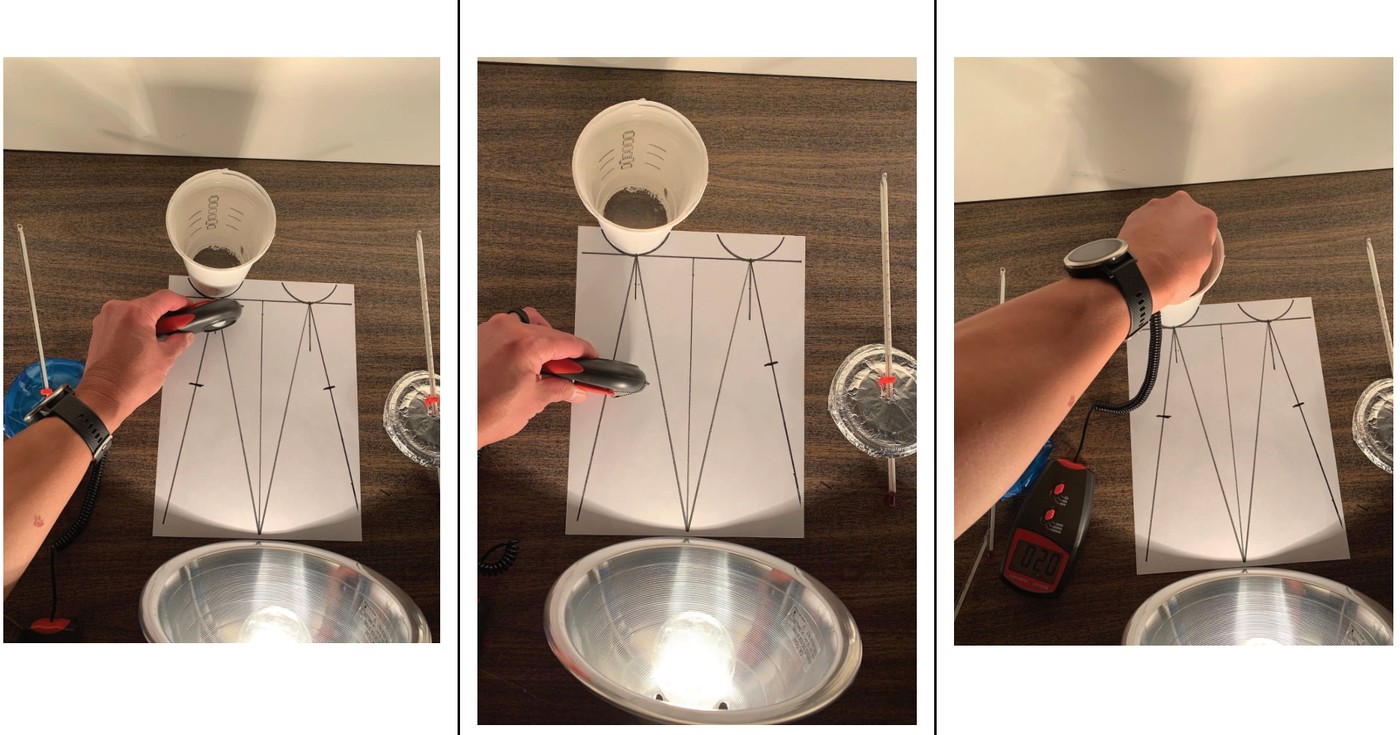
A covered insulated cup can reduce energy transfer through its walls and evaporation or air exchange at its top. Record both design changes before attributing the entire effect to one material. Use supplied data if safe temperature control is impractical.
Pause and explain
What would make an insulation comparison hard to interpret?
Check your reasoning after answering
Changing water amount, starting temperature, lid use, and insulation simultaneously makes it difficult to attribute a difference to one intended feature.
Apply the whole unit · Interpret a cooling comparison
Illustrative cups each start with 200 mL water at 40°C in the same room. After 15 minutes, bare cup A is 28°C; wrapped cup B is 34°C. The cups, lids, and locations are otherwise comparable.
Your task
Compare temperature decreases, describe possible transfer pathways, and explain what the evidence supports about the wrapping. Propose repeated trials and identify a quantity these temperatures alone cannot determine.
What your response should show
- Use the supplied observations and measurements accurately; include units where needed.
- Explain the science behind your answer, rather than giving only a number or label.
- Show a labeled model, calculation, or evidence comparison as requested.
- State an assumption or limitation and suggest a useful next measurement.
Response guidance — after your attempt
A cools by 12°C and B by 6°C. Under the supplied controls, the wrapping is associated with slower net cooling. Conduction through walls, convection around surfaces, and radiation may contribute. Repeat the comparison and check initial conditions. Temperatures alone do not establish exact transferred joules or prove that all transfer was conduction.
Scientific references and adapted teaching resources
- OpenSciEd 6.2 Thermal Energy — public unit overview
- OpenSciEd 8.3 Forces at a Distance — public unit overview
- OpenSciEd instructional model — storyline routines
- Creative Commons Attribution 4.0 — middle-school material license
Parent / teacher teaching notes
Use comfortably warm or supplied data. Ask for particle-level conduction, a convection circulation loop, and a radiation arrow. Check that insulation is described as slowing transfer rather than producing warmth. Adaptation credit: OpenSciEd middle-school teaching routines and public task structures by OpenSciEd, CC BY 4.0. This independent version adds original explanatory text, data and figures, terminology support and a home-study schedule. It does not reproduce the complete teacher editions or their classroom validation.
The key idea
Heat flows from warm to cool by conduction (contact), convection (fluid movement), or radiation (waves, no medium needed) — until both reach the same temperature.
Temperature Change
ΔT = T final − T initial
used to find how many degrees an object warmed or cooled as it moved toward thermal equilibrium.
Worked examples
Example 1
- Net passive energy transfer is from the warmer water to the colder ice.
- Ice below its melting temperature can warm first. During melting, energy can change its state while temperature remains nearly constant.
- The water cools. The final result depends on amounts, initial temperatures, and exchange with surroundings: all ice may melt, or some ice may remain with liquid at approximately the melting temperature.
Example 2 · Worked application
- Thermal transfer through the metal is conduction.
- Moving warmer air transports energy by convection.
- Energy crossing the room as electromagnetic radiation is radiation.
More than one process can occur in the same scene.
Example 3
- Compare the spoon's starting and ending temperature: 25°C to 65°C — it warmed up, so it gained thermal energy from the hotter soup.
- Temperature change = 65 − 25 = 40.
Example 4
- A vacuum largely removes matter needed for conduction and convection across the gap.
- Radiation can still cross the gap, so reflective surfaces and other design features help.
Example 5 · Find and fix the mistake
- Test the claim against the stated conditions: More than one process can occur in the same scene.
- Convection requires moving matter. Sunlight transfers energy by radiation through the near vacuum.
More than one process can occur in the same scene.
Example 6 · Interpret the visual model
- Identify the represented objects, axes, labeled quantities and stated conditions before choosing a rule.
- Heat names energy transferred because of a temperature difference. Thermal energy names an energy contribution within an account. When temperatures match, the simple model has no net heat transfer between these two objects, though microscopic exchanges can still occur.
- No. For this ideal equal-mass, same-substance case the result is the midpoint 50 °C, not 100 °C. Amount, substance, phase and outside transfers affect the prediction.
Keep the model’s stated limits explicit: The model compares equal masses of the same substance initially at 80 and 20 °C, with no phase changes or net exchange with other objects. Net energy transfer is from warmer to cooler, reaching 50 °C under the stated ideal assumptions. The red arrow shows energy transfer, not flow of a substance called heat or cold. Different masses or substances would require a different final-temperature account.
Avoid these mistakes
- Cold does not flow into a warmer object; net heat transfer is from warmer to cooler.
Check your understanding
Why can a vacuum flask reduce heat transfer even though it cannot stop all radiation?
Discuss the answer
The gap limits conduction and convection; radiation remains possible.
Why does a metal spoon's handle warm without the spoon itself flowing?
Discuss the answer
Conduction transfers energy through interactions within material or between touching materials. Convection involves bulk movement of a fluid, so it can occur in liquids and gases but not by movement of a solid as a fluid. Radiation transfers energy by electromagnetic waves and can cross empty space. An insulating layer reduces a transfer rate; it does not supply coldness or stop every transfer forever. A lid reduces moving air and evaporation, and reflective surfaces can reduce some radiant exchange. Different designs target different mechanisms.
Return to the phenomenon
Illustrative equal warm-water samples cool from 40 °C to 31 °C in an uncovered cup and to 36 °C in an otherwise matched insulated lidded cup over 10 min. Compare changes and propose follow-up tests separating insulation from a lid. Explain conduction, convection and evaporation in plain words. Revise your first explanation using a named idea from the lesson. Mark the changed part and the evidence that supports it.
Compare explanations after your attempt
The drops are 9 and 4 °C. The treatment changes both walls and lid, so separate wall-only and lid-only comparisons can distinguish effects. Contact interactions transfer energy through walls; moving fluid transfers energy between regions; escaping water removes matter and energy. A lid and insulation reduce some rates but do not guarantee zero exchange.
What should we investigate next?
Which condition could be changed to test a remaining uncertainty in this explanation? State the predicted observation and what result would challenge your model.
Investigate, explain and revise
Use these tasks after the three teaching sessions as needed. Discuss an attempted explanation before opening response guidance; a matching sentence is less important than a supported mechanism.
Activity 1 · Explain the new evidence case
Use the visible scenario above, Parts 1–4 and your first notebook model. No outside reading or equipment is required.
Your task
Illustrative equal warm-water samples cool from 40 °C to 31 °C in an uncovered cup and to 36 °C in an otherwise matched insulated lidded cup over 10 min. Compare changes and propose follow-up tests separating insulation from a lid. Explain conduction, convection and evaporation in plain words. Write 100–150 words or give a labeled drawing with an equivalent oral explanation.
Success criteria
- Use two relevant stated records or conditions.
- Explain the mechanism rather than only repeat a definition.
- Label observation and inference.
- Name a changed model feature or a remaining uncertainty.
Hint
Read the stated boundary and conditions before selecting a relationship. The unit’s worked examples show intermediate steps.
Response guidance — discuss after your attempt
The drops are 9 and 4 °C. The treatment changes both walls and lid, so separate wall-only and lid-only comparisons can distinguish effects. Contact interactions transfer energy through walls; moving fluid transfers energy between regions; escaping water removes matter and energy. A lid and insulation reduce some rates but do not guarantee zero exchange.
Activity 2 · Read and extend the figure
Study the new labeled figure and its caption, then compare it with the associated teaching part.
Your task
Which pictured mechanism requires a moving bulk fluid? Explain what each important label represents. Add one missing feature that would be needed for a different question, and explain why the original figure leaves it out.
Success criteria
- Answer the figure question with its stated labels.
- Connect the visual representation to the scientific idea.
- Identify a specific limitation from the caption.
- Propose a useful change without misrepresenting supplied evidence.
Hint
These three boxes distinguish mechanisms rather than three substances called heat. Several can operate together around a cup, and evaporation adds a matter-and-energy transfer. The schematic does not rank rates without material, geometry, temperature and environmental data.
Response guidance — discuss after your attempt
Convection. Conduction involves local interactions without that required bulk motion, and radiation can cross empty space. These three boxes distinguish mechanisms rather than three substances called heat. Several can operate together around a cup, and evaporation adds a matter-and-energy transfer. The schematic does not rank rates without material, geometry, temperature and environmental data.
Words to know
- thermal energy
- Internal energy associated with random particle motion and particle interactions; temperature alone does not give its total amount.
- heat
- Thermal energy that flows from a warmer object to a cooler one.
- conduction
- Heat transfer through direct contact, particle to particle.
- convection
- Heat transfer through the movement of a fluid (liquid or gas).
- radiation
- Heat transfer as electromagnetic waves, needing no medium at all.
- thermal equilibrium
- The state reached when two objects in contact reach the same temperature and heat stops flowing between them.
- model
- A representation that explains selected features and makes predictions; it leaves other details out.
- evidence
- Relevant observations or records used to support or challenge a claim.
- system boundary
- The chosen limit separating the objects being studied from their surroundings.
- assumption
- A condition taken as true for a model or calculation and needing to be checked against the case.
Why metal feels colder than wood, even in the same room
A metal doorknob and a wooden door in the same room are both at room temperature — but touch them and the metal feels distinctly colder. That's not because it's a lower temperature; it's because metal is a much better conductor, so it pulls thermal energy out of your warm hand much faster than wood does. There's no such thing as 'cold' flowing into your hand — there's only heat flowing out of your hand faster or slower, depending on what it touches. This is a classic case where how something feels doesn't match what a thermometer would actually measure.
Count Rumford's cannon and the death of the 'caloric' theory
For most of the 1700s, scientists pictured heat as a weightless, invisible fluid called caloric that flowed between objects. In 1798, while supervising the boring of cannon barrels, physicist Count Rumford (Benjamin Thompson) noticed the drilling generated a seemingly endless supply of heat as long as the drill kept turning — far more than any fixed amount of 'caloric fluid' trapped in the metal could explain. His observations helped convince scientists that heat isn't a substance at all, but a form of energy created by motion and friction, paving the way for the true understanding of thermal energy used today.
Specific heat capacity: why the ocean keeps coastal cities mild
Different materials absorb wildly different amounts of thermal energy for the same rise in temperature — a property called specific heat capacity. Water's specific heat capacity (about 4.18 joules per gram per degree Celsius) is unusually high, meaning it takes a lot of thermal energy to change its temperature even a little. That's exactly why coastal cities tend to have milder weather than inland cities at the same latitude: the nearby ocean soaks up huge amounts of thermal energy on hot days and releases it slowly on cold ones, acting like a giant thermal buffer for the whole coastline.
Trapping heat on purpose: how insulation really works
Good insulation doesn't just 'keep heat out' — it specifically targets all three heat transfer methods at once. A down jacket traps pockets of air, which is a poor conductor, to slow conduction; that trapped air is also too still to circulate, blocking convection. A vacuum flask goes even further, using an actual vacuum layer (no particles at all) to eliminate both conduction and convection completely, since both require touching matter — and often adds a shiny reflective coating to bounce back radiant heat, the one transfer method that doesn't need a medium. Blocking all three at once is what makes a great thermos so much better than a simple cup with a lid.
In the real world
Thermos bottles use a vacuum layer to block conduction and convection, keeping drinks hot or cold for hours.
Exit check
Which pictured mechanism requires a moving bulk fluid? Explain the relevant mechanism and one model limitation.
Check your explanation after answering
Convection. Conduction involves local interactions without that required bulk motion, and radiation can cross empty space. These three boxes distinguish mechanisms rather than three substances called heat. Several can operate together around a cup, and evaporation adds a matter-and-energy transfer. The schematic does not rank rates without material, geometry, temperature and environmental data.
Explain your reasoning without notes. If a key idea is missing, revisit the lesson and try again.
Problem 1
Answer and explanation
40 °C
Temperature change = 65 − 25 = 40°C.
Problem 2
- conduction
- convection
- radiation
- friction
Answer and explanation
radiation
Radiation travels as electromagnetic waves and can cross empty space with no medium needed.
Problem 3
- conduction
- convection
- radiation
- sublimation
Answer and explanation
convection
Convection is heat transfer through the movement of a fluid, like circulating soup.
Problem 4
Answer and explanation
Metal conducts heat much faster than wood, so thermal energy transfers quickly from the soup through the metal spoon to your hand, while wood is a poor conductor and transfers heat much more slowly.
Problem 5
Answer and explanation
30 °C
The cooler object rose from 30°C to 60°C, a change of 60 − 30 = 30°C.
Problem 6
Answer and explanation
The gap limits conduction and convection; radiation remains possible.
A vacuum largely removes matter needed for conduction and convection across the gap.
Radiation can still cross the gap, so reflective surfaces and other design features help.
Response criteria
- Use the stated conditions.
- Show the evidence or calculation.
- Explain the conclusion and any stated limitation.
Problem 7
Hints
More than one process can occur in the same scene.
Answer and explanation
Air conducts poorly compared with many solids, and small trapped pockets limit bulk convection. Radiation may still contribute.
Problem 8
Hints
State what the supplied observations or conditions establish, and separate that from any assumption.
Answer and explanation
Conduction to the table, convection to surrounding air, and radiation are possible; select any two and identify the receiving surroundings.
Problem 9
Answer and explanation
No. For this ideal equal-mass, same-substance case the result is the midpoint 50 °C, not 100 °C. Amount, substance, phase and outside transfers affect the prediction.
Heat names energy transferred because of a temperature difference. Thermal energy names an energy contribution within an account. When temperatures match, the simple model has no net heat transfer between these two objects, though microscopic exchanges can still occur.
No. For this ideal equal-mass, same-substance case the result is the midpoint 50 °C, not 100 °C. Amount, substance, phase and outside transfers affect the prediction.
Response criteria
- Use the named labels, directions or supplied quantities accurately.
- Connect the visual evidence to the scientific mechanism or calculation.
- State the relevant model conditions or limitation.
Problem 10
Answer and explanation
Radiation can cross the vacuum. Convection needs moving material and conduction needs an interacting material pathway. A full net account includes both objects’ emission/absorption and their temperatures.
Use the presence or absence of matter to distinguish mechanisms.
Do not mistake a selected one-way arrow for every transfer in the full exchange.
Radiation can cross the vacuum. Convection needs moving material and conduction needs an interacting material pathway. A full net account includes both objects’ emission/absorption and their temperatures.
Response criteria
- Use the named labels, directions or supplied quantities accurately.
- Connect the visual evidence to the scientific mechanism or calculation.
- State the relevant model conditions or limitation.