Light & the Electromagnetic Spectrum — Print · Grade 8 Science
Chapter: Waves, Sound & LightLight & the Electromagnetic Spectrum
Learning goals
- I can order the electromagnetic spectrum by wavelength, frequency, and energy.
- I can describe how light interacts with materials through reflection, absorption, and transmission.
Readings for this unit
Before this unit
Place wavelength and frequency in inverse order for fixed speed.
Use three teaching sessions of about 40–45 minutes: first observe the phenomenon, draft a model and study Parts 1–2; next explain Parts 3–4 with the figures and evidence; then work the application, examples, practice, model revision and exit check. Divide any difficult part into smaller steps and revisit after feedback. Investigations, review and quizzes have separate sessions. Study the four visual parts across the scheduled sessions, then use the illustrated worked case and independent transfer questions. Extend or revisit a session when the learner cannot explain the figure; completion time is a proposed allocation, not a mastery guarantee.
Start with something to explain
What would explain the observations in light & the electromagnetic spectrum?
Illustrative evidence case. Illustrative light energy incident on a sheet is 100 units: 25 reflected, 60 transmitted and 15 absorbed. A ray drawing shows only a transmitted arrow.
Notice and wonder
Why is a transmitted arrow alone incomplete here? Write two observations from the supplied record without guessing their cause. Include a quantity and its unit when given. An observation is what was recorded; an inference is what you think explains it.
Write one question about why the pattern occurs and one question about a comparison that could distinguish competing explanations. A testable question identifies what could be observed or measured.
Your first model
Before reading the model answer, sketch the named objects or particles and label what you think changes. Complete the diagram and energy account, then explain why light crossing a vacuum differs from ordinary sound. Keep this first version so you can compare it with your later explanation.
Build the language from the idea
- electromagnetic (EM) wave
- A wave that can travel through empty space, carrying energy as vibrating electric and magnetic fields.
- electromagnetic spectrum
- The full range of EM waves, ordered from long, low-energy radio waves to short, high-energy gamma rays.
- reflection
- Light bouncing off a surface instead of passing through it.
- absorption
- Light energy being taken in by a material, often becoming thermal energy.
- transmission
- Light passing through a material, like light through clear glass.
- model
- A representation that explains selected features and makes predictions; it leaves other details out.
- evidence
- Relevant observations or records used to support or challenge a claim.
- system boundary
- The chosen limit separating the objects being studied from their surroundings.
- assumption
- A condition taken as true for a model or calculation and needing to be checked against the case.
Light is an electromagnetic (EM) wave — a ripple of vibrating electric and magnetic fields. Unlike sound, it needs no medium whatsoever, which is how sunlight crosses the empty vacuum of space to reach us. Light is also staggeringly fast, traveling at about 300,000,000 m/s (3 × 10⁸ m/s) — quick enough to circle the entire Earth roughly seven times in a single second. Nothing in the universe travels faster.
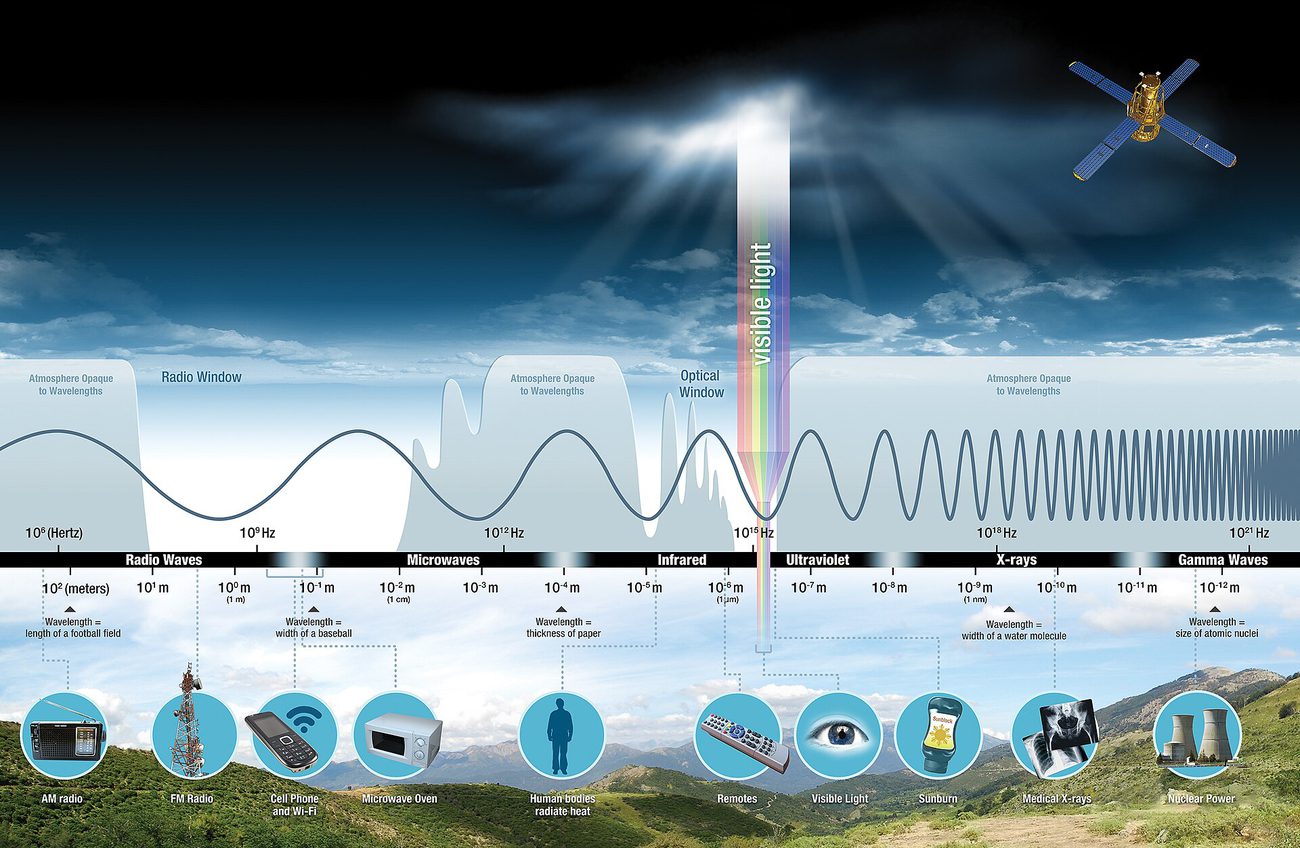
Visible light is only a tiny slice of a much larger family. The electromagnetic spectrum is the full range of EM waves, arranged by wavelength. Starting from the longest waves and working down, it runs: radio waves, microwaves, infrared, then the narrow band of visible light our eyes can detect, followed by ultraviolet, X-rays, and finally gamma rays with the shortest wavelengths. They're all fundamentally the same kind of wave — they differ only in wavelength.
In a vacuum, shorter wavelength corresponds to higher frequency and higher energy per photon, while wave speed remains the same. Total delivered energy also depends on intensity and duration. Ionizing radiation can damage matter, but lower photon energy does not make every possible exposure harmless; interaction, power, and duration matter. The spectrum is an organizing model, not a complete safety chart. Use ordinary safe illumination or supplied data, without direct Sun viewing or laser experiments.
When light strikes an object, three things can happen to it. It can be reflected — bounced back, the way a mirror throws your image back at you. It can be absorbed — soaked in and usually turned into thermal energy, which is why a black shirt gets hot in the sun. Or it can be transmitted — passed straight through, the way sunlight streams through clear glass. Most objects do a mix of all three, and an object's color is simply the wavelengths of light it reflects instead of absorbing: a red apple absorbs most colors but bounces red light back to your eyes.
Because each part of the spectrum carries a different amount of energy and interacts with matter differently, we've found a use for nearly all of it. Doctors use high-energy X-rays to photograph bones and gamma rays to destroy tumors; we cook with microwaves, feel warmth as infrared, communicate through radio waves, and see the world by visible light. Reading the electromagnetic spectrum is really a guide to how energy travels and how it touches everything around you.
Electromagnetic waves include radio, microwave, infrared, visible, ultraviolet, X-ray and gamma-ray regions. They travel at the same speed in a vacuum. Shorter wavelength corresponds to higher frequency and higher photon energy, not a faster vacuum speed.
Reflection sends light back into the original medium. Refraction changes direction when light enters a medium where its speed differs, except along the normal. Absorption transfers energy to matter. Several processes can happen at one surface, such as a window partly reflecting and transmitting.
An object looks colored because of the light it sends to the eye under the illumination provided. A red object may look dark under light with little red content. A diagram showing rays helps trace paths, but does not show all wave behavior; choose the model for the question.
Build your understanding
Where this fits
This unit helps answer the chapter question: How do waves and circuits transfer energy and information? Keep a notebook table with the question, evidence, explanation and one unresolved issue. Revise a previous model only when you can name the new evidence or idea that changes it.
Use three teaching sessions of about 40–45 minutes: first observe the phenomenon, draft a model and study Parts 1–2; next explain Parts 3–4 with the figures and evidence; then work the application, examples, practice, model revision and exit check. Divide any difficult part into smaller steps and revisit after feedback. Investigations, review and quizzes have separate sessions.
Part 1 · Recognize one electromagnetic family
Radio, microwave, infrared, visible, ultraviolet, X-ray, and gamma-ray regions belong to the electromagnetic spectrum. In a vacuum they travel at the same speed, about 3×10⁸ m/s. They differ in frequency and wavelength; electromagnetic waves do not require a material medium as sound does.
Read the visual model
Does a gamma ray move faster than a radio wave in a vacuum?
Visual reasoning — after your attempt
No. Both travel at the same vacuum light speed. Their frequencies, wavelengths, and photon energies differ.
A radio signal and visible light can both cross space. Their different frequencies do not give different vacuum speeds. In matter, propagation and interactions depend on the material, so the vacuum-speed rule needs its stated condition.
Pause and explain
Does a gamma ray move faster than a radio wave in a vacuum?
Check your reasoning after answering
No. Both travel at the same vacuum light speed. Their frequencies, wavelengths, and photon energies differ.
Part 2 · Keep photon energy separate from total exposure
Higher frequency corresponds to higher energy per photon. Total transferred energy also depends on how much radiation arrives and for how long. Lower photon energy does not automatically mean every exposure is harmless; intensity and how radiation interacts with tissue or material matter.
Read the visual model
A photon is a quantum of electromagnetic radiation. Per-photon energy, arrival amount and exposure duration are distinct. Do not replace a total-energy comparison with a frequency-only slogan when the photon counts or duration also change.
Which case has more energy per photon, and which has more total supplied energy for the matched comparison?
Visual reasoning — after your attempt
The higher-frequency case has more per photon (2 versus 1). The lower-frequency case has more total (8 versus 6), because it has more supplied photons.
A weak visible beam and a high-power visible beam can have similar photon frequency but very different total energy delivery. Do not use spectrum position alone as a complete safety rule. Avoid lasers and direct Sun viewing in home activities.
Pause and explain
Why is frequency alone insufficient to judge total delivered energy?
Check your reasoning after answering
Frequency sets energy per photon, while photon quantity, intensity, and exposure duration affect total delivery. Interaction with material also matters.
Part 3 · Trace reflection, absorption, and transmission
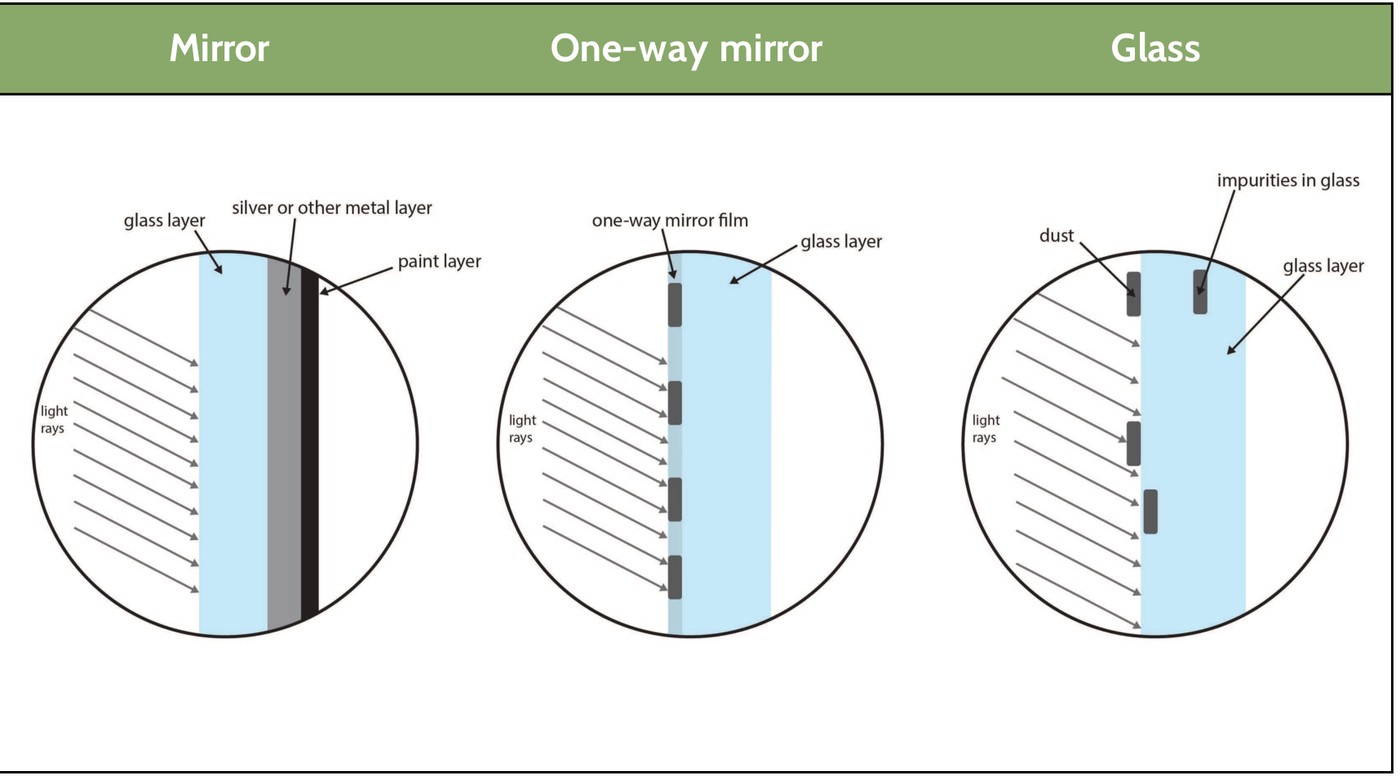
At a surface, light may be reflected, absorbed, or transmitted. Refraction describes a direction change as light passes between media with different propagation properties, except for suitable normal incidence. Several processes can occur at once, as a window can both reflect and transmit light.
Read the visual model
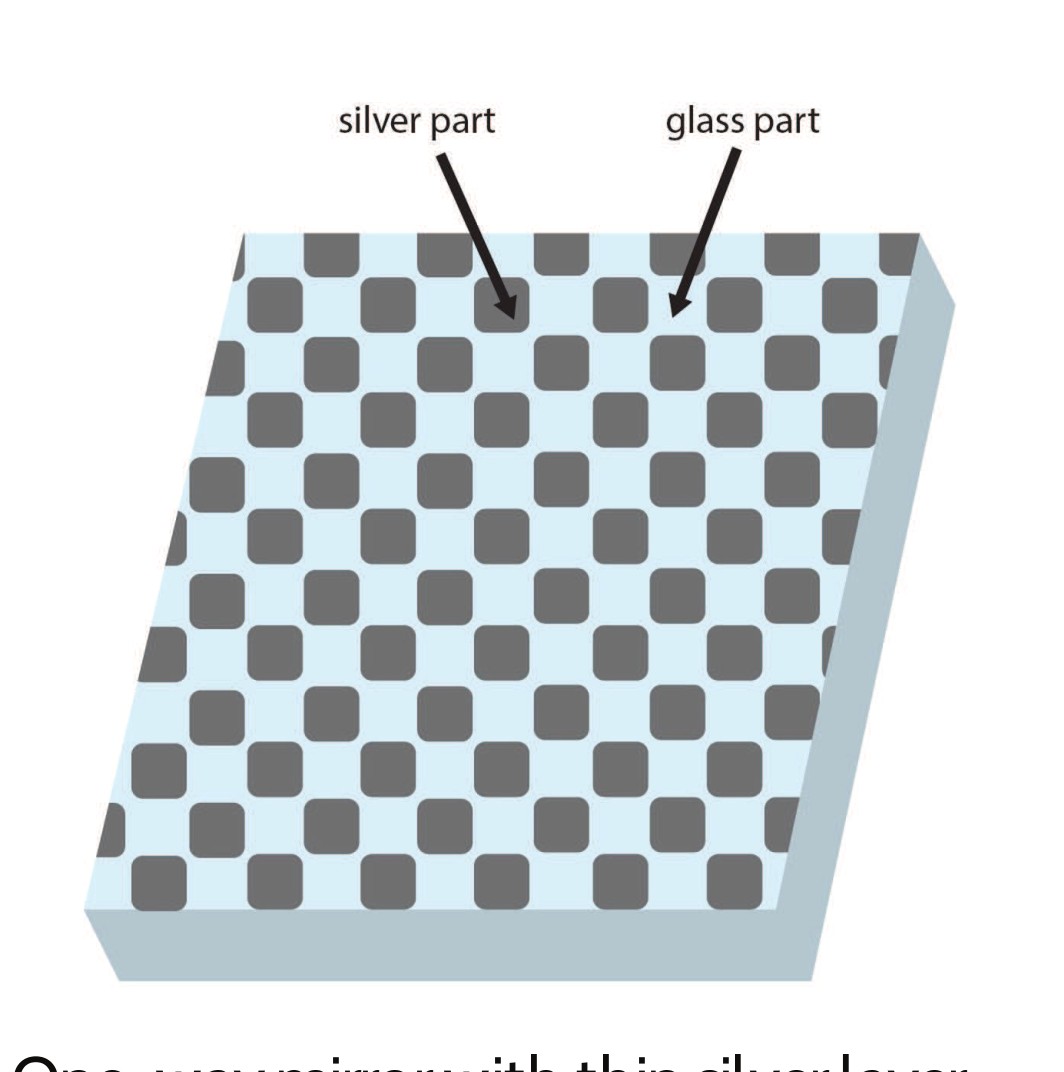
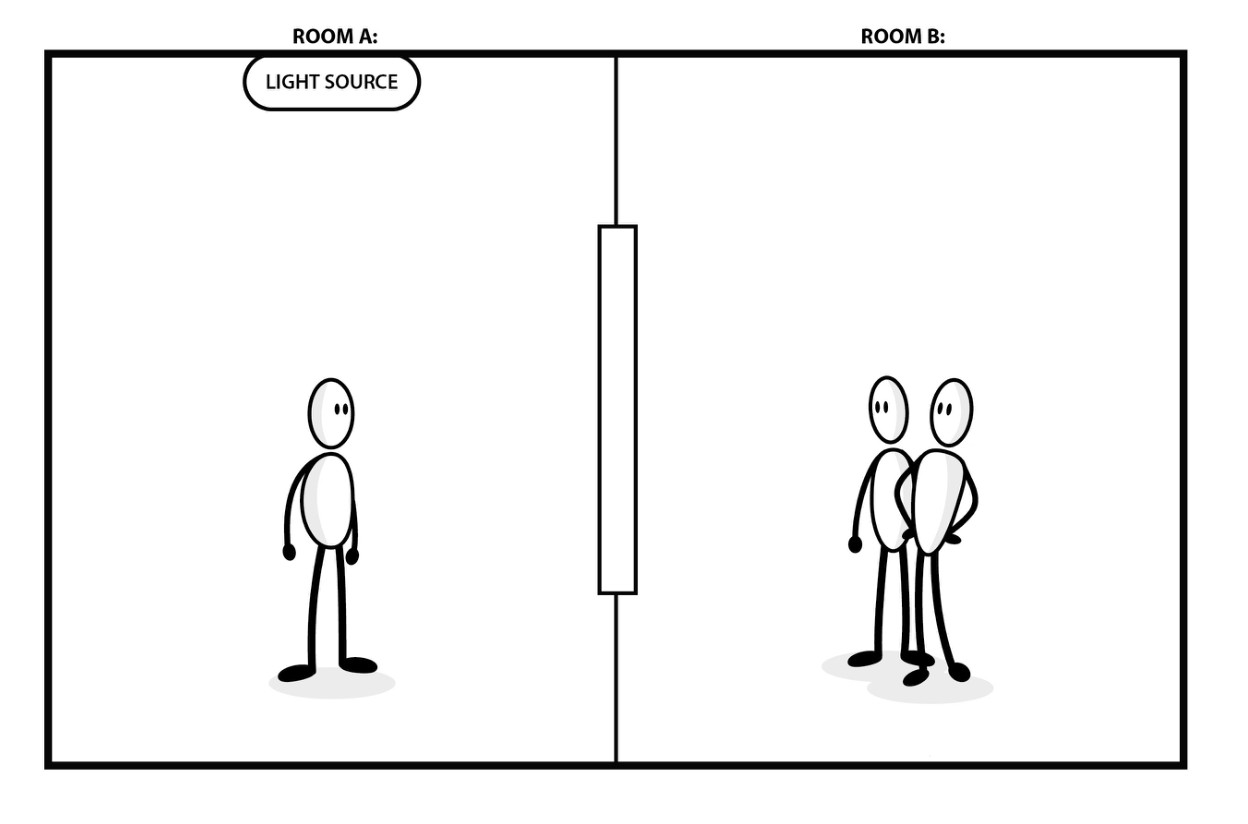
Keep pathways distinct from the material’s microscopic structure. OpenSciEd’s coating diagrams below help explain why changing a surface can change the proportions. An incoming-ray picture alone is not a completed outgoing-light or energy account.
If a second material reflects 15 and transmits 65 of the same 100 units, what is the absorbed amount in the full stated account?
Visual reasoning — after your attempt
20 units: 100−15−65. That result requires the account to include all relevant outgoing and retained changes, rather than silently ignoring another pathway.
Draw an incoming ray and label which portion returns, passes through, or transfers energy to the material. A dark surface may absorb much of a given visible illumination, but actual behavior depends on wavelength and material.
Pause and explain
Can a transparent window also reflect light?
Check your reasoning after answering
Yes. Some incident light can be transmitted while some is reflected or absorbed. Transparent does not mean perfect transmission at every wavelength.
Part 4 · Explain color using source and object together
An opaque object sends selected wavelengths of incident light toward the eye. Its apparent color depends on the illumination and its reflection properties. A red surface under a source with little red light can appear dark. A ray model helps trace paths but does not represent every wave phenomenon.
Read the visual model
Reflection carries some incoming light toward an observer. Absorption transfers energy to the material. The blue absorption arrow is a pathway label, not a claim that blue photons travel out of the object after being absorbed.
Does an object called red have to look red under every lamp? Use the model to explain a different result.
Visual reasoning — after your attempt
No. Its appearance depends on the wavelengths arriving as well as those reflected toward an observer. With blue-only illumination it may reflect little and appear dark.
Compare a supplied red-object record under white light and nearly blue-only light. The object has not necessarily changed composition; the available illuminating wavelengths changed. Keep source color and reflected light separate in the drawing.
Pause and explain
Why might a red object look dark under nearly blue-only light?
Check your reasoning after answering
There is little red light available to reflect, and the object absorbs much of the incident blue light. Appearance depends on both source spectrum and surface properties.
Apply the whole unit · Explain a window and a colored object
Illustrative record: a window receives 100 J of a stated radiation band, transmits 80 J, and reflects 15 J. A red surface looks red under white light but dark under nearly blue-only illumination.
Your task
Complete the window energy account under the stated no-storage-change assumption. Draw the light paths, explain the color change, and state why these observations do not establish behavior for every wavelength or radiation exposure.
What your response should show
- Use the supplied observations and measurements accurately; include units where needed.
- Explain the science behind your answer, rather than giving only a number or label.
- Show a labeled model, calculation, or evidence comparison as requested.
- State an assumption or limitation and suggest a useful next measurement.
Response guidance — after your attempt
The remaining 5 J is absorbed if those are the only transfers and storage changes are neglected. Label transmitted, reflected, and absorbed portions. The red surface receives little red illumination in the second case, so less red light reaches the eye. A band-specific record does not establish all-spectrum transparency or exposure safety; material response and intensity vary.
Scientific references and adapted teaching resources
- OpenSciEd 8.2 Sound Waves — public unit overview
- OpenSciEd 8.3 Forces at a Distance — public unit overview
- OpenSciEd instructional model — storyline routines
- Creative Commons Attribution 4.0 — middle-school material license
Parent / teacher teaching notes
This required waves unit is included in the final exam. Use supplied data and ordinary safe illumination. Check the distinction between wavelength, vacuum speed, photon energy, and total exposure; never use direct Sun viewing or laser experiments. Adaptation credit: OpenSciEd middle-school teaching routines and public task structures by OpenSciEd, CC BY 4.0. This independent version adds original explanatory text, data and figures, terminology support and a home-study schedule. It does not reproduce the complete teacher editions or their classroom validation.
The key idea
The EM spectrum ranges from long, low-energy radio waves to short, high-energy gamma rays; light hitting matter is reflected, absorbed, or transmitted.
Speed of Light Wave Equation
c = f × λ
c is the speed of light (about 3 × 10⁸ m/s); f is frequency in Hz; λ is wavelength in meters.
Worked examples
Example 1
- Recall the spectrum order: radio waves have the longest wavelengths, then microwaves, infrared, visible light, ultraviolet, X-rays, and gamma rays have the shortest.
- Pick out just the four listed waves in that order.
Example 2 · Worked application
- Both are electromagnetic waves and have the same vacuum speed c.
- Visible light has higher frequency than typical radio waves.
- At fixed speed, λ=c/f means higher frequency corresponds to shorter wavelength.
Compare speed in the same medium; do not confuse frequency with speed.
Example 3
- Use λ = v ÷ f.
- λ = 300,000,000 ÷ 1,000,000.
- = 300.
Example 4
- White light contains red wavelengths that the material can reflect toward the eye.
- Blue illumination provides little red light to reflect and much may be absorbed.
Example 5 · Find and fix the mistake
- Test the claim against the stated conditions: Compare speed in the same medium; do not confuse frequency with speed.
- All electromagnetic waves have the same vacuum speed. Frequency changes wavelength and photon energy, not vacuum speed.
Compare speed in the same medium; do not confuse frequency with speed.
Example 6 · Interpret the visual model
- Identify the represented objects, axes, labeled quantities and stated conditions before choosing a rule.
- A photon is a quantum of electromagnetic radiation. Per-photon energy, arrival amount and exposure duration are distinct. Do not replace a total-energy comparison with a frequency-only slogan when the photon counts or duration also change.
- The higher-frequency case has more per photon (2 versus 1). The lower-frequency case has more total (8 versus 6), because it has more supplied photons.
Keep the model’s stated limits explicit: The deliberately simplified lower-frequency case has eight photons at one relative energy unit each; the higher-frequency case has three at two units each. Totals are eight and six under the matched area/time comparison. The circles are a counting aid rather than literal photon shapes. Higher frequency means higher energy per photon, but total exposure also depends on how many arrive and the comparison conditions.
Avoid these mistakes
- All electromagnetic waves have the same vacuum speed even though their frequencies differ.
Check your understanding
A red shirt appears bright under white light but dark under blue light. Explain without changing the shirt's material.
Discuss the answer
The reflected light depends on both the material and the illumination.
Why does a higher-frequency electromagnetic wave not have a higher vacuum speed?
Discuss the answer
Electromagnetic waves include radio, microwave, infrared, visible, ultraviolet, X-ray and gamma-ray regions. They travel at the same speed in a vacuum. Shorter wavelength corresponds to higher frequency and higher photon energy, not a faster vacuum speed. Reflection sends light back into the original medium. Refraction changes direction when light enters a medium where its speed differs, except along the normal. Absorption transfers energy to matter. Several processes can happen at one surface, such as a window partly reflecting and transmitting.
Return to the phenomenon
Illustrative light energy incident on a sheet is 100 units: 25 reflected, 60 transmitted and 15 absorbed. A ray drawing shows only a transmitted arrow. Complete the diagram and energy account, then explain why light crossing a vacuum differs from ordinary sound. Revise your first explanation using a named idea from the lesson. Mark the changed part and the evidence that supports it.
Compare explanations after your attempt
The three pathways sum to 100 units; add reflected and absorbed arrows with their quantities. Absorbed energy can contribute to thermal changes. Light is an electromagnetic disturbance and can cross a vacuum, while ordinary sound requires material interactions. A ray model shows paths and energy partitions but not every wave or microscopic effect.
What should we investigate next?
Which condition could be changed to test a remaining uncertainty in this explanation? State the predicted observation and what result would challenge your model.
Investigate, explain and revise
Use these tasks after the three teaching sessions as needed. Discuss an attempted explanation before opening response guidance; a matching sentence is less important than a supported mechanism.
Activity 1 · Explain the new evidence case
Use the visible scenario above, Parts 1–4 and your first notebook model. No outside reading or equipment is required.
Your task
Illustrative light energy incident on a sheet is 100 units: 25 reflected, 60 transmitted and 15 absorbed. A ray drawing shows only a transmitted arrow. Complete the diagram and energy account, then explain why light crossing a vacuum differs from ordinary sound. Write 100–150 words or give a labeled drawing with an equivalent oral explanation.
Success criteria
- Use two relevant stated records or conditions.
- Explain the mechanism rather than only repeat a definition.
- Label observation and inference.
- Name a changed model feature or a remaining uncertainty.
Hint
Read the stated boundary and conditions before selecting a relationship. The unit’s worked examples show intermediate steps.
Response guidance — discuss after your attempt
The three pathways sum to 100 units; add reflected and absorbed arrows with their quantities. Absorbed energy can contribute to thermal changes. Light is an electromagnetic disturbance and can cross a vacuum, while ordinary sound requires material interactions. A ray model shows paths and energy partitions but not every wave or microscopic effect.
Activity 2 · Read and extend the figure
Study the new labeled figure and its caption, then compare it with the associated teaching part.
Your task
Why is a transmitted arrow alone incomplete here? Explain what each important label represents. Add one missing feature that would be needed for a different question, and explain why the original figure leaves it out.
Success criteria
- Answer the figure question with its stated labels.
- Connect the visual representation to the scientific idea.
- Identify a specific limitation from the caption.
- Propose a useful change without misrepresenting supplied evidence.
Hint
The supplied model partitions 100 light-energy units among reflection, transmission and absorption. Arrow widths and angles are schematic and do not establish a ray-angle calculation. Absorption can contribute to thermal changes, while a complete wave model would add properties not shown in this ray account.
Response guidance — discuss after your attempt
It omits the reflected 25 and absorbed 15 units, preventing a complete energy account. The supplied model partitions 100 light-energy units among reflection, transmission and absorption. Arrow widths and angles are schematic and do not establish a ray-angle calculation. Absorption can contribute to thermal changes, while a complete wave model would add properties not shown in this ray account.
Words to know
- electromagnetic (EM) wave
- A wave that can travel through empty space, carrying energy as vibrating electric and magnetic fields.
- electromagnetic spectrum
- The full range of EM waves, ordered from long, low-energy radio waves to short, high-energy gamma rays.
- reflection
- Light bouncing off a surface instead of passing through it.
- absorption
- Light energy being taken in by a material, often becoming thermal energy.
- transmission
- Light passing through a material, like light through clear glass.
- model
- A representation that explains selected features and makes predictions; it leaves other details out.
- evidence
- Relevant observations or records used to support or challenge a claim.
- system boundary
- The chosen limit separating the objects being studied from their surroundings.
- assumption
- A condition taken as true for a model or calculation and needing to be checked against the case.
Is light a wave or a particle? Yes.
The old Huygens-vs-Newton argument over whether light is a wave or a stream of particles didn't end with Young's 1801 wave experiment. In 1905, Albert Einstein explained a puzzling phenomenon called the photoelectric effect — where light striking a metal knocks electrons loose — by proposing that light also arrives in discrete packets of energy called photons, behaving like particles after all. This explanation, and not his more famous work on relativity, is what won Einstein his Nobel Prize. Modern physics accepts that light — and every wave in the electromagnetic spectrum — genuinely behaves as both a wave and a stream of particles, a strange but experimentally rock-solid idea called wave-particle duality.
Wilhelm Röntgen's accidental discovery that could see through skin
In 1895, German physicist Wilhelm Röntgen was experimenting with a device that made a nearby screen glow, even with opaque material blocking the direct path — evidence of a mysterious, invisible new kind of ray. He called it an X-ray, using 'X' for 'unknown,' and famously produced the first-ever X-ray image: a picture of his wife's hand, showing her bones and wedding ring in ghostly detail. The medical world was transformed almost overnight, and Röntgen won the very first Nobel Prize in Physics in 1901 for the discovery.
One family, wildly different energies
Radio waves, visible light, and gamma rays sound like completely different things, but they're literally the exact same phenomenon — oscillating electric and magnetic fields — differing only in wavelength and frequency. Higher frequency waves carry more energy packed into each photon, which is exactly why gamma rays and X-rays can damage living cells and DNA (they carry enough energy per photon to break chemical bonds), while radio waves constantly passing harmlessly through your body from every nearby radio station carry far too little energy per photon to do any damage at all.
Invisible light shapes our planet: greenhouse gases and the ozone layer
Two wavelengths you can't see have planet-sized effects. Infrared radiation from the Sun warms Earth's surface, and gases like carbon dioxide absorb and re-emit some of that infrared back downward instead of letting it escape to space — the greenhouse effect that keeps Earth's average temperature livable (and, in excess, drives climate change). Meanwhile, high-energy ultraviolet radiation from the Sun is mostly absorbed by the ozone layer high in the atmosphere before it can reach the ground and damage the DNA of living things. Both are everyday reminders that the electromagnetic spectrum extends far beyond what your eyes can detect.
In the real world
Doctors use high-energy X-rays to see inside the body, while remote controls use lower-energy infrared waves to send signals to your TV.
Exit check
Why is a transmitted arrow alone incomplete here? Explain the relevant mechanism and one model limitation.
Check your explanation after answering
It omits the reflected 25 and absorbed 15 units, preventing a complete energy account. The supplied model partitions 100 light-energy units among reflection, transmission and absorption. Arrow widths and angles are schematic and do not establish a ray-angle calculation. Absorption can contribute to thermal changes, while a complete wave model would add properties not shown in this ray account.
Explain your reasoning without notes. If a key idea is missing, revisit the lesson and try again.
Problem 1
Answer and explanation
300 m
λ = v ÷ f = 300,000,000 ÷ 1,000,000 = 300 m.
Problem 2
- gamma rays
- visible light
- radio waves
- X-rays
Answer and explanation
radio waves
Radio waves sit at the long-wavelength end of the electromagnetic spectrum.
Problem 3
- radio waves
- microwaves
- visible light
- gamma rays
Answer and explanation
gamma rays
Gamma rays have higher photon energy because their frequencies are higher. Total delivered energy also depends on how much radiation arrives and for how long.
Problem 4
- reflected
- absorbed
- transmitted
- turned into sound
Answer and explanation
transmitted
Clear glass mostly transmits light, letting it pass through.
Problem 5
Answer and explanation
The apple's surface absorbs most colors of light but reflects red wavelengths back to our eyes, so we perceive the apple as red.
Problem 6
- is absorbed at the surface
- is only reflected
- refracts (bends) when passing from water to air
- stops moving inside the water
Answer and explanation
refracts (bends) when passing from water to air
Light bends (refracts) as it passes between materials like water and air, making the pencil appear bent.
Problem 7
Answer and explanation
The reflected light depends on both the material and the illumination.
White light contains red wavelengths that the material can reflect toward the eye.
Blue illumination provides little red light to reflect and much may be absorbed.
Response criteria
- Use the stated conditions.
- Show the evidence or calculation.
- Explain the conclusion and any stated limitation.
Problem 8
Hints
Compare speed in the same medium; do not confuse frequency with speed.
Answer and explanation
Frequency and wavelength differ; frequency remains unchanged when light passes between stationary media, while speed and wavelength can change.
Problem 9
Hints
State what the supplied observations or conditions establish, and separate that from any assumption.
Answer and explanation
Light is electromagnetic and needs no material medium; sound is a mechanical disturbance requiring matter.
Problem 10
Answer and explanation
The higher-frequency case has more per photon (2 versus 1). The lower-frequency case has more total (8 versus 6), because it has more supplied photons.
A photon is a quantum of electromagnetic radiation. Per-photon energy, arrival amount and exposure duration are distinct. Do not replace a total-energy comparison with a frequency-only slogan when the photon counts or duration also change.
The higher-frequency case has more per photon (2 versus 1). The lower-frequency case has more total (8 versus 6), because it has more supplied photons.
Response criteria
- Use the named labels, directions or supplied quantities accurately.
- Connect the visual evidence to the scientific mechanism or calculation.
- State the relevant model conditions or limitation.
Problem 11
Answer and explanation
Absorbed amount is 120−30−70 = 20 units. Appearance depends on the incident wavelengths and the surface’s reflection toward the observer; a different lamp can change it.
Keep reflected, transmitted and absorbed pathways distinct.
Name both source and surface in a color explanation.
Absorbed amount is 120−30−70 = 20 units. Appearance depends on the incident wavelengths and the surface’s reflection toward the observer; a different lamp can change it.
Response criteria
- Use the named labels, directions or supplied quantities accurately.
- Connect the visual evidence to the scientific mechanism or calculation.
- State the relevant model conditions or limitation.