Geologic Time & the Rock Record — Print · Grade 9 Science
Chapter: Earth’s HistoryGeologic Time & the Rock Record
Learning goals
- I can describe how the geologic time scale organizes Earth's 4.6-billion-year history into eons, eras, and periods.
- I can use the law of superposition to determine the relative order in which rock layers formed.
Readings for this unit
Before this unit
Read a sequence and distinguish relative from numerical ages.
Plan three teaching sessions: core explanation and Parts 1–2; Parts 3–4 with diagrams and reasoning checks; then the whole-unit application, worked examples, independent practice, and exit check. Read one part at a time, explain it without notes, and revisit any gap. Allow about 40–50 minutes per session; adjust after checking understanding. Trace and explain the labeled figures in each part. In the third session, complete the illustrated case and changed independent application; retain a corrected explanation rather than only an answer.
Start with something to explain
Why does a thick rock record still leave gaps in Earth’s history?
Illustrative evidence case. Tilted older layers are cut by an erosional surface, with horizontal younger sediment above it. Other deposits are bracketed between dated volcanic layers.
Notice and wonder
Record two observations using the stated quantities or relationships. Keep observations separate from possible causes. Write one question that a new measurement could help answer.
Why does a thick rock record still leave gaps in Earth’s history?
Your first model
Sketch event order and mark intervals where the record cannot supply a continuous clock.
Build the language from the idea
- geologic time scale
- The timeline scientists use to divide Earth's 4.6-billion-year history into nested divisions, from largest (eons) down to eras and periods.
- eon
- The largest unit of geologic time; Earth's history is divided into a few eons, with the Phanerozoic being the most recent.
- era
- A division of geologic time within an eon — the Phanerozoic eon, for example, is split into the Paleozoic, Mesozoic, and Cenozoic eras.
- superposition
- The law stating that in an undisturbed sequence of rock layers, the oldest layer is on the bottom and the youngest layer is on top.
- Ma
- Million years before present in a stated geological age; larger values are older.
The geologic time scale organizes Earth’s approximately 4.6-billion-year history into nested divisions: eons, eras, periods, epochs, and ages. Boundaries are defined using evidence and conventions, including changes in the rock and fossil record. Use the assigned reference chart when precise boundary ages are needed.
Precambrian time encompasses most of Earth’s history before the Phanerozoic, which began roughly 539 million years ago. Ancient rocks preserve evidence of early crust, oceans, atmospheric change, and life. The record is incomplete because rocks have been altered, eroded, or recycled; incomplete evidence does not make this history unimportant.
That recent, life-filled slice is the Phanerozoic eon, and it splits into three eras, each bookended by dramatic turning points in the history of life. The Paleozoic is when complex life first exploded across the oceans and later crawled onto land. The Mesozoic, nicknamed the age of reptiles, was ruled by the dinosaurs — until it ended abruptly about 66 million years ago in a mass extinction widely linked to a giant asteroid impact. And the Cenozoic, the age of mammals, is the era we are living in right now. Those era boundaries aren't random dates; they mark moments when so many species died out that the cast of life on Earth was almost completely rewritten.
Numbers like '4.6 billion' are impossible to truly feel, so here's a trick geologists love: squeeze all of Earth's history into a single calendar year, starting at midnight on January 1. On that scale, the dinosaurs don't disappear until around December 26, and every scrap of recorded human history — pyramids, empires, the internet, all of it — fits into the last few seconds before midnight on December 31. Almost everything that ever happened on Earth happened before humans showed up for the final heartbeat of the year.
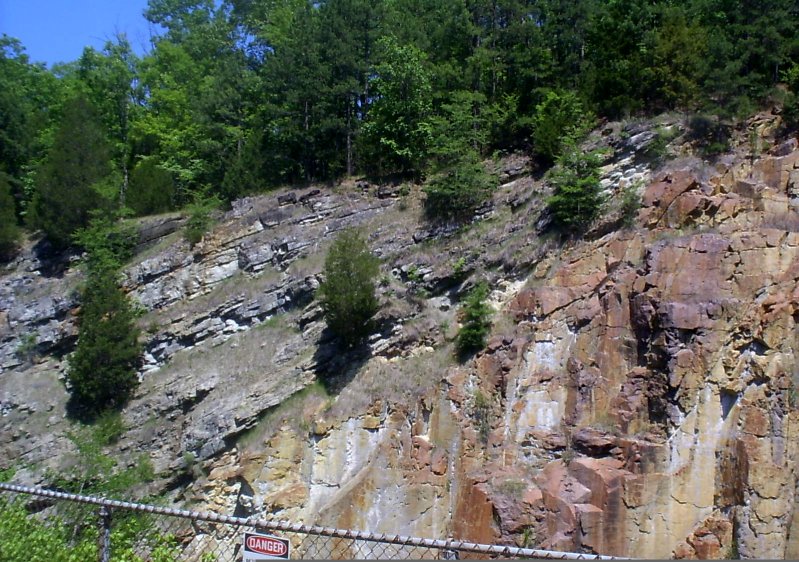
Understanding how long ago things happened is one thing; working out the order they happened in is another, and that's where the law of superposition comes in. In an undisturbed stack of rock layers, gravity guarantees that the oldest layers lie at the bottom and each layer above is younger than the one beneath it — sediment can only settle on top of what is already there. So a cliff face or a road cut becomes readable like the pages of a book stacked bottom to top: dig down, and you travel backward in time. It's the foundation geologists stand on to turn bare rock into Earth's story.
In an undeformed sequence, lower sedimentary layers generally formed before higher ones. An intrusion or fault is younger than the rock it cuts. These relationships establish order; they do not by themselves give an age in years.
An unconformity represents missing time from erosion or nondeposition. The missing interval can be much longer than the time represented by nearby beds. A thin layer is not automatically a short period because sediment accumulation rates vary.
Geologic time scales combine rock relationships, fossils and numerical dating. A diagram should indicate overturned layers or later deformation if present. Reconstruct a sequence step by step, testing whether every stated event respects the cross-cutting and superposition evidence.
Build your understanding
Plan three teaching sessions: core explanation and Parts 1–2; Parts 3–4 with diagrams and reasoning checks; then the whole-unit application, worked examples, independent practice, and exit check. Read one part at a time, explain it without notes, and revisit any gap. Allow about 40–50 minutes per session; adjust after checking understanding.
Part 1 · Organize deep time with a scale
A billion is one thousand million, so about 4.6 billion years is about 4,600 million years. In this timeline, larger numbers before present mean older times; moving toward zero approaches the present. Eons are broad divisions, subdivided into eras, periods and other intervals. Their ranks describe the hierarchy, not equal lengths. The last roughly 540 million years occupy only a small part of the full Earth-history scale. A magnified recent-time chart is useful for details but must state its changed scale. Precise boundary ages should be read from a dated reference table.
Read the visual model
Compare widths on the shared linear time scale rather than the number of named divisions. The boundaries are intentionally rounded for this overview.
Approximately what fraction of 4,600 million years is the last 540 million years?
Visual reasoning — after your attempt
540/4,600 is about 0.117, or 12%. Equal-sized boxes for the eons would distort their relative durations.
Geological time spans intervals much larger than human experience. The nested divisions organize a record and use defined boundaries; equal-sized labels do not imply equal durations. Distinguish time before present from the duration between two events. Use a dated reference chart for precise boundary ages.
On a one-meter model of approximately 4.6 billion years, one centimeter represents about 46 million years. A narrow recent interval can contain many human events while occupying very little of the model.
Pause and explain
Why should geological eras not be drawn as equally long merely because they share a rank?
Check your reasoning after answering
Their durations differ; the hierarchy does not specify equal time intervals.
Part 2 · Connect boundaries with evidence
A geological time boundary is a defined convention tied to particular evidence and reference sections. Changes in fossil assemblages or chemical and physical records help recognize and correlate intervals. A fossil assemblage is a group of preserved taxa found together in a deposit. Sediment accumulation can be rapid, slow or interrupted, and compaction can change thickness. Therefore a 1 m layer can represent a very different duration from another 1 m layer. Use independent evidence before turning a measured rock thickness into elapsed time.
Read the visual model
Compare which fossil groups are recorded above and below the marked contact. The panel heights were chosen for visibility and do not encode durations.
Does a layer twice as thick necessarily represent twice as much geological time?
Visual reasoning — after your attempt
No. Different accumulation, compaction, erosion and nondeposition histories can produce different thickness-time relationships. A time inference needs more evidence.
Changes in fossils, rocks, chemistry or other records can help define and correlate time intervals. A time boundary is a scientific convention tied to evidence, not a physical line simultaneously visible everywhere. Sedimentary layers may differ in thickness because accumulation and erosion rates differ.
Ten meters of one formation may represent less time than one meter of another. A gap can represent an even longer interval without a preserved layer. Distinguish thickness from duration before making a timeline.
Pause and explain
Why does a thicker layer not automatically mean a longer time interval?
Check your reasoning after answering
Deposition rates vary and erosion or nondeposition can omit time.
Part 3 · Recognize gaps and altered records
An unconformity is a discontinuity involving nondeposition or erosion. In the schematic, older strata were tilted and their upper portions removed before younger horizontal sediment accumulated. The missing record can include events and long intervals, but the geometry alone does not tell us their exact durations. Later metamorphism or intrusion can further modify what survives. Absence of a layer therefore does not establish that nothing happened during that time; it may establish that a continuous record is not preserved at this site.
Read the visual model
Follow the order required by tilted layers cut at the wavy surface and younger material deposited above it.
What sequence is established before any numerical dates are supplied?
Visual reasoning — after your attempt
Older deposition preceded tilting; erosion/nondeposition preceded the younger overlying deposit. The interval length and exact dates remain unconstrained without further evidence.
An unconformity records a discontinuity involving erosion or nondeposition. Its interpretation depends on geometry and surrounding rocks. Later deformation, metamorphism and intrusion can complicate an older record. The absence of a fossil or layer may reflect preservation or sampling, not absence of the original event.
An eroded surface beneath younger sediment establishes a break in the preserved record. To estimate its duration, correlate surrounding units or use suitable age evidence; appearance alone does not yield an exact number.
Pause and explain
What does an unconformity establish before dates are supplied?
Check your reasoning after answering
A gap or discontinuity in the preserved sequence; its exact duration remains undetermined.
Part 4 · Integrate relative sequence and numerical ages
A numerical age estimates when a dated event occurred. A deposit between independently dated volcanic layers must fit the stratigraphic order when the sequence is undeformed and the ages date the relevant eruptions. A lower ash at 100 million years and upper ash at 90 million years bracket the intervening deposit between those ages; they do not prove it is exactly 95 million years old. A dated old grain carried into the deposit would instead constrain the grain’s older formation event, not directly the deposition event. Always name the material and clock-start event.
Read the visual model
Read older age below and younger above in this undisturbed example. The midpoint is not automatically the sediment’s measured age.
Would averaging 100 and 90 Ma establish an exact 95 Ma depositional age?
Visual reasoning — after your attempt
No. The supplied relations give a bracket of 90–100 Ma. An exact estimate requires additional dating or a justified accumulation model.
Relative dating orders events. Numerical dating estimates ages using appropriate materials and methods. Combining them constrains a history: a volcanic bed can bracket adjacent sediment, while a fault that cuts it must be later. Attach every numerical age to the material and event actually measured.
If a sediment lies between ash beds dated 100 and 90 million years, its deposition is bracketed under the stated relationships. It is not automatically exactly 95 million years old.
Pause and explain
Why is an age bracket different from a single exact age?
Check your reasoning after answering
The bounding events constrain a range but do not locate the intervening event precisely.
Apply the whole unit · A scaled timeline and missing interval
Illustrative sequence: lower ash is 120 million years old, an eroded surface lies above it, and upper sediment contains an ash dated 100 million years.
Your task
Place the dated events on a scaled line, explain what relative relationships establish, and state why the erosion gap cannot be assigned the entire 20-million-year interval without more evidence.
What your response should show
- Use the supplied evidence accurately and label units or locations.
- Explain a physical mechanism or evidence-to-claim relationship.
- Show calculations or a clearly labeled model when the task calls for one.
- Identify a meaningful assumption, uncertainty, or competing explanation.
Response guidance — after your attempt
The two dates are 20 million years apart, but that interval can include deposition, exposure, erosion and nondeposition. The unconformity establishes a gap; additional correlation and dating constrain its share of the interval.
Scientific references and adapted source material
Parent / teacher teaching notes
Use a long paper timeline and ask for scale calculations. Mark event ordering and age limits separately; do not turn uncertain ancient reconstructions into exact unsupported dates. Ask the learner to explain each visual label and causal step before calculating. Preserve a first model, attempt the changed independent case, then use feedback to revise. Diagrams state whether values are illustrative or observed. Selected OpenSciEd excerpts are middle-school source material used for supported foundations; the independent high-school explanations and supplements are not the complete OpenSciEd teacher editions or an endorsement.
The key idea
Geologic time has nested divisions, including eons, eras, periods, epochs, and ages. Superposition gives relative order in an undisturbed sequence; numerical ages require additional evidence.
Geologic Time Scale Model ("Earth as one year")
days into model year = (event's age ÷ 4.6 billion years) × 365
compresses Earth's 4.6-billion-year history into a single 365-day calendar year, making enormous time spans easier to picture; count forward from Jan 1 (Earth's formation) or backward from Dec 31 (today).
Worked examples
Example 1
- Set up a ratio comparing the event's age to Earth's total age: 66,000,000 ÷ 4,600,000,000.
- Divide: 66,000,000 ÷ 4,600,000,000 ≈ 0.0143 — that's the fraction of the model year that has passed since the event.
- Multiply that fraction by the 365 days in the model year: 0.0143 × 365 ≈ 5.2 days.
- The event happened about 5.2 days before the end of the year (December 31), so count backward: December 31 − 5 days ≈ December 26.
Example 2 · Worked application
- Superposition puts older deposited layers below younger ones in an undisturbed sequence.
- Check the qualifier: overturning or faulting could alter simple interpretation.
Relative order does not provide numerical ages.
Example 3
- Superposition gives A before B before C.
- The fault is younger than every bed it cuts.
Example 4 · Find and fix the mistake
- Test the claim against the stated conditions: Relative order does not provide numerical ages.
- Depth supports relative order only with geological context; radiometric or other calibrated evidence is needed for numbers.
Relative order does not provide numerical ages.
Example 5 · Reason from the visual evidence
- Follow the order required by tilted layers cut at the wavy surface and younger material deposited above it.
- Older deposition preceded tilting; erosion/nondeposition preceded the younger overlying deposit. The interval length and exact dates remain unconstrained without further evidence.
Original hypothetical angular-unconformity section. The wavy red surface denotes the record gap/erosional contact; older bedding is truncated there. Shapes are schematic and layer thickness does not set duration. The example establishes relative relationships before dates are attached.
Avoid these mistakes
- Relative dating gives an order, not automatically a numerical age.
Check your understanding
Horizontal beds A, B and C lie bottom to top; a fault cuts all three. Order their formation and faulting.
Discuss the answer
A, then B, then C, then faulting, assuming the beds were not overturned.
What does an unconformity tell you that a continuous stack of beds does not?
Discuss the answer
An unconformity establishes a discontinuity involving erosion or nondeposition, potentially missing events/time. Geometry orders surrounding events but numerical dates are needed for the gap duration.
Return to the phenomenon
Return to the initial case. Why does a thick rock record still leave gaps in Earth’s history? Revise your drawing or explanation using two named ideas and one stated limitation.
Compare explanations after your attempt
Geometry orders deposition, deformation and erosion, while numerical ages tied to appropriate events constrain brackets. Missing material or fossil occurrences may reflect preservation and sampling rather than no event.
What should we investigate next?
Which comparison would test a remaining uncertainty? State what you would change, keep comparable and measure.
Investigate, explain and revise
Complete the tasks after studying the visual parts. Keep the first model and explain a revision before consulting the guidance.
Activity 1 · Explain the opening case
Use this unit’s opening record, Parts 1–4 and your notebook model. No external equipment or text is required for this supplied-data route.
Your task
Return to the initial case. Why does a thick rock record still leave gaps in Earth’s history? Revise your drawing or explanation using two named ideas and one stated limitation.
Success criteria
- Use two stated observations or conditions.
- Connect the mechanism to a labeled diagram or calculation.
- Identify what your original model missed.
- State a useful further test and a limitation.
Hint
Name the quantities and interactions before assigning a cause.
Response guidance — discuss after your attempt
Geometry orders deposition, deformation and erosion, while numerical ages tied to appropriate events constrain brackets. Missing material or fossil occurrences may reflect preservation and sampling rather than no event.
Activity 2 · Transfer to a changed case
Use the figures, captions and vocabulary in this unit; cover the worked answer.
Your task
A sediment layer lies above ash dated 72 million years and below ash dated 68 million years in an undisturbed sequence. State its age bracket and explain why equal layer thickness does not select one exact age.
Success criteria
- Use the stated measurements or conditions, with correct units.
- Connect the result to the physical mechanism or evidence relationship.
- Identify the assumption, model limit or further evidence requested.
Hint
Separate measured values, calculated results and model assumptions.
Response guidance — discuss after your attempt
Its deposition is younger than 72 and older than 68 million years, subject to valid ash-event dates and order. Thickness does not imply constant accumulation; gaps and variable deposition can prevent an exact midpoint age.
Words to know
- geologic time scale
- The timeline scientists use to divide Earth's 4.6-billion-year history into nested divisions, from largest (eons) down to eras and periods.
- eon
- The largest unit of geologic time; Earth's history is divided into a few eons, with the Phanerozoic being the most recent.
- era
- A division of geologic time within an eon — the Phanerozoic eon, for example, is split into the Paleozoic, Mesozoic, and Cenozoic eras.
- superposition
- The law stating that in an undisturbed sequence of rock layers, the oldest layer is on the bottom and the youngest layer is on top.
- Ma
- Million years before present in a stated geological age; larger values are older.
The clock inside every rock: how radiometric dating actually works
While relative dating (covered elsewhere in this unit) only reveals order, radiometric dating gives an actual age in years by measuring radioactive decay. Unstable ('parent') isotopes decay into stable ('daughter') isotopes at a fixed, predictable rate called a half-life — the time it takes for exactly half of the parent isotope in a sample to decay. After one half-life, 50% of the original parent remains; after two half-lives, only 25% remains; after three, just 12.5%, and so on. Carbon-14 (half-life ~5,730 years) works for dating things up to about 50,000 years old, but for Earth's oldest rocks, scientists use isotopes like uranium-238 decaying into lead-206, which has a half-life of about 4.5 billion years — perfectly matched to measuring truly ancient rock.
How scientists learned Earth's true age — a 300-year argument
Figuring out Earth's real age took centuries of scientific back-and-forth. In the 1650s, Archbishop James Ussher calculated an age of about 6,000 years by adding up generations listed in biblical genealogies. In the 1800s, physicist Lord Kelvin used Earth's cooling rate to estimate an age of 20 to 400 million years — a huge improvement, but still far too young, because he had no way of knowing that radioactive decay inside Earth constantly generates fresh heat. Only in the early 1900s, after the discovery of radioactivity, could geologist Arthur Holmes apply radiometric dating and finally arrive at figures in the billions of years — the method still used today.
Golden spikes: how geologists officially mark time
Where exactly does the Jurassic period officially end and the Cretaceous begin? Geologists don't just estimate — for many boundaries, an international commission designates an exact physical layer in one specific rock outcrop somewhere on Earth as the official reference point, informally nicknamed a 'golden spike' (formally, a Global Boundary Stratotype Section and Point). Once a golden spike is placed, that precise rock layer becomes the internationally agreed-upon definition other geologists worldwide compare their own rock layers against — turning an abstract time boundary into a specific, physical, visitable location.
New York's rocks span an enormous slice of the Paleozoic
You don't have to travel to the Grand Canyon to see a huge chunk of geologic time — New York State's bedrock alone exposes an extraordinary run of the Paleozoic era, from roughly 500-million-year-old rock in the Adirondacks and Hudson Highlands region down through richly fossiliferous 380-million-year-old Devonian-age rock across central New York. Traveling across the state, a geologist can essentially walk through tens of millions of years of Earth's history exposed at the surface, using exactly the superposition principle described in this lesson to place each rock layer in its proper order.
In the real world
Geologists studying rock layers exposed in road cuts or river bluffs along the Hudson Valley use superposition every day to figure out the order in which those rocks formed.
Exit check
What can superposition tell you, and what does it not give by itself?
Check your explanation after answering
In an undisturbed sedimentary sequence it gives relative order, oldest below youngest. It does not give numerical ages and needs caution if layers are overturned or disturbed.
Explain your reasoning without notes. If a key idea is missing, revisit the lesson and try again.
Problem 1
- Eon, era, period
- Period, era, eon
- Era, eon, period
- Period, eon, era
Answer and explanation
Eon, era, period
Eons are the biggest divisions, then eras, then periods — like books, chapters, and pages.
Problem 2
- The layer on the very bottom
- The layer on the very top
- The middle layer
- It's impossible to tell
Answer and explanation
The layer on the very bottom
Superposition says undisturbed layers get younger as you go up, so the bottom layer formed first and is the oldest.
Problem 3
- Mesozoic — age of reptiles
- Cenozoic — age of reptiles
- Paleozoic — age of mammals
- Precambrian — age of dinosaurs
Answer and explanation
Mesozoic — age of reptiles
The Mesozoic era is nicknamed 'the age of reptiles' because dinosaurs and other reptiles dominated it.
Problem 4
Answer and explanation
88 %
Precambrian time covers roughly the first 4 billion years of Earth's 4.6-billion-year history, which is about 88%.
Problem 5
Answer and explanation
4 days
46,000,000 ÷ 4,600,000,000 = 0.01. Multiply by 365 days: 0.01 × 365 = 3.65, which rounds to about 4 days before the end of the year.
Problem 6
Answer and explanation
Many ancient rocks were altered, eroded, or recycled, and much early life left subtle traces. Preserved evidence records the formation of crust and oceans, changes in the atmosphere, and early life.
Problem 7
Answer and explanation
A, then B, then C, then faulting, assuming the beds were not overturned.
Superposition gives A before B before C.
The fault is younger than every bed it cuts.
Response criteria
- Use the stated conditions.
- Show the evidence or calculation.
- Explain the conclusion and any stated limitation.
Problem 8
Hints
Relative order does not provide numerical ages.
Answer and explanation
The intrusion is younger than the layers it cuts, by cross-cutting relationships.
Problem 9
Hints
State what the supplied observations or conditions establish, and separate that from any assumption.
Answer and explanation
A gap from nondeposition and/or erosion; the preserved sequence does not contain every interval.
Problem 10
Answer and explanation
Older deposition preceded tilting; erosion/nondeposition preceded the younger overlying deposit. The interval length and exact dates remain unconstrained without further evidence.
Follow the order required by tilted layers cut at the wavy surface and younger material deposited above it.
Older deposition preceded tilting; erosion/nondeposition preceded the younger overlying deposit. The interval length and exact dates remain unconstrained without further evidence.
Response criteria
- Read the labeled quantities, reference frame or objects correctly.
- Explain the relation between the visual evidence and the mechanism.
- Keep the drawing’s stated assumptions and limits in the conclusion.
Problem 11
Answer and explanation
Its deposition is younger than 72 and older than 68 million years, subject to valid ash-event dates and order. Thickness does not imply constant accumulation; gaps and variable deposition can prevent an exact midpoint age.
Its deposition is younger than 72 and older than 68 million years, subject to valid ash-event dates and order. Thickness does not imply constant accumulation; gaps and variable deposition can prevent an exact midpoint age.
Response criteria
- Use the stated measurements or conditions, with correct units.
- Connect the result to the physical mechanism or evidence relationship.
- Identify the assumption, model limit or further evidence requested.