Vibration — Science definition
Repeated motion around a rest position.
Where it is taught
- Sound Sources, Vibrations & Receivers — Waves, Sound & Light, Physical Science: Matter, Forces & Energy, Grade 8
In use
Students who cannot hear a sound can study its visible motion and supplied vibration records.
Sound Sources, Vibrations & Receivers
Questions using vibration
Problem 1
Answer and explanation
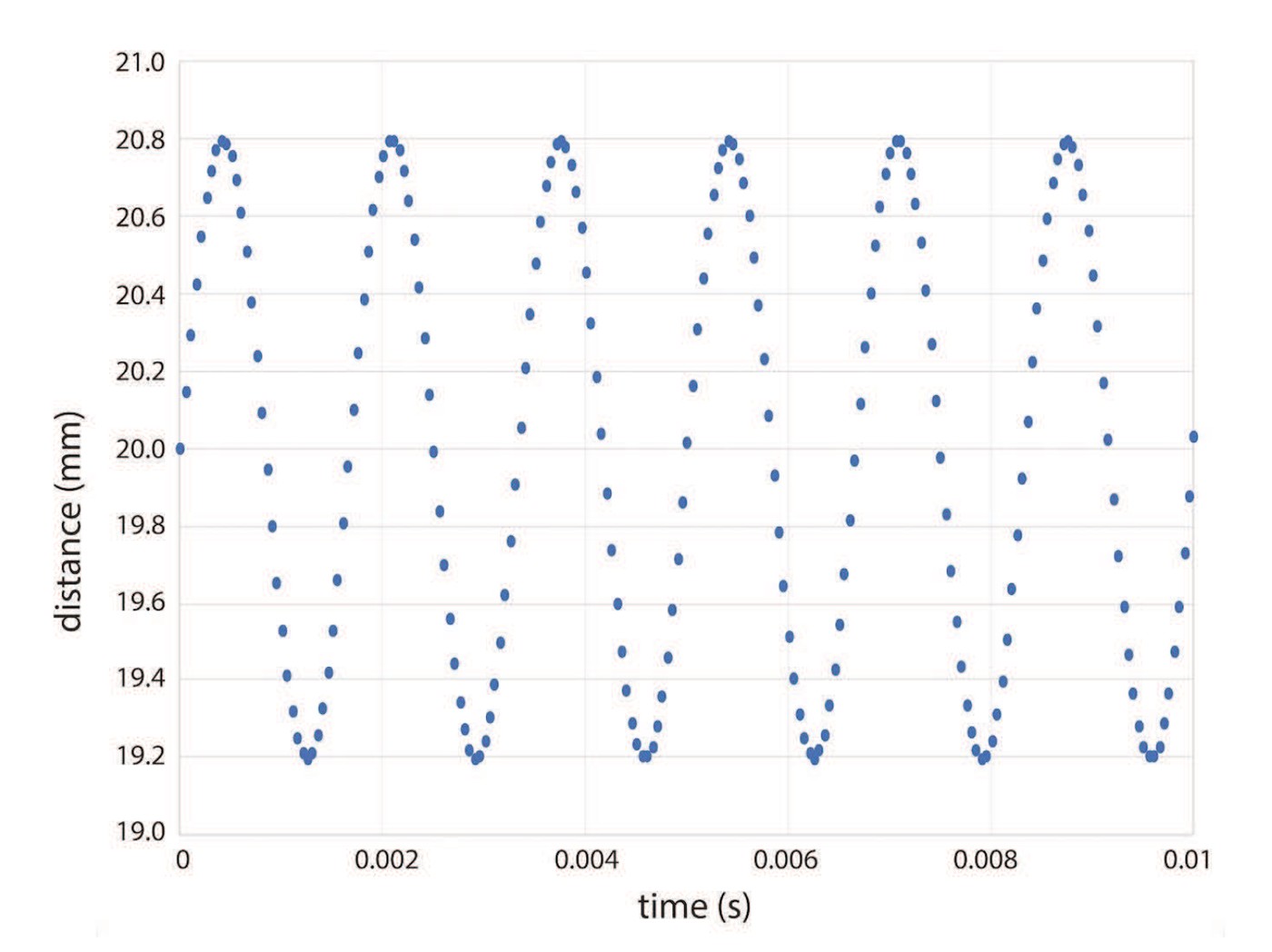
One cycle takes about 0.0017 s, giving frequency about 600 Hz using cycles per second = 1/period. The midline is near 20 mm and extrema are about 19.2 and 20.8 mm, so displacement amplitude is about 0.8 mm. Amplitude measures departure from the midline, not distance from the coordinate origin. Allow reasonable approximate readings from this source graph. B has about twice A’s frequency and half its period, while displacement amplitude stays approximately 0.8 mm. Faster repetition does not automatically mean a larger vibration.
Compare consecutive peaks: about 0.0017 s per cycle.
Compute 1/period, approximately 600 cycles per second, or Hz.
Amplitude is about 20.8−20 = 0.8 mm (half the peak-to-peak displacement).
Response criteria
- Read time on the horizontal axis; do not call it wavelength.
- Estimate frequency from repeats per second.
- Measure amplitude from the midline and distinguish coordinate origin from equilibrium.