Calculus I
Building a Function From Its Derivatives
Or: a curve is a line, then a parabola, then a polynomial — and you choose how close
Companion notebook. Play with this chapter’s ideas — sliders, animations, and drills — in
notebooks/ch7_taylor.ipynb.
By the end of this chapter you will be able to take almost any smooth function and replace it, near a point, with a polynomial that matches it as closely as you like — first matching its value, then its slope, then its curvature, then bending after bending — and you will know exactly how wrong the replacement is.
You will derive the one formula that runs the whole machine: the -th coefficient is . Not memorize it — derive it, in two lines, and see why the factorial is forced to be there.
You will build the Taylor series of and watch it fall out as inevitable — — precisely because is its own derivative, the property you fought for in Chapter 5. You’ll do the same for (and meet an old friend, the geometric series) and for .
And you will meet the remainder — the honest accounting of the error — which turns out to be the Mean Value Theorem of Chapter 6, taken one derivative deeper. That is not a coincidence; it is the whole reason we proved the MVT first.
Here is the theme, and it is the third floor of a building we’ve been climbing. Continuity (Chapter 2) forced a function’s values to behave. Differentiability and the MVT (Chapter 6) forced its first derivative to behave. Now: a function smooth enough to be differentiated again and again is pinned down, near a point, by its whole tower of derivatives at that one point. A function is — almost — nothing more than its derivatives, reassembled. “Almost” is the most interesting word in that sentence, and by the end you’ll know exactly what it’s hiding.
The tangent line was only a first draft
Back in Chapter 3 you learned that near a point , a function is well approximated by its tangent line:
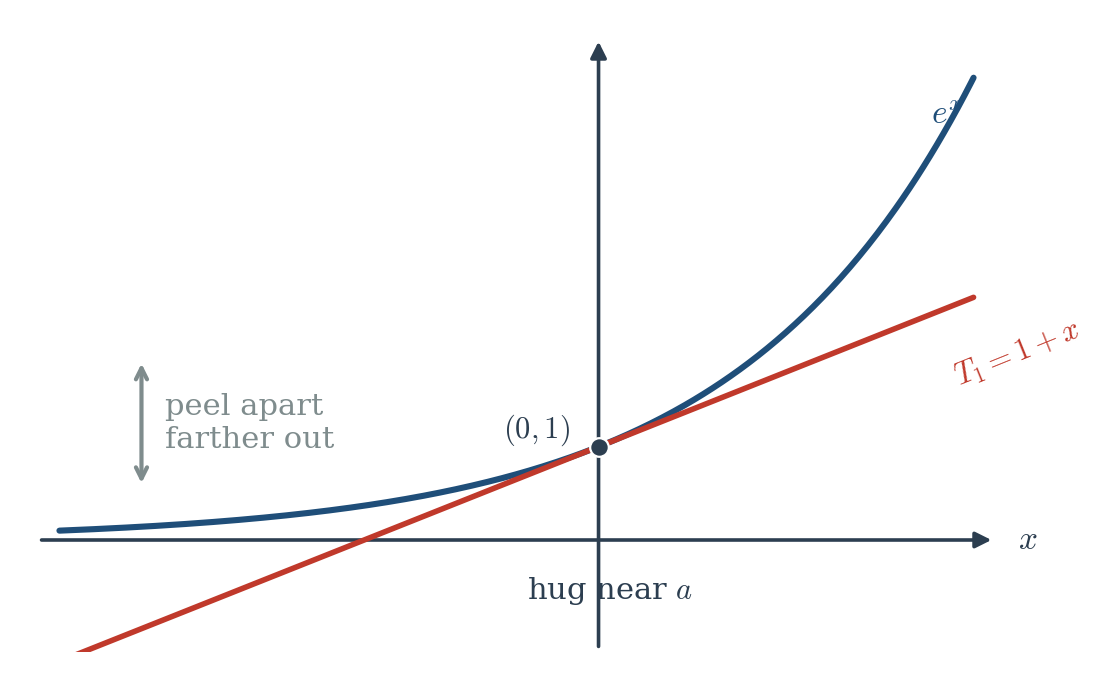
Look at why this line, of all lines, is the right one. It agrees with in two ways at : same height () and same slope (). Among every line you could draw through the point , the tangent is the one whose slope matches — and that makes it the one that hugs the curve most tightly right there. This is worth saying in plain words, because it is one of the central ideas of all of calculus and the bridge to everything you’ll do later:
The derivative is the best linear approximation. To know near to first order is to know its tangent line.
But a line is straight, and almost nothing in the world is. The tangent is excellent in a tiny window around and then peels away, because it cannot bend and does. So the obvious move is: let our approximation bend too. (Figure 7.1: a curve with its tangent line, the two hugging near and visibly separating as you move away.)