Calculus I · Building a Function From Its Derivatives
Match the curvature: the quadratic approximation
Bending is what the second derivative measures. So let’s look for a parabola that matches not in two ways but in three — value, slope, and curvature at . Write the unknown parabola in powers of , which makes everything easy to evaluate at :
Now force the three matches, computing each derivative and plugging in (where every becomes ):
- Value: , so matching forces .
- Slope: , so , forcing .
- Curvature: , so , forcing .
So the best quadratic is
It contains the tangent line (the first two terms) and adds one bending term. It hugs the curve better, and over a wider window. (Figure 7.2: the same curve with its tangent and its matching parabola; the parabola tracks the curve far past where the line gave up.)
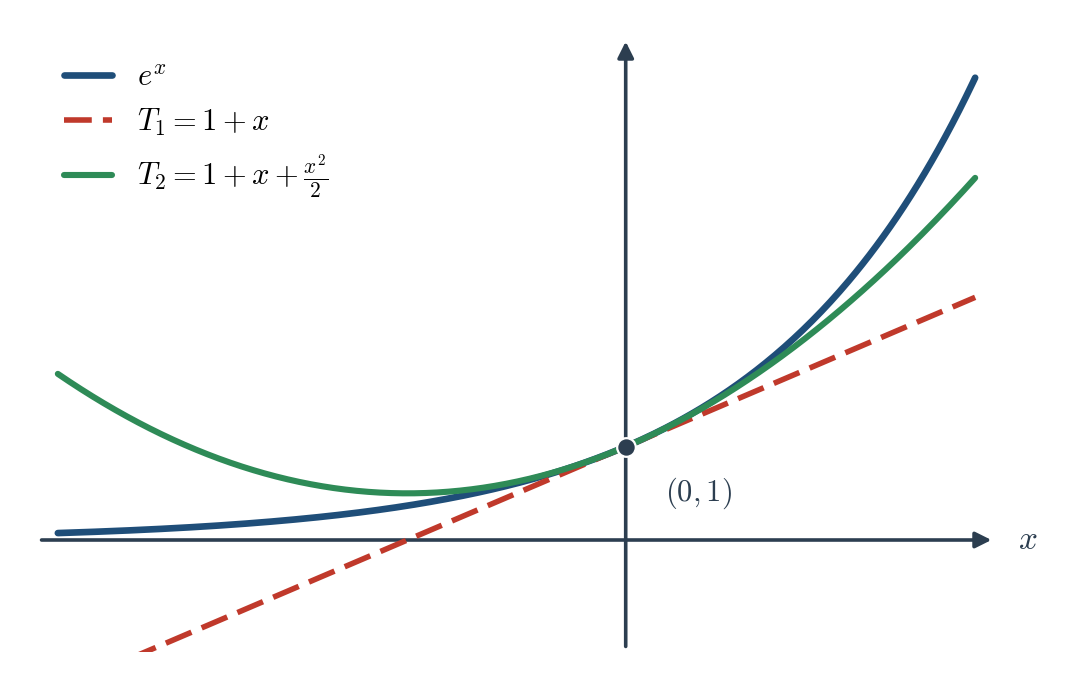 The pattern is already visible — keep matching higher derivatives, keep adding terms — so let’s find the general rule, and the factorial it hides.
The general pattern, and why the factorial is forced
Suppose we want a degree- polynomial matching and its first derivatives at :
To find , differentiate exactly times and evaluate at . The key is what happens to a single power when you hit it with derivatives:
- If : you differentiate it down to a constant and then past it — it becomes .
- If : after derivatives it still carries a factor of , which is at .
- If : differentiating exactly times peels off in turn, leaving the constant .
So when you compute , every term dies except the -th, which leaves . Setting that equal to :
There’s your factorial, and now you know why it’s there: it’s the that falls out of differentiating down to the ground. We give the result a name.
The Taylor polynomial of degree for centered at is Centered at it’s often called a Maclaurin polynomial. Let and (where it’s valid — see the remainder, below) you get the Taylor series.
Toolkit: Building a Taylor polynomial
- Compute — the derivatives at the center.
- Divide the -th one by .
- Assemble: . Look for a pattern in the coefficients — the best functions have one.