Calculus I · Getting Arbitrarily Close
From a marching to a sliding
We write
to mean: as gets arbitrarily close to — closing in from the left and from the right — the value gets and stays arbitrarily close to . Everything you earned in Chapter 1 carries straight over: the limit laws (sums, products, quotients of limits behave as you’d hope), the squeeze idea, and the challenge–response game behind the word “arbitrarily.” We are lifting the same machinery from a discrete staircase to a continuous slide.
For most functions, at most points, this is gloriously boring. The function heads toward as , for the unsurprising reason that . When a function is well-behaved, the limit is just the value, and you find it by substitution. The interesting cases — the ones we built this whole subject to handle — are exactly the cases where substitution fails.
The point you’re approaching might not be on the graph
Look at
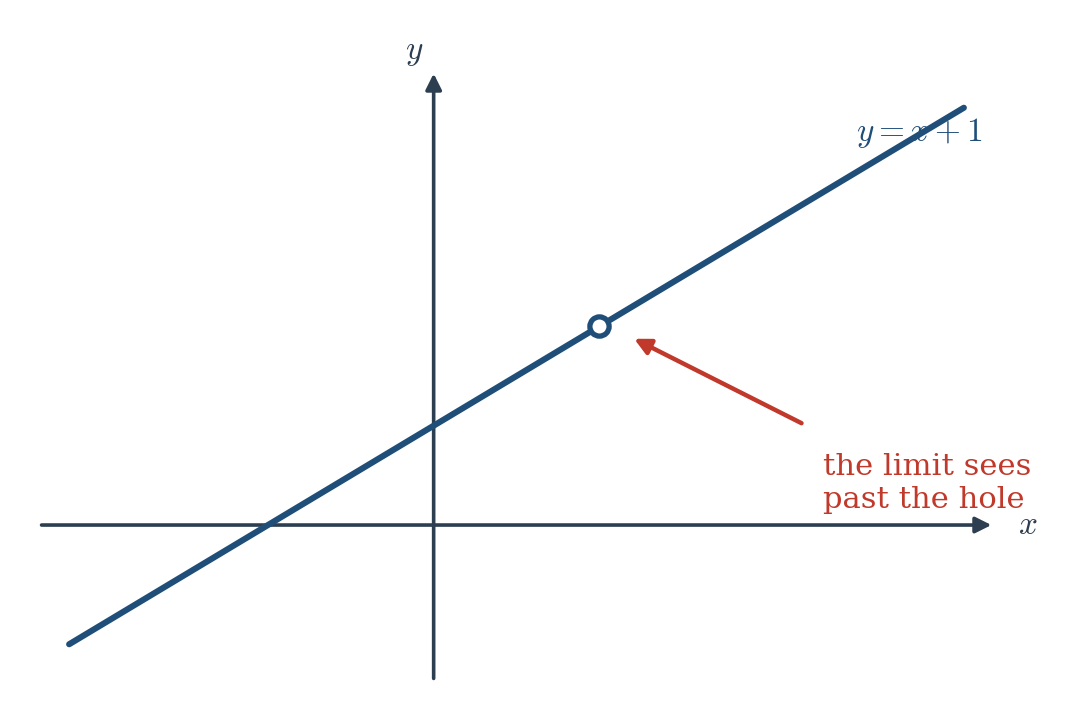
Try to evaluate it at by substitution: you get , which is not a number. The function is undefined at — there is a literal hole in its graph there. A careless reader concludes “no value, no limit, move on.” Watch what actually happens.
For every , we are allowed to cancel, because the thing we’re canceling isn’t zero:
So everywhere except the single point , this function is identical to the simple line . And obviously heads toward as . Therefore
even though flat-out does not exist. Read that again. The limit is at a point where the function has no value at all. This is the loophole promised above, stated plainly: the limit listens to what the function does on the approach, and the destination point itself is allowed to be missing. (Figure 2.1: the line with a small open circle punched out at — the hole the function has, that the limit sees right past.)
Hold onto this example with both hands, because it is the entire shape of the next chapter. In Chapter 3, the slope of a curve will be defined as a fraction that is exactly at the point of interest — and we will get a real answer out of it by canceling, in precisely this way. Every derivative you ever compute is a limit tamed by cancellation. You just did your first one.