Calculus I · Getting Arbitrarily Close
Approaching from two sides
Because slides along a line, it can reach from the left or from the right, and sometimes the two stories disagree. We write for the approach from below (the left-hand limit) and for the approach from above (the right-hand limit).
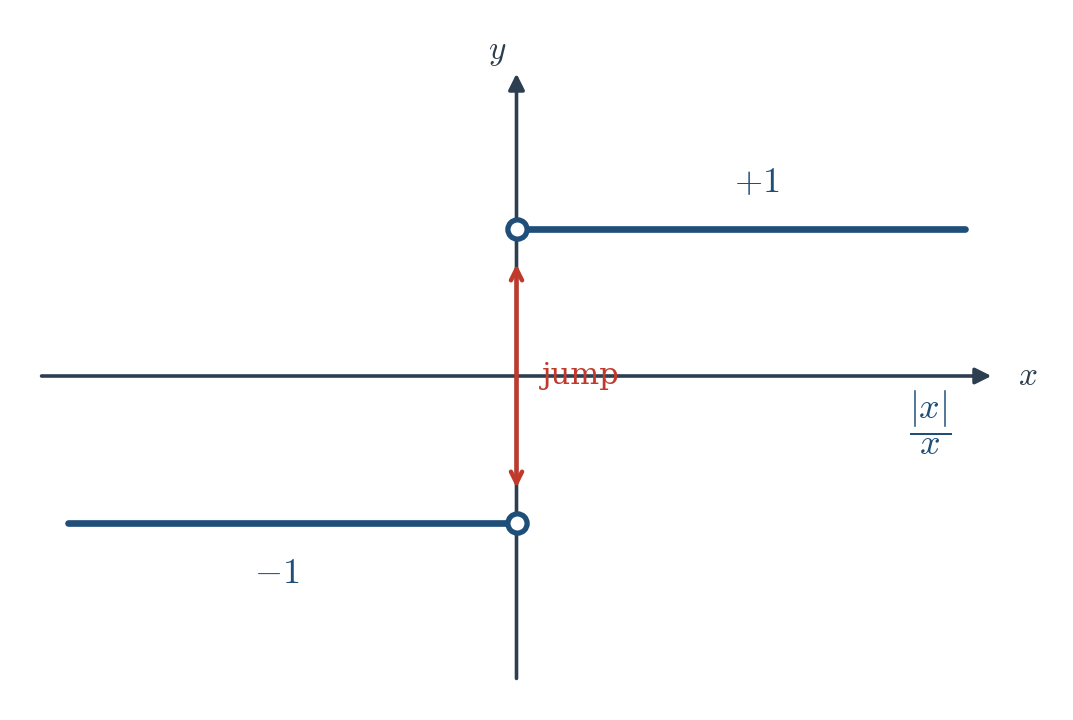
The two-sided limit exists only if both one-sided limits exist and agree. The classic disagreement is
which equals for every positive and for every negative . As it sits at ; as it sits at . The two sides refuse to meet, so does not exist — not because of a hole, but because of a jump. The function can’t make up its mind, so the limit declines to exist. (Figure 2.2: the two flat arms at and with the cliff between them at .)
Toolkit: Evaluating the limit of a function
Step 1 — try substitution. If is well-behaved (continuous) at , then . Done. Always try this first.
Step 2 — if you hit , don’t stop — rewrite. The means a common factor is hiding. Two moves flush it out: - Factor and cancel: as . - Rationalize (when roots appear): multiply top and bottom by the conjugate to clear the square root.
Step 3 — limits at infinity: divide top and bottom by the highest power of , exactly as you divided by the highest power of in Chapter 1.
Worked example (rationalizing a ). Find . Substituting gives . Multiply top and bottom by the conjugate :
The troublesome canceled. Now substitution is safe: as this heads to . (And yes — this too is secretly a derivative, the slope of at . They’re everywhere once you know the shape.)
Continuity: the graph you can draw without lifting your pen
A function is continuous at when the limit and the value finally agree:
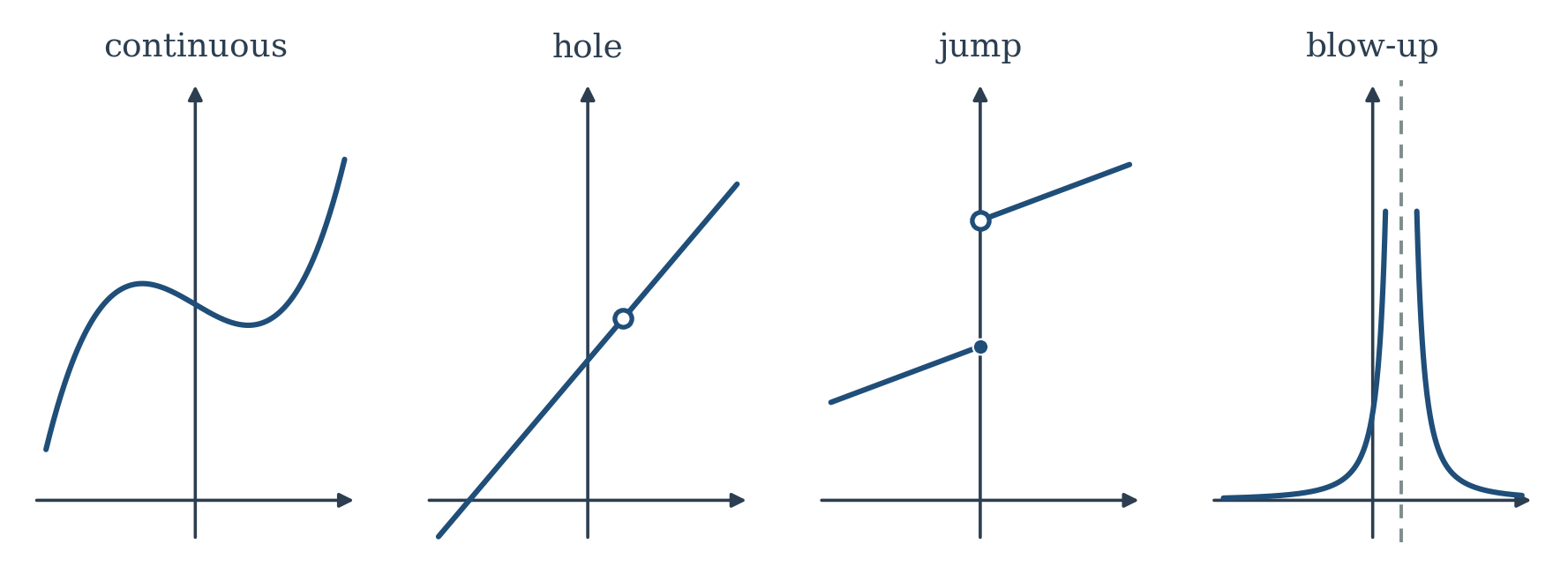
Three things have to line up: has to exist, the limit has to exist, and they have to be equal. When this holds at every point of an interval, you can draw the whole graph there without lifting your pen off the paper — no holes, no jumps, no flying off to infinity. Polynomials are continuous everywhere; so are , , and . The failures come in three flavors, and naming them is useful:
A removable discontinuity is a single missing point — our hole. The limit exists; the function just forgot to take the value. You can “repair” it by defining the missing point to be the limit.
A jump is when the two one-sided limits exist but disagree — our cliff. No repair possible; the gap is real.
An infinite discontinuity is when the function blows up, like at . There’s no finite limit to repair to.
(Figure 2.3: a continuous curve beside the three failures — the punched hole, the cliff, the blow-up.)
Why an engineer cares
Continuity sounds like a tidiness rule for graphs. It is really a statement about robustness, and that is the first reason this idea reaches far beyond math class. Continuity says: nudge the input a little, and the output moves only a little. Nothing snaps. A continuous control system doesn’t lurch when a sensor reading wobbles; a continuous model doesn’t return a wildly different answer because a measurement was off in the third decimal. Where a system is discontinuous — a circuit breaker tripping, water flashing to steam, a market gapping — is exactly where it behaves unpredictably and where engineers pay closest attention. We will sharpen “a little” into something measurable in the diamond box below, and that sharpening is the same one that makes the whole subject rigorous.