Calculus I · The Function That Is Its Own Slope
Logarithms: undoing the exponential
We have a function that grows. We will constantly need to run it backward: “the account reached $5000 — how long did that take?” Running backward is exactly what the natural logarithm does. In the language of Chapter 4, is the inverse function of :
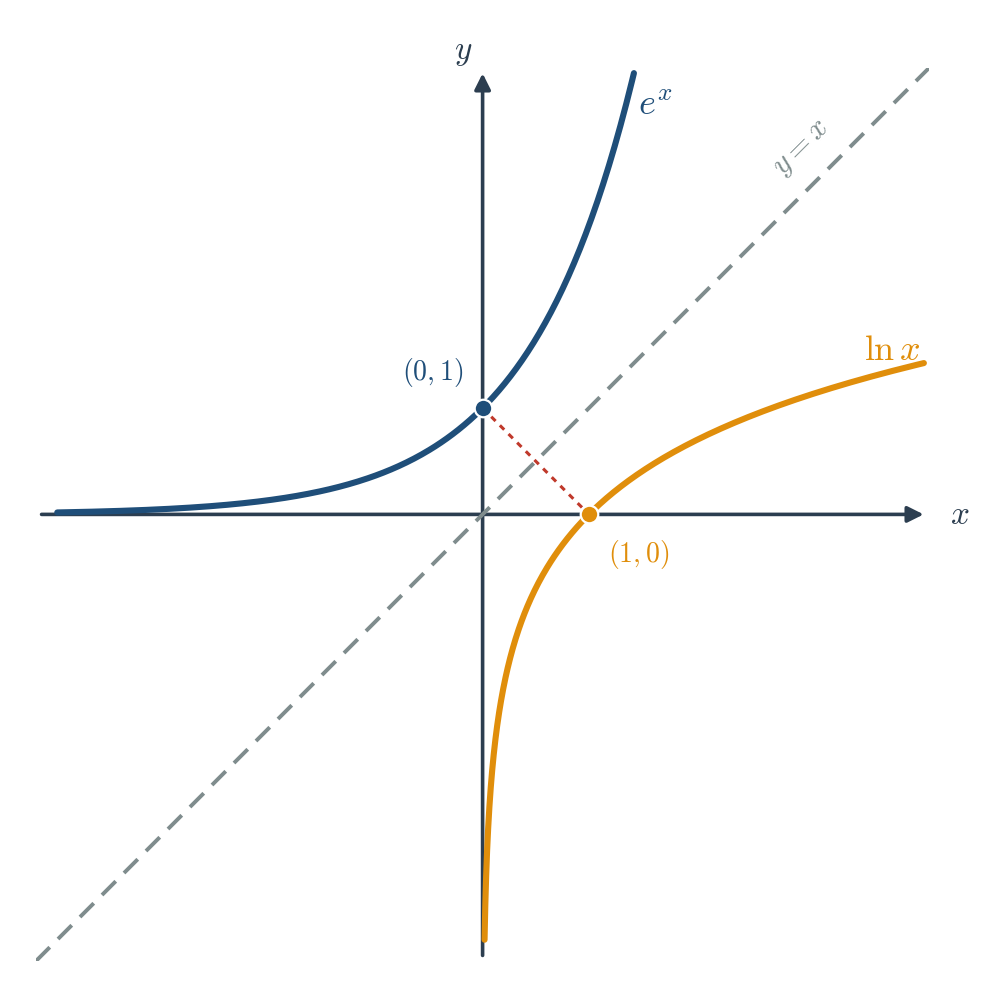
takes in “what the exponential grew to” and gives back “the input that got us there.” Two facts fall straight out of being an inverse: and . And the exponent rules become logarithm rules — for instance, since , taking of both sides turns multiplication into addition:
(That single property — turns multiplication into addition — is the entire reason logarithms were invented, centuries before anyone cared about calculus. It is also why log scales work, which we will get to.)
Now the part worth the price of admission: what is the derivative of ? We do not need a new limit. We have a tool for differentiating inverse functions from Chapter 4, and this is its finest hour. Let . By the definition of , that means
Differentiate both sides with respect to . The right side is easy: . The left side needs the chain rule, because is itself a function of :
Solve for , then use :
Take a moment with how clean that was. We never computed a single difference quotient for . We leaned entirely on “ is the inverse of ” plus the chain rule, and the answer dropped out in three lines. This is what it feels like when the earlier tools start paying for themselves.
Paying off one small debt right now: the mystery constant was
I promised that the mysterious — the slope of at the axis — is really . We can settle that one immediately, because we now have the machine to do it. The trick is to write every exponential in terms of the one base we understand. Since ,
Now differentiate using the chain-rule line from the toolkit, with :
So , exactly as advertised. The “mystery number” attached to every base was never mysterious; it was the natural log of the base all along. And notice the consistency check: , which is precisely the condition we used to define . Everything closes up.