Calculus I · The Function That Is Its Own Slope
What all of this is for
Time to collect on the three real-world situations that started the chapter. They were all the same equation, — “the rate of change is proportional to the amount.” We can now write down its solution and check it ourselves:
Here is the amount at the start (set : , so — good). Does it actually solve the equation? Differentiate, using the chain rule:
Yes. The derivative came back equal to times the function itself, which is exactly the equation we needed to satisfy. We have not just been handed the answer — we have verified it.
Growth: money and rabbits
When , grows, and it grows faster the bigger it gets. This is continuous compounding: a bank account growing at rate , compounded not yearly or monthly but every instant, reaches after time . (This is also where secretly lives — compounding times a year and letting is what produces in the first place. The promise from earlier, peeking through again.)
Decay and half-life: atoms and medicine
When , write it as with , and the same function now decays:
This describes a radioactive sample losing atoms, and — the example to keep in your pocket if you care about drug design — a medicine being cleared from the bloodstream. Most drugs leave the body by first-order kinetics: the liver and kidneys remove an amount proportional to how much is currently circulating, which is exactly .
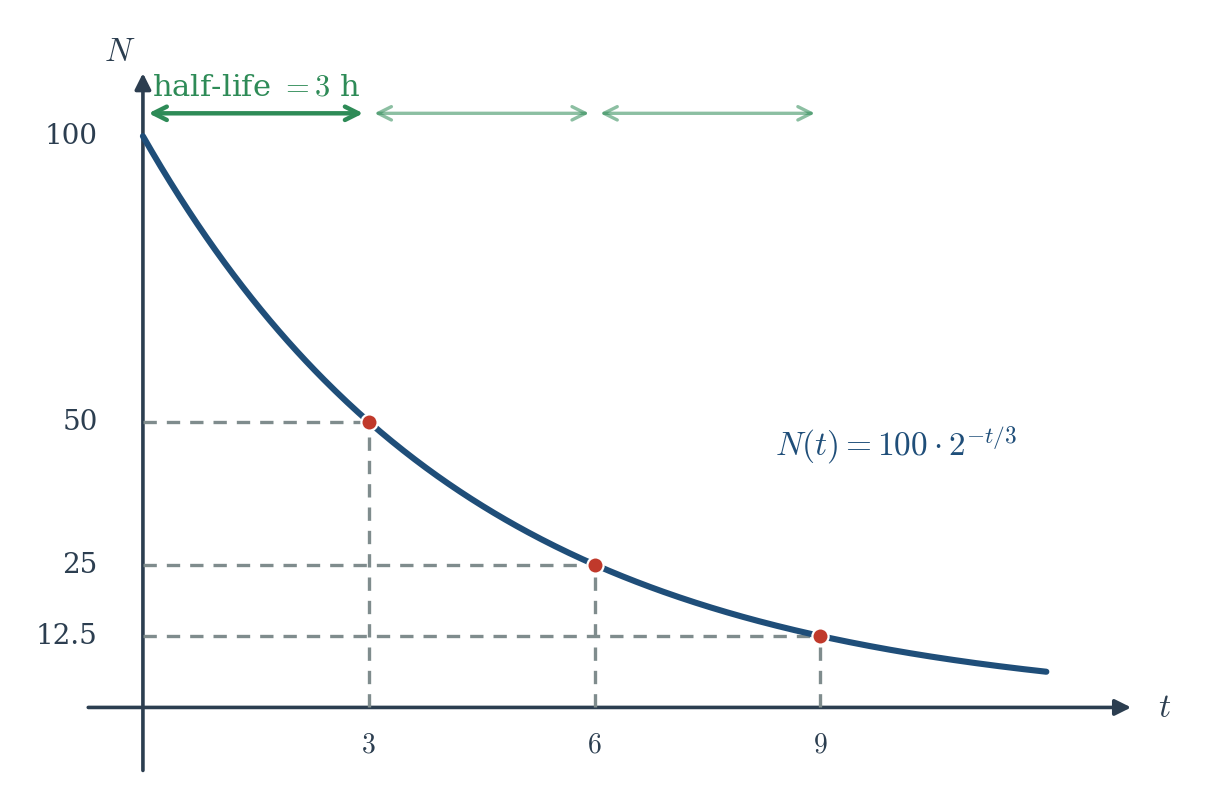
The number everyone quotes for such a process is its half-life: the time for the amount to fall to half of whatever it was. We can derive it instead of memorizing it. We want the time when has dropped to :
Cancel , then take of both sides to pull the exponent down (this is the moment logarithms were built for — undoing an exponential):
Worked example. A painkiller has an elimination rate constant per hour. What is its half-life, and how much of a dose remains after hours?
Half-life: hours. So the amount halves every hours.
After hours: that is exactly three half-lives, so we expect three halvings: . Check it the precise way too: . The two methods agree, which is how you know you did it right. (Figure 5.4: the decay curve with the dose halving at hours marked.)
Why log scales exist
Because turns multiplication into addition, it squashes enormous multiplicative ranges into walkable additive ones. That is why the loud, scientific scales of the world are logarithmic: earthquake energy (Richter), sound (decibels), acidity (pH). A jump of “one unit” on these scales means times ten, not plus ten. When someone tells you a magnitude- quake is “a bit worse” than a magnitude-, the logarithm is the reason they are off by a factor of a hundred.