Calculus I · The Fundamental Theorem of Calculus
Integration by parts: the product rule, backward
Substitution (Chapter 10) was the chain rule reversed. The other great technique is the product rule reversed, and it’s derived the same way. Start from the product rule, , and integrate both sides. The left gives ; rearrange:
You use it when the integrand is a product, and differentiating one factor makes the integral simpler. Pick that factor to be (so it gets differentiated) and the rest to be (so it gets integrated).
- : let (its derivative simplifies things), . Then .
- : let , , giving .
- : the slick one. Take and (yes, the whole rest is just ). Then , , and . We integrated a function that isn’t even a product by inventing one.
- : when one pass isn’t enough, repeat. Let , , giving — and the leftover integral is the first example (times ), so parts again finishes it: . Each pass knocks the power down by one.
That’s the principle — the product rule, read right to left. (Substitution and parts are the reverse-images of Chapter 4’s two big rules; together they handle an enormous range of integrals, and when they fail, the integral often has no elementary antiderivative at all, and we fall back on the Riemann sums of Chapter 10.)
Every “total” is one idea: slice and sum
A standard calculus course now unloads a warehouse of formulas — areas between curves, volumes by disks, volumes by shells, arc length, surfaces of revolution, work, fluid pressure — each with its own boxed equation to memorize. Don’t. They are all the same idea, the idea the integral was built from: to measure a total, cut it into infinitesimal pieces simple enough to measure, then add the pieces up (integrate). Learn that move and you can derive any of the formulas on demand; memorizing them is a confession that you didn’t see they were one thing. Three quick illustrations, then we move on:
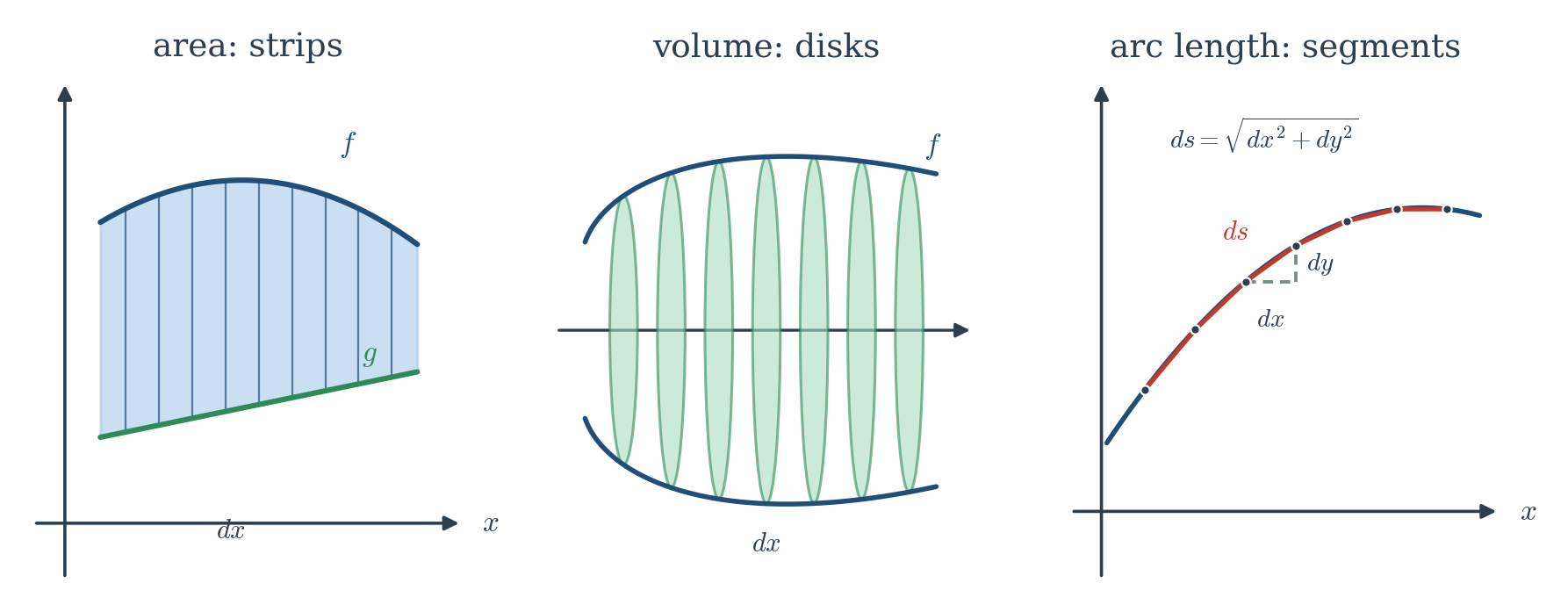
- Area between two curves. Slice the region into thin vertical strips. Each strip has width and height (top curve bottom curve), so its area is . Add them: .
- Volume of a solid of revolution. Spin a curve around the -axis and slice the solid into thin coins. Each coin is a disk of radius and thickness , with volume . Add them: .
- Length of a curve. Slice the curve into tiny nearly-straight segments. By the Pythagorean theorem each segment has length . Add them: .
In every case the recipe was identical: what does one infinitesimal piece contribute, and what do they sum to? Notice, too, the honesty in the last one — that arc-length integrand is a square root of a polynomial, and for most curves (even a humble parabola) it has no elementary antiderivative. So you set up the integral by the principle and then, as often as not, hand it to a Riemann sum. This is exactly why memorizing the formula is pointless and understanding the slice is everything.