Will you live to 120? · Folding and Falling Apart
Carry these three things
We end the chapter where this book’s deepest theme — the promise and the limits of artificial intelligence in medicine — reaches its single most spectacular example. Because the folding problem from the start of this chapter, the fifty-year grand challenge of predicting a protein’s shape from its sequence, was solved — by an AI.
Recall the setup: Anfinsen proved the sequence determines the structure, which meant that, in principle, you should be able to compute a protein’s shape from its amino-acid sequence alone, without the slow, expensive experiments (crystallizing the protein, bombarding it with X-rays) that had been the only reliable way to see a structure. For half a century, “in principle” was as far as it went; the computation was intractable, and predicting structure from sequence was considered one of the hardest open problems in all of biology, with its own biennial worldwide competition to measure the meager progress. Then, in 2020, a system called AlphaFold, built by the AI laboratory DeepMind, entered that competition and effectively ended it — predicting the structures of many proteins to an accuracy rivaling the experimental methods, a leap so large it stunned the field. AlphaFold’s predicted structures were soon released, free, for essentially every protein known to science — hundreds of millions of them, a resource that would have taken the old experimental methods many lifetimes to produce. Its creators were awarded the Nobel Prize in Chemistry. It is, without serious competition, the most celebrated achievement of artificial intelligence in the history of biology, and it has genuinely accelerated structural biology and the early stages of drug discovery — finding the shape of a target is often the first step to designing a drug against it.
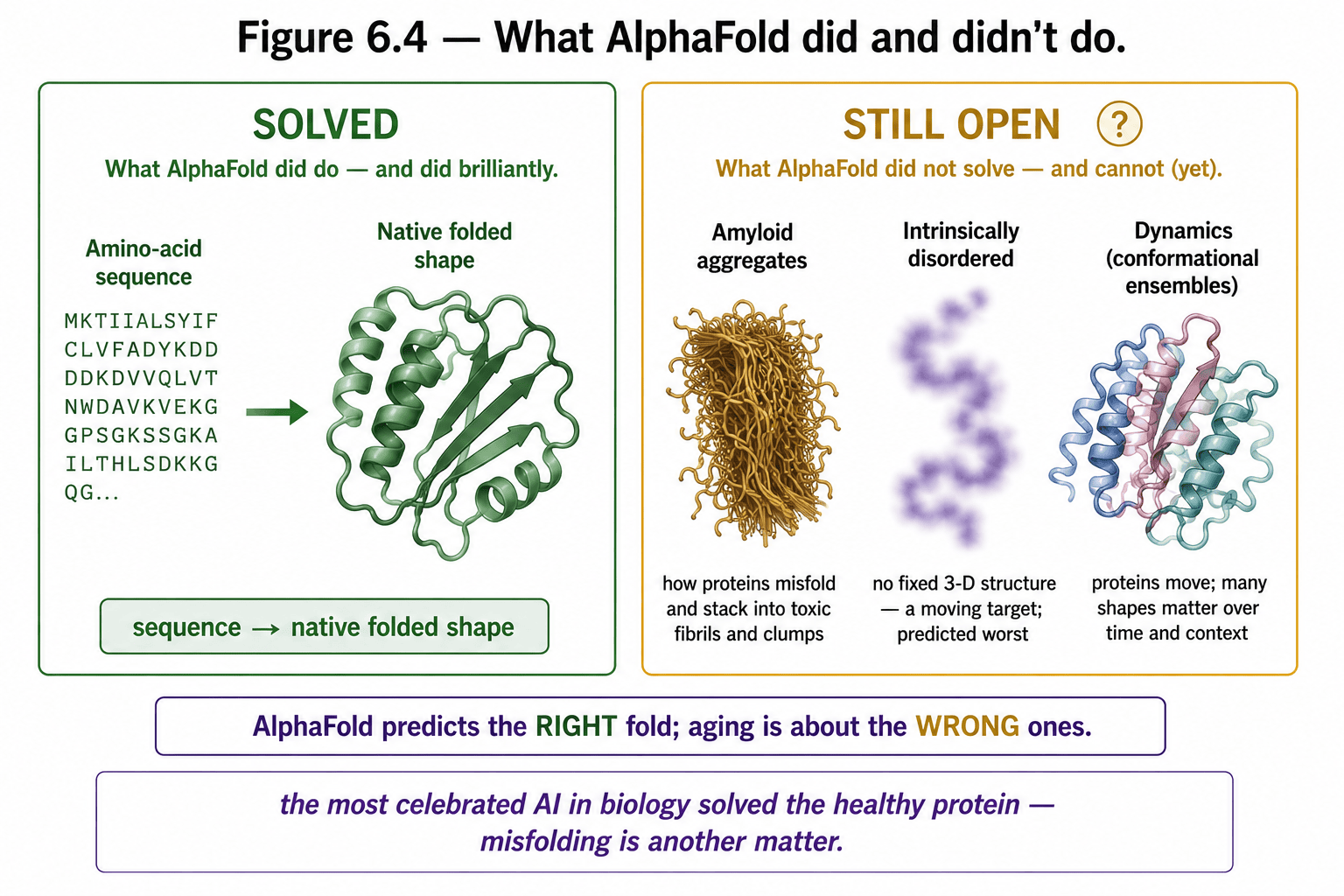
It deserves every bit of that credit. And now the honest footnote, which is not a grudging asterisk but the very heart of this chapter — because of what specifically AlphaFold solved, and what it did not. AlphaFold predicts the native, correctly folded shape of a well-behaved protein. It tells you, brilliantly, the right answer — the bottom of the folding funnel. But everything that has made this chapter a chapter about disease is about the wrong answers — and those AlphaFold largely does not predict. It does not predict misfolding: the very thing that causes Alzheimer’s and Parkinson’s and the rest is a protein going to the wrong shape, and AlphaFold models the right one. It does not predict aggregation: how misfolded proteins clump is outside what it computes. It struggles most with intrinsically disordered proteins — proteins that don’t fold into one fixed shape at all — and here is the cruel irony: several of the most important aggregation-prone proteins in neurodegeneration, including tau and alpha-synuclein and amyloid-beta itself, are themselves intrinsically or partly disordered — the kind AlphaFold handles worst. It largely gives a single static snapshot, while proteins flex and breathe and visit multiple shapes, and function often lives in that motion. And predicting how a small-molecule drug will bind, or how a mutation will change a protein’s behavior, remains hard, though newer versions reach toward protein interactions and drug binding.
So AlphaFold is a triumph at predicting the right fold — and aging, this chapter has shown, is largely about the wrong ones. That is not a knock on AlphaFold; it is the precise shape of what it gave us and what it didn’t, and it generalizes the lesson the whole book keeps relearning. A spectacular tool that solves one cleanly posed problem — sequence to native structure — is not the same as a solution to the messy, downstream, clinical problem you actually care about — why proteins misfold, how to stop them aggregating, how to keep an aging neuron’s cleanup crews from losing. The most dazzling AI in biology mastered the healthy protein. The diseased one — the misfolded, the aggregated, the disordered — is still, largely, waiting.
✦ ✦ ✦
Carry these three things
Aging is the cleanup crews losing — and the same crews are why fasting works. The shape of a protein is its function, and the cell wages a constant war to keep proteins folded (chaperones), shred the broken ones (the proteasome), and digest the big aggregates and worn-out organelles (autophagy). With age, all three crews weaken, misfolding outpaces clearing, and toxic aggregates accumulate — the same “maintenance loses to damage” story as senescent cells and mitochondria, in a sixth costume. And the circuit ties straight back to Chapter 4: mTOR shuts autophagy off, so fasting and rapamycin — by switching mTOR off — switch the cleanup crew on. The hunger switch and the cleanup crew are one circuit.
The amyloid story is the biomarker trap at the scale of a generation — and the most important place to hold two truths at once. For thirty years the field chased amyloid, a marker it could measure and move; drug after drug cleared the plaques and left patients no better, and one was even approved on the marker alone with the benefit unproven. Then the newest drugs finally slowed decline — a modest, risky, real effect. So the hypothesis was neither simply right nor simply wrong: amyloid is genuinely part of the disease (removing it helps a little), and the smallness of that help is the proof that it is not the whole story. Alzheimer’s is multifactorial and still contested, and anyone who tells you it’s solved — in any direction — is overclaiming where the stakes are highest.
The most celebrated AI in biology solved the right fold; aging is about the wrong ones. AlphaFold cracked a fifty-year grand challenge — predicting a protein’s native structure from its sequence — and earned a Nobel for it, and genuinely transformed structural biology. But misfolding, aggregation, the disordered aggregation-prone proteins of neurodegeneration, and protein motion are largely what it doesn’t predict — and those are exactly what these diseases are made of. A dazzling solution to one clean problem is not a solution to the messy one you care about. Every chapter so far has been about damage accumulating and maintenance falling behind, and every intervention about slowing the damage or clearing it. The last chapter asks the most radical question in the field: not whether we can slow the damage, but whether we can wipe it away — reset an old cell to a young state, the way each of us was reset at conception. It is the most exciting idea in aging biology, the one just now entering its very first human trial — and, you will not be surprised to learn, the least proven of all.
Questions to talk about
No answer key. These are for arguing over, with someone who read the same chapter.
- Levinthal's paradox: a protein searching randomly for its shape would take longer than the age of the universe, yet real proteins fold in milliseconds. When a calculation says something is impossible and it plainly happens, what is usually wrong with the calculation?
- AlphaFold won a Nobel for predicting the shape a protein is supposed to take — and the diseases in this chapter are about the shapes they wrongly take instead. What is the risk in saying 'AI solved protein folding'?
- The shape is the function, so a protein folded wrong is simply gone, like a key filed to the wrong shape. The cell runs cleanup crews to catch these. Why would those crews weaken with age when the damage does not?
All 10 chapters of Will you live to 120? · Foundations · All courses