Will you live to 120? · The Cells That Won’t Die
Why they pile up
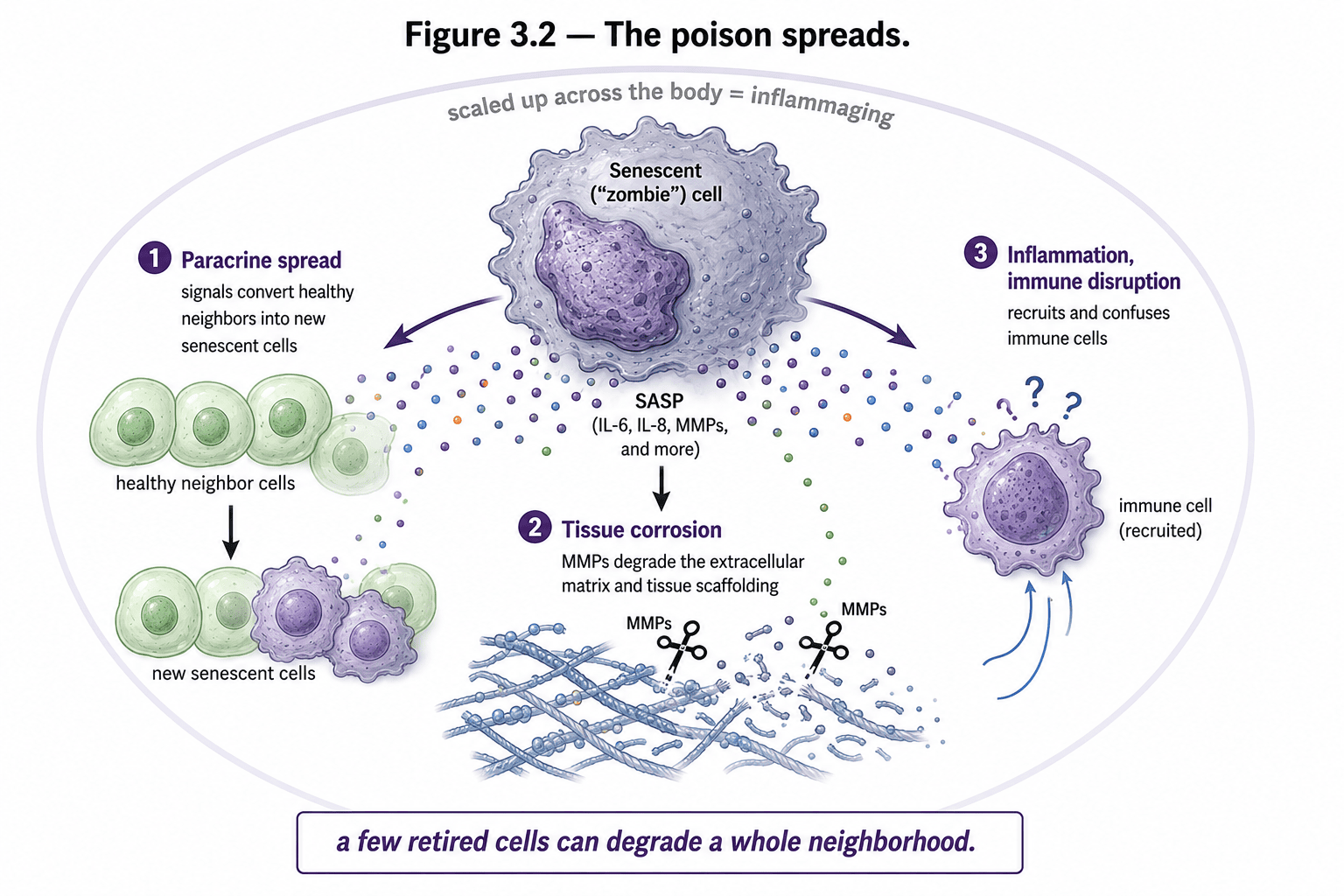
The SASP is a brew of inflammatory signaling molecules (cytokines such as IL-6, IL-1, and IL-8), chemical “come here” signals that summon immune cells, growth factors, and enzymes called proteases (the MMPs) that chew up the structural scaffolding between cells. It is driven from inside the cell largely by a master inflammatory switch called NF-κB, with a contribution from an ancient innate-immune alarm — the cGAS-STING pathway — that normally detects viral DNA but here is tripped by the cell’s own damaged DNA fragments leaking where they shouldn’t be. The senescent cell, in other words, partially activates the pathways that normally respond to an infection, and calls in the immune system accordingly.
This screaming does three kinds of damage. It inflames the local tissue, chronically. It corrodes the surrounding structure through the proteases. And — most insidiously — it pushes neighboring healthy cells into senescence too, through the very inflammatory signals it is releasing. A senescent cell can recruit its neighbors into the same state, which is called paracrine or bystander senescence. A few zombie cells become a spreading patch.
Zoom out from one tissue to the whole body, and the SASP is one major source of a hallmark of aging we are otherwise not giving its own chapter — chronic inflammation, often called inflammaging. As you age, the slow, smoldering, body-wide inflammation that quietly raises your risk of nearly every age-related disease, from atherosclerosis to dementia, appears to be driven in important part by accumulated senescent cells, each one a tiny inflammatory siren — though they are not the only contributor: aging of the innate immune system, a leakier gut, inflamed visceral fat, and lingering chronic infections all feed the same fire. Still, senescence is one of the most mechanistically concrete contributors we can point to, which is why we treat inflammaging here, as a major consequence of senescence, rather than as its own thing: in this book, much of the chronic inflammation of aging has a traceable cellular address.
Why they pile up
If senescent cells are so harmful, why does the body let them accumulate? The answer is a balance between two rates, and it is worth writing down, because the arithmetic explains both why the problem accelerates with age and what the two ways to attack it are.
Let be the burden of senescent cells in a tissue. They are produced at some rate — new cells flipping into senescence from telomere exhaustion, oncogenic stress, and accumulated damage — and they are cleared by the immune system (natural-killer cells and macrophages recognize and remove them) at a rate proportional to how many there are, with a clearance constant . Then
which settles at a steady-state burden of
Here is the trouble. Aging pushes both terms the wrong way at once. The production rate rises — more cells reach critically short telomeres, more accumulate irreparable damage, more oncogenic near-misses occur, as the years go by. And the clearance constant falls — because the immune system itself ages and grows less effective at removing senescent cells (a decline called immunosenescence). Worse, the decline in clearance is partly caused by the SASP, which disrupts immune function: a vicious circle, the zombies sabotaging the very janitors meant to remove them. With the numerator climbing and the denominator shrinking, the steady-state burden does not creep upward linearly. It accelerates. That is why senescent-cell burden is low and well-managed for most of life and then climbs steeply in old age — not because anything new switches on, but because a balance that was comfortably in your favor tips, from both ends, into a steep climb.
The same equation lays out the two therapeutic strategies cleanly. You can attack the burden by raising effective clearance — drugs that kill senescent cells, which the field calls senolytics, effectively boosting . Or you can leave the cells in place but muzzle their secretions — drugs that suppress the SASP, called senomorphics or senostatics, which lower the harm per cell rather than the number of cells. Most of the excitement, and the chapter’s hard lesson, lives in the first strategy.
Deeper Water — when the janitors saturate, and the burden runs away. The simple model on the main road, , hides a comfort in its structure: no matter how high production climbs or how far the clearance constant falls, the burden always settles at some finite value, . It can grow large, but it never truly runs away — there is no tipping point, only a smoothly steepening climb (halve and you double ). Real immune clearance, though, has a feature this linear term ignores: it saturates. You have only so many natural-killer cells and macrophages, and they can remove senescent cells only so fast; past a certain burden the cleanup crew is working flat out and simply cannot speed up. A standard way to write a clearance rate that rises with burden but plateaus at a ceiling is , where is now the maximum clearance rate — the most cells the immune system can mop up per unit time, a different quantity (and different units) from the per-cell constant in the linear model — and is the burden at which clearance runs at half that maximum. At low burden () this behaves almost like the linear model, clearing at roughly ; at high burden () the clearance term flattens out at , the crew maxed out. That one change does something the linear model structurally cannot: it creates a genuine threshold. Setting gives a steady state only when production stays below the clearance ceiling, , at which point — an expression that blows up as , the denominator going to zero and the burden to infinity. And once production exceeds the ceiling, , there is no steady state at all: because the clearance term can never exceed , the burden grows without bound. The system has tipped. This is a sharper and more honest picture of late-life acceleration than the linear model offers — senescent burden may not just be climbing a steepening curve but approaching, and then crossing, a clearance threshold past which accumulation becomes self-sustaining. And the main road’s vicious circle makes it worse from the other side: as the SASP degrades immune function, it drags the ceiling downward toward the rising production , hurrying the system toward the tipping point. It also reframes what a therapy must achieve: nudging the burden down a little is futile if you are past the tipping point — you have to push the system back across it, lifting effective clearance back above production or cutting production back below clearance, to escape the runaway. (This is still a toy model: real senescence is heterogeneous, spread across tissues and compartments, with feedbacks on both and at once. But it captures a qualitative truth the linear form cannot — a system with finite clearance capacity does not merely degrade, it can collapse.)
The brake and the price, again
All 10 chapters of Will you live to 120? · Foundations · All courses