Will you live to 120? · The Clock and the Lever
The most important sentence in this book
This is the heart of a hypothesis associated most prominently with David Sinclair, and it deserves to be stated at its strongest, because it is genuinely interesting. The idea is that aging is, at bottom, a loss of epigenetic information. Over a lifetime, the cell’s careful pattern of marks — the markup that tells it which genes to read — slowly degrades and grows noisy, like scratches accumulating on a disc until the music skips. The DNA text stays intact, but the cell increasingly forgets which cell it is supposed to be, and that forgetting is the aging. The provocative corollary is that if the information is merely misfiled rather than erased, it might be restored — the cell reminded of its youthful identity — which is the thread we pick up in Chapter 7, on cellular reprogramming.
The hypothesis comes with real experiments, not just analogy. In a provocative and much-debated 2023 study, Sinclair’s group built mice in which they could induce breaks in the DNA that the cell repairs without changing the sequence — breaks designed to disturb the epigenome while leaving the text untouched. Those mice showed accelerated signs of aging and advanced epigenetic clocks, and partial reprogramming pushed some of it back. To the hypothesis’s supporters, that is close to a demonstration that epigenetic disruption alone can drive aging.
But this is exactly the kind of claim the book has trained you to hold at arm’s length, and two cautions apply. The first is the now-familiar one from Chapter 1: those mice underwent repeated, deliberately induced DNA breaks that do not obviously resemble ordinary aging — an artificial perturbation, not the gentle drift of the years. Showing that a violent epigenetic insult accelerates aging does not establish that ordinary aging is caused by epigenetic drift rather than accompanied by it. The second caution is deeper and is the subject of the rest of this chapter: the clocks themselves cannot settle the cause-or-consequence question, because a clock is a correlation, and a correlation, however tight, is silent about cause. The very precision that makes the clock impressive is precisely what makes it unable to tell you whether the methylation it reads is steering the ship or just watching from the deck.
So the honest status is: methylation change is one of the most reliable correlates of aging we have ever found, and whether it is a primary driver is open and contested. Reasonable scientists land on different answers. The clock does not adjudicate between them — and anyone who tells you it does has skipped the most important step.
The most important sentence in this book
Here it is, and it is worth setting apart, because if you take one idea from these pages it should be this one:
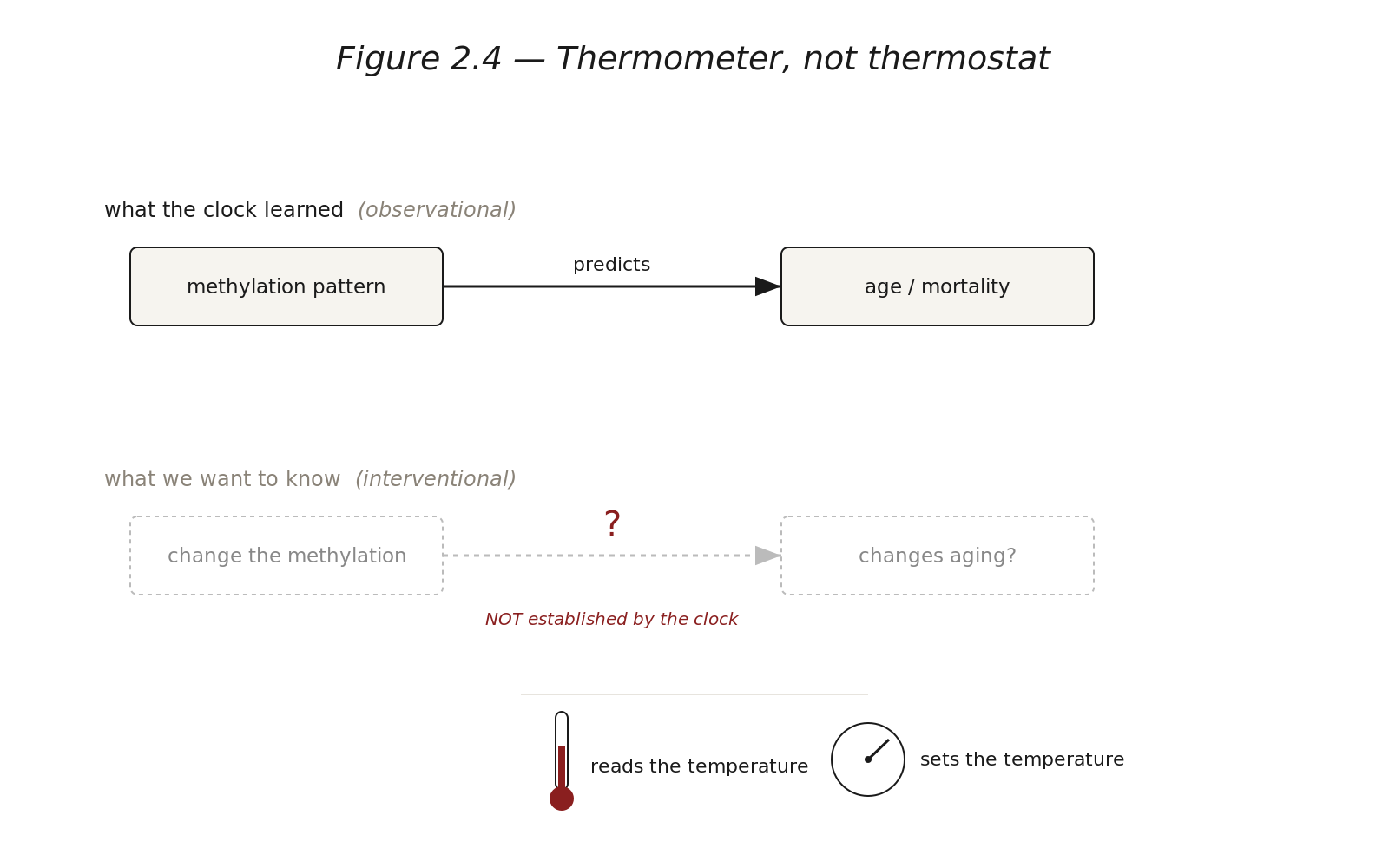
A measurement that predicts an outcome is not the same as a handle that controls it.
The epigenetic clock is the cleanest illustration there will ever be. The clock was fit to predict age (or mortality) from methylation. It selected the sites it uses because their methylation correlates with the outcome. That makes it an excellent thermometer for aging. It says nothing whatsoever about whether those sites are a thermostat — about whether changing the methylation, or moving the clock reading, would change the aging itself.
Confuse the two, and you get the defining error of the entire longevity-marketing world. The clock reads your “biological age” at, say, fifty-two. You take some intervention — a supplement, a diet, a drug — and the clock now reads forty-nine. The pitch: you reversed three years of aging. The reality: you moved a predictor by three years, and whether you moved aging by even a day is completely unestablished by that fact. You may simply have nudged the specific methylation sites the clock happens to watch, while the underlying biology rolls on unchanged. In machine-learning terms, you may have taught to the test — improved the score on the metric without improving the thing the metric was supposed to stand for. The clock is a model, and any model can be gamed by an intervention that targets its inputs rather than the world.
You can see the trap operating in real studies. The most cited example is a small 2019 trial in which nine men took a combination of growth hormone and two other drugs for about a year, and several epigenetic clocks read them as roughly one to two years “younger” afterward. It made headlines as the first reversal of human aging. But pause on what it actually was: nine people, no control group, a cocktail with its own serious risks, and an outcome measured entirely by clock readings. Moving a clock in a tiny uncontrolled study is a hypothesis, not a result — and it is hypothesis-generating in exactly the way that should make you cautious, not excited, because the one thing it cannot rule out is that the drugs nudged the clock’s inputs without touching anyone’s lifespan.
What would it take to trust a clock as a measure of an intervention’s worth? In drug development the concept is a surrogate endpoint — a marker you’re allowed to use in place of the real outcome (living longer, getting sick less) because moving the marker has been shown to reliably move the real outcome. A surrogate has to earn that status: you must demonstrate, across many different interventions, that whenever you move the marker you also move the hard endpoint in step. LDL cholesterol earned much of that status for heart disease the hard way, over decades and many trials — and even there, drugs that lowered cholesterol by the “wrong” mechanism sometimes failed to help, a reminder of how easily a marker and an outcome can come apart. The epigenetic clocks have not earned surrogate status for aging. They are candidate surrogates — promising, unvalidated. This is not a technicality; it is why a regulator will not yet accept “we lowered the patient’s GrimAge” as evidence that a drug works, and why you shouldn’t either. A precise predictor is still only a predictor until something proves it is also a lever.
All 10 chapters of Will you live to 120? · Foundations · All courses