Will you live to 120?
The Question
Whether you will live to a hundred and twenty — and how to tell the science from the slogans.
You have seen the headlines. A pill that turns back your biological clock. A billionaire pouring a fortune into reversing aging. A supplement that promises to restore your cells to a youthful state. A famous scientist predicting that the first person to live to a hundred and fifty has already been born. And somewhere underneath all of it, a question you may have asked yourself — half hopeful, half skeptical — about whether any of this is real, and whether you might live to a hundred and twenty.
This book is about that question. But it is not going to hand you a slogan, in either direction. It will not tell you that you’ll live forever if you buy the right supplement, and it will not tell you that aging research is all hype and that nothing works. Both of those are false, and the truth is far more interesting than either. What this book will do is give you something better than an answer: the actual biology of why we age, the actual evidence for what can and cannot be done about it, and — most of all — the judgment to tell the astonishing from the oversold, for the rest of your life. By the last page you will be able to answer the hundred-and-twenty question for yourself, which is worth a great deal more than being told.
From fate to a problem
To see why the question is even worth asking, you have to appreciate how recently it became one. For almost all of human history, aging was simply fate — the unalterable winding-down of the body, no more a subject for intervention than the weather or the tides. It looked like pure entropy, the slow rusting of a complicated machine. There were no genes “for” aging, the thinking went, any more than there are genes for a car rusting; you might slow the process a little by living carefully, but the process itself was beyond reach.
Then, only a few decades ago, that changed — and it changed because of a worm. In a discovery you’ll meet properly in Chapter 4, a single genetic change was shown to double the lifespan of a laboratory roundworm, and to keep it youthful and vigorous the whole way. Aging, it turned out, was not unalterable fate but a regulated process — something with molecular switches and levers, something that could in principle be adjusted. That one result, and the thousands that followed it, converted aging from a fact of life into a scientific problem — and a scientific problem can be worked on. This book is a report from that revolution. It is also, not coincidentally, the source of all the noise: the moment aging became something we might be able to change, an enormous industry sprang up to promise that we already can.
Two words the headlines blur
Before we go further, two distinctions that the headlines constantly blur together, and that you will need to keep straight to think clearly about any of this — including the hundred-and-twenty question itself.
The first is the difference between life expectancy and maximum lifespan. Life expectancy is the average — how long a typical person can expect to live. Maximum lifespan is the ceiling — how long the longest-lived human being makes it. These are completely different quantities, they respond to completely different things, and they have very different histories. Over the past century and a half, life expectancy in wealthy countries roughly doubled — but almost all of that gain came from preventing early death: clean water, vaccines, antibiotics, safer childbirth. The ceiling has barely moved. The longest verified human life, a French woman who reached 122, ended in 1997, and no one has clearly beaten it in the nearly thirty years since. So whenever someone says “we’re going to live to 120,” you must immediately ask which number they mean — the average creeping upward, or the ceiling being broken — because the evidence for those two things could hardly be more different.
The second distinction is between lifespan and healthspan. Lifespan is how long you live. Healthspan is how long you live in good health — before the years of frailty and disease at the end. They are not the same, and which one you care about changes everything. A treatment that adds frail, sick years is a very different thing from one that adds healthy ones — and, as you’ll see, the most defensible goal of aging science may not be to make us live longer at all, but to keep us healthy longer, compressing the sick years at the end into a shorter span. Hold both distinctions as you read; the whole book, and especially its final reckoning, turns on them.
The mouse and the human
Now the single most important idea in this book — the thread to carry through every chapter, the question to put to every claim.
Aging research is full of genuinely astonishing results: lifespans doubled, organs regrown, biological clocks wound backward, the visible reversal of aging. And almost all of those results are in animals — in worms, in flies, and above all in mice. Here is the hard truth that organizes everything that follows: some of those astonishing animal results survive the jump to a human being, and many of them quietly do not. A mouse is not a person. Again and again in these pages you will watch a beautiful, well-supported result in mice fail to transfer to humans — sometimes after decades and billions of dollars — and fail for a specific, instructive reason: the mouse differs from us in exactly the way that made the experiment work in the first place.
So the question to carry, the spine of this entire book, is simple: for any claim about slowing or reversing aging, does it actually survive the jump from the mouse to the human? Most of the distance between the headlines and reality lives inside that one gap.
The marker and the lever
A close cousin of that question will recur so often it’s worth planting now. Aging science is full of markers — things you can measure that change with age: the length of the caps on your chromosomes, the reading of a chemical “clock” in your cells, the amount of a particular protein in your brain. It is endlessly tempting to assume that if you can move one of these markers, you have changed aging itself. But a marker that predicts aging is not the same as a lever that controls it — and one of the most important and most consistently ignored facts in this whole field is that you can very often move the marker without changing the thing it was measuring. “We can measure it” is not “you should act on it.” A thermometer is not a thermostat. You will meet this trap in its mildest form in Chapter 1 and its sharpest form in Chapter 2, and it will keep returning, because it is the single most common way that people — including very intelligent, very well-funded people — fool themselves about aging.
This is what I mean by giving you judgment rather than an answer. The book refuses the hype in both directions. It gives full, honest credit to what genuinely works and what is genuinely exciting — and there is real science here, some of it breathtaking. And it names, just as honestly, what is unproven, what is oversold, and what is flatly wrong — and there is a great deal of that too, often dressed in the costume of science and backed by enormous commercial interest. The discipline is to tell the two apart, and the discipline is teachable. By the end, you’ll have it.
Seven hallmarks, done properly
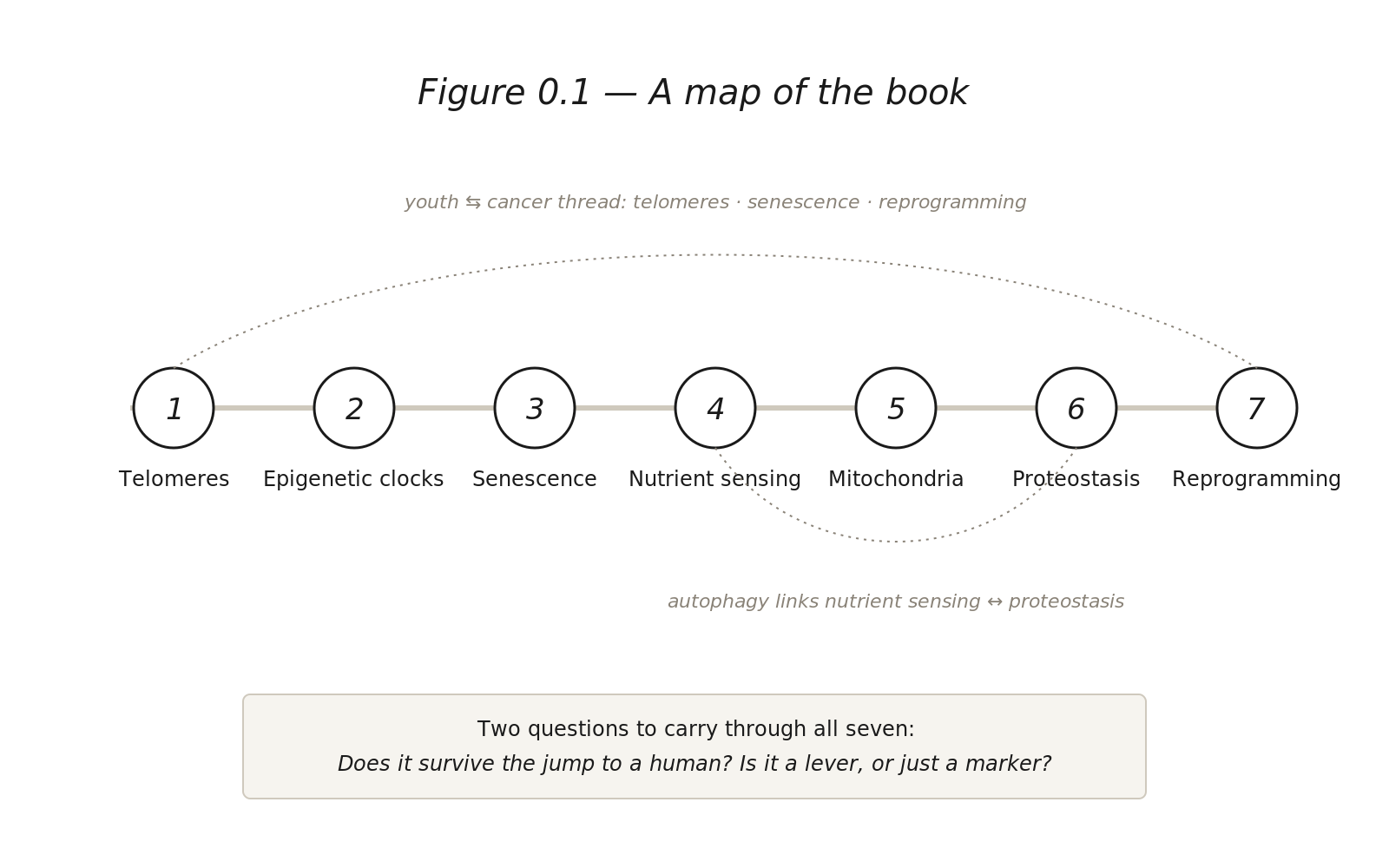
To organize the biology, this book uses a framework the field itself uses: the hallmarks of aging. The core idea is that aging is not one single thing but a collection of distinct, identifiable, interacting kinds of damage and decline — a dozen or so fundamental processes that, together, add up to growing old. Rather than survey all of them shallowly, this book takes seven of the most important and most illuminating and does each one properly — because understanding seven mechanisms deeply will serve you far better than memorizing twelve names. Each chapter takes one hallmark, tells the story of how we discovered it, builds the actual biology at real depth, examines what we’ve tried to do about it, and — without fail — names exactly what we do and do not know.
The seven, in order: the shortening of the protective caps on our chromosomes, and the discovery that a cell counts its own divisions (Chapter 1, telomeres); the drift of the chemical marks that switch our genes on and off, and the machine-learning “clocks” built to read it (Chapter 2, epigenetic alterations); the cells that stop dividing but refuse to die and poison the tissue around them (Chapter 3, cellular senescence); the ancient circuits that sense how much food is around and flip cells between growth and repair (Chapter 4, nutrient sensing) — the most reliable longevity lever we have, and the most oversold; the most famous wrong theory of aging, that we simply rust from the inside, and the expensive way we learned it was wrong (Chapter 5, mitochondria); the proteins that must fold into exact shapes to work, and the diseases that follow when folding and cleanup fail (Chapter 6, proteostasis); and finally the most radical idea of all — not slowing the damage but erasing it, resetting an old cell to a young one (Chapter 7, reprogramming), now entering its very first human trial.
Where the machines fit
One more thread runs through all seven chapters, because this book is part of a series about how artificial intelligence is reshaping the search for medicines. Aging is one of the places where AI has made its most spectacular marks. The “clocks” of Chapter 2 are themselves machine-learning models. The prediction of protein structure in Chapter 6 was a fifty-year grand challenge that an AI essentially solved, winning a Nobel Prize. And the search for the molecules that might safely reset a cell’s age, in Chapter 7, is exactly the kind of problem the newest AI tools are built to attack.
So as we go, we’ll keep a second question running alongside the first: where can artificial intelligence genuinely help here, and where can’t it? You’ll find the honest answer is neither “everywhere” nor “nowhere.” AI is extraordinary at certain pieces of this puzzle — finding patterns in vast data, predicting structures, searching enormous spaces of molecules — and powerless over others: it cannot, by itself, tell you whether something will work in a living human being, and it cannot run the years-long trials that are the only thing that ever settles that question. A dazzling tool that solves one cleanly posed problem is not the same as a solution to the messy one you actually care about — and learning to see that boundary is part of the judgment this book is trying to hand you.
How to read this book
A last word about who this is for, and what it asks of you. It is written for anyone who wants to genuinely understand this: the curious teenager who might one day work in a lab like the ones described in these pages, the adult who wants to make sense of the headlines and the choices, the reader who needs to evaluate claims rather than just absorb conclusions. It does not assume you already know the biology — but it does not condescend, either. Where there is real mechanism, you’ll get the real mechanism. Where an equation genuinely illuminates, the equation is right here on the page and explained in plain sight. Where the science is uncertain or contested, you’ll be told so directly, because the contested places are exactly where you most need the truth and are most often denied it. The book is meant to reward you now, and to reward you again on a second reading years from now.
So carry the two questions — does it survive the jump to a human? and is this a real lever, or just a marker someone moved? — and we’ll return, at the very end, to the one you came in with: whether you can expect to live to a hundred and twenty. By then, you’ll be able to answer it yourself.
Let’s begin where the field began — at the ends of your chromosomes, with the discovery that a cell can count.
Questions to talk about
No answer key. These are for arguing over, with someone who read the same chapter.
- The book refuses both slogans — that you will live forever with the right supplement, and that aging research is all hype. Why is refusing both harder than picking one? What does a reader lose when an author picks?
- Two questions are offered as tools to carry through the whole book: does it survive the jump to a human, and is this a real lever or just a marker someone moved? Try them on a health headline you have seen recently. Does either one break it?
- For most of history aging was treated as fate, like weather. One worm experiment turned it into a problem that could be worked on. What else do people currently treat as fate that might turn out to be a mechanism?
All 10 chapters of Will you live to 120? · Foundations · All courses