Will you live to 120?
Chapter 8 · The Reckoning
After seven hallmarks — can we expect to live to a hundred and twenty? The honest answer, and the tools to keep asking it for the rest of your life.
Companion notebook · Chapter 8. Curing One Disease, or Slowing Aging? — open it in Google Colab and build it yourself: Open in Colab →
We began with a question you may have half-believed and half-doubted: whether you will live to a hundred and twenty. We have now done the work that lets us answer it honestly — walked all seven hallmarks, counted the telomeres and read the clocks, met the cells that won’t die and the switch that senses hunger, buried the most beautiful wrong theory in the field, watched proteins fold and fail, and pressed the reset button. So let us gather what we’ve learned, answer the question we came in with, and — more lasting than any single answer — leave you with the tools to keep asking it for the rest of your life, as the headlines keep coming.
What aging actually is
Start with what aging actually is, now that we’ve seen it from seven angles. The most important thing the tour reveals is that aging is not one thing. It is many distinct, interacting failures happening at once: caps wearing off chromosomes, the chemical marks on our genes drifting out of order, damaged cells accumulating and poisoning their neighbors, nutrient-sensing circuits stuck in the wrong setting, mitochondria and protein-folding declining, the stem-cell reserve running down. There is no single switch labeled “aging,” which is the first reason there will be no single pill to stop it.
And beneath the diversity, one pattern recurred chapter after chapter until it became unmistakable. Aging is, in large part, the slow defeat of maintenance by damage. Your cells are under constant assault — and they carry elaborate systems to repair, replace, and clean up what gets damaged. For most of your life, maintenance keeps up. Aging is what happens, gradually, as the maintenance systems themselves weaken and fall behind: the cleanup of worn-out cells slows, the quality control on mitochondria falters, the protein-folding crews lose ground, the stem cells that rebuild tissues exhaust. Damage is roughly constant; maintenance declines; and the widening gap between them is growing old.
The tour revealed one more thing — the reason aging is so much harder to fix than the headlines suggest. The levers are entangled with cancer. Over and over: the enzyme that keeps cells young is the one cancers switch on to live forever (Chapter 1); the cells that protect us from cancer when we’re young poison us when we’re old (Chapter 3); the very plasticity that would let us reset a cell’s age is the plasticity cancer exploits (Chapter 7). The thing that would rejuvenate us keeps turning out to be bound up with the thing that would kill us, for the same underlying reason. This is not bad luck repeated seven times. It is a single deep fact: many of the brakes that age us were installed to protect us from cancer, and releasing them is dangerous. Aging is, in significant part, the price we pay for not getting cancer at thirty. That is why “just turn the clock back” is almost never free — and why this field is genuinely, structurally hard, not merely underfunded or unlucky, but hard in the bones.
So — a hundred and twenty?
Now the question. Can you expect to live to a hundred and twenty? The honest answer requires both distinctions from the introduction.
Take maximum lifespan — the ceiling — first. The longest verified human life ended at 122, in 1997, and in the nearly thirty years since, no one has clearly approached it. One camp of researchers argues there is a real biological ceiling, somewhere around 115 to 125; another argues there is no fixed limit and the ceiling will eventually give way. The debate is genuinely unresolved. But here is what matters for you: nothing demonstrated today — in any human being, in any trial — has moved that ceiling, and the burden of proof sits squarely on those who claim it will. The dramatic life-doubling results are all in worms and mice, and you now know to ask whether they survive the jump to a human. For raising the human maximum, the honest answer is that they have not — not yet, and perhaps not for a long time.
Now take life expectancy — the average — which is what most people actually mean. Here the most rigorous recent evidence is sobering for the optimists. Careful analysis of the world’s longest-lived populations finds that the dramatic gains of the last century have slowed, and that, absent some breakthrough that targets aging itself, average life expectancy in even the best-off countries appears to be leveling off in the high eighties — not climbing toward a hundred and twenty. The easy gains, from stopping early death, are mostly spent. Pushing the average into the hundreds would require not better treatment of the diseases we already fight, but a fundamental intervention in aging itself — exactly the thing that, as this whole book has shown, remains unproven in humans.
So the honest verdict on the hundred-and-twenty question is this: as a routine, average outcome, with anything demonstrated today — no. Not for most people, not soon. Some individuals do reach a hundred, even a hundred and ten — but that is the existing high tail of human variation, shaped heavily by inherited luck (longevity runs in families, and a few people are simply built to last), not a sign that the whole population is shifting upward. Reaching a hundred is real; it is the top of the distribution we already have, not evidence of a new one. The gap between “a few people reach a hundred” and “we can all expect a hundred and twenty” is, one final time, the gap this book has been measuring from its first page.
The prize worth wanting
But here is where the honest answer turns genuinely hopeful — if you’ve kept the second distinction in mind. The most defensible goal of aging science, and arguably the most valuable, may not be lengthening life at all. It is lengthening healthy life: compressing the years of frailty and disease at the end into a shorter span, so that you stay vigorous longer and decline quickly at the very end rather than spending a decade or two in slow deterioration.
And there is a powerful argument, from the field itself, for why this is the right target. Because the diseases of aging arrive together — driven by the same underlying processes you’ve now studied — fighting them one at a time yields shockingly little. Eliminate cancer entirely, and you would add only about two to four years to average life expectancy, because heart disease, dementia, and the rest are waiting right behind it. The real prize is to slow the shared root — aging itself — and thereby push back all of those diseases at once. That goal — more healthy years, fewer sick ones — is genuinely plausible on the evidence, even where a routine hundred-and-twenty is not. It is the honest hope this book can offer: not that you’ll live to a hundred and twenty, but that the science is real enough that you might, plausibly, stay healthier for longer than the generation before you.
What actually works
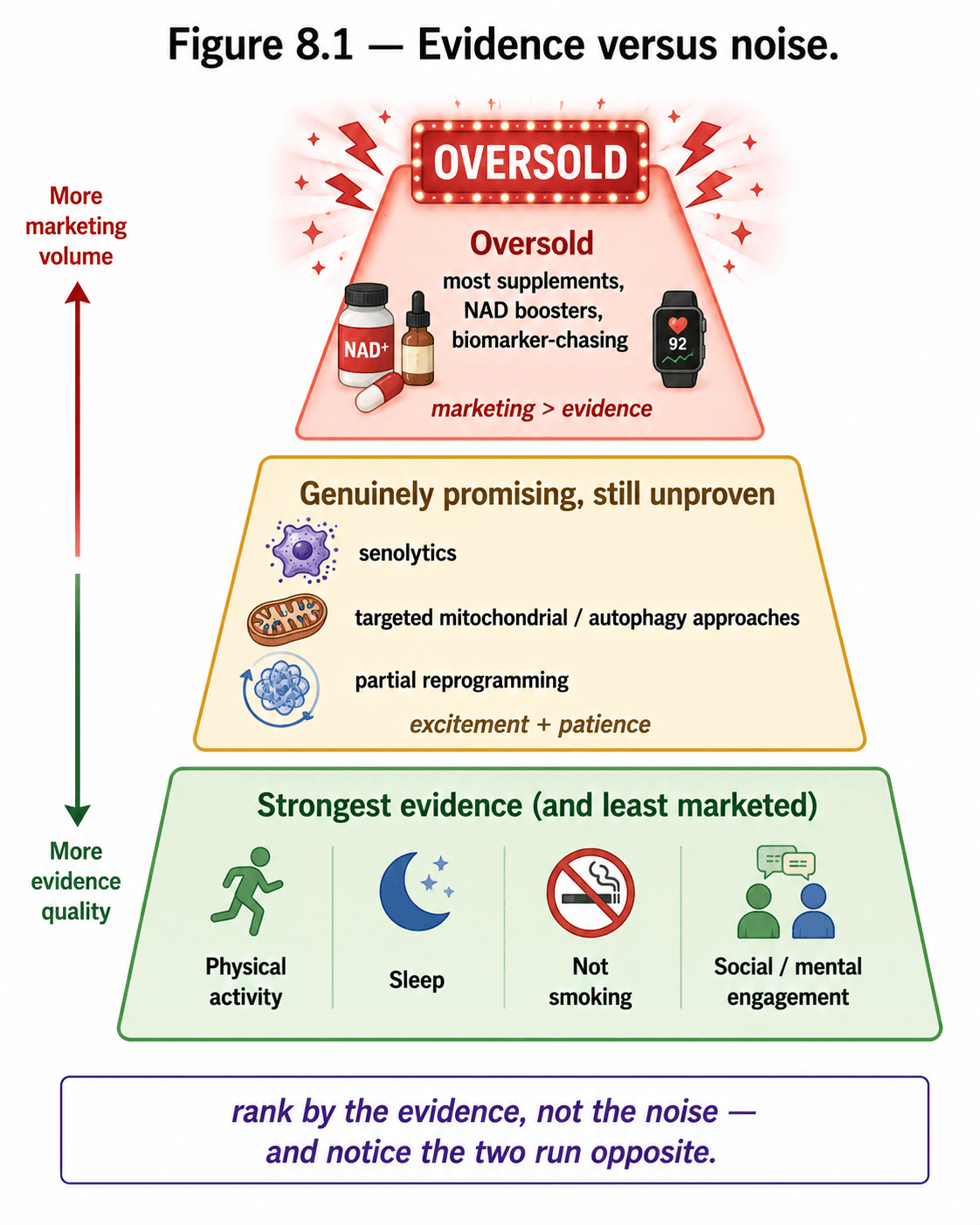
Which brings us to the question every reader eventually asks: so what actually works? Here the most honest answer is also the least glamorous, and it deserves to be said plainly. The interventions with the strongest evidence for a longer, healthier life are not in any bottle sold to you as a longevity breakthrough. They are the boring basics — regular physical activity above all, adequate sleep, not smoking, staying socially and mentally engaged, a reasonable diet, and maintaining a healthy weight and metabolic health. These are unsexy, unpatentable, and unprofitable, which is precisely why they are drowned out by the marketing for things that work far less well, or not at all. (And recall a sharp lesson from Chapter 5: don’t sabotage the things that work — the finding that high-dose antioxidant supplements can erase the benefits of exercise is a vivid warning that “more intervention” is not always better.)
Beyond the basics sits a tier of genuinely promising but unproven science — the senolytics of Chapter 3, the targeted mitochondrial and proteostasis approaches, the reprogramming of Chapter 7 — worth real excitement and real patience, none of it yet a proven human therapy. And there is a large, loud tier of the oversold — most supplements, the NAD boosters of Chapter 4, the endless biomarker-chasing — where the marketing has vastly outrun the evidence. Rank by the quality of the evidence, not the volume of the marketing, and the two, as you’ve seen all book long, are very nearly inverted. (This is a map of where the evidence stands, which is a different and more durable thing.)
Six questions for the rest of your life
That ranking is possible only because you now hold the tools to do it — and those tools, not any single fact, are the real thing this book set out to give you. They will outlast every specific result in these pages and serve you for every aging headline you ever read. Gather them:
Does it survive the jump from the mouse to the human? Most astonishing results are in animals, and the gap to humans is where most claims die.
Is this a real lever, or just a marker someone moved? A measurement that predicts aging is not a handle that controls it. “We can measure it” is not “you should act on it.” A thermometer is not a thermostat.
Compared to what? The control group makes or breaks a study; most whiplash-inducing health news turns out to be two honest studies with different comparisons.
Is more actually better — or is there a dose? Biology runs on curves, not lines; a little of a stressor can help while a lot harms, and the obvious “more is better” is often exactly wrong.
What would it take to actually believe this? A large, randomized, placebo-controlled trial, measuring an outcome that matters, replicated by people with no stake in the result — and short of that, hold your enthusiasm in reserve.
Who benefits if I believe this? In a field this saturated with money, follow the incentives — and note that the conflicts of interest run in every direction, including the skeptics’.
Carry those six questions and you can navigate this entire field — and the next one, and the one after that — without being easily fooled in either direction. That is a more valuable possession than any answer about telomeres or clocks, because the answers will keep changing and the questions will not.
Amazed and careful
A final word about the strange moment in which this book is written, because it asks you to hold two true things at once that are usually presented as opposites.
The first is that we are living through a genuine scientific revolution. In a single human lifetime, aging went from unalterable fate to a regulated, studyable, in-some-ways-adjustable biological process. We can now read a cell’s age, clear its damaged components, reset its clock in a dish, and run the earliest human trials of ideas that would have been science fiction a generation ago. That is real, and it is extraordinary, and it is easy to lose under the noise.
The second true thing is that this same field is the most hype-saturated in all of medicine — a place where genuine breakthroughs and outright snake oil are sold side by side, often by the same people, in the same language, and where the gap between what is claimed and what is known is wider than almost anywhere else in science.
Both of these are completely true at once. The science is real and the claims are oversold. The revolution is genuine and the timeline is a fantasy. Living wisely in this moment — as a patient, a citizen, a parent, perhaps one day a scientist — means holding both, refusing neither the wonder nor the skepticism. That, in the end, is the whole discipline of this book, and of good science itself: to be amazed and to be careful at the same time.
✦ ✦ ✦
So — will you live to a hundred and twenty? Almost certainly not; not as the world is, not with what we can do today. But you might, plausibly, live healthier for longer than your grandparents did, because some of this science is real and some of it is arriving. And you can now do something better than either hope or despair about it: you can read this field for the rest of your life with clear eyes — telling the lever from the marker, the mouse from the human, the breakthrough from the bottle — and be far harder to fool in either direction.
And if you are one of the readers this book was secretly written for — the ones who finish it not satisfied but hungry, who want to go and do this work themselves — then the most important thing to know is that the field needs exactly that. Not more hype, and not more cynicism, but more people who can tell the difference. The questions in these pages are not closed. Some of them are waiting for you.
Questions to talk about
No answer key. These are for arguing over, with someone who read the same chapter.
- Aging is described as the slow defeat of maintenance by damage: damage stays roughly constant, maintenance declines, and the widening gap is growing old. If that is right, which would you rather fund — less damage, or better maintenance?
- Over and over, the lever that would rejuvenate us is entangled with cancer, for the same underlying reason each time. The book says this is not bad luck repeated seven times. What is it instead?
- The answer given is: almost certainly not a hundred and twenty, but plausibly healthier for longer. Is that a disappointing answer or a useful one? What would you have done with a confident yes?
All 10 chapters of Will you live to 120? · Foundations · All courses