Will you live to 120? · The Reset
The gold rush, and the first human
So the whole game, the entire frontier, comes down to a single word: partial.
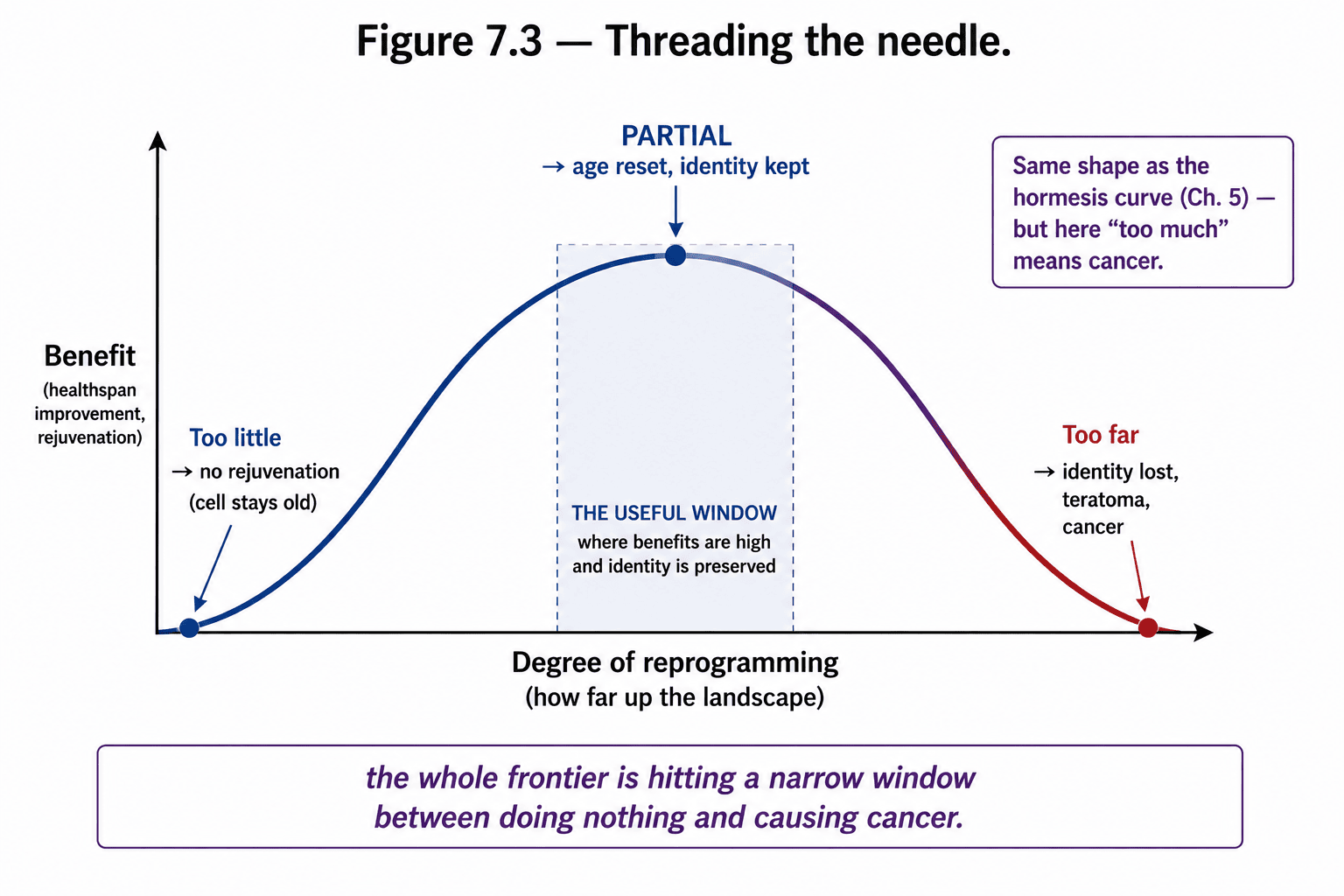
The idea, first demonstrated convincingly in 2016, is to roll the ball only partway up the landscape — far enough to shed the age-related epigenetic marks, but not so far that the cell loses its identity or becomes pluripotent. Instead of switching the reprogramming factors on permanently, you apply them in brief pulses — on, then off, then on again — or for a limited time, hoping to catch the cell in a rejuvenated-but-still-itself state before it climbs too high. When researchers did this cyclically in fast-aging mice, the animals’ aging signs improved and they lived longer, without the teratomas that full reprogramming would have caused. Partial reprogramming could rejuvenate a living mammal, at least in that controlled setting. The reset button could, apparently, be tapped rather than held down.
The most striking demonstration of partial reprogramming restoring actual function came from David Sinclair’s laboratory, and it deserves to be described plainly and credited fully, separate from any of the surrounding hype. His group used three of the four factors (dropping the fourth, c-Myc — the most overtly cancer-causing of them) and delivered them to neurons in the eye. In old mice, and in mice whose optic nerves had been crushed or damaged in a model of glaucoma, this partial reprogramming restored vision — resetting the epigenetic age of the retinal neurons and allowing damaged nerve fibers to regrow, something adult nerve cells normally cannot do. This is real, peer-reviewed, repeatedly examined science, and it is among the most impressive demonstrations in the field that partial reprogramming can not only make cells measure younger but make a tissue work younger. Later work from the same lab extended the approach toward protecting neurons from the inflammation and degeneration of aging. The science here is genuine, and it is the engine behind everything in the next section.
But notice the catch hiding inside the word “partial,” because it is the named uncertainty of this chapter and the reason the frontier is a frontier. How far is partway? Reprogram too little, and you reset nothing — the cell stays old. Reprogram too much, and you lose identity and risk teratomas and cancer. The useful window lies between, and it is narrow and poorly defined — and it is, you will recognize, the same non-monotonic shape we met as hormesis in Chapter 5: too little does nothing, too much does harm, and the benefit lives at an intermediate dose you have to hit precisely. Except here the failure mode on the “too much” side is not merely losing exercise’s benefits — it is cancer. Threading this needle, in the right cells, to the right degree, reversibly, in a living human being, is the entire problem. And we are only just beginning to try.
The gold rush, and the first human
The promise of reprogramming — erase the damage, reset the age, regrow what’s lost — has set off the largest concentration of money and talent in the history of aging science. A single company launched in 2022 with roughly three billion dollars in funding, the most ever raised by a biotechnology startup at birth, devoted to cellular rejuvenation, and it recruited a stunning roster of the field’s leaders — including, fittingly, the inventor of the partial-reprogramming approach and the inventor of the epigenetic clock from Chapter 2. Other well-funded ventures followed, backed by some of the most prominent names in technology, several explicitly using machine learning to search for better and safer reprogramming recipes. Reprogramming is, right now, the biggest bet in the field, and the bettors are not naive — they are the people who know best how hard it is, wagering that the needle can be threaded.
And here, at last, is the moment this entire book has been building toward — stated plainly, and then weighed honestly, because the gap between the two is the lesson of all seven chapters.
At the time of writing, partial reprogramming has entered its very first human clinical trial. Sinclair’s company received regulatory clearance to begin a Phase 1 study of partial epigenetic reprogramming — delivering the three-factor combination, as a gene therapy, to treat a form of vision loss in the human eye. The most radical idea in aging biology, the literal resetting of cellular age, is being tested in a human being for the first time. That is a genuine milestone, and it is right to find it remarkable.
Now read it with the discipline this book has spent six chapters trying to build. What this is: one gene-therapy approach, entering the earliest and smallest phase of human testing — the phase that asks only “is it safe?”, not “does it work?” — for one narrow condition, in the eye. The eye was chosen for excellent reasons that reveal exactly how cautious this first step is: it is small, contained, and accessible, you can deliver the therapy locally without exposing the whole body, it is partly shielded from the immune system, and you can watch it closely. This is the most careful possible first toe in the water. What this is not: it is not the reversal of human aging. It is not whole-body rejuvenation. It does not yet tell us whether partial reprogramming is safe over years, whether the age-and-identity decoupling holds up in humans, or whether the cancer risk can be controlled in living tissue over time. Between “a Phase 1 trial of a reprogramming gene therapy for one eye disease” and “we can make people young again” lies the entire distance this book has been measuring — the distance between an astonishing result and a proven human therapy, between the mouse and the person. The first human trial of reprogramming is the most exciting sentence in modern aging biology. It is also a single, narrow, early, careful experiment. Both of those things are completely true, and holding them together — neither dismissing the milestone nor inflating it — is the final exam of everything you have learned.
All 10 chapters of Will you live to 120? · Foundations · All courses