Evaporation, Condensation & a Wet Cold Cup · Grade 8 Science
Chapter: Phases of MatterEvaporation, Condensation & a Wet Cold Cup
Learning goals
- I can account for water during evaporation and condensation using a boundary and a particle model.
- I can use a supplied dew point and plan a comparison that separates influential conditions.
Readings for this unit
Before this unit
Review the earlier states and temperature units. The visible language notes explain this unit’s quantities; then connect them to its concrete records and figure.
Use three teaching sessions of about 40–45 minutes: first observe the phenomenon, draft a model and study Parts 1–2; next explain Parts 3–4 with the figures and evidence; then work the application, examples, practice, model revision and exit check. Divide any difficult part into smaller steps and revisit after feedback. Investigations, review and quizzes have separate sessions. Study the four visual parts across the scheduled sessions, then use the illustrated worked case and independent transfer questions. Extend or revisit a session when the learner cannot explain the figure; completion time is a proposed allocation, not a mastery guarantee.
Start with something to explain
What would explain the observations in evaporation, condensation & a wet cold cup?
Illustrative evidence case. Illustrative records show a cold intact cup with clear outside droplets. An open tray loses 6 g while a covered matched tray loses 1 g in an hour.
Notice and wonder
What energy pathway should a fuller model add? Write two observations from the supplied record without guessing their cause. Include a quantity and its unit when given. An observation is what was recorded; an inference is what you think explains it.
Write one question about why the pattern occurs and one question about a comparison that could distinguish competing explanations. A testable question identifies what could be observed or measured.
Your first model
Before reading the model answer, sketch the named objects or particles and label what you think changes. Explain both observations and identify a limit of the mass comparison. Keep this first version so you can compare it with your later explanation.
Build the language from the idea
- evaporation
- Liquid changing to gas at its surface.
- condensation
- Gas changing to liquid.
- water vapor
- Water in the normally invisible gas phase.
- humidity
- Water vapor content of air, expressed with a specified measure.
- dew point
- Temperature at which cooling air reaches saturation under the specified conditions.
- model
- A representation that explains selected features and makes predictions; it leaves other details out.
- evidence
- Relevant observations or records used to support or challenge a claim.
- system boundary
- The chosen limit separating the objects being studied from their surroundings.
- assumption
- A condition taken as true for a model or calculation and needing to be checked against the case.
A dry cold cup can acquire droplets on its outside while a puddle elsewhere dries. Water has not been created in one place and destroyed in the other.
Evaporation means liquid water changes to gas at its surface; condensation means gaseous water changes to liquid. Water vapor is the gas form and is normally invisible.
Visible fog is mainly tiny liquid droplets suspended in air. Begin by drawing separate boundaries around the cup contents, the cup surface and the surrounding air.
This prevents the common mistake of assuming that outside droplets must have leaked through the cup wall.
An observation is what a person or instrument records. An inference is a proposed interpretation of those records. Keep the two separate: a graph can show a pattern while more than one mechanism might explain it. State the chosen system, or part of the world being studied, and its boundary before accounting for material or energy transfers.
Use each figure as a reasoning tool. Read its caption and labels, describe the pattern, then explain a cause. If the picture is schematic, use the stated numbers rather than measuring its printed size. Check whether its simplified conditions match the problem before applying a formula.
Build your understanding
Where this fits
This unit helps answer the chapter question: How can adding or removing energy change matter? Keep a notebook table with the question, evidence, explanation and one unresolved issue. Revise a previous model only when you can name the new evidence or idea that changes it.
Use three teaching sessions of about 40–45 minutes: first observe the phenomenon, draft a model and study Parts 1–2; next explain Parts 3–4 with the figures and evidence; then work the application, examples, practice, model revision and exit check. Divide any difficult part into smaller steps and revisit after feedback. Investigations, review and quizzes have separate sessions.
Part 1 · Use a boundary to ask where water came from
A system is the part of the world chosen for analysis; its boundary separates it from the surroundings. A cup containing colored water can help distinguish inside water from water already present as vapor in the surrounding air. The color is evidence about origin, not a complete molecular photograph.
Read the visual model
Why compare with a room-temperature cup?
Visual reasoning — after your attempt
It helps test the role of cooling while keeping the cup construction similar. Clear outside water on the cold cup supports an air-water source rather than a colored leak.
Illustrative observations show blue water inside a sound cup but clear droplets outside after cooling. A room-temperature identical cup stays dry. These observations favor condensation from the air over a colored-water leak, though checking the cup for cracks remains sensible.
Pause and explain
Why compare with a room-temperature cup?
Check your reasoning after answering
It helps test the role of cooling while keeping the cup construction similar. Clear outside water on the cold cup supports an air-water source rather than a colored leak.
Part 2 · Explain evaporation below boiling
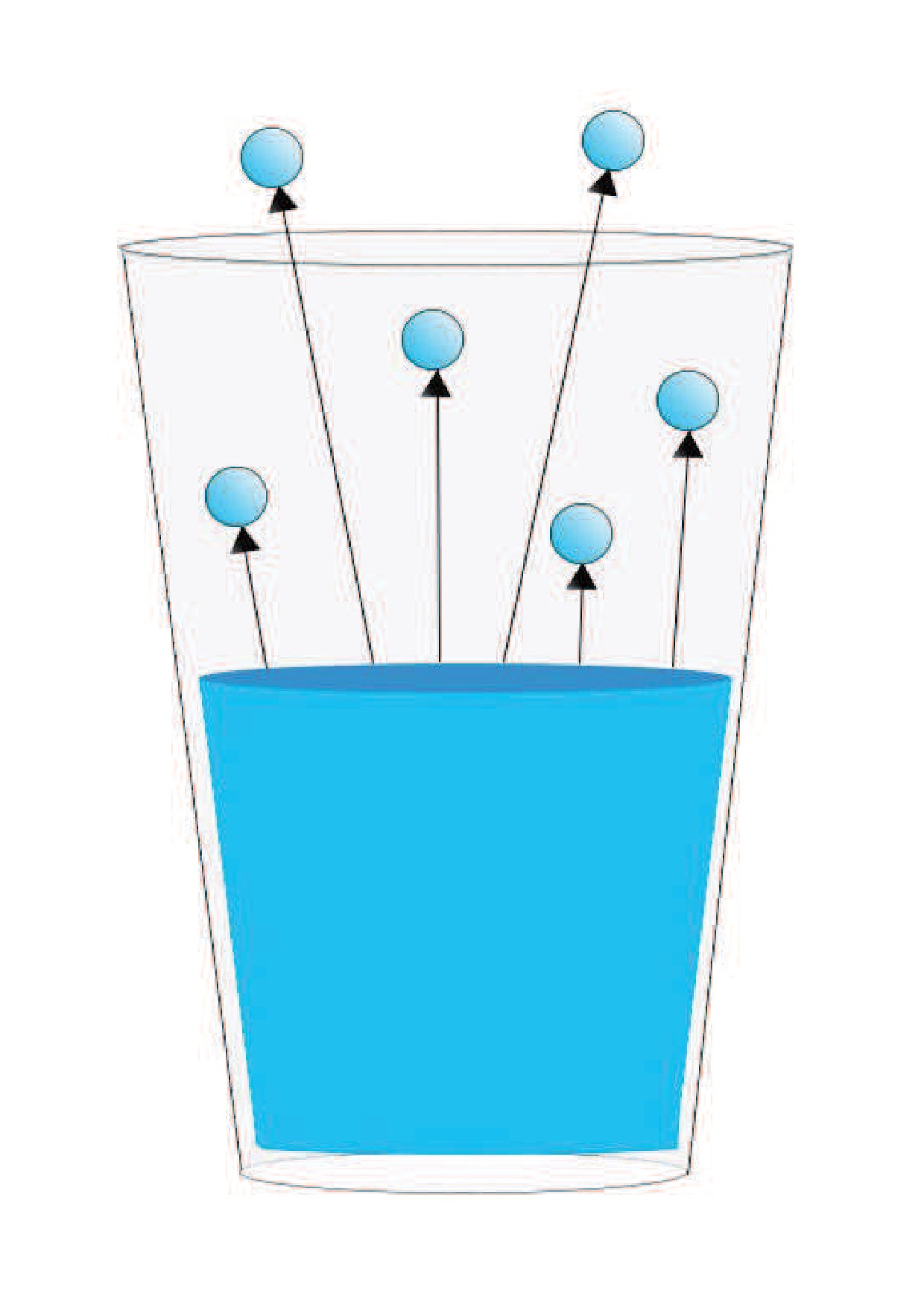
Liquid particles have a range of motion energies. Some at the surface can escape into the gas phase even while the liquid is well below its boiling temperature. Boiling produces vapor bubbles throughout liquid under suitable pressure; evaporation occurs at the surface and does not require visible bubbles.
Read the visual model
A surface is the boundary between liquid and its surroundings. Molecules in a liquid have a range of motions; an escaping molecule retains its chemical identity. Matter leaving also carries energy, linking evaporation to cooling.
Why can a puddle dry at room temperature without the whole puddle boiling?
Visual reasoning — after your attempt
Some surface particles can escape into the gas phase under those conditions. Boiling is a different bulk process involving vapor bubbles throughout the liquid.
A shallow wet tray can lose mass at room temperature. Covering it limits exchange with room air and permits vapor to return. The escaped water remains matter in the surroundings; a reduced reading for the tray is not destruction of water.
Pause and explain
Does a drying cloth need to reach 100 °C?
Check your reasoning after answering
No. Surface evaporation occurs below boiling. Water transfers from the cloth into the air, rather than vanish.
Part 3 · Explain condensation through energy transfer
When vapor contacts a sufficiently cool surface, energy transfer can favor liquid droplets. Humidity describes the water vapor in air; relative humidity compares the amount present with the saturation amount at that temperature. The dew point is the temperature at which air reaches saturation on cooling under the specified conditions.
Read the visual model
Condensation is a gas-to-liquid phase change. Keep chemical identity, water origin and energy transfer as separate questions. The container wall can be dry initially yet gain outside water without leaking from its interior.
Where do the droplets’ water and the transferred energy come from in this model?
Visual reasoning — after your attempt
The water comes from vapor in surrounding air. During condensation, energy transfers from the vapor/surrounding system toward the cooler wall; no new water is created.
If a supplied room dew point is 12 °C, a cup surface at 8 °C can collect condensation while one at 18 °C may remain dry. You do not need to calculate dew point here. Use the supplied value and distinguish surface temperature from the water temperature inside.
Evaporation and condensation can both occur at the same room temperature: particles leave a liquid surface while vapor particles can return. The net direction depends on the surroundings, vapor content and exchange conditions. There is no single universal evaporation temperature equivalent to a pure substance’s ordinary-pressure boiling point. Melting/freezing comparisons also need matching pressure and composition. This resolves the district map’s shared-temperature question without teaching that every evaporation and condensation event occurs at one fixed temperature.
Pause and explain
Which supplied cup is more likely to condense water?
Check your reasoning after answering
The 8 °C surface is below the supplied 12 °C dew point; the 18 °C surface is above it. The prediction depends on those air conditions.
Part 4 · Plan a comparison and account for energy
Air movement, exposed area and humidity can all affect evaporation. To investigate area, use equal water masses at the same starting temperature in two clean shallow vessels with different exposed areas, kept in comparable locations. Record mass changes without tasting any experimental water.
Read the visual model
Separate the outcomes: temperature measures thermal conditions and a balance measures matter remaining. A lid can affect several pathways, so use the results to evaluate the proposed mechanism rather than calling every difference proof.
At 30 minutes, how much cooler is the uncovered sample? What additional measurement tests evaporation directly?
Visual reasoning — after your attempt
It is 19.2−15 = 4.2 °C cooler. Measuring comparable mass loss tests whether more matter left the uncovered sample, while still considering other energy pathways.
Evaporation can cool the remaining liquid because escaping particles remove energy. Water and energy accounts therefore need separate arrows: a water arrow indicates where matter moves; an energy arrow shows a transfer, not a stream of a material called heat.
Pause and explain
Why is greater loss from a sunny wide tray not proof of an area effect alone?
Check your reasoning after answering
Area, illumination and possibly temperature differ. A comparison changing only intended area is needed to isolate its effect.
Apply the whole unit · Droplets and missing water
Illustrative case for analysis, not measurements collected by the learner. Illustrative records show a cold intact cup with clear outside droplets. An open tray loses 6 g while a covered matched tray loses 1 g in an hour.
Your task
Explain both observations and identify a limit of the mass comparison. Use the supplied conditions, show intermediate reasoning and distinguish the supported conclusion from a broader claim.
What your response should show
- Use the specified quantities and units.
- Explain an intermediate step or comparison.
- Connect the pattern to the physical mechanism.
- State an assumption or limitation.
Response guidance — after your attempt
Identify two matter boundaries: inside/outside the cold cup, and the water tray/room air.
Clear outside droplets on the intact cup can come from air vapor, while the tray can lose water by surface evaporation.
Subtract the tray losses: 6−1=5 g greater loss from the open tray in the stated hour.
Covering changes exchange and may change other conditions, so the comparison does not isolate every mechanism or imply water creation.
The droplets can be condensed water from surrounding air; the tray loss can be water evaporating into that air. The open tray loses 5 g more under the stated comparison. Covering changes exchange and can also change temperature or airflow, so the result does not isolate every mechanism. Neither observation requires water creation or destruction.
Scientific references and adapted teaching resources
- OpenSciEd 6.2 Thermal Energy — public unit overview
- OpenSciEd instructional model — storyline routines
- Creative Commons Attribution 4.0 — middle-school material license
Parent / teacher teaching notes
Ask the learner to describe the phenomenon before naming a formula. Discuss each checkpoint after an attempt. Use the supplied records when equipment is unavailable and label them illustrative rather than actual measurements. The final explanation should identify a mechanism and a limit, with different defensible wording accepted. Adaptation credit: OpenSciEd middle-school teaching routines and public task structures by OpenSciEd, CC BY 4.0. This independent version adds original explanatory text, data and figures, terminology support and a home-study schedule. It does not reproduce the complete teacher editions or their classroom validation.
The key idea
Existing water vapor from the air can condense on the cold surface; identify its source and energy transfer. The droplets can be condensed water from surrounding air; the tray loss can be water evaporating into that air.
Worked examples
Example 1 · Build the first reasoning step
- Identify what the question asks and what the stated observation establishes.
- It helps test the role of cooling while keeping the cup construction similar. Clear outside water on the cold cup supports an air-water source rather than a colored leak.
Example 2 · Droplets and missing water
- Identify two matter boundaries: inside/outside the cold cup, and the water tray/room air.
- Clear outside droplets on the intact cup can come from air vapor, while the tray can lose water by surface evaporation.
- Subtract the tray losses: 6−1=5 g greater loss from the open tray in the stated hour.
- Covering changes exchange and may change other conditions, so the comparison does not isolate every mechanism or imply water creation.
Explain why each stated condition matters.
Example 3 · Transfer to a different condition
- Identify the changed condition.
- The gas water vapor itself is normally invisible. The visible white cloud mainly consists of small condensed liquid droplets, and its appearance alone does not identify every particle present.
Example 4 · Find and fix the mistake
- Distinguish what is observed from what is inferred.
- Existing water vapor from the air can condense on the cold surface; identify its source and energy transfer.
Compare the claim with the stated observations and model assumptions.
Example 5 · Interpret the visual model
- Identify the represented objects, axes, labeled quantities and stated conditions before choosing a rule.
- A surface is the boundary between liquid and its surroundings. Molecules in a liquid have a range of motions; an escaping molecule retains its chemical identity. Matter leaving also carries energy, linking evaporation to cooling.
- Some surface particles can escape into the gas phase under those conditions. Boiling is a different bulk process involving vapor bubbles throughout the liquid.
Keep the model’s stated limits explicit: Selected particles leave the surface while the remaining liquid still contains interacting particles. Evaporation can occur below the boiling temperature and often removes particles with above-average kinetic energy, lowering the remaining average. This is a schematic selected-particle view, not a universal rule that every particle moves upward or that molecules break into new atoms.
Avoid these mistakes
- Existing water vapor from the air can condense on the cold surface; identify its source and energy transfer.
- Do not treat a schematic drawing as a scale measurement or a universal guarantee.
- Keep the stated comparison conditions and measurement boundary explicit.
- A correct numerical result needs units and an explanation of its meaning.
Check your understanding
Why compare with a room-temperature cup?
Discuss the answer
It helps test the role of cooling while keeping the cup construction similar. Clear outside water on the cold cup supports an air-water source rather than a colored leak.
Does a drying cloth need to reach 100 °C?
Discuss the answer
No. Surface evaporation occurs below boiling. Water transfers from the cloth into the air, rather than vanish.
Which supplied cup is more likely to condense water?
Discuss the answer
The 8 °C surface is below the supplied 12 °C dew point; the 18 °C surface is above it. The prediction depends on those air conditions.
Why is greater loss from a sunny wide tray not proof of an area effect alone?
Discuss the answer
Area, illumination and possibly temperature differ. A comparison changing only intended area is needed to isolate its effect.
Return to the phenomenon
Illustrative records show a cold intact cup with clear outside droplets. An open tray loses 6 g while a covered matched tray loses 1 g in an hour. Explain both observations and identify a limit of the mass comparison. Revise your first explanation using a named idea from the lesson. Mark the changed part and the evidence that supports it.
Compare explanations after your attempt
The droplets can be condensed water from surrounding air; the tray loss can be water evaporating into that air. The open tray loses 5 g more under the stated comparison. Covering changes exchange and can also change temperature or airflow, so the result does not isolate every mechanism. Neither observation requires water creation or destruction.
What should we investigate next?
Which condition could be changed to test a remaining uncertainty in this explanation? State the predicted observation and what result would challenge your model.
Investigate, explain and revise
Use these tasks after the three teaching sessions as needed. Discuss an attempted explanation before opening response guidance; a matching sentence is less important than a supported mechanism.
Activity 1 · Explain the new evidence case
Use the visible scenario above, Parts 1–4 and your first notebook model. No outside reading or equipment is required.
Your task
Illustrative records show a cold intact cup with clear outside droplets. An open tray loses 6 g while a covered matched tray loses 1 g in an hour. Explain both observations and identify a limit of the mass comparison. Write 100–150 words or give a labeled drawing with an equivalent oral explanation.
Success criteria
- Use two relevant stated records or conditions.
- Explain the mechanism rather than only repeat a definition.
- Label observation and inference.
- Name a changed model feature or a remaining uncertainty.
Hint
Read the stated boundary and conditions before selecting a relationship. The unit’s worked examples show intermediate steps.
Response guidance — discuss after your attempt
The droplets can be condensed water from surrounding air; the tray loss can be water evaporating into that air. The open tray loses 5 g more under the stated comparison. Covering changes exchange and can also change temperature or airflow, so the result does not isolate every mechanism. Neither observation requires water creation or destruction.
Activity 2 · Read and extend the figure
Study the new labeled figure and its caption, then compare it with the associated teaching part.
Your task
What energy pathway should a fuller model add? Explain what each important label represents. Add one missing feature that would be needed for a different question, and explain why the original figure leaves it out.
Success criteria
- Answer the figure question with its stated labels.
- Connect the visual representation to the scientific idea.
- Identify a specific limitation from the caption.
- Propose a useful change without misrepresenting supplied evidence.
Hint
Arrows indicate water from surrounding air reaching the cool outside surface. Blue liquid inside and clear droplets outside help compare possible sources. The drawing omits most air particles and energy pathways; it does not mean water vapor is itself visibly blue or that a cup makes new water.
Response guidance — discuss after your attempt
Energy transfers between the warmer air/vapor and cool surface as conditions favor condensation. Water and energy require distinct accounts. Arrows indicate water from surrounding air reaching the cool outside surface. Blue liquid inside and clear droplets outside help compare possible sources. The drawing omits most air particles and energy pathways; it does not mean water vapor is itself visibly blue or that a cup makes new water.
Words to know
- evaporation
- Liquid changing to gas at its surface.
- condensation
- Gas changing to liquid.
- water vapor
- Water in the normally invisible gas phase.
- humidity
- Water vapor content of air, expressed with a specified measure.
- dew point
- Temperature at which cooling air reaches saturation under the specified conditions.
- model
- A representation that explains selected features and makes predictions; it leaves other details out.
- evidence
- Relevant observations or records used to support or challenge a claim.
- system boundary
- The chosen limit separating the objects being studied from their surroundings.
- assumption
- A condition taken as true for a model or calculation and needing to be checked against the case.
In the real world
Illustrative records show a cold intact cup with clear outside droplets. An open tray loses 6 g while a covered matched tray loses 1 g in an hour.
Exit check
What energy pathway should a fuller model add? Explain the relevant mechanism and one model limitation.
Check your explanation after answering
Energy transfers between the warmer air/vapor and cool surface as conditions favor condensation. Water and energy require distinct accounts. Arrows indicate water from surrounding air reaching the cool outside surface. Blue liquid inside and clear droplets outside help compare possible sources. The drawing omits most air particles and energy pathways; it does not mean water vapor is itself visibly blue or that a cup makes new water.
Explain your reasoning without notes. If a key idea is missing, revisit the lesson and try again.