Calculus I · Building a Function From Its Derivatives
The flagship: rebuilds itself
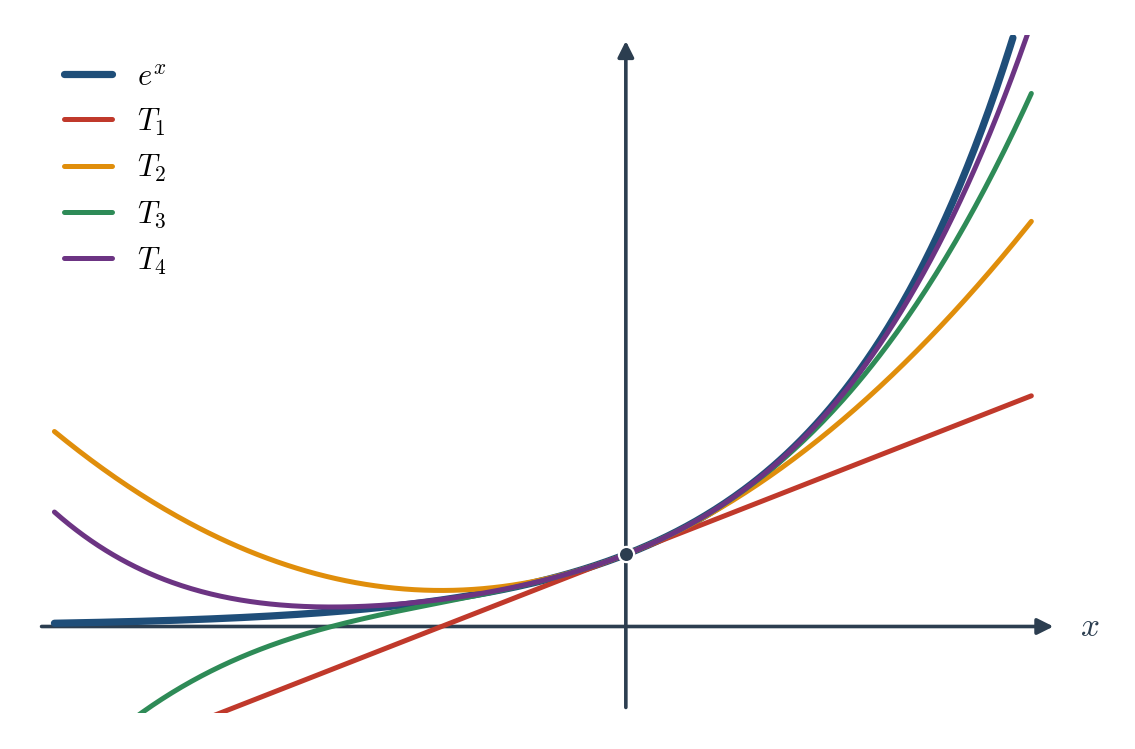
Now the example the whole chapter was waiting for. Center at . We need all the derivatives of at — and here is where Chapter 5 pays an enormous dividend. Since is its own derivative, every derivative of is again , and at every one of them equals . So every coefficient is , and
Look at how inevitable that was. We didn’t grind through a table of messy derivatives; the self-similarity of handed us every coefficient at once. The most beautiful series in mathematics exists because its function refuses to change under differentiation. Test it: , and a calculator gives — agreement to five places from four terms, because the factorials in the denominators crush the later terms fast. (Figure 7.3: with layered on top, each clinging to the curve over a visibly wider stretch.)
Two more, and an old friend returns
at . Its derivatives are , so , and the coefficient is . Every coefficient is :
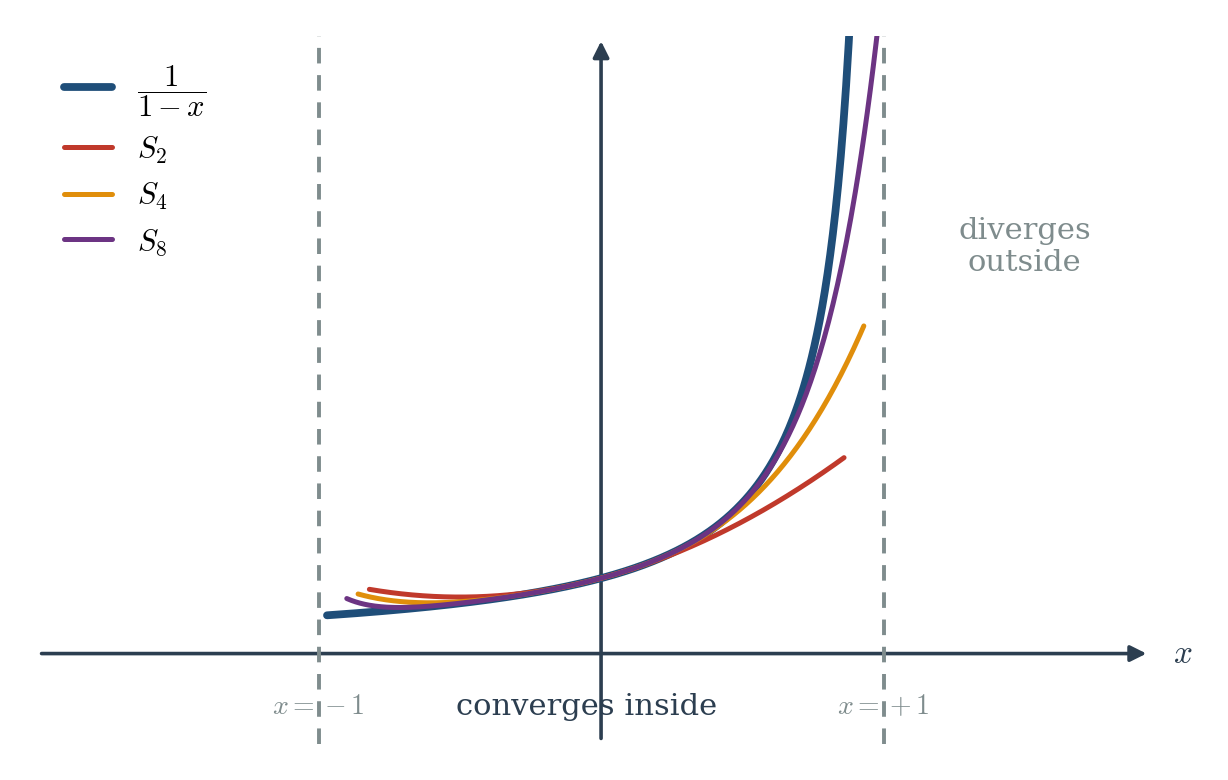
That is the geometric series from Chapter 1, now revealed as a Taylor series. And it carries a warning you must respect: this equality only holds for . Plug in and the left side is while the right side is . A Taylor series is a local promise; it is true only where it converges. We’ll make that precise with the remainder in a moment.
at . Here , and the derivatives give , so the coefficient is :
Notice the leading term is just . That is the exact reason behind a limit we borrowed back in Chapter 1: as , the fact that made work. The “loan” was that near — and there it is, the first Taylor term, finally explained.